|

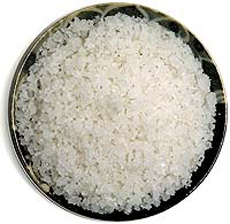
[1] Table salt. Functional, but not the best (photo courtesy Tablecraft)./font>
[2] Fleur de sel, a favorite of chefs harvested off the Atlantic coast of France. It’s a type of sel gris, the category of gray salt (photo courtesy Saltworks).
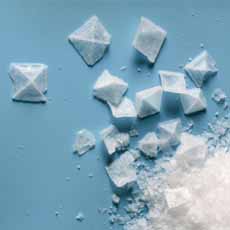
The unique pyramid-shaped crystals of Maldon River salt from England (photo © Stephen Upson).
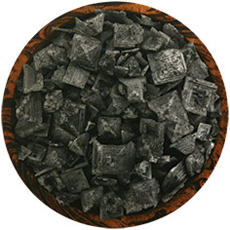
[4] Black lava salt from Cyprus is an example of both lava salt and flake salt (photo courtesy Saltworks).
[5] Alaea, red sea salt from Hawaii. The color comes from the area’s natural red clay (photo courtesy Saltworks).
|
|
You know that there’s a difference between table salt and sea salt, but what exactly is it?
Table salt (photo #1) is mined from underground salt beds, which are the evaporated remains of ancient bodies of salt water. It is then refined, with added anti-clumping agents and iodine, an essential element for nutrition. However, the process of removing impurities also removes the trace minerals.
Sea salt is directly evaporated from sea water through evaporation, boiling or other techniques. It is not refined, so it contains trace amounts of minerals.
Both have the same amount of sodium, and experts agree that for most Americans, there is no meaningful heath benefit in choosing one over the other.
However, to the refined palate, there is a difference in taste.
HOST A SEA SALT TASTING
Before we present our favorite types of sea salt, consider planning a tasting to compare them. We recommend three umbrella groups to taste:
Sel gris (grey salt) such as fleur de sel, an everyday finishing salt.
Black, pink and red, and smoked salts for specialty garnish and plate garnish.
Maldon (photos #3 and #6) or flake salts for extra eye appeal and crunch.
Don’t worry about the expense: Get together a group of like-minded foodies who are happy to share the cost. And since you will only use a small amount from each jar, everyone gets to take home the rest of the salt they brought.
If you enjoy the first tasting as much as we think you will, you can plan follow-up tastings such as:
Plain white sea salts from different parts of the world.
Pink sea salts from different terroirs (ditto black salts).
Flake salts.
Flavored salts.
Test them on very bland foods; for example:
Boiled potatoes
Celery sticks
Chicken (ideally skinless white meat)
Cottage Cheese
Green beans (al dente)
Hard-boiled eggs
Pasta (look for large, dense shapes, like shells)
Polenta squares
Tofu
About salt being the enemy: The main source of sodium in our diet is not salt from the mine or the sea, but that hidden in processed foods.
CATEGORIES OF SALT
CATEGORY I: REFINED KITCHEN SALTS
First, the basic salts:
1. TABLE SALT
Table salt, the most common salt in use worldwide, is harvested from salt deposits found underground. As mentioned above, most table salt is iodized. This iodine prevents iodine deficiency, which can cause hypothyroidism (goiter) and other maladies. While this problem evaporated (pun intended) with improvements in the American diet in the early 20th century, it still occurs in parts of the third world.
2. KOSHER SALT
Kosher salt—originally called koshering salt–is coarser-grained than regular table salt, with a flaky appearance. The large grains were originally used to kosher meat, drawing blood and other liquids from the surface of the meat, per kosher law.
Most kosher salt does not have added iodine, and usually has no anti-clumping agents. Unless indicated on the package, it isn’t even kosher (the name refers to the process).
It is an all-purpose cooking salt, typically used to salt the water prior to cooking pasta and grains. However, it can also be a crunchy finishing salt, less expensive than coarse sea salt. It’s also used as a Margarita rimmer and a pretzel topper.
|
3. PICKLING SALT
People who pickle use pickling salt for brining. Like kosher salt, it’s a refined salt, but pickling salt is always made without anti-clumping or other agents.
Tip: Never use sea salt for pickling. The trace elements can discolor the food.
CATEGORY II: SEA SALTS
“Sea salt” is a broad term, comprising plain salts, smoked salts and flavored salts. They are variously referred to as artisan salts and gourmet salts.Have a salt tasting to see how different these salts are on basic foods.
Harvested from evaporated sea water, sea salt is usually unrefined and coarser-grained than table salt; although specialty salt sites often sell their salts in both fine and coarse grinds.
Sea salts also contain some the minerals that occur naturally in the water where they are harvested. Iron, potassium, zinc and trace minerals give sea salt a more complex flavor profile.
They are often used as finishing salts: a sprinkle on top of the foods (as opposed to a recipe ingredient). Have a tasting to see the for a different mouth feels and bursts of flavor for yourself.
4. ALAEA, RED HAWAIIAN SALT
This naturally red Hawaiian salt (photo #5) gets its name and color from the reddish, iron-rich volcanic clay in the area.
Used for centuries in ceremonial ways for cleansing, purification and the blessing of tools, red Hawaiian salt is also great in the kitchen, adding an attractive finish and robust flavor to seafood and meat, as well as traditional island dishes like poke and pipikaula, a Hawaiian jerky.
5. CELTIC SEA SALT
In the sel gris (pronounced sell GREE, French for “grey salt”) category, Celtic sea salt is harvested from the bottom of mineral-rich tidal ponds off the coast of France. The salt crystals are raked out after sinking; this, plus the miner. The grains are moist and chunky, with a grey hue and briny taste of the sea.
However, don’t save it for seafood: It’s used on just about every food, including baked goods and as a garnish for chocolate desserts.
|
|
6. FLAKE SALT
Flake salt is thin and irregularly shaped with a bright, salty taste and very low mineral content. The flakes dissolve quickly, though, resulting in a pop of flavor where they sat.
Flake salt is popular as a finishing salt, especially on meats. Chefs will toss some on before the plate goes up to the pass.
Flake salts occur around the world. Maldon salt from England is the best-known and perhaps the most beautiful, with natural pyramid-shaped crystals (photo #3). It is available in its natural form as well as smoked.
7. FLEUR DE SEL
Literally “flower of salt,” fleur de sel (photo #2) is hand-harvested from tidal pools off the coast of Brittany, France. Paper-thin salt crystals are delicately skimmed from the water’s surface with traditional wooden rakes.
Understandably, this labor can only be undertaken on sunny, dry days with no more than a slight breeze. Because of its labor-intensive harvesting, fleur de sel is the world’s most expensive salt.
As a type of sel gris, it retains moisture. It has a particular blue-grey tint from the high mineral content in its terroir. It is used as a finishing salt for meat, seafood, vegetables, even desserts (let’s not forget salted caramels, plain or chocolate-coated).
8. HIMALAYAN PINK SALT
Himalayan salt is the purest form of salt in the world. That’s because its water source evaporated long before mankind arrived to pollute the planet.
It is harvested in the Himalayan Mountains of Pakistan. It may also be the richest in minerals, containing the 84 natural minerals and elements found in the human body.
Pink salts are also found elsewhere in the world, including Australia’s Murray River salt, Bolivia and Peru. The colors can range from pinkish-white to deep pink.
The mineral content of pink salts gives them flavor as well as beauty. Use them as plate decor and cocktail rims.
9. KALA NAMAK & OTHER BLACK SALTS
Kala namak, which means “black salt” in Nepalese, is a flavored salt: Himalayan salt that’s been packed in a container with charcoal, herbs, seeds and bark. The container is fired in a furnace for 24 hours; then it’s cooled, stored and aged.
The process gives kala namak its reddish-black color, its pungent, salty taste and a faint, sulfurous aroma of eggs. It’s often used in vegan and vegetarian dishes to give egg-free dishes the taste of egg, as well as in Ayurvedic practice.
You can also find naturally blank lava salts, from areas of volcanic activity around the world—from Cyprus (photo #4) to Hawaii.
Coarse-grained and crunchy, blacks salt make eye-popping glass rims, plate garnishes, and are popular as finishing salts with pork and seafood.
|
|
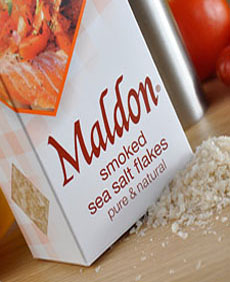
[5] Smoked Maldon salt, a pyramid-shaped salt from England (photo courtesy Maldon).
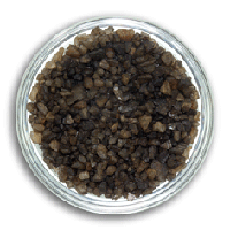
[6] By comparison, sea salt with a heavy Calderwood smoke (photo courtesy Saltworks).
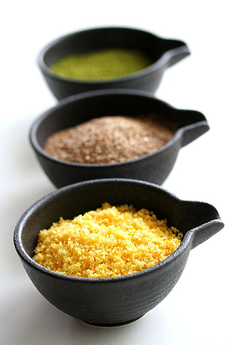
[7] A trio of flavored salts. From top: matcha, bourbon, saffron.
|
10. SMOKED SALT
Smoked salt is slow-smoked for up to two weeks over a wood fire. Some brands highlight the wood. Alder, apple, hickory, mesquite and oak are most common, but you can also find chardonnay and cabernet salts smoked over barrels in which the wine was aged (actual wine can be added as well).
People who enjoy a smokey hit will enjoy smoked salts (we’re fans). Use them on heartier foods: meats, poultry, potatoes, grilled vegetables.
Some salts, like Maldon, are available in both regular and smoked form. You can add to a tasting by comparing them.
CATEGORY III: FLAVORED SALTS
Beyond the garlic salt, onion salt and seasoned salt found in many kitchens, you can find salts mixed with everything from chocolate and espresso to lemon and lemongrass, chipotle and chile verde to truffle and Thai ginger.
Photo #6 shows matcha, bourbon and saffron salts.
There are dozens of different flavors. Our favorites in terms of universality: rosemary salt and saffron salt. We love these flavors, so use the salts every day, instead of plain sea salt.
Check out Saltworks.us for a variety that will knock your salty socks off.
Some examples, in addition to those already mentioned, of what can be found at Saltworks:
Vegetable & Herb Salts: garlic, onion, porcini, rosemary, tomato, truffle
Hot & Spicy Salts: chipotle, curry, ghost pepper, ginger, habanero, jalapeño, serrano, sriracha, szechuan
Other: lemon, lime, merlot, vanilla,
|
|