THE NIBBLE BLOG: Products, Recipes & Trends In Specialty Foods


Also visit our main website, TheNibble.com.

RECIPE: Chopped Fennel & Apple Salad

This crunchy chopped salad is a smooth transition from summer to heartier winter salads.

It’s based on what we think is an under-used vegetable, fennel, which is in season from early fall to early spring.

Crisp fennel and crisp apple combine with crunchy pomegranate arils, which add a festive touch.

(Don’t like arils? Try this fennel and arugula salad with apple and orange.

We’re also fond of these fennel pickles.)

This recipe comes to us from Beth Warren Nutrition. Beth is the author of two books, Living a Real Life with Real Food (2014) and Kosher Girl, due in spring 2018. Her focus is health-conscious kosher meals; but you don’t have to be kosher to enjoy every bite.

Beth likes this recipe for Rosh Hashanah. It goes splendidly with yesterday’s recipe for Buttermilk Roast Chicken.

Also take a look at this Orange Fennel Salad recipe, this Shaved Salad With Pear & Fennel, and these Fennel Pickles.
 
 
RECIPE: FALL FENNEL SALAD

Ingredients For 4-6 Servings

  • 2 bulbs fennel, chopped
  • ½ thinly sliced green apple
  • ¼ cup pomegranate seeds
  • Juice of ½ lime
  • 1 tablespoon chopped walnuts
  • Salt and pepper to taste
  •  
    Preparation

    1. COMBINE the ingredients in glass mixing bowl. Sprinkle salt and pepper to taste.
     
     
    FENNEL FACTS

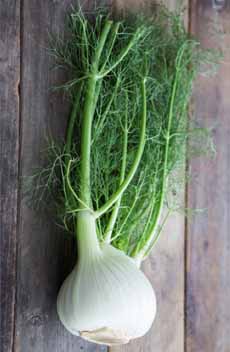
    Fennel looks like the offspring of a peeled white onion and a bunch of dill. It’s crunchy like celery, with a slight anise taste.


    Fennel Apple Salad
    [1] A fall chopped salad: fennel salad, with apples and pomegranate arils (photo courtesy Beth Warren Nutrition).

    Fennel Bulb

    [2] A bulb of fennel. All parts can (and should!) be eaten (photo courtesy Good Eggs).

     
    You can use every part of it.

  • If you only want to use the bulb, turn the stalks into pickled fennel, a.k.a. fennel pickles.
  • The fronds make a lovely food or plate garnish for any savory food, and can be dried and used as herbs.
  •  
    The History Of Fennel

    Fennel is highly aromatic and flavorful, with a long history of both culinary and medicinal uses. The bulb and stalks resemble celery, the leaves look like dill (Anethum graveolens, also of the same order and family), and the aroma and flavor resemble sweet licorice (Glycyrrhiza glabraa, a totally different order [Fabales] and family [Fabaceae]).

    A member of the parsley family* (Apiaceae), fennel (Foeniculum vulgare) and celery (Petroselinum crispum) are botanical cousins, members of the same order* (Apiales) and family* (Apiaceae). Both are believed to be indigenous to the shores of the Mediterranean, growing wild before they were cultivated thousands of years ago.

    Records of fennel’s use date back to about 1500 B.C.E, although its use far precedes the records.

    Fennel was likely first cultivated in Greece, and was used for both medicinal† and culinary purposes. The ancient Greeks and Romans ate the entire plant: the bulb, the the seeds, blossoms and the fronds.

    Theirs was a more bitter variety. Florence fennel, also called sweet anise and finocchio in Italian, the variety eaten as a vegetable, wasn’t developed until the 17th century, in the area of Florence, Italy [source].

    Although many recipes make reference to fennel “root,” it is actually the stalk, swollen into a bulb-like shape at the plant’s base, which is consumed (the same is true with kohlrabi).

    Uses For Fennel

    Fennel can be substituted for celery in recipes when an additional nuance of flavor is desired. We also enjoy it as part of a crudités plate.

    Fennel seeds are a popular spice, for baking, bean dishes, brines, fish, pork, sausages and much more. We especially like them in cole slaw and cucumber salad.

    Plain and sugar-coated fennel seeds are used as a spice and an after-meal mint in India and Pakistan. If you don’t see a dish of them as you leave, ask for them at restaurants.
    ___________________________________________
     
    *We love this family, which also includes angelica, anise, asafoetida, caraway, carrot, celery, chervil, coriander, cumin, dill, fennel, lovage, cow parsley, parsley, parsnip and lesser known edible plants (sea holly, giant hogweed). It also includes the poisonous hemlock.

    In case you don’t remember plant taxonomy from high school biology, here’s a refresher.

    †Pliny The Elder mentions fennel as a treatment for stomachache, the “stings of serpents,” uterus health and other maladies. Those ancient homeopaths got it right: According to Web MD, modern uses include various digestive problems, such as heartburn, intestinal gas, bloating, loss of appetite and colic in infants. It is also used for upper respiratory tract infections, coughs, bronchitis, cholera, backache, bedwetting, and visual problems. Some women use fennel for increasing the flow of breast milk, promoting menstruation, easing the birthing process, and increasing sex drive. And yes, fennel powder is used as a poultice for snakebites.


    Comments off

    FOOD 101: Why Onions Make You Cry…And How To Stop It

    Sliced Onion
    Cutting an onion releases the “tear” chemicals (photo Flagstaff Fotos).
     

    An onion is a thing of beauty—until you slice into it and the fumes assault your eyes. But that doesn’t need to be. Here are some tips to minimize the impact of the acrid gas that’s released when you slice into an onion.

    WHY DO ONION VAPORS BURN YOUR EYES?

    Simply peeling an onion does not make your eyes water.

    But once you chop, cut, crush or smash the onion, the onion’s cells break open, creating a chemical reaction. Enzymes called alliinases break down the amino acids (sulfoxides)in the onion and generate sulfenic acids.

    These further react to produce a volatile gas known as the onion lachrymatory factor, or LF. LF diffuses through the air and activates sensory neurons in eye, causing that burning, stinging sensation.

    It’s not dissimilar to the effects of tear gas. Tear glands come to the defense, producing tears to dilute and flush out the irritant. If you slice onions a lot, your eyes will become more tolerant (they may build up a tolerance to the LF).

     
    The amount of LF differs among onion varieties. That’s why some onions are real “burners” and others are milder. Sweet onions, for example, grow in soils that are low in sulphur and don’t produce much alliinase.

    NO-STING & LESS-STING SOLUTIONS

    Our personal technique: For no sting whatsoever, wear swimming goggles (or any goggles). It works like a charm.

    No goggles? These will help:

  • Slice the onion vertically, through the root end. The onion base has a higher concentration of sulphur compounds than the rest of the bulb. Even better, avoid the root altogether. Use only the top 80% of the onion.
  • Slice under running water. Place your cutting board in the sink and cut the onions under running water. The water whisks the fumes away. Submerge the onions in a basin of water, if you have a basin large enough!
  • Refrigerate the onions before cutting. This reduces the enzyme reaction rate.
  • Turn on a fan. Position it to blow the gas away from your eyes.
  •   

    Comments off

    RECIPE: Buttermilk Roast Chicken

    We have roasted chicken on our mind. It’s close to Rosh Hashanah (September 23rd this year), and we’re thinking back to Nana’s roasted chicken.

    Post-Nana, our roast chicken was never as good, even if we followed the same steps. Nana must have had an understanding with chickens.

    Until we tried the recipe below, soaking the chicken in buttermilk. Some chefs prefer to soak the chicken overnight. It creates a tender chicken with an extra punch of flavor.

    Marinating chicken in buttermilk is a time-honored pathway to moister meat, whether roasted or fried. With a bit of advance planning the night before to marinate the chicken, you’re virtually guaranteed a beautifully browned and richly-flavored bird the next day.

    The recipe is from chef/writer Samin Nosrat.

    Samin serves the chicken with a panzanella (bread salad with vegetables). In this case, panzanella comprises the greens and rustic bread cooked in the pan.

    If you’re off bread, simply roast, saute or steam triple the amount of veggies. Samin uses mustard greens. We highly recommend them—they’re a very under-used green. If you don’t like even a hint of mustard flavor, you can substitute collards or kale.

    Thanks to Good Eggs for sending us the recipe.

    Don’t need a while bird? Another of our favorite food writers and photographers, the White On Rice Couple, presents this delicious recipe for Milk Roasted Chicken Thighs, using whole milk.
     
     
    RECIPE: SAMIN’S BUTTERMILK ROAST CHICKEN WITH MUSTARD GREEN PANZANELLA

    With the chicken marinated in buttermilk, you need just 15 minutes of prep time, and 60 minutes to roast the chicken.

    Ingredients For 4 Servings

  • 1 3-4 pound chicken, salted
  • 1 quart buttermilk, well shaken
  • 3 tablespoons table salt or fine sea salt
  • 4 slices of rustic country bread, torn into 2 inch chunks
  • 2 bunches of mustard greens or kale, de-stemmed
  • 4 shallots, sliced or 1 red onion
  • Handful of fresh sage or rosemary leaves
  • 6 ounces king trumpet mushrooms*, cleaned and sliced
  • 4 cloves of garlic, peeled and sliced
  • ¼ preserved lemon†, sliced thinly
  •  
    Plus

  • Brining bag or other resealable plastic bag
  • Butchers twine
  • ________________

      Buttermilk Roast Chicken
    [1] With this buttermilk chicken, technique delivers a remarkable bird.

    Country Loaf
    [2] A country loaf, also known as a rustic loaf.

    Mustard Greens
    Mustard greens. You can substitute kale.
    King Trumpet Mushrooms
    King trumpet mushrooms. All photos courtesy Good Eggs.

    *King trumpet mushrooms, also called king oyster mushrooms and French horn mushroom and eryngii/eringii mushroom and other names, is the largest variety in the oyster mushroom family. It is now being cultivated in the U.S. You can substitute matsutake mushrooms (which may be even harder to find), or any meaty mushroom (perhaps portabella or baby bellas).
     
    †Here’s a recipe for preserved lemons; but you only need a bit in this recipe. Check your food store’s olive bar or a Middle Eastern market: You may be able to buy one already made.
    ________________

    Preparation

    This recipe requires some preparation a day in advance. Beginning the day before you plan to cook the chicken:

    1. SEASON it generously with the salt (more salt than you’d use for ordinary seasoning). Let the salted chicken sit for 30 minutes.

    2. ADD 3 tablespoons of salt into the container container of buttermilk. Seal it and shake to encourage the salt to dissolve. Place the chicken in a re-sealable plastic bag and pour in the buttermilk. Seal it, squish the buttermilk all around the chicken, place the bag on a rimmed plate or in a pan, and refrigerate. If you’re so inclined, over the next 24 hours you can turn the bag so each part of the chicken gets marinated, but it’s not essential.

    3. REMOVE the chicken from the fridge two hours before you plan to start cooking. When you’re ready to roast, preheat the oven to 425°F/218°C. Remove the chicken from the plastic bag and scrape off as much buttermilk as you can without being obsessive (we used a rubber spatula).

    4. TRUSS the chicken by placing a 12-inch length of butcher’s twine with its center at the small of the chicken’s back. Tie the twine around each wing tightly and then flip the chicken over and use the remaining twine to tie the legs together as tight as you can.

    5. PLACE the bird in a big cast iron skillet or a roasting pan with, the legs pointing toward the rear left corner of the oven. Place in the oven and close the door. You should hear the chicken sizzling pretty quickly. After about 15 minutes, when the chicken starts to brown, reduce the heat to 400°F/205°C and continue roasting.

    6. WAIT another 15 minutes, remove the pan and add the shallots/onion, greens, herbs and chanterelles. Using tongs, mix the veggies around in the chicken drippings and place the pan back in the oven, this time with the legs facing the rear right corner of the oven.

    7. CONTINUE cooking for another 35-40 minutes, stirring the veggies with tongs once or twice so they cook evenly. The chicken is done when it’s brown all over and the juices run clear when you insert a knife down to the bone between the leg and the thigh.

    8. REMOVE the bird to a platter and set it on a cutting board on your counter. Add the bread to the skillet or pan and toss with all of the veggies, making sure to coat the bread evenly in the drippings.

    9. RETURN the vegetables to the oven for 10 minutes. When you remove the pan from the oven, add the preserved lemon to the bread and mustard greens. The chicken will be ready to carve and eat immediately.


    Comments off


    © Copyright 2005-2026 Lifestyle Direct, Inc. All rights reserved. All images are copyrighted to their respective owners.