|
September 1st is National Gyro Day, and the first thing you need to know is that gyro is pronounced YEE-ro, not JY-ro.
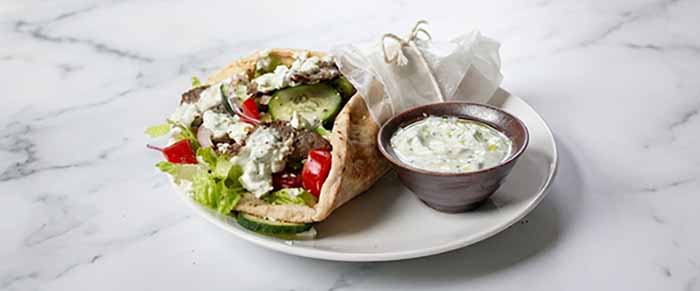
A gyro (pronounced YEE-ro) is a Greek lamb sandwich on pita bread, roasted on a vertical spit and served with tomato, onion, and tzatziki, a yogurt-cucumber sauce (recipe). Other condiments and sauces can be added or substituted.
While lamb is traditional, chicken or pork can be used; outside Greece, you can find beef, lamb or another sausage, even veal. In addition to slices of meat, the meat can be minced and shaped into small patties.
If you’re a vegetarian, you can substitute grilled portabello musuhrooms.
The word “gyro” comes from the Greek word for “turn,” referencing the meat that is turning on the spit (see the photo towards the bottom of this article). A deboned leg of lamb is grilled on a rotating vertical spit and shaved off the leg in thin slices for the gyro.
Eating food off of pita bread or wrapping food in pita is an Ancient Greek tradition; the pita is served as an edible plate. The tradition continues today—although you’ll also get a piece of foil or kitchen parchment to hold the pita from a street vendor, and a plate in a restaurant.
National Gyro Day is September 1st. National Pita Day is March 29th.
Below:
> The history of the gyro.
> The recipe for lamb gyros with feta.
> Also check out the Greek gyro salad bowl: great if you don’t want pita (or even if you do).
Elsewhere on The Nibble:
> The year’s 27+ sandwich holidays.
> The different types of sandwiches: a photo glossary.
> The different types of bread: a photo glossary.
> The history of bread.
> The year’s 20+ bread holidays.
> The year’s 16 Greek food holidays.
> The history of pita bread.
GYRO HISTORY
Gyros, per se, originated in Greece, a descendant of the Turkish döner kebab. While humans have roasted meat on horizontal spits for millennia, the vertical rotisserie was a 19th-century innovation from the Ottoman Empire around the 1830s–1850s.
Grilling stacked meat on a vertical spit and cutting cooked slices to serve is a technique developed in the Turkish city of Bursa in the 19th century. The name döner comes from the Turkish word for turning. Döner kebab literally means “rotating roast.”
Cooking meat vertically allowed the juices to bast the meat as they dripped down, and it saved significant space in crowded city markets. The sliced meat and other sandwich fixings were served on pita or other flatbread. Other relatives include shawarma from the Middle East and tacos al pastor from Mexico.
Shawarma. While döner kebab and shawarma (also Middle Eastern) are both vertical rotisserie meats, they differ in seasoning and service. Döner kebab uses mildly-spiced, often minced lamb/beef in thicker bread with salad, while shawarma is heavily spiced (cumin, garlic) with bolder toppings like tahini or pickles.
Gyros. Döner kebab typically features lamb or beef with yogurt or tomato sauce, often served with rice; while Greek gyros typically use pork or lamb/beef with yogurt sauce (tzatziki), tomatoes, onions, and often fries. Both are similar, but gyros are typically wrapped in fluffy pita, while döner kebabs often uses thicker pita or lavash.
Americans added lettuce, tomato, and onion to the gyro.
Tacos al pastor (“shepherd style”) are a similar creation, spit-grilled meat (usually pork) served in the local flatbread, tortillas. The spit-grilling technique was brought to Mexico by Lebanese immigrants in the early 1900s. Mexican cooks created a marinade using chiles and achiote, accompanied by chopped white onions, salsa, cilantro. Served with a lime wedge, it was eventually topped by some people with pineapple and today, many more options*.
Döner Kebabs Migrate To Greece
Döner kebabs traveled from Turkey to Greece following the 1922 population exchange between Greece and Turkey†. Greek and Armenian refugees from cities like Constantinople (Istanbul) and Smyrna (Izmir) brought the vertical spit technology with them to Athens.
In Greece, the name eventually was translated to gyros, from the Greek word γύρος (yee-ros), which also means to turn or circle.
Gyros Shift To Pork
While the döner kebab uses lamb or beef due to Islamic dietary laws, the Greeks used pork, which was more affordable and widely available in the region.
Gyros Come To America
The gyro sandwich as a mass-market fast food happened in Chicago and New York.
Most food historians credit Greek immigrant George Apostolou with serving the first American gyro at the Parkview Restaurant in Chicago, in 1965.
In fact, the reason Americans eat “gyros” and not “doner kebabs” is due to the far larger amount of Greek immigrants to the U.S. in the 20th century. They set up gyro stands and introduced a delicious new fast food to the nation.
And then came gyro cones. Traditionally, gyros were made by hand-stacking individual slices of sliced meat.
But when the gyro began to take off, Chicago entrepreneurs like Chris Tomaras (Kronos Foods) and Peter Parthenis (Grecian Delight) industrialized the process. They created the mass-produced, ground-meat “cone,” a blend of beef and lamb that could be frozen and shipped to restaurants nationwide, to be cooked and wrapped like a cone in pita.
The gyro got a boost from a 1971 New York Times article, which introduced the “new” sandwich to New Yorkers, describing it as a “lamb, tomato, and onion concoction nestled in a fold of soft bread called pita.”
MAKE YOUR OWN GYROS
Most people eat gyros made by food vendors, but for National Pita Day, try making your own at home. The recipe below is adapted by one from Maria Benardis, award-winning author, chef and founder of Greekalicious, Sydney, Australia’s first exclusively Greek cooking school.
But for Maria’s recipe you don’t need a spit: Roasting the lamb is just as delicious.
PICK YOUR MEAT
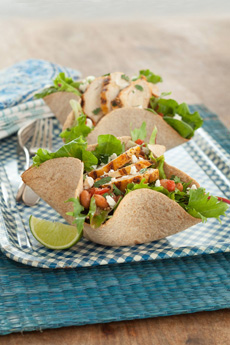
If you don’t like lamb or don’t want to roast a whole leg, you can use any of the following:
Grilled or roasted beef, chicken or pork
Lamb sausage or other sausage variety
Grilled portobello mushrooms
Grilled fish fillet
PLUS
Traditional condiments: lettuce, onion, tomato, tzatziki
Cilantro or parsley
Feta cheese
Black olives (pitted), pickles, pepperoncini
Shredded red cabbage or yogurt-based slaw
Tahini sauce (recipe)
RECIPE: FETA-CRUSTED LAMB GYROS WITH HERBED YOGURT SAUCE
This recipe is more layered than your typical gyro. A salty feta crust forms on the lamb with some heat from the red chili flakes.
Instead of the standard tzatziki yogurt-cucumber-garlic-dill sauce, Maria makes a herbed yogurt sauce which eliminates the cucumber but adds basil, mint and parsley. (It’s also a delicious dip.)
Maria also adds the baby potatoes to the gyro, but we prefer to serve them on the side. You can replace them with an all-American side of fries.
|
|
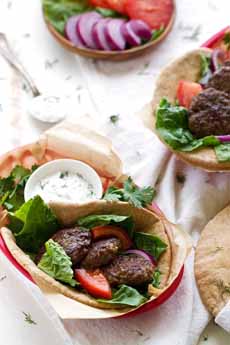
[1] Gyros made from chopped meat patties, with the traditional tzatziki sauce (yogurt and cucumber). Here’s the recipe from The Little Spice Jar (photo © The Little Spice Jar).
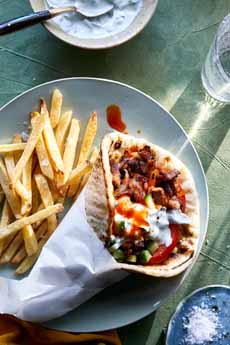
[2] Pork gyros served American style, with fries. Sometimes, a smaller number of fries are tucked into the pita, alongside the meat (recipe by Sam Sifton, photo © Gentl and Hyers for The New York Times, food stylist Maggie Ruggiero, prop stylist Rebecca Bartoshesky).
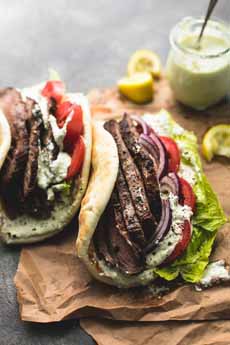
[3] Steak gyros. Here’s the recipe from Le Creme De La Crumb (photo © Le Creme De La Crumb).
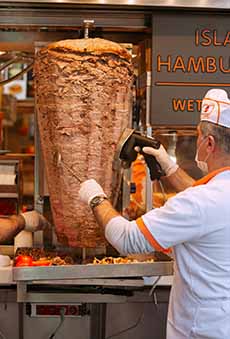
[4] Lamb roasting on a spit (photo © Meruyert Gonullu | Pexels).
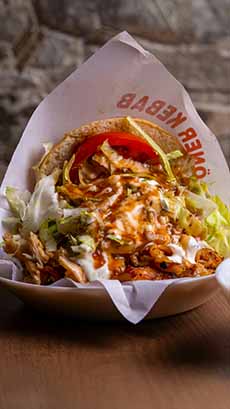
[5] Doner kebab with tomato sauce, cucumber, and a side of fries (photo © Nano Erdozain | Pexels).

[6] No lamb to roast? Use lamb sausage as in this gyro from Kevin Eats (photo © Kevin Eats).
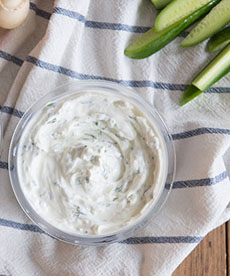
[7] We love tzatziki, herb-flavored Greek yogurt with cucumbers. While the recipe below doesn’t include the cucumbers, here’s a classic tzatziki recipe that does (photo © Cava Grill).
|
3. COVER the baking dish with aluminum foil and place it in the oven. Reduce the temperature to 300°F (150°C). Bake for at 2 to 2-1/2 hours until the lamb is cooked through to 155°-160° on a meat thermometer for medium, 160° for well done. Because ovens vary, it is important to use a meat thermometer! Uncover and cook for a further 30-45 minutes until the top is golden brown.
4. COMBINE the ingredients for the yogurt sauce in a food processor and blend until all the herbs are chopped and the sauce is smooth and thick. Place in a bowl and refrigerate. When the lamb is ready…
5. SLICE the lamb thinly. Warm the pita; if you like, you can lightly brush each side with olive oil and place the bread on a hot grill or in a grill pan for warming and grill marks.
6. ASSEMBLE: Place some yogurt sauce in the center of the pita, arugula and slices of tomato and onion. Top with some lamb and some more yogurt sauce. Serve flat, with an optional side of roasted potatoes.
Find more of Maria’s delicious recipes at Greekalicious.com.au.
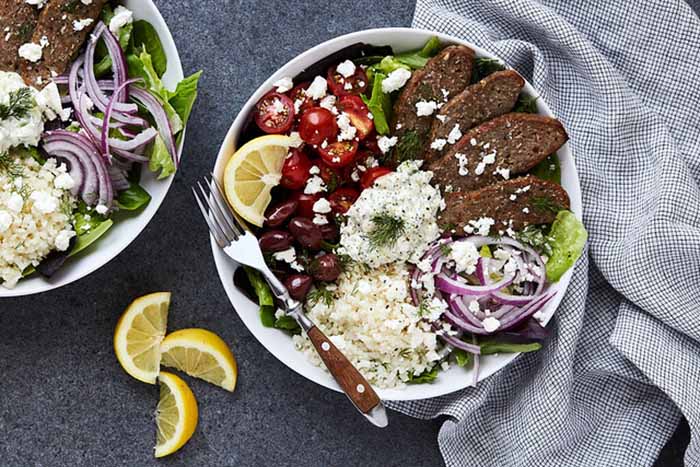
[8] Avoiding bread? Try these lamb gyro bowls. No pita is required—but don’t let that stop you from enjoying some. Here’s the recipe (photo © Tasty Yummies).
________________
*Al pastor toppings can include avocado sauce, lime wedges, Mexican crema (sour cream), pickled onions, pico de gallo, salsa roja and/or salsa verde.
†This mandatory exchange between Greece and Turkey was a formal attempt to create ethnically homogeneous nation-states following the end of the Greco-Turkish War (1919–1922) and the collapse of the Ottoman Empire. Turks in Greece returned to Turkey, Greeks in Turkey returned to Greece. This event is unique in history because it was not just a side effect of war, but a legally mandated “exchange” enshrined in international law. The exchange was officially authorized by the Convention Concerning the Exchange of Greek and Turkish Populations, signed in Lausanne, Switzerland, on January 30, 1923. Crucially, the exchange was based on religion, not language or ethnicity. Greek Orthodox Christians living in Turkey were defined as “Greeks.” Muslims living in Greece were defined as “Turks.” Approximately 1.2 million Christians moved from Asia Minor (Turkey) to Greece, and roughly 400,000 Muslims moved from Greece to Turkey.
The logic at the time was “prevention of further bloodshed.” Both countries had been through years of battle: horrific violence and ethnic cleansing. The international community believed that by physically separating the two religious groups, they could prevent future civil wars and minority persecution. However, this forced millions of people who had lived in their ancestral homes for centuries to leave everything behind. While it arguably stabilized the borders between the two nations, it left a deep “cultural trauma” on both sides, as families were uprooted from lands they had inhabited since antiquity. The exchange radically changed agriculture. In many cases, the departing Greeks were the primary vintners and silkworm farmers in Turkey, while the departing Muslims from Crete and Macedonia were expert olive and tobacco growers.
On a positive note regarding the culinary “exchange”: Refugees from Smyrna (now Izmir) brought the Smyrna stile of more sophisticated, spice-heavy culinary tradition to Athens. This included the use of cumin, cinnamon, and allspice in savory dishes like Soutzoukakia Smyrneika (spiced meatballs). The refugees, often arriving with nothing, turned to small-scale vending. The gyro and bougatsa, a custard or meat-filled phyllo pastry, became staples of the Greek urban diet.
CHECK OUT WHAT’S HAPPENING ON OUR HOME PAGE, THENIBBLE.COM.
|