|
Updated June 2026
August 6th is National Root Beer Float Day: a type of ice cream float (a.k.a. ice cream soda) that combines ice cream, usually chocolate or vanilla, with root beer.
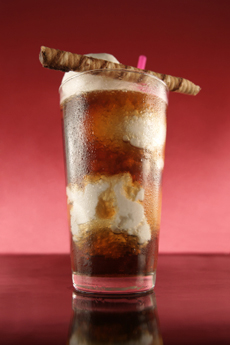
Just place a couple of scoops of ice cream in a tall glass, add the root beer, and serve with a straw and a long spoon (photo #1). Yum!
You can do this with any flavor ice cream and any coordinating soda. But for root beer, there’s a second day to celebrate: July 17th is National Root Beer Day. No one will challenge if you add ice cream to the glass.
Below:
> Root beer float recipe.
> The history of the ice cream float.
> The history of root beer.
Elsewhere on The Nibble:
> More ice cream float recipes.
> More recipes.
> The year’s 24 non-alcoholic beverage holidays (including juice and soft drinks).
RECIPE: ROOT BEER FLOAT
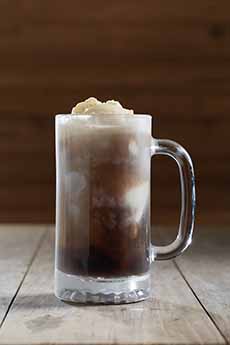
Make this in a tall glass, beer stein, or classic soda fountain glass.
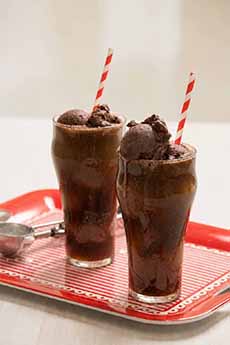
Vanilla ice cream is traditional, chocolate ice cream makes the drink a “Brown Cow.”
You can also add a splash of beer or spirit!
Ingredients Per Drink
2–3 scoops of vanilla ice cream
12 ounces root beer, chilled
Optional spirit: 1 ounce aged rum, Bourbon, coffee liqueur, cream liqueur, or vanilla liqueur or vodka
Optional beer: milk stout, oatmeal stout, or vanilla porter
Optional garnishes: chocolate sprinkles, grated chocolate,, maraschino (or brandied) cherry, whipped cream
Straw and a long spoon (e.g. iced tea spoon)
Preparation
1. FROST the glass by placing in the freezer for 15 to 20 minutes or more; this keeps the drink chilled longer. When ready to make the drink…
2. SCOOP the ice cream into a tall, frosted glass. If using alcohol, pour it over the ice cream.
3. SLOWLY POUR the chilled root beer at an angle down the tilted inside of the glass to limit the foam. Let any foam settle, then top off with more root beer. Garnish and serve immediately.
Variations
Two of our favorites alcoholic floats:
Banana float: banana ice cream, vanilla soda, rum, and banana liqueur.
Creamsicle float: vanilla ice cream, orange soda, optional vodka, and orange liqueur.
You can also make a beer float:
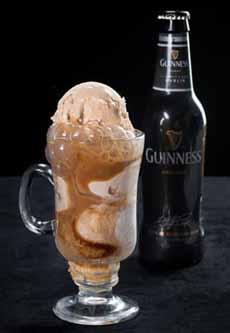
Guinness Float & Double Chocolate Stout Float
Tipsy Leprechaun Stout Float with Irish whiskey
ICE CREAM FLOAT HISTORY
Credit for the invention of the ice cream float was invented by Robert McCay Green, operator of a soda fountain in Philadelphia, Pennsylvania. In the era before bottled soft drinks, a soda fountain was a place where people would stop by for a fresh-jerked soda.
The “soda jerk” would add syrup to a glass, then jerk the handle of the soda water [carbonated water] tap. The pressure blended the soda, although a swirl with a spoon finished the job.
Green wanted to create something special to compete with a larger, fancier soda fountain down the street. His brainstorm: a combination of vanilla ice cream and soda water with a choice of 16 different flavored syrups. He called it an “ice cream soda.”
A variation of the story is that, on one hot day, Green ran out of ice for his soda fountain drinks and used vanilla ice cream from a neighboring vendor, has been put to rest by his own account, published in Soda Fountain magazine in 1910 (source).
Alas, in those days small business owners were not trademark-oriented, and the competitors soon knocked him off.
As the ice cream soda soda concept took off, different fountain syrups were used: birch beer, cola root beer and fruit-flavored soft drinks.
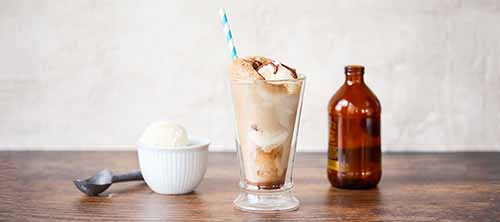
[6] Those counting calories can use sugar-free ice cream and root beer (photo © American Heritage Chocolate).
|
|

[1] A root beer float given the glamour treatment with whipped cream and a cookie (photo ShagPhoto | IST).
[2] The classic, in a frosted beer stein (photo © BJ’s Restaurants).
[3] Guinness Float. Here’s the recipe for the float, plus homemade stout ice cream (photo courtesy Silver Moon Ice Cream).
[4] A root beer float made with chocolate ice cream is called a Brown Cow (photo: The Nibble).
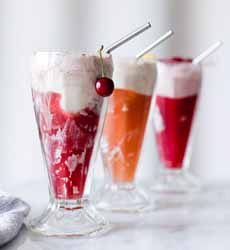
[5] Ice cream floats with fruit sodas: strawberry, orange (a Creamsicle float), and raspberry (photo © lanna Taylor Tobin | The Bojon Gourmet).
|
Bottled soft drinks became broadly available by 1950, enabling consumers to mix and match their own floats. Some examples of the variety:
Boston Cooler: ginger ale and vanilla ice cream (invented in Detroit, with no relation to Boston).
Brown Cow: a root beer float made with chocolate ice cream.
Coffee Float: vanilla ice cream with actual coffee and cream, plus coffee soda or cola (the recipe).
Cola Float: vanilla or chocolate ice cream with Coca-Cola or Pepsi Cola.
Creamsicle® Float: vanilla ice cream and orange sherbet.
Framboise Float: vanilla ice cream with raspberry soda.
Orange Whip: orange sorbet with orange soda and optional orange juice.
Purple Cow: vanilla ice cream with grape soda.
Root Beer Float: also called a Black Cow or a Brown Cow: root beer with vanilla ice cream (or flavor of choice).
Snow White: 7 Up or Sprite with vanilla ice cream.
In older times, soda jerks would top the float with whipped cream and a maraschino cherry. Today, anything goes—as long as it doesn’t collapse the whipped cream.
THE HISTORY OF ROOT BEER
Modern soft drinks would not exist, had carbonated water not been invented. Here’s the history of carbonated water, which was first sold commercially in the late 1700s; and the debut dates of early soft drinks.
Root beer, at least in its earliest, non-carbonated form, long predates carbonation.
Emigrants to the New World found Native Americans drinking beverages made of sassafras root and sarsaparilla vine, for culinary and medicinal reasons American culture.
By the 16th century, colonists were using European culinary techniques to create it, and other root- and herb-based beverages.
Ingredients could include, among others, allspice, birch bark, burdock root, dandelion root, coriander, juniper, ginger, hops, licorice, molasses, sarsaparilla, sassafras root, vanilla beans, wild cherry bark and wintergreen.
Today, the root commonly used is the root bark of the sassafras tree (Sassafras albidum) or the sarsaparilla vine (Smilax ornata).
With the spread of soda water/carbonated water in the early 19th century, the technique was applied to these traditional beverages. Sweet syrups were the foundation of soda fountains, and it was combined with soda water as early as the 1850s.
Drinks like root beer were also sold as “tonics,” for their perceived medicinal qualities. The syrup was added to a glass, topped with carbonated water and given a brief stir.
While traditional root beer was indeed made from sassafras tree roots, modern commercially produced root beer typically does not contain any sassafras root. In 1960, the FDA banned sassafras oil due to an ingredient, safrole, which was shown to be carcinogenic in rats.
This led to the use of artificial flavorings in most commercially produced root beer. Artisan brands use extracts from which the safrolehas been removed.
Modern, commercially-produced root beer (and other sodas) is typically sweet, foamy, carbonated, nonalcoholic, and flavored with artificial* sassafras oil (source).
________________
*Sassafras root is still used to flavor traditional root beer. However, sassafras is no longer used in commercially-produced root beer since 1960, when it was banned by the FDA for use in commercially mass-produced foods and drugs. There were health concerns, highly controversial, about the carcinogenicity of safrole, a major constituent of sassafras oil, in animal studies. Some small-batch root beers do use a safrole-free sassafras extract.
|