|
National Prunes Day is June 17th and October 17th is Four Prunes Day. The latter may sound like a funny name for a food holiday, but it’s named after a medical study on digestive regularity: that eating four to six prunes daily will aid digestion*.
Some people say “meh” to prunes, but we love the flavor of moist prunes and good prune juice.
A campaign launched by prune producers in 2001 promoted a name change from prunes to “dried plums” (which is what prunes are), to make them more appealing.
It was not successful in moving the needle, and “prune” has returned to common use.
But as anyone who has ever made a pork or chicken roast with stuffed prunes knows, the dried fruits are delicious in recipes as well as on their own as snacks.
While dried fruits such as prunes are easy to tote around for a healthy snack, Sunsweet Growers has made it even easier with Sunsweet Ones, which are individually wrapped. One prune contains just 23 calories, plus full of antioxidants, fiber, magnesium, and potassium.
Below:
> The history of prunes.
> Prunes at every meal.
> Prune nutrition.
Elsewhere on The Nibble:
> Why eat four prunes a day?
> The year’s 4 prune holidays.
> The year’s 80 fruit holidays.
> The year’s 90 snack holidays.
PRUNES AT EVERY MEAL
Breakfast: breakfast bars, cottage cheese, oatmeal, pancakes, scones and muffins, smoothies, yogurt
Lunch: green salads, chicken salad, grilled cheese, shaved root salad, turkey/chicken lettuce cups or wraps
Appetizers: bacon-wrapped prunes, cheese board, crostini, skewers
Dinner: chili, meatloaf, stews, stuffed chicken breasts, stuffed pork roast, Tuscan Chicken,
Sides: carrot salad, glazed vegetables,rice and grains, stuffed or cubed squash, stuffing
Dessert: brownies, cookies, fruit and nut bark, mousse/prune whip, prune cake, prune flan/clafoutis
There are so many recipes in each of these categories. Check out:
California Prunes
Sunsweet.com
You’ll find everything from every day to creative recipes (don’t knock prune pizza until you’ve tried it).
Two of our own favorites:
Easy dessert: Soak prunes in Cognac, Grand Marnier, prune liqueur, or orange liqueur for several hours or overnight. Then use them to top vanilla ice cream.
Easy hors d’oeuvre: Stuff prunes with chicken liver mousse. You can marinate the prunes in Cognac overnight before stuffing them.
You can even flambé them, like Cherries Jubilee.
PRUNE NUTRITION
Prunes have been appreciated for thousands of years due to their nutritional, dietary, and medical properties, and were prescribed by Greek, Roman and Arab doctors.
Today, we know that they are:
High in antioxidants, including vitamin C.
High in soluble fiber, which helps normalize blood sugar levels.
High in insoluble fiber, which helps with lower cholesterol and regularity.
As a snack, the fiber may help keep hunger pangs at bay.
Their high beta-carotene content can help prevent cancer and help slow the aging of the brain and body.
In addition to nutrition, prunes are fun to eat: sweet, flavorful, and moist, and with a sticky, chewy texture.
THE HISTORY OF PRUNES
A prune is a dried plum of any cultivar, mostly the European plum (Prunus domestica).
More than 1,000 plum cultivars are grown worldwide for drying; an additional 1,000 or so are grown for plum fruit (different cultivars are created to do better in particular environments).
The Greeks and Romans were very fond of both variations of the fruit.
Wild plums originated in China and were cultivated from sour plums into sweet fruit.
Plums came to the Middle East along the Silk Road, and plum trees flourished all over the Mediterranean basin.
The plums were dried in the sun or in bakers’ ovens, transforming them into prunes.
Because they are highly nutritious and have a long shelf life, prunes and other dried fruits were ideal for travelers, and to store in case of poor harvests.
From the Mediterranean to Northern Europe:
The Romans planted the first variety of plum in Gaul near the town of Agen, which is still famous for its delicious prunes.
In the 12th century, Benedictine monks returning from the Third Crusade brought new varieties of plums from Syria and grated them onto the local rootstock to create new varieties.
|
|

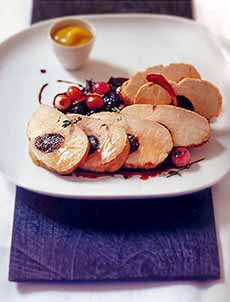
[1] Pork roast stuffed with prunes. Here’s the recipe from Leites Culinaria (photo © Leites Culinaria).
[2] Asian noodles with prune-ginger sauce. Here’s the recipe from California Prunes (photo © California Prunes).
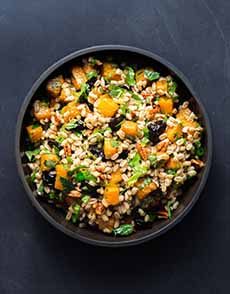
[3] Farro (substitute grain of choice) with prunes, butternut squash and pecans. Here’s the recipe from California Prunes (photo © California Prunes).
[4] Brownies with chopped prunes. Here’s the recipe from A Taste Of Madness (photo © A Taste Of Madness).
[5] Prune clafoutis, in custard. Here’s the recipe from Papilles Et Pupilles (photo © Papilles Et Pupilles).
[6] Whole, pitted, bite-size, diced, individually wrapped for grab-and-go: Sunsweet makes it easy to cook and bake with prunes (photo © Sunsweet).
|
Known as Pruneaux d’Ente (grafted prunes), this was the prune that made its way to California, in 1850.
It was brought by a man from the Agen area, who grafted it onto local wild plum trees.
While these California prunes were growing, so was the U.S. consumer demand for European prunes.
By the 1870s, there were enough imports to catch the eye of farmers, who began planting plum trees from the California stock.
Today, California is America’s source of prunes. They’re available year-round.
Try some sooner, rather than later.
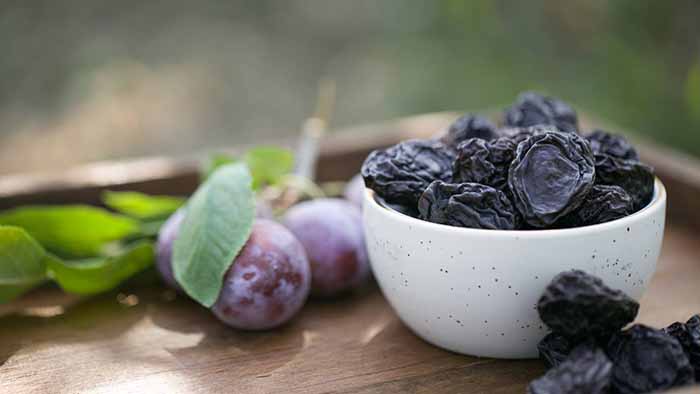
[7] Fresh plums and the prunes that result when they’re dried (photo © California Prunes).
________________
**Clinical trials, including the landmark “Prune Study” from Penn State researchers, used a baseline dose of 50 grams of prunes per day—which works out to about 4 to 6 prunes—to measure positive changes in the body.
CHECK OUT WHAT’S HAPPENING ON OUR HOME PAGE, THENIBBLE.COM.
|