|

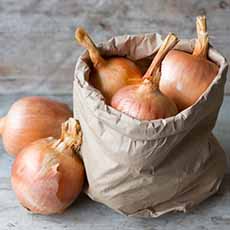
[1] Baked onions (photo and recipe @ Jaci Goodman | Peri & Sons Onions).

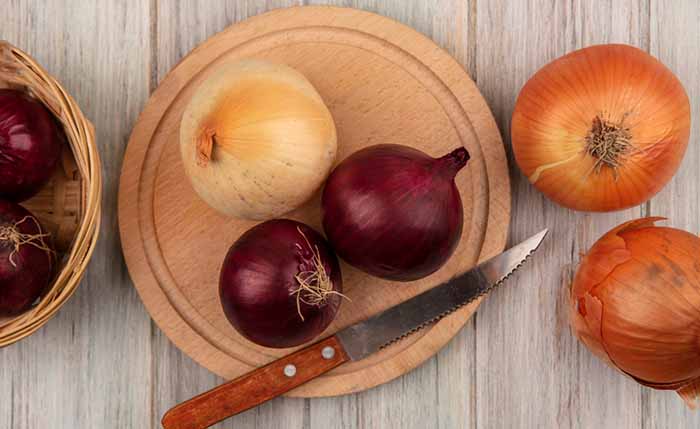
[2] Yellow onions (photo © Good Eggs).
[3] Red onions showing the concentric circles of eternity, per ancient Egyptians (photo © Burpee).
|
|
We’d never thought about baking a dish of onions-only, until we came across this easy-to-make onion recipe from Peri & SonsPeri & Sons, growers of onions.
Using white and red onions, the recipe is vegan, gluten- and dairy-free and makes a wonderful accompaniment to a piece of grilled steak, chicken, or fish.
The recipe was created by This recipe makes 6-8 servings. Recipe courtesy of Jaci Goodman.
The recipe follows, but first, for your perusal:
> The history of onions.
> The different types of onions: a photo glossary.
> The year’s 6 onion holidays.
> More uses for onions.
RECIPE: BAKED ONIONS
Prep time is 5 minutes, bake time is 30 minutes.
Ingredients For 6-8 Servings
2 red onions, quartered and peeled
1 yellow onion, quartered and peeled
1/4 cup olive oil
2 tablespoon lemon juice
2 to 3 cloves garlic, chopped
1 tablespoon fresh thyme off the stem
1 tablespoon Dijon mustard
1 teaspoon salt
1/2 teaspoon pepper
Garnish: 1/2 tablespoon parsley, chopped
Preparation
1. PREHEAT the oven to 350°F.
2. MIX together the oil, lemon juice, garlic, thyme, mustard, salt, and pepper. Pour over the quartered onions and toss. Place in a baking dish.
3. BAKE for 30 minutes and remove from the oven.
4. GARNISH with chopped parsley and bring the dish to the table; or apportion among plates and garnish.
|
THE HISTORY OF ONIONS
Scholarly thought is divided on the history of wild onions.
Archaeologists, botanists, and food historians believe onions originated in central Asia.
Other research suggests onions were first grown in Iran and West Pakistan.
A Prehistoric Staple
Whichever the source, ancient hunter-gatherers, who foraged for anything edible, discovered and started eating wild onions long before farming began (around 10,000 B.C.E. in the Fertile Crescent, in the West).
Very likely, wild onions were a staple food in the prehistoric diet.
Most researchers agree the onion has been cultivated for 5000 years or more. Since onions grew wild in different areas, they were probably domesticated roughly simultaneously* all over the world.
Onions may be one of the earliest cultivated crops, because they were easy to grow in a variety of soils and climates, were less perishable than other produce types, and were easily transportable. They could be dried and preserved for times when food might be scarce.
The high water content of onions prevented thirst as well. Many documents from the invention of writing (around 3200 B.C.E. by Sumerian scribes in the ancient city-state of Uruk, in present-day Iraq) describe its importance in medicine.
Today, onions are used in every cuisine of the world. They can be baked, barbecued, broiled, candied, caramelized, fried, grilled, pickled, roasted, sautéed, spiced, eaten raw and mixed into dressings and other foods.
More history:
Ancient Egypt: Onions were an object of worship, symbolizing eternity because of the circle-within-a-circle structure. They were buried with the mummified pharaohs, often in their body cavities. King Ramses IV, who died in 1149 B.C.E., was entombed with onions in his eye sockets. Paintings of onions appear on the inner walls of the pyramids, and are depicted on the banquet tables of great feasts and on the altars of the gods.
The Old Testament: In Numbers 11:5, the children of Israel lament the meager desert diet engendered by the Exodus. “We remember the fish, which we did eat in Egypt freely, the cucumbers and the melons and the leeks and the onions and the garlic.”
India: As early as the 6th century, the famous medical treatise Charaka-Sanhita, written in the 1st century C.E., celebrated the onion as a diuretic for digestion, the heart, the eyes, and the goings.
Greece: In the 1st century C.E., the physician Pedanius Dioscorides described several medicinal uses of onions. Greek athletes used them for fortification during the Olympic Games. Before a competition, they consumed pounds of onions, drank onion juice, and rubbed onions on their bodies.
Rome: Pliny the Elder wrote of Pompeii’s onions and cabbages (excavators have even found gardens where onions were grown). He cataloged Roman briefs about the medical efficacy of the onion: to cure vision, induce sleep and heal maladies such as mouth sores, toothaches, dog bites, dysentery, and lumbago. The Roman gourmet Apicius, credited with writing the first cookbook, in the 1st century C.E. Likely, Apicius was a pseudonym and the cookbook was a group effort. It included many recipes with onions.
Middle Ages: Much of the cuisine of Europe featured beans, cabbages and onions. In medicine, onions were prescribed for headaches, snakebites, and hair loss. They were also used as currency: for rent payments and wedding gifts.
Native Americans: Strains of wild onion grew throughout North America, and were used raw, cooked, and as seasoning and syrups. Onions were also used in poultices, as an ingredient in dyes, even as toys.
The Pilgrims: The Pilgrims brought onions to America on the Mayflower, and grew them as a crop so prolific that they could be sold abroad. A record from 1667 shows onions on a cargo list of a ship on Long Island Sound, and on vessels headed to Barbados and Surinam in 1718.
Sweet Onions: Vidalia onions, a sweet, no-tears onion, were an accidental discovery in the 1930s, when a crop of onions was planted in Vidalia, in the state of Georgia, USA. When harvested, the farmers were amazed at their sweetness and lack of acrid flavor, and eye irritation. The distinctive profile results from a combination of weather, water, and soil. This unique terroir† is found within 20 counties in southern Georgia. The soil has much less sulfur than other soils, eliminating the eye burn and the bite of raw onions, and allowing the natural sweetness of the onions to shine through. Since then, more locations have produced sweet onions.
Thanks to the National Onion Association for these notes.
New Developments On The Horizon
Breeders are working on develop the “tearless opnion, varieties with increased shelf, and varieties enhanced disease resistance, particularly against pink root disease, basal rot, and downy mildew.
___________
*The onset of the Holocene, the current geological epoch, began around 10,000 B.C.E., after the last glacial period, which concluded with the Holocene glacial retreat. The hypothesis for why agriculture began independently the world over at this time: The warmer, wetter, higher CO2 conditions of the Holocene generally encouraged plant growth (source.
†Pronounced tuhr-WAH, terroir is the French expression “sense of place,” the unique environment in which something grows—its specific soil composition and microclimate. Microclimate includes temperature, amount of sunshine, and rain. The flavor nuances of agricultural products, from grapes to olives to milk to cacao, are a function of its terroir.
[4] Tip: Wear swimming goggles to protect your eyes while you slice onions (photo via Stock King | Freepik).
CHECK OUT WHAT’S HAPPENING ON OUR HOME PAGE, THENIBBLE.COM.
|