THE NIBBLE BLOG: Products, Recipes & Trends In Specialty Foods


Also visit our main website, TheNibble.com.

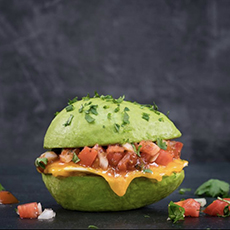
FOOD FUN: Avocado Burger Or Sandwich


[1] An avocado “burger” or “sandwich” filled with whatever you like (photo © Love One Today).


[2] Instead of American cheese, use a Hispanic melting cheese like queso quesadilla (photo by Claire Freiermann © The Nibble).


What’s inside this avocado burger? Anything you want.

The idea is from Love One TodayLove One Today, the consumer website for the Hass Avocado Board and a source for everything avocado, including recipes.
 
 
BUILD YOUR AVOCADO BURGER

Starting with two avocado halves that form the “buns” or “bread,” you can add:

  • Any type of patty
  • Any type of sandwich fixings
  • Chicken, egg or seafood salad
  • Cheese
  • Lettuce, onion and tomato
  • Other raw vegetables (artichoke hearts, arugula, cucumbers, kale, radishes, red cabbage, shaved vegetables (broccoli stems, carrots or fennel), snow peas, sprouts, watercress
  • Pickled vegetables
  • Roasted vegetables
  • Salad dressing (blue cheese, ranch, Russian)
  • Slaw
  • Condiments: chutney, mostarda, mayonnaise (ideally, flavored mayo*), olives, salsa, slaw, tapenade
  •  
    For our first avocado burger, we created the Ultimate Veggie Burger: veggie burger, lettuce and tomato, sweet onion, pickled vegetables, raw vegetables, roasted vegetables, sprouts…and melted gruyère cheese.

    (Frankly, we went through everything in the fridge.)

    We placed the Gruyère in a ramekin, melted it in the microwave, and poured it over the other ingredients piled onto the bottom avocado half; then put the top on and garnished the veggie burger with a toothpick of assorted olives.

    A good lunch was had by all!

     
    ________________

    *Bacon, blue cheese, curry, garlic (i.e., aïoli—here’s the recipe), Dijon, hot sauce, lemon or lime zest. Just add any particular seasoning to taste.


    Comments off

    RECIPE: Coq Au Vin For National Coq Au Vin Day

    May 29th is National Coq Au Vin Day (pronounced cuhk-oh-VAN). The name of this French country dish means “rooster with wine [sauce].”

    The wine varies by local specialty and can be red or white: Burgundy in Burgundy, Riesling in Alsace, and so forth.

    This classic dish is a bistro favorite, and one of the first French dishes many home cooks learn in the French repertoire.

    Here’s a recipe. It’s a simpler preparation than the recipe from Chef Antoine Westermann, below.

    Although the word coq in French means rooster or cock, most modern Coq au Vin recipes call for female chicken. It can be an old chicken: Tough birds with lots of connective tissue become tender meat after a long braise.

    Older roosters and hens were preferred because more connective tissue creates a richer broth. In earlier days, chickens and roosters past their prime were headed to the braising pan or the stew pot.

    In the U.S., standard recipes often call for red wine (often Burgundy or “red wine”) for braising, lardons (salt pork or bacon), button mushrooms, onions, perhaps garlic, and sometimes brandy.

    The usual seasonings are bay leaf, parsley and thyme—usually in the form of a bouquet garni—plus salt and pepper. The pan juices are thickened with a roux.

    The preparation is similar in many respects to Boeuf Bourguignon. The chicken is seasoned, dusted with flour, then seared in fat and slowly simmered in wine until tender.

     
    THE HISTORY OF COQ AU VIN

    Anecdotal talk traces Coq au Vin to ancient Gaul and the table of Julius Caesar, but it is generally accepted that the rustic dish existed long before then.

    All a cook needed was wine and a rooster (both originating around 6000 B.C.E.).

    However, it seems that the recipe was not documented until the early 20th century. A somewhat similar recipe, poulet au vin blanc ) chicken in white wine, appeared in an 1864 cookbook (source).

    In recent centuries, Coq au Vin became a specialty in Lyon, a French culinary capital that also gave us:

  • Lyonnaise potatoes, sliced pan-fried potatoes and thinly sliced onions, sautéed in butter with parsley.
  • Rosette de Lyon, a cured rosy saucisson (French pork sausage).
  • Lyonnaise sauce, a brown sauce for roasted or grilled meat and poultry, made with white wine, vinegar and onions.
  • Salade Lyonnaise, a frisée salad with bacon, asparagus and a sherry vinegar and Dijon mustard dressing (recipe).
  •  
    Julia Child helped popularize Coq au Vin in the U.S. in her seminal 1961 cookbook, Mastering the Art of French Cooking; and she frequently prepared it on her PBS cooking show, The French Chef.

    It became a popular dish for entertaining, because much of the preparation is done before guests arrive.
     
     
    BRAISE, FRICASSEE, SAUTÉ: THE DIFFERENCE

    Coq au Vin is a braise. Related dishes are sautés and fricassees.

    In Mastering the Art of French Cooking, Julia Child describes fricassee as “halfway between a sauté and a stew.” A sauté has no liquid added (besides the fat), while a stew includes liquid from the beginning.

    A braise is first sautéed or seared at a high temperature, then cooked with a liquid or sauce for a longer time, at a lower temperature, in a covered pot.

    In both Coq au Vin and Chicken (or veal) Fricassee, the meat is first braised.

    The vegetables are usually carrots and onions or leeks, and they are generally served with dumplings, noodles, rice or roasted potatoes. A fruity red wine is a favored accompaniment to Coq au Vin (Beaujolais, California Syrah, Italian Dolcetto), a white wine for a fricassee.
     
     
    RECIPE: COQ AU VIN

    This recipe comes straight from the kitchen of Chef Antoine Westermann, who famously gave back his three Michelin stars to pursue “unfettered culinary creativity.”

    A lifelong champion of poultry, Chef Westermann perfected the art of cooking fowl at his restaurant Le Coq RicoLe Coq Rico, with locations in Paris and New York City.


    Coq Au Vin Recipe
    [1] Antoine Westermann’s coq au vin recipe (below), served in a pasta plate, a bowl with a very large rim (photo © Paste Magazine).

    Coq Au Vin Recipe
    [2] The Coq au Vin recipe of Chef Antoine Westermann. The recipe is below (photo © Antoine Westerman | Le Coq Rico.


    [3] He’s handsome now, but when he gets past his prime: Coq au Vin! (photo © Muhammad Mahdi Karim | Wikipedia).

    Beaujolais Glasses
    [4] Pair Coq au Vin with a fruity red wine like Beaujolais (photo © Schott-ZwieselSchott-Zwiesel, which makes this special glass shape for Beaujolais).

     
    Coq Au Vin, he says, is renowned for its simple ingredients and basic techniques. He serves his Coq au Vin with egg noodles.

    Ingredients For 4 Servings

    Total prep and cook time is 1 hour, 55 minutes.
     
    For The Chicken

  • 1 chicken, 5.5 to 6.5 pounds, cut into pieces
  • 7 ounces smoked bacon
  • 3 cups mushrooms
  • 3½ ounces stale bread
  • 1 liter (4-1/4 cups) chicken stock
  • 2 tablespoons flour
  • 10 tablespoons olive oil
  • 1½ tablespoons butter for the croutons
  • Salt and pepper
  •  
    For The Marinade

  • 1 carrot
  • 1 leek
  • 1 celery stalk
  • 1 onion
  • 2 cloves garlic
  • 1 clove (the spice)
  • 1 stem of thyme
  • 1 bay leaf
  • 1 liter (3.3 cups) Cotes-du-Rhone or similar wine
  • Salt and pepper
  •  
    Plus

  • Egg noodles and more wine for serving
  •  
    Preparation

    1. PREPARE the marinade: Peel and chop the carrots into pieces, wash and cut the leek into rounds, wash and cut the celery into chunks, peel and cut the onion into rings, and peel and crush the cloves of garlic.

    2. PLACE the carrot, leek, celery, onion and garlic in a large bowl. Mix in the clove, thyme, bay leaf and wine. Place the chicken pieces in the marinade, cover, and put in the refrigerator to marinate for 24 hours. After the chicken has marinated…

    3. POUR 7 tablespoons of olive oil into a cocotte (that’s French for a Dutch oven). Reserving the marinade, remove the chicken and cook over high heat until golden.

    4. PLACE the marinade and vegetables in a pan and bring to a boil. Run through a strainer to clarify the liquid.

    5. REMOVE the pieces of chicken from the pan and deglaze the pan with the chicken stock. Season with salt and pepper.

    6. ADD the chicken, vegetables from the marinade, and filtered liquid. Cover the pan and cook over low heat for 90 minutes.

    7. WASH the mushrooms and cut them into large pieces. Pour 3 tablespoons of olive oil in a pan and brown the mushrooms and bacon. Add salt and pepper.

    8. REMOVE the chicken and place it under a sheet of aluminum foil. Add 1 tablespoon of flour to the cooking juices, stirring constantly. Adjust the seasoning. Return the pieces of chicken to the pan, and add the bacon and mushrooms. Cook for a few minutes on low heat.

    9. CUT the bread into small cubes. Heat the butter and cook the croutons until golden brown.

    10. PLACE the chicken in a baking dish. Distribute the bacon, mushrooms and croutons around the chicken. Evenly drizzle the sauce atop the dish. Reheat for a few minutes, so that the dish is very hot. Serve with egg noodles.

    In conclusion: Cocorico!, French for cock-a-doodle-doo!


    Comments off

    Wine Spritz (Spritzer) Recipe & The Coravin Wine Preservation System


    [1] Start with a bottle of Sauvignon Blanc (photo © Cloudy Bay WineCloudy Bay Wine).


    [2] Mixed berries for muddling into your wine spritzer (photo © Green Giant FreshGreen Giant Fresh).


    [3] Squeeze in a couple of lime wedges (photo by Hannah Kaminsky | The Nibble).


    [4] Two of the 20 flavors of Polar Seltzer (photograph © Polar SeltzerPolar Seltzer).


    [5] Coravin Wine System (photo © CoravinCoravin | Facebook).

    Blueberry Spritz
    [6] A blueberry spritz (photo © Timur Weber | Pexels).

    Red Wine Spritz Drinks
    [6] Red wine spritzes (photo © Carraba’s Italian Grill | Facebook).


    May 25th was National Wine Day, and since then we’ve been enjoying a daily wine spritzer using the recipe below.

    The recipe came to us from Coravin, a leading wine preserving system, which allows you to pour a glass from a bottle of wine without ever opening it.

    Watch this short video for a demo.

    Essentially, a thin needle goes through the cork and the wine is pumped into the glass. The cork heals after the needle is removed so the wine is safe from air.

    If you purchase a Coravin System directly from Coravin.com, you can try it at home risk-free. If you’re not completely satisfied, you may return it within thirty days of the purchase date.

    No one less than our favorite wine critic, Robert M. Parker, Jr., has hailed the Coravin System as “the most transformational and exciting new product for wine lovers that has been invented in the last 30+ years—this is a killer device.”

    The models start at a fairly-priced $249.95 and up, and are a great gift for a wine connoisseur who wants to drink costly bottles a glass or two at a time.

    Make yourself a wine spritzer—no Coravin required—as you contemplate the different models.

    > The history of the Spritz is below.

    > The history of Sauvignon Blanc.

    > The history of wine.

    > The year’s 22+ white wine holidays.
     
     
    RECIPE: SKINNY WHITE WINE SPRITZ WITH FRUIT

    Starting note: While Americans tend to call this drink a spritzer, the proper name is Spritz.

    A plain wine Spritz combines wine and carbonated water, and perhaps a wine wedge.

    This one adds muddled berries and remains a low-calorie cocktail option.

    Ingredients Per Drink

  • 4 berries, muddled (e.g. raspberries, blackberries, blueberries, etc.)
  • Ice
  • 2 ounces Sauvignon Blanc
  • Your favorite fruit-flavored seltzer
  • 2 lime wedges
  • 3-4 pieces whole berries
  •  
    Preparation

    1. MUDDLE the fruit in a wine glass, then fill the glass halfway with ice.

    2. ADD the Sauvignon Blanc first; then add the seltzer to fill the glass.

    3. SQUEEZE in the lime juice and stir. Add the whole pieces of fresh fruit and the squeezed lime wedges to garnish.
     
     
    WINE SPRITZER HISTORY

    In German, spritz means a splash or spray.

    A Spritzer is a tall, chilled drink, made from white wine (still or sparkling) and soda water.

    The Spritz Veneziano (Venetian Spritz or wine spritzer, as it’s called in the U.S.) is a wine-based cocktail, commonly served as an apéritif in northeastern Italy where Venice, and the Veneto region, are located.

    The drink originated in Venice while it was part of the Austrian Empire (1815-1866), and is based on the Austrian Spritzer, a combination of equal parts white wine and soda water.

    When the Habsburgs began to dominate the area of the Veneto, the Hapsburg soldiers, merchants, diplomats and administrative employees of who were stationed in the area, headed to the tavern for a glass of wine.

    But they found that the wines from the Veneto were significantly higher in alcohol content than the wines to which they were accustomed at home.

    They began to ask the tavern-keepers to spray a bit of water into the wine (spritzen, in German) to make the wines lighter. The original Spritz, in fact, was simply sparkling white or red wine diluted with water.

    The Spritz Evolves

    The first evolution of The Spritz arrived in the early 1900s, when siphons for carbonated water became widely available. They made it possible to make a sparkling Spritzer using still wine.

    The trend moved beyond the taverns: Austrian noblewomen, who because of the siphon now saw the drink as glamorous, drank it and served it in their homes.

    Over the years, the Spritz evolved to include liqueur (Aperol or Campari, e.g., garnished with an orange slice) or a bitter (China Martini or Cynar, e.g., garnished with a lemon peel or olive).

    In Venice and the surrounding Veneto area of northern Italy, Select, a local red bitter aperitif liqueur, is a popular pairing.

    Our favorite version is the Aperol Spritz, prepared with prosecco, Aperol, and a topping-off of sparkling mineral water.

    The Aperol Spritz is usually served over ice in a rocks glass or in a wine glass, and garnished with a slice of orange. Here’s the recipe.

    The recipes for spritzers are numerous, depending on local tastes and bartenders (source).
     
     
    THE ORIGIN OF THE WORD “SPRITZ”

    When drilling down into a topic, we often check out the origin of the word. And with “Spritz,” a most German-sounding word, we found out that the word’s origin is…English!

    The German verb spritzen (“to spray” or “to splash”) is the direct linguistic root of both the English word “spritz” and the name of the popular wine cocktail.

  • The word entered the Yiddish language as shprits.
  • It crossed into English via Yiddish speakers immigrating to the U.S. in the early 20th century. It became part of the lingua franca: Americans began referring to a quick burst of liquid e.g, as a spritz of perfume or spritzing the plants.”
     
    Why is “spritz” considered an English word today when it is based on a German word that dates back 1,000 years?

    Because it went through a process called anglicization: adapting a foreign word into English usage, spelling, and grammar—although changing the spelling from the Yiddish shprits to the German-style spritz becasuse the “shp” sound was less familiar.

    By 1917, “spritz’ appeared in English dictionaries. Once a word takes on English grammar endings (-ing, -ed), it is officially an English word.

  •  


    CHECK OUT WHAT’S HAPPENING ON OUR HOME PAGE, THENIBBLE.COM.


    Comments off


    © Copyright 2005-2026 Lifestyle Direct, Inc. All rights reserved. All images are copyrighted to their respective owners.