THE NIBBLE BLOG: Products, Recipes & Trends In Specialty Foods


Also visit our main website, TheNibble.com.

TOP PICK OF THE WEEK: Bellwether Farms Sheep Milk Yogurt

Some of us remember when all yogurts made in the U.S. were tart, the way they were made in Europe and elsewhere.

Over time, to get more Americans (and their children) to enjoy yogurt, more sugar was added to diminish the tartness.

It worked: Yogurt became a best-seller in supermarkets.

For those who prefer tartness, though, Bellwether Farms Sheep’s Milk Yogurt is the delectable answer.

Fans of Greek yogurt will like the extra tartness of their sheep’s milk yogurt.

It doesn’t have a “sheepy” taste; just rich, creamy, thick and tart, with 10g total sugars per 6-ounce container (other yogurts can have twice the sugar).

Bellwether Farms, in Sonoma County (north of San Francisco), is a family farm making sheep’s cheese and yogurt since 1986. (A bellwether is the leading sheep of a flock, and has a bell on its neck.)

The sheep are a Northern European breed called East Friesian, among the best milk producing sheep in the world.

The pastures are free of herbicides and artificial fertilizers, and the sheep are never given growth hormones (they’re rBst-/rBSTfree).

The award-winning yogurts are made in:

  • Blackberry
  • Blueberry
  • Plain (a substitute for sour cream or crème fraïche)
  • Spiced Apple
  • Strawberry
  • Vanilla
  •  
    The yogurts are sold at fine food stores nationwide. Here’s a store locator.

    Discover more of dairy’s products at BellwetherFarms.com.
     
     
    ABOUT SHEEP’S MILK YOGURT

    Sheep were the first animals to be domesticated*, as mankind transitioned from nomadic hunters to sedentary farmers. The domestication date is estimated between 11,000 and 8,000 B.C.E. in Mesopotamia.

    Eventually, man discovered how to transform the milk into yogurt and cheese†.

    While sheep and goats** are still the staple dairy animals in many areas of the world, cows have replaced sheep in countries that have enough grazing land for the large animals.

    The reason is economic: cows give a higher yield of milk.

  • A sheep can give just one quart of milk per day (a high-producing breed, 1.5 quarts); a goat, 3 quarts; a cow, 14 quarts.
  • The lower yield is also why goat’s and sheep’s milk products are usually more expensive than their cow’s milk counterparts.
  •  
     
    HEALTH & NUTRITION BENEFITS

    Sheep’s milk has 48% more protein than, and twice the calcium of. cow’s milk.

    Is higher in vitamins A, B (B1, niacin; B2, riboflavin; B5, folic acid; and B12), C, D and E, has higher levels of biotin, magnesium, phosphorus, potassium and zinc, and has less sodium.

  • All-natural: Sheep are not given growth hormones; all the milk is rBGH-free.
  • Cholesterol: The short chain fatty acid (stearic acid) has also been found to have little effect on human cholesterol levels or formation of plaque in the arteries.
  • Digestibility: The smaller fat globules in sheep’s milk make it more digestible, so people with lactose intolerance to cow’s milk may be able to enjoy it in cheese and yogurt.
  • In addition, sheep’s milk beta casein proteins are strictly A2. The A1 beta casein found in most cow’s milk is often the cause of digestive intolerance of dairy, even for people who are not lactose-intolerant.
  • Fat content: While the fat content is higher, sheep’s milk has more beneficial fat than other milks. Sheep’s milk is not as high in saturated fatty acids; 45% of the fatty acids are either monounsaturated or polyunsaturated.
  • Lactose: Sheep’s milk is 10% lower in lactose than cow’s milk, and is even less after the live yogurt cultures break it down (source).
  • Texture: Sheep produce thicker milk—it contains almost twice as much solids as cow’s milk—so there is no need to add stabilizers to the yogurt.
  • ________________

    *The domestication of dogs may have occurred more than 20,000 years earlier.

    †Some well-known sheep’s milk cheeses include Feta, Manchego, Ossau-Iraty, Pecorino Romano and Roquefort.

    **The domestication of goats is dated at between 8,000 and 9,000 years ago in Western Asia (the area encompassing Anatolia, the Arabian Peninsula, Iran, the Levant, Mesopotamia, the Sinai Peninsula and Transcaucasia).


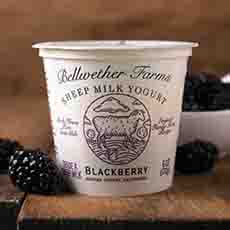
    [1] Blackberry Bellwether Farms Sheep Milk Yogurt (all photos © Bellwether FarmsBellwether Farms).


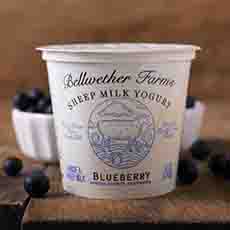
    [2] Blueberry Bellwether Farms Sheep Milk Yogurt.

    ]
    [3] Plain Bellwether Farms Sheep Milk Yogurt.


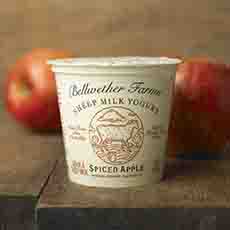
    [4] Spiced Apple Bellwether Farms Sheep Milk Yogurt.


    [5] Strawberry Bellwether Farms Sheep Milk Yogurt.


    [6] Vanilla Bellwether Farms Sheep Milk Yogurt.


    Comments off

    Baked Onions Recipe & The History Of Onions

    Baked Onions For National Onion Day
    [1] Baked onions (photo and recipe @ Jaci Goodman | Peri & Sons Onions).

    A Bag Of Yellow Onions
    [2] Yellow onions (photo © Good Eggs).

    Whole and halved red onions
    [3] Red onions showing the concentric circles of eternity, per ancient Egyptians (photo © Burpee).


    We’d never thought about baking a dish of onions-only, until we came across this easy-to-make onion recipe from Peri & SonsPeri & Sons, growers of onions.

    Using white and red onions, the recipe is vegan, gluten- and dairy-free and makes a wonderful accompaniment to a piece of grilled steak, chicken, or fish.

    The recipe was created by This recipe makes 6-8 servings. Recipe courtesy of Jaci Goodman.

    The recipe follows, but first, for your perusal:

    > The history of onions.

    > The different types of onions: a photo glossary.

    > The year’s 6 onion holidays.

    > More uses for onions.
     
     
    RECIPE: BAKED ONIONS

    Prep time is 5 minutes, bake time is 30 minutes.

    Ingredients For 6-8 Servings

  • 2 red onions, quartered and peeled
  • 1 yellow onion, quartered and peeled
  • 1/4 cup olive oil
  • 2 tablespoon lemon juice
  • 2 to 3 cloves garlic, chopped
  • 1 tablespoon fresh thyme off the stem
  • 1 tablespoon Dijon mustard
  • 1 teaspoon salt
  • 1/2 teaspoon pepper
  • Garnish: 1/2 tablespoon parsley, chopped
  •  
    Preparation

    1. PREHEAT the oven to 350°F.

    2. MIX together the oil, lemon juice, garlic, thyme, mustard, salt, and pepper. Pour over the quartered onions and toss. Place in a baking dish.

    3. BAKE for 30 minutes and remove from the oven.

    4. GARNISH with chopped parsley and bring the dish to the table; or apportion among plates and garnish.


    THE HISTORY OF ONIONS

    Scholarly thought is divided on the history of wild onions.

  • Archaeologists, botanists, and food historians believe onions originated in central Asia.
  • Other research suggests onions were first grown in Iran and West Pakistan.
  •  
     
    A Prehistoric Staple

    Whichever the source, ancient hunter-gatherers, who foraged for anything edible, discovered and started eating wild onions long before farming began (around 10,000 B.C.E. in the Fertile Crescent, in the West).

    Very likely, wild onions were a staple food in the prehistoric diet.

    Most researchers agree the onion has been cultivated for 5000 years or more. Since onions grew wild in different areas, they were probably domesticated roughly simultaneously* all over the world.

    Onions may be one of the earliest cultivated crops, because they were easy to grow in a variety of soils and climates, were less perishable than other produce types, and were easily transportable. They could be dried and preserved for times when food might be scarce.

    The high water content of onions prevented thirst as well. Many documents from the invention of writing (around 3200 B.C.E. by Sumerian scribes in the ancient city-state of Uruk, in present-day Iraq) describe its importance in medicine.

    Today, onions are used in every cuisine of the world. They can be baked, barbecued, broiled, candied, caramelized, fried, grilled, pickled, roasted, sautéed, spiced, eaten raw and mixed into dressings and other foods.
    More history:

  • Ancient Egypt: Onions were an object of worship, symbolizing eternity because of the circle-within-a-circle structure. They were buried with the mummified pharaohs, often in their body cavities. King Ramses IV, who died in 1149 B.C.E., was entombed with onions in his eye sockets. Paintings of onions appear on the inner walls of the pyramids, and are depicted on the banquet tables of great feasts and on the altars of the gods.
  • The Old Testament: In Numbers 11:5, the children of Israel lament the meager desert diet engendered by the Exodus. “We remember the fish, which we did eat in Egypt freely, the cucumbers and the melons and the leeks and the onions and the garlic.”
  • India: As early as the 6th century, the famous medical treatise Charaka-Sanhita, written in the 1st century C.E., celebrated the onion as a diuretic for digestion, the heart, the eyes, and the goings.
  • Greece: In the 1st century C.E., the physician Pedanius Dioscorides described several medicinal uses of onions. Greek athletes used them for fortification during the Olympic Games. Before a competition, they consumed pounds of onions, drank onion juice, and rubbed onions on their bodies.
  • Rome: Pliny the Elder wrote of Pompeii’s onions and cabbages (excavators have even found gardens where onions were grown). He cataloged Roman briefs about the medical efficacy of the onion: to cure vision, induce sleep and heal maladies such as mouth sores, toothaches, dog bites, dysentery, and lumbago. The Roman gourmet Apicius, credited with writing the first cookbook, in the 1st century C.E. Likely, Apicius was a pseudonym and the cookbook was a group effort. It included many recipes with onions.
  • Middle Ages: Much of the cuisine of Europe featured beans, cabbages and onions. In medicine, onions were prescribed for headaches, snakebites, and hair loss. They were also used as currency: for rent payments and wedding gifts.
  • Native Americans: Strains of wild onion grew throughout North America, and were used raw, cooked, and as seasoning and syrups. Onions were also used in poultices, as an ingredient in dyes, even as toys.
  • The Pilgrims: The Pilgrims brought onions to America on the Mayflower, and grew them as a crop so prolific that they could be sold abroad. A record from 1667 shows onions on a cargo list of a ship on Long Island Sound, and on vessels headed to Barbados and Surinam in 1718.
  • Sweet Onions: Vidalia onions, a sweet, no-tears onion, were an accidental discovery in the 1930s, when a crop of onions was planted in Vidalia, in the state of Georgia, USA. When harvested, the farmers were amazed at their sweetness and lack of acrid flavor, and eye irritation. The distinctive profile results from a combination of weather, water, and soil. This unique terroir† is found within 20 counties in southern Georgia. The soil has much less sulfur than other soils, eliminating the eye burn and the bite of raw onions, and allowing the natural sweetness of the onions to shine through. Since then, more locations have produced sweet onions.
  •  
    Thanks to the National Onion Association for these notes.
     
     
    New Developments On The Horizon

    Breeders are working on develop the “tearless opnion, varieties with increased shelf, and varieties enhanced disease resistance, particularly against pink root disease, basal rot, and downy mildew.

    ___________

    *The onset of the Holocene, the current geological epoch, began around 10,000 B.C.E., after the last glacial period, which concluded with the Holocene glacial retreat. The hypothesis for why agriculture began independently the world over at this time: The warmer, wetter, higher CO2 conditions of the Holocene generally encouraged plant growth (source.

    Pronounced tuhr-WAH, terroir is the French expression “sense of place,” the unique environment in which something grows—its specific soil composition and microclimate. Microclimate includes temperature, amount of sunshine, and rain. The flavor nuances of agricultural products, from grapes to olives to milk to cacao, are a function of its terroir.

    Onions On Cutting Board
    [4] Tip: Wear swimming goggles to protect your eyes while you slice onions (photo via Stock King | Freepik).


    CHECK OUT WHAT’S HAPPENING ON OUR HOME PAGE, THENIBBLE.COM.


    Comments off

    RECIPES: Watermelon Rind Slaw and Coleslaw

    Don’t throw away your watermelon rinds.

    Watermelon rind is not only edible; it can be turned into crunchy slaws and watermelon pickleswatermelon pickles (pickled watermelon rind).

    Here are two crunchy, fun recipes from the Watermelon Promotion BoardWatermelon Promotion Board, which has the best collection of watermelon recipes.

    The slaw has a yogurt dressing while the coleslaw has an oil and rice vinegar vinaigrette with watermelon chunks.
     
     
    RECIPE #1: WATERMELON RIND SLAW

    Ingredients For 4 One-Cup Servings

    Ingredients For The Dressing

  • 1/4 cup fat-free, plain Greek yogurt
  • 1/4 cup low-fat sour cream
  • 1 1/2 tablespoons stone-ground mustard
  • 1 tablespoon apple cider vinegar
  • 4 teaspoons fresh lemon juice
  • 1 tablespoon sugar
  • 1 teaspoon poppy seeds
  • 2 teaspoons olive oil
  • Dash salt and pepper (to taste)
  •  
    Ingredients For The Slaw

  • 4 cups grated watermelon rind with fruit and green peel removed
  • 1 cup grated carrot
  • 1-1/2 cups diced fresh pineapple
  •  
    Preparation

    1. BLEND the dressing thoroughly in a small bowl. Set aside.

    2. PLACE the watermelon rind on several layers of paper towels to soak up the excess juice.

    3. PLACE the dressing, rind, carrot, and pineapple in a medium-sized bowl, and toss to thoroughly coat.

    4. CHILL for at least 1 hour to allow the flavors to meld.
     
     
    RECIPE #2: WATERMELON RIND COLESLAW

    Watermelon rind replaces cabbage in this tasty slaw. We even added some watermelon chunks to our Watermelon Rind Coleslaw, for a pop of color and juicy sweetness! Created by Mr. Food Test Kitchen.

    Ingredients For 10 Servings

  • ½ whole medium-sized watermelon
  • 3 tablespoons vegetable oil
  • ½ cup rice vinegar
  • 1 tablespoon sugar
  • 1 teaspoon salt
  •  
    Preparation

    1. CUT the watermelon from rind from the flesh and remove the green peel. Discard the peel.

    2. CUT the red flesh into 1/2-inch chunks. Place 1-1/2 cups in a bowl and set aside the remaining flesh.

    3. SHRED the white rind a food processor with a shredding attachment, or a box grater. Place it in a large bowl (you should have about 6 cups).

    4. WHISK together in a small bowl the oil, vinegar, sugar and salt. Pour the oil mixture over the rind and toss until evenly coated. Stir in watermelon chunks from the bowl.

    5. CHILL at least 1 hour before serving.


    [1] If you can’t use a large watermelon, round mini versions are available (photo © Good Eggs).


    [2] Watermelon slaw (photo and recipe © National Watermelon Promotion Board).


    [3] Watermelon coleslaw with watermelon chunks (photo and recipe © National Watermelon Promotion Board).


    [4] If you want to collect rinds from slices your family has eaten, you can wash them under running cold water (photo © National Watermelon Promotion Board)


    > WATERMELON HISTORY


    Comments off


    © Copyright 2005-2026 Lifestyle Direct, Inc. All rights reserved. All images are copyrighted to their respective owners.