|
October 27th is National Parmigiano-Reggiano Day, celebrating one of the world’s great cheeses—often referred to as the “King Of Cheeses.”
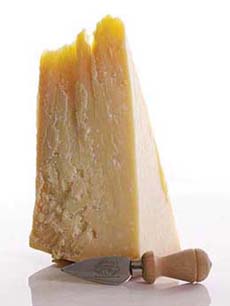
The point we’d like to make today is that “parmesan cheese” is not Parmigiano-Reggiano: a cheese whose reputation is known worldwide, and whose quality is guaranteed with seels of authenticity.
Anyone can make a cheese called “Parmesan,” which is why large-scale food companies do.
True Parmigiano-Reggiano is a D.O.P. cheese are restricted by a governing body to production in specific locales, with traditional ingredients and techniques.
D.O.P., Denominazione d’Origine Protetta, is the European certification of authenticity of origin.
An Italian D.O.P. cheese must be produced in its historic region of Italy, using the same centuries-old artisan techniques as its predecessors.
It guarantees that the milk of the cheese and its production methods take place in prescribed regions, with specified techniques. It guarantees the consumer that a cheese labeled Parmigiano-Reggiano will deliver the expected gustatory experience.
We continue in a moment, but first, for your perusal.
> The different Italian grating cheeses.
> The history of Parmigiano-Reggiano cheese is below.
> The history of cheese.
> The different types of cheese: a photo glossary.
> The year’s 30 cheese holidays.
> The year’s 40+ Parm-related holidays are below.
STRICT OVERSIGHT IN PRODUCTION
Production of Parmigiano-Reggiano can only be carried out in five select provinces: Bologna, Mantova, Modena, Parma and Reggio-Emilia. Some 350 small dairy farms produce more than 3.6 million wheels per year.
Only Parmigiano-Reggiano PDO cheese can be sold under the “Parmesan” denomination in Europe. Unfortunately, the laws that classify and protect Parmigiano-Reggiano within the European Union are not globally observed, as both Parmigiano-Reggiano and “parmesan” can coexist on the same shelf in some countries outside the EU. These products are often mistaken for authentic PDO products by consumers.
A cheese labeled as parmesan in the U.S. can still can be a tasty cheese—especially those made by artisanal cheese makers. Factory cheeses (made in bulk), however, have far less complexity and aroma. Just taste them side-by-side to see for yourself.
In the case of Parmigiano-Reggiano, the cheese must be made by a cheesemaker who is a member of the Consorzio Formaggio Parmigiano-Reggiano, a self-governing body of dairies.
The cheese is produced in accordance with strict regulations, and a fine-quality Parmigiano-Reggiano is one of the glories of the cheese world.
The aging wheels are tested. Those which fail the test are declassified into a generic cheese.
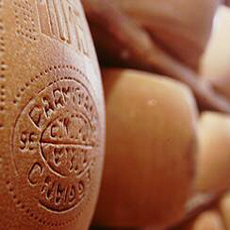
Those that pass are branded with the seal of the Consorzio, guaranteeing authenticity (photo #4). The words Parmigiano-Reggiano imprinted on the rind of the wheel is a modern touch, made with a plastic belt (see the result in photo #4). By the way, the rind is edible. In Italy, it’s cooked in a soup or broth to add great Parmigiano flavor.
Along with the factory’s number, and the month and year the cheese was made, the belt is wrapped around the cheese for about two days in order to imprint the signature name on the rind.
The wheels are aged for a minimum of 12 months and up to 36 months or more. The final wheel weighs about 100 pounds!
A 12-month old Parmigiano will be lighter in flavor and smoother in texture, while a 36-month old cheese will have more complex flavors, a stronger salty kick, and a more granular texture.
The result of all this attention and care is that Parmigiano-Reggiano delivers a well-known sharp and complex flavor, balanced by fruity and nutty notes, and a signature aroma that provides a whiff of joy.
Here’s more about the production process of Parmigiano-Reggiano cheese.
What Are The Crunchy Bits?
If you’ve eaten (or just seen) aged Parmigiano-Reggiano, you know that its texture is slightly gritty. This is due to to the tyrosines, amino acid clusters that form with age (photo #3).
Tyrosine clusters are signs of a well-aged cheese, and are also found in aged Goudas (among other cheeses). The longer the aging, the more pronounced the tyrosines.
They are crunchy, tasty and (if we may say so) fun!
THE HISTORY OF PARMIGIANO-REGGIANO
In the 13th century, in the northern Italy provinces of Parma, Reggio Emilia, Modena, and Bologna, a long-aged cheese began to be produced in some of the bigger Benedictine monasteries.
The story is that Parmigiano-Reggiano was first created im the 13th century in Bibbiano, a small town located in the central province of Reggio-Emilia.
Local Benedictine monks who managed dairies had been searching for a long-aging cheese for their milk.
They developed a recipe for what we now know as Parmigiano-Reggiano. The hard, granular, flavorful and aromatic cheese quickly became popular, and production expanded into the nearby Parma and Modena provinces. The name of the cheese became a combination of the names of two of the producing provinces, Parma and Reggio-Emilia.
The first-known recorded mention of Parmigiano-Reggiano was in 1254 C.E., when a noblewoman from Genova actually traded her house in order to have a yearly supply of 53 pounds of Parmigiano Reggiano cheese (we’re assuming she had a second house to live in) [source].
The popularity of the cheese spread throughout Italy, and soon, the rest of Europe.
During the 14th century, history has given us another mention of Parmigiano-Reggiano cheese, in The Decameron by Giovanni Boccaccio.
When describing an imaginary town called Bengodi, he wrote that there was “a mountain of grated Parmigiano cheese” where “dwell folk that do nothing else but make macaroni and ravioli, and boil them in capon’s broth, and then throw them down the mountain.”
Back to the monasteries: They had large tracts of land for dairy cow grazing. Cow’s milk (and sheep, goats, and other grazing milk animals) is heavily influenced by the diet of the animal. The monks planted clover and lucerne (alfalfa) in their meadows, which gave a particular flavor to the milk that came through in the Parmigiano-Reggiano cheese.
Neither the cheese nor its production methods have changed substantially since the 1200s. The Consorzio Formaggio Parmigiano-Reggiano sees to that.
And we are grateful for their efforts!
It still begins with the cows’ feed, by the way (article continues below photo).
|