|
Updated August 2026
Do you use dried mushrooms in your cooking? If not, you’re missing out.
They give you opportunities to throw mushrooms into your omelet, make mushroom soup, elevate grain bowls, and so much more. Take a look.
Below:
> The benefits of dried mushrooms.
> How to rehydrate and use mushrooms.
> Our favorite ways to use dried mushrooms.
> Melissa’s dried mushrooms.
> The history of mushrooms.
> Mushrooms are not vegetables (at least, not to botanists.
> Mushroom trivia.
Elsewhere on The Nibble:
> The different types of mushrooms: a photo glossary.
> 25+ yummy mushroom recipes.
> The year’s 8 mushroom holidays.
1. THE BENEFITS OF DRIED MUSHROOMS
Dried mushrooms offer several advantages:
Much longer shelf life: When properly stored in an airtight container, dried mushrooms can last for months or longer, while fresh mushrooms spoil relatively quickly.
More concentrated flavor: Drying intensifies their savory, earthy, and umami qualities. This is particularly valuable with porcini, shiitake, morels, and other strongly flavored varieties.
Flavorful soaking liquid: A bonus is that rehydrating them produces a rich liquid that can be strained and added to soups, sauces, gravies, risottos, and stews.
Year-round availability: Dried mushrooms make seasonal or difficult-to-find varieties available throughout the year.
Easy storage: They require no refrigeration and take up little space.
Great for long-cooked dishes: Their concentrated flavor works especially well in broths, braises, stuffing, casseroles, and sauces.
Potentially savings: Dried mushrooms may be less expensive than buying an equivalent amount of fresh specialty mushrooms, especially when the fresh variety is seasonal.
2. HOW TO USE DRIED MUSHROOMS
To reconstitute them, simply blanch them in boiling water for 2 to 5 minutes, or soak them for 30 minutes in lukewarm water.
For even more flavor, soak the mushrooms in wine or consommé.
The liquid, drained of the re-hydrated mushrooms, is known as mushroom liquor.
Reserve the liquor to add even more flavor to your dishes.
Add to a soup or braising liquid, replacing an equal amount of water.
Add to a vegetable stir-fry, to prevent the vegetables from drying out.
Use as a vegetarian/vegan substitute for chicken broth.
Use it instead of water to cook grains.
Anyone Who Turns On A Stove Can Use Dried Mushrooms
Dehydrated mushrooms are not just for the pantry of a good cook. They’re a hit with:
Dieters (mushrooms have 15 calories/cup).
Vegans/vegetarians.
Anyone seeking a more sustainable, plant-based diet.
Anyone who wants to eat healthier
Mushrooms contain protein, vitamins, minerals and antioxidants. Check out the various health benefits.
Speaking of health: only eat mushrooms foraged by experts. Many poisonous mushrooms look benign.
3. OUR FAVORITE WAYS TO USE WILD MUSHROOMS
The flavor of dried mushrooms is slightly more concentrated than that of fresh mushrooms.
As a result, they add more flavor than fresh mushrooms.
Breakfast: Sautéed mushrooms in frittatas, omelets and scrambled eggs; on toast with shaved parmesan and herbs.
Lunch: Sautéed atop burgers, grilled cheese, panini; gourmet mushroom pizza; quiche.
Dinner: Add to braises (photo #7), ragouts, sauces and stews, along with the mushroom liquor; plus risotto and other grain dishes.
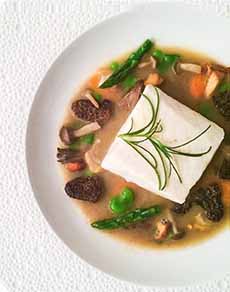
Side: Sautéed atop or to the side of grilled or roasted chicken, fish (photo #6), pork, steak; gratins.
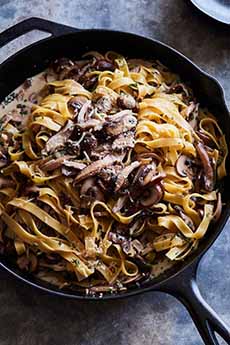
Pasta: Sautéed as a topping or mix-in for any pasta (photo #3), including mac and cheese.
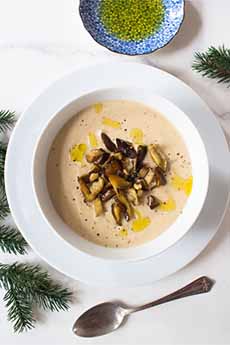
Soup/Stew: Add to the soup base, or use as a garnish (photo #4).
4. MELISSA’S DRIED MUSHROOMS
People who love to cook will appreciate gourmet dried mushrooms from Melissa’s, an online purveyor of fine fruits and vegetables. We give them as general gifts and stocking stuffers.
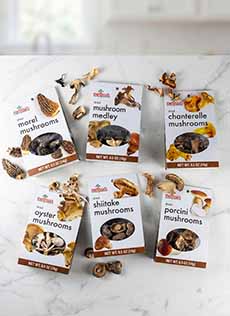
Their Mushroom Medley Sampler contains individual packages of five gourmet mushrooms, which are also sold individually:
Chanterelles
Morels
Oyster Mushrooms*
Porcini
Shiitake
With these varieties on hand, there are many opportunities to add great flavor your cooking at breakfast, lunch. and dinner.
5. A BRIEF HISTORY OF MUSHROOMS
Mycophagy, the act of consuming mushrooms†, dates back to ancient times. People foraged for them in fields and forests.
Edible mushroom species have been found in 13,000-year-old archaeological sites in Chile.
Ötzi the Iceman, the mummy of a man who lived between 3400 and 3100 B.C.E. in Europe, was found in the Alps carrying two types of mushrooms [source].
But as civilization and cuisine in the Western Europe of the Middle Ages, mushrooms fell off the radar as a culinary focus.
Mushrooms Become Fashionable
They were still gathered by country folk to supplement their diets, but mushrooms were not on the tables of the well-to-do.
Until the middle of the 17th century.
Then, a melon grower outside of Paris accidentally “discovered” the potential of growing and selling mushrooms.
He (or his wife) poured out some water that had been used to wash wild mushrooms they had gathered.
In a short while later, a crop of mushrooms sprouted in that spot of soil.
It was the start of the era of the cultivated mushroom. The farmer evolved from melon grower to mushroom grower—a much more profitable undertaking since mushrooms became the hot new ingredient among the chefs of Paris. Other farmers joined the fold.
The “champignon de Paris” became a must-have for cooks and their employers, and for home cooks.
A couple of centuries later, Americans embraced the mushroom.
One of the first English language mushroom cookbooks, published in 1899, is Kate Sargeant’s One Hundred Mushroom Receipts [source].
Mushrooms have remained an important part of Western cuisine. They have found their way into cuisines around the world.
Mushrooms Today
Today, more than 20 species are commercially cultivated, in at least 60 countries.
The biggest producers are China, the U.S., Poland, The Netherlands, and India being were the top five producers in 2013 [source].
Today, the most commonly consumed variety of mushroom is the button mushroom, Agaricus bisporus (photo #11). It comprises about 40% of the mushrooms grown around the world.
It’s easy to grow‡. While it adds flavor to recipes and can be eaten raw in salads or on crudité plates, it is also the blandest mushroom.
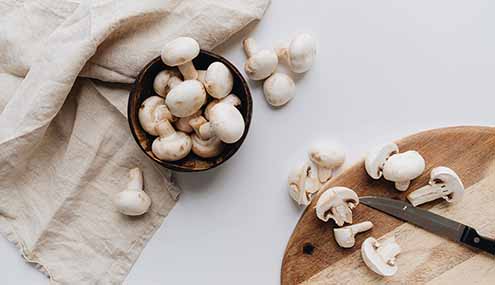
[11] The most commonly consumed mushroom: Agaricus bisporus, the white button mushroom (photo © Alleksana | Pexels).
6. MUSHROOMS ARE NOT VEGETABLES!
Some mushroom biology: Because they have no leaves, roots or seeds and don’t need light to grow, mushrooms are not a true vegetable.
Botanists have given mushrooms their own kingdom in the taxonomy of organisms that is separate from plants and animals: Fungi.
Vegetables, fruits and other plants are members of the Plantae kingdom. Here’s more about it.
But you don’t have to remember the details: Just enjoy mushrooms often.
A big meaty portobello cap is a great substitute for meat—grilled, roastéd, sauteed, or stuffed.
In fact, because of the way they are grown indoors, mushrooms are one of the most sustainable foods on the planet [source].
|
|

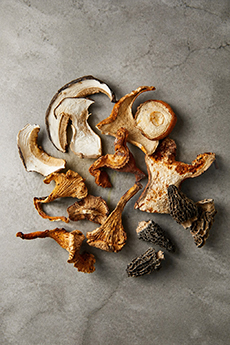
[1] Mixed wild mushrooms are available from numerous purveyors. These are from from Northwest Wild Foods.
[2] Gourmet mushrooms turn a plate of fettuccine into something special (photo © DeLallo).
[3] You can make an intensely-flavored mushroom soup, or use the mushrooms to garnish another puréed vegetable soup (above, cauliflower soup) or a consommé (photo © Quinciple).
[4] A first course: wild mushroom tarts (photo © Mackenzie Ltd).
[5] Poached halibut with clams and morels (photo © Le Bernardin | NYC).
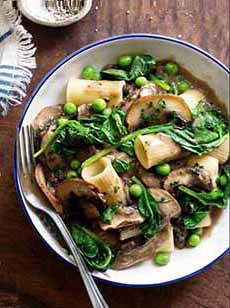
[6] A vegetable braise with pacchieri, large pasta tubes (photo © Sun Basket).
[7] Individual packages of different varieties are also sold. These from Melissa’s, nicely packaged, make nice gifts or stocking stuffers for cooks (photo © The Nibble).
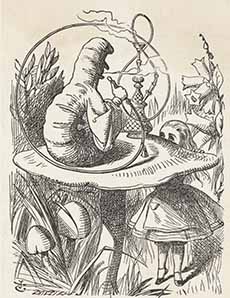
[8] The original John Tenniel drawing of Alice and the Caterpillar atop a mushroom, circa 1965 (illustrations #8, #9, and #10 public domain).
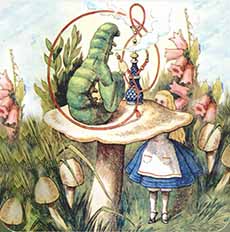
[9] The colored version circa 1898.
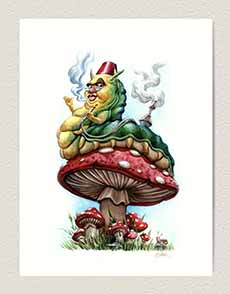
[10] For the 1951 Technicolor animated motion picture version, Disney decided that a bland white mushroom wouldn’t do, and substituted the now-iconic Amanita muscaria, a bright red cap with white warts, with a complementary red fez for the hookah-smoking Caterpiller. While earlier film versions existed, they were often in black and white or used earlier colorization processes, whereas the 1951 Disney movie is known for its vibrant, eye-popping colors. You can buy this print from Red Bubble.
|
7. MUSHROOM TRIVIA
The current mushroom featured in “Alice in Wonderland” is a red-topped Amanita muscaria, a large white mushroom with a red cap and spotted white warts (photo #10). (It’s also called called the fly agaric or fly amanita mushroom—see more in the **footnote). They are not edible.
While Lewis Carroll never explicitly names the species in the text, the illustrations by John Tenniel are most similar to a giant puffball (Calvatia gigantea), a smooth, beige mushroom which can grow enormous (enough to be a lounge chair for the Caterpiller) and have that distinctive dome shape.
They’re also edible, when young and fresh, and are considered quite good! They’re one of the safer wild mushrooms.
________________
*While dried mushrooms are typically re-hydrated, oyster mushrooms can be used in recipes without rehydration.
**The “fly” in fly agaric refers to the mushroom’s historical use as an insecticide in medieval Europe. Commonly, it was crumbled into milk or water to attract and kill flies who drank the liquid.
“Agaric” comes from the ancient Greek agarikon, which originally referred to a type of tree fungus and over time became a general term in mycology for a large group of gilled mushrooms.
Thus, fly agaric literally means “the agaric (mushroom) that kills flies.” In modern taxonomy, Agaricus is actually a different genus (which includes the common button mushroom, Agaricus bisporus), but the term “agaric” is still used broadly.
What about Amanita muscaria, the mushroom’s scientific name? The most accepted theory about the genus, Amanita, is that it comes from Mount Amanus, an ancient name for the modern-day Nur Mountains in southern Turkey, near the Syrian border. “Amanita” was used by ancient Greek and Roman writers, including Galen, to describe certain mushrooms; and when Linnaeus and subsequent mycologists formalized fungal taxonomy, they adopted Amanita as the genus name for this distinctive group of mushrooms. The species name, muscaria comes from the Latin word for fly, musca.
†We’re only addressing culinary mushrooms here, e.g., no medical, mind-altering, or poisonous mushrooms.
‡Some mushrooms are very difficult to cultivate, or totally resist cultivation and only are gathered wild. These include the chanterelle, hedgehog, lobster, morel and porcini mushrooms. Hen-of-the-woods and oyster mushrooms must be gathered wild.
Beyond killing flies, the Amanita genus includes killers beyond the fly agaric: the deadly “death cap,” Amanita phalloides), and the “destroying angel,” Amanita virosa. Amanitas should only be consumed if identified with absolute certainty by expert foragers. Mistakes can be fatal, and even experts make them. The toxins in deadly Amanitas cause liver and kidney failure, and symptoms may not appear for 6-24 hours after consumption—often too late for effective treatment.
But there are some edible mushrooms in the Amanita genus, ranging from highly desirable to meh: Caesar’s mushroom (Amanita caesarea with a distinctive orange cap, a favorite of Roman emperors and still a prized delicacy in Mediterranean and European cuisines; Amanita jacksonii, the American version of Caesar’s mushroom, found in eastern North America; Amanita rubescens, “The Blusher,” referring to the reddish staining that appears when the flesh is bruised, edible when thoroughly cooked but toxic when raw; and so-called grisette species, Amanita vaginata and Amanita fulva, two varieties of a group that may be edible but not particularly desirable. Their flavor is bland and they’re quite fragile so don’t store or transport well. In other words, meh. Among the different meanings of “grisette” in French referred to a cheap gray fabric worn by working-class women. This suggests that grisettes were considered common, everyday mushrooms. Amanita vaginata means “sheathed Amanita,” Amanita fulva means tawny or yellowish-brown Amanita, referring to the color of the cap. Both names derive from classic Latin.
CHECK OUT WHAT’S HAPPENING ON OUR HOME PAGE, THENIBBLE.COM.
|