THE NIBBLE BLOG: Products, Recipes & Trends In Specialty Foods


Also visit our main website, TheNibble.com.

COCKTAIL RECIPE: Dirty Martini With Black Pepper & Black Olives

Today, a sonata on the Dirty Martini, offering a different interpretation for its fans.

Dirty Martinis are typically made with green olive brine and a green olive garnish.

This twist on the Dirty Martini recipe below is black olive brine and black olives.

For a touch of heat, it infuses the vodka with black peppercorns and adds a ground black pepper rim.

The idea and recipe are from Lindsay Olives.

Why infuse the vodka. Can’t you buy it?

You can buy “pepper”-infused vodka like Absolut Peppar, but the commercial products are infused with hot chili peppers, a different flavor,

Here, you get to infuse your own plain vodka with black peppercorns. It’s as easy as tossing cracked peppercorns into a bottle of vodka, and letting it sit for seven days (you can get away with less infusion time).
 
 
CHILES VS. PEPPERCORNS

Food 101: Chile peppers are not related to black peppercorns. Here’s the difference.

Their names have been confused since Columbus landed in the West Indies. One of his crew tasted a hot chile and called it “pepper,” relating the heat to the black pepper known in Europe.

The confusion engendered three terms: chili peppers vs. peppers vs. chiles.

And how about chile vs. chili vs, chilli? Here’s the scoop.
 
 
RECIPE: DIRTY MARTINI WITH BLACK OLIVES & BLACK PEPPER

Ingredients

Infuse the vodka in advance (step 1 below). Just as with plain vodka, the pepper vodka will keep indefinitely.

As with the salt rim on a Margarita, if you want less pepper, only coat half the rim.

For a gathering, you can prepare the Martinis in advance by making them in a pitcher and rimming the glasses. Prepare olive picks, or just add one or two olives before pouring the drink.

For The Pepper Vodka

  • 1 bottle (750ml) vodka
  • 2 tablespoons peppercorns, slightly cracked (see below)
  •  
    Per Drink

  • 2½ ounces black pepper-infused vodka
  • ½ ounce dry vermouth
  • ½ ounce black olive brine
  • ½ tablespoon ground black pepper
  • Lemon wedge
  • Ice cubes
  • Garnish: single black olive or a pick of olives
  •  
    Preparation

    1. MAKE the black pepper-infused vodka: Add the cracked peppercorns to the bottle of vodka. Place in a cool dark place for 7 days, gently shaking every 2 or 3 days. If you don’t have 7 days, you can infuse for as long as you have (at least 1 day); but it will be less peppery.

    2. REMOVE the solids by straining the vodka through a fine mesh strainer into a clean* container. Discard the peppercorns and use a funnel to add the pepper vodka to the original vodka bottle.

    3. PREPARE the ground pepper rim for a coupe or Martini glass. Place the pepper in a small dish or saucer and run the lemon wedge along the rim (or half rim). Dip the rim into the pepper and twist to coat. Set aside.

    4. COMBINE the vodka, olive brine and vermouth in a mixing glass with ice. Stir until chilled and strain into the glass. Garnish as desired and serve.
     
     
    HOW TO CRACK PEPPERCORNS

    The whole peppercorns need to be cracked slightly to release the piperine in the seed (piperine is the organic compound that provides the pungency).

    Yes, peppercorns are a fruit, a drupe. The tiny red fruits grow on a vine; the peppercorn is the seed of the fruit. Here’s a photo: You can buy a plant and grow peppercorns at home.

    Cracked is different from crushed, the latter of which are large pieces than ground pepper. Essentially, the cracked peppercorn remains whole, with an opening from the crack.

    To crack peppercorns:

    1. PLACE the peppercorns in a mound in the center of a cutting board.

    2. PLACE a large pot or a second cutting board on top of the peppercorns, and press firmly for 10 seconds. Then check; if the peppercorns don’t have cracks, try again.

     
    DIRTY MARTINI HISTORY

    A traditional Dirty Martini is made of gin, vermouth, a small amount of olive brine and an olive garnish.

    The olive brine clouds what is a clear drink, and makes the Martini look “dirty.”


    [1] The black olive, black pepper Dirty Martini. The recipe is below (photo and recipe © Lindsay).


    [2] Aren’t these peppercorns beautiful? They’re top-quality Tellicherry black peppercorns, available from Silk Road Spices. Tellicherry peppercorns are left on the vine longer, which produces berries with bolder, more robust flavor. They have a bright, almost citrusy taste that make them really stand out as something special, and are the preferred black peppercorn of many fine chefs.


    [3] Lindsay sells organic and conventional olives, in cans, mixes and in grab-and-go snack packs. Check out all the varieties here (photo © Lindsay Olives).


    [5] A conventional Dirty Martini: green olives and brine. These green olives are stuffed with blue cheese (photo © Ruth’s Chris Steak House).


    [4] Blue-cheese-stuffed olives are a popular garnishe for the classic Dirty Martini. Here’s the easy recipe from Martha Stewart (photo © Martha Stewart Living).

     
    According to David Wondrich, cocktail historian and author, Dirty Martini’s history begins in 1901, when John E. O’Connor served a Martini with muddled olives at the Waldorf Astoria.

    However, using olive brine doesn’t appear in the written record until 1930. The drink, called the Perfect, consisted of half gin, half vodka, dry vermouth, three types of bitters and one teaspoon of olive brine.

    The Perfect dropped out of sight until after World War II, transforming into a Martini recipe requiring two parts gin, one part vermouth and a teaspoon of olive brine [source]. That’s our modern Dirty Martini.

    But where did it go? We hadn’t heard of it until about 20 years ago, when a colleague ordered it at a bar. We, an olive lover, ordered one of our own.

    The garnish, then and still, is blue cheese-stuffed olives. Some like it hot, and opt for jalapeño-stuffed olives.

    Don’t like blue cheese or chiles? Classic pimento-stuffed olives do just fine.

    Here’s the history of the original Martini.

    _______________

    *To avoid any contamination, we rinse the transfer container twice boiling water.


    Comments off

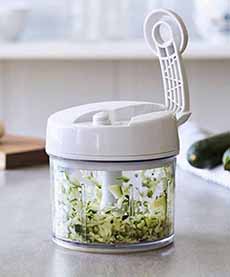
    RECIPE: Spiralizer Zucchini Linguine, Super Low In Calories


    [1] Simple, delicious, low in calories (photo © Pampered Chef).

    Zucchini Noodles
    [2] Don’t want to spiralize? Buy zucchini that’s been spiralized for you (photo © Hazel Claire Ivy | Pinterest).

    Earlier this month we covered all the ways you can use your spiralizer.

    One of the recipes we’ve been spiralizing a lot is this Zucchini Linguine.

  • It’s easy to make: 4 minutes in the microwave.
  • It’s low in calories: Two cups of zucchini (a big portion) are 37 calories. A half cup of marinara sauce is 65 calories. Two tablespoons of grated parmesan are 44 calories.
  • Make or buy the zucchini noodles.
  • You can use any red sauce.
  •  
    Or, use a heart-healthy EVOO-based sauce mixed with:

  • Basil and capers
  • Cacio e pepe (grated cheese and black pepper)
  • Cherry or sundried tomatoes
  • Pimento and olives (roasted red pepper)
  • Sautéed mushrooms
  • Sautéed seafood (salmon, scallops, shrimp)
  •  
     
    RECIPE: ZUCCHINI LINGUINE MARINARA

    Ingredients For 2 Servings

  • 3-4 zucchini
  • 1/2 cup marinara or sauce of choice
  • 1 pressed garlic clove
  • 1-2 tablespoons grated parmesan cheese
  • Optional garnish: fresh basil, red pepper flakes
  •  
    Preparation

    1. PLACE the ingredients into a microwave-safe dish: zucchini, sauce, pressed garlic.

    2. MICROWAVE, covered, on HIGH for 4 minutes.

    3. REMOVE from the microwave, stir and garnish as desired.

    4. OPEN a bag of salad and enjoy your easy, low-calorie dinner.


    Comments off

    PRODUCT: World Centric Paper Straws (The Best Paper Straws!)

    From ancient times, man has used drinking straws. Here’s the history of the drinking straw, dating back to Sumeria.

    The modern drinking straw, made of paper, debuted in 1888, ultimately coated in wax so it would hold up longer before getting mushy. But mushy it did get, losing its shape when saturated with liquid.

    The use of plastic straws became popular following World War II and now, Americans use millions of plastic straws each day.
     
     
    THE CRISIS OF DISPOSABLE PLASTICS

    Plastic drinking straws are among the top 10 contributors to marine debris pollution [source].

    According to statistics, the average person uses 1.6 straws per day. Plastic straws are among the top 10 items collected every year during Ocean Conservancy’s International Coastal Cleanup.

    Plastics are cluttering the world’s oceans, seriously harming wildlife.

    These plastics are not biodegrade, but break down into smaller microplastics that have made their way into our food chain via the seafood we eat.

    Amazingly, these microplastics have been found in the Mariana Trench, the deepest ocean trench in the world (some 7 miles deep).
     
     
    THE MOVEMENT TO END PLASTIC STRAWS

    In 2014, Ocean Conservancy launched its Skip the Straw Campaign.

    Tens of thousands of people pledged to request their beverages without straws.

    The movement has grown slowly, but finally, there’s momentum.

    Coalitions of restaurants, bars, cafes, hotels, event venues and other organizations are committing to eliminate single-use plastic straws. Thousands of restaurants across the country have now either gone strawless or switched to sustainable alternatives*.


    [1] Our favorite paper drinking straw, compostable and biodegradable (photo © World Centric).


    [2] These straws really hold up. We used one straw for three different drinks, letting it dry between uses (photo © Pacific Green Products).

     
    Environmentally-conscious consumers are aware of the problem, and request no straw, drinking straight from the glass.

    Some purchased metal or durable plastic reusable straws to carry with them.

    Truth to tell, though, most people don’t want to carry and clean a reusable straw.
     
     
    GREAT PAPER STRAWS ARE HERE!

    So finally, industry has created the better paper straw—one does not collapse with wetness before the drink is finished, and is fully biodegradable.

    We’ve tried different brands, and the one we like best is from World Centric.

    These straws really hold up. We used one straw for three different drinks, letting it dry between uses.

    They’re available in 8″ and 10″ sizes.

    Get them here.
     
     
    ABOUT WORLD CENTRIC

    World Centric was founded in 2004 to raise awareness of large-scale humanitarian and environmental issues.

    Our pursuit of better living has severely degrading the planet’s ecosystems.

    The organization also focuses on humanitarian issues, noting that 2.5 billion people live on less than $2/day, without access to basic necessities such as adequate food, water, healthcare, education, housing, sanitation etc.

    In order to be a self-sustaining organization, without requesting donations or grants, World Centric began selling Fair Trade products and compostable products in the beginning of 2005. Here’s more about World Centric.
    ________________

    *The European Union has banned straws and other single-use items.


    Comments off

    VALENTINE GIFT: Lover’s Leap Tea


    [1] Lover’s Leap, a blend of superior black teas with rose and chamomile petals, is available in both loose tea and tea bags (both photos © Steven Smith Teamaker).


    [2] Lover’s Leap Tea, nicely boxed.


    Lover’s Leap Tea is a limited edition for Valentine’s Day, created by our favorite tea emporium, Steven Smith Teamaker.

    It’s a mix of medium-bodied black teas, with pink rose petals and chamomile flowers (photo #1).

    A delicate, fragrant marriage of high-grown Ceylon* tea from the Lover’s Leap tea estate, the flavors are complicated and delicious—just like love.

    For dieters, love means only 2 calories per cup of tea.

    The late Steve Smith crafted the blend himself. It is sold, handsomely packaged, in your choice of loose tea or tea bags.

    Get your Lover’s Leap tea here, and see more of Steven Smith’s wonderful teas.
     
     
    WHY IS IT CALLED LOVER’S LEAP?

    The most famous tea garden in the Sri Lankan district of Nuwara Eliya, the Lover’s Leap estate was named after star-crossed lovers who lived there long ago.

    As legend has it, the two young lovers began a forbidden affair. Knowing that they could not be together, they leapt from the waterfall surrounding the estate to express their undying love.

    Look at it this way: Lover’s Leap Tea means undying love.
     
     
    A Year Of Tea Party Ideas

    Brewing The Perfect Cup Of Tea

    Glossary Of Tea Terms

    History Of Tea

    Pairing Tea With Food

    Tea Facts

    ________________

    *The colonial name for Sri Lanka.


    Comments off

    TIP OF THE DAY: Valentine’s Day Cocktails

    If you don’t have romantic plans for Valentine’s Day, how about inviting friends for cocktails?

    You can set up a bar buffet with pitchers of three or four red or rosy cocktails:

  • Bloody Mary
  • Cranberry Mimosa
  • Cosmopolitan
  • Crantini
  •  
    Other options:

  • Mulled wine, perfect for February.
  • Kir, white wine poured atop crème de cassis (blackcurrant liqueur).
  •  
     
    THE BUBBLY OPTION

    Sparkling wine is perhaps the most festive way to celebrate Valentine’s Day. In fact, to keep things simple, you can simply serve sparkling wine.

    You don’t have to spring for champagne. Here are much more affordable sparkling wines.
     
    HAVE A KIR PARTY

    Want a theme? Have a Kir party.

    The drink was named after Félix Kir, a mayor of the city of Dijon in Burgundy (the same city of mustard fame).

    As an apéritif, he added a splash of crème de cassis, a liqueur specialty of Burgundy, to aligote, a local still white wine.

    The “Kir,” as it was known, became very popular and led to a the Kir Royale, substituting Champagne for the still wine*.

    Your menu can include:

  • Kir for those who don’t like bubbly.
  • Kir Royale, sparkling wine with crème de cassis.
  • Poinsettia, sparkling wine with cranberry liqueur.
  • Other liqueur: Chambord, framboise, or any other pink, red or purple liqueur you may have.
  • Straight sparkling or still wine for those who don’t want any sweetness.
  •  
    For an easy party, set out still white wine, sparkling wine, and two or more liqueurs.

    Add your favorite nibbles, including some Valentine chocolate.

    It’s a DIY Kir Valentine Party!
     
     
    RECIPE: KIR OR KIR ROYALE

    Ingredients

  • Sparkling or still white wine
  • Crème de cassis
  • Optional garnish: blackberries or raspberries or on a pick.
  •  
    Preparation

    1. ADD 1 tablespoon or more of liqueur to each wine glass or champagne flute. The less liqueur, the drier the drink; the more liqueur, the sweeter and fruitier the drink.

    2. FILL up each glass with wine or champagne. You can stir the wine to blend the two ingredients, but give champagne only one delicate swirl with a swizzle stick. Otherwise, you break some of the bubbles.
     
     
    ________________

    *There are many variations of Kir and Kir Royale using different liqueurs. Take a look.


    [1] Kir: dry white wine with crème de cassis, blackcurrant liqueur (photo © Stuart Webster | Wikipedia).

    Cranberry Kir Royale
    [2] For a Kir Royale, switch still wine for bubbly (photo © Ocean Spray).


    [3] Creme de cassis, a liqueur made of blackcurrants (photo © DeKuyper).


    [4] Blackcurrants (photo © Currant C).


    Comments off

    The Nibble Webzine Of Food Adventures
    RSS
    Follow by Email


    © Copyright 2005-2026 Lifestyle Direct, Inc. All rights reserved. All images are copyrighted to their respective owners.