|

[1] Beautiful tomatoes that everyone would buy. Compare to the misshapen tomato below, that no one in a first-world country wants to buy (photo courtesy FAO).
[2] Misshapen produce, although tasting just like normally attractive produce, is thrown away (photo © U.C. Davis).
[3] Fruits with surface blemishes are not acceptable in first world countries, and are tossed away—even though removing the inedible peel makes the fruit perfectly fine to eat (photo by Pijarn Jangsawang | CCO Public Domain).
[4] Would you buy these pears? Wind or rain caused the blotches, but they taste perfectly good—even the skin (photo © Not Eating Out In New York).
[5] Before you throw it out, here’s how to soften stale bread, and recipes for it (photo © )(
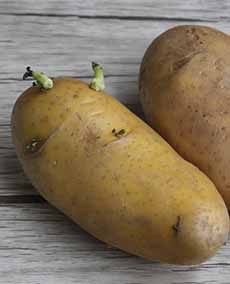
[6] Can you eat sprouted potatoes? Yes, just cut them out. Here’s more about it (photo © Mashed).
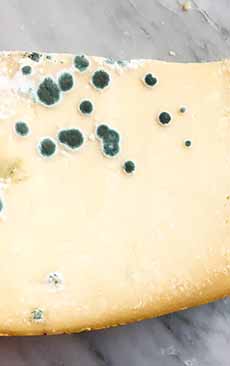
[7] Can you eat cheese with mold? Yes; just cut it off. Here’s more about it (photo © Culture Cheese Magazine).
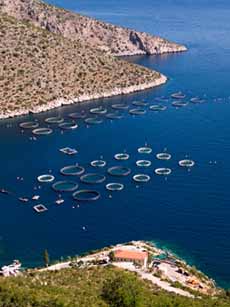
[8] Sustainable fish farming (photo © Ollirg | iStock Photo).
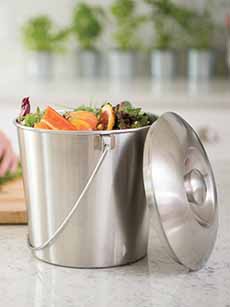
[9] From backyard bins to pails for the smallest kitchens, there’s a compost pail for everyone (this one, from Gardeners.com).
|
|
World Food Day, October 16th, is an international holiday that commemorates the date of the founding of the United Nations Food and Agriculture Organization, in 1945. “The food you choose and the way you consume it affects our health and that of our planet.” says the organization. “Each time you eat, you participate in the system. So you need to be part of the change” to improve it.
Here’s what you need to know about World Food Day. Thanks to the Food And Agriculture Of The United Nations for this information.
To see what you, personally, can do about it, see the section below.
WHAT IS AN AGRI-FOOD SYSTEM?
An agri-food system may seem like an academic term, but your life depends on it. Agri-food systems employ 1 billion people worldwide, more than any other economic sector.
The way we produce, prepare, consume, store and waste food exacts a heavy toll on our planet.
It puts unnecessary pressure on natural resources and the environment.
Food production too often degrades or destroys natural habitats and contributes to species extinction.
Inefficiency costs trillions of dollars.
It also exposes profound inequalities in our global society.
Three billion people cannot afford healthy diets, while obesity continue to increase worldwide.
The COVID-19 pandemic has underscored that urgent change is needed. The pandemic has made it even harder for farmers, already grappling with climate variability, to grow and sell their harvests.
At the same time, in the U.S. alone, rising poverty is pushing an increased number of city residents to use food banks. Millions of people require emergency food aid.
Worldwide, we need sustainable agri-food systems that are capable of nourishing 10 billion people by 2050.
WHAT IS A SUSTAINABLE AGRI-FOOD SYSTEM?
A sustainable agri-food system is one in which a variety of sufficient, nutritious foods is available at an affordable price to everyone. Nobody goes hungry or suffers from malnutrition.
Food security and nutrition are available for all, without compromising the economic, social, and environmental bases, for generations to come.
The shelves are stocked at the local market, and less food is wasted.
The food supply chain is more resilient to shocks, such as extreme weather, shortages and price spikes, and pandemics.
Environmental degradation and climate change are limited, rather than worsening.
Improvements lead to better production, better nutrition, a better environment, and a better life for all.
WHAT CAN BE DONE ABOUT IT?
This massive challenge requires that governments need to both repurpose old policies and adopt new ones to foster sustainable production of affordable nutritious foods.
Policies need to promote equality and learning, drive innovation, boost rural incomes, offer safety nets to small farms, and build climate resilience.
They also need to consider the multiple linkages between areas affecting food systems, including education, health, energy, social protection, finance and others, and make solutions fit together.
They need to be backed by a major increase in responsible investment and strong support to reduce negative environmental and social impacts across sectors, particularly the private sector, civil society, researchers and academia.
The U.N. Secretary-General convened the very first Food Systems Summit in September 2021 to forge consensus on bold new actions to transform the way the world produces and consumes food.
The aim is to get back on track to achieving the Sustainable Development Goals.
WHAT WE THROW AWAY
Across the world, we waste 1,555 million tons of food each year [source].
Here are the food categories that are wasted the most, shown in tons and as a percentage share of the total amount of food wasted.
Fruits and vegetables: 644 million tons thrown away (42%)
Cereals*: 347 million tons thrown away (22%)
Roots and tubers†: 275 million tons thrown away (18%)
Dairy: 143 million tons thrown away (9%)
Meat: 74 million tons thrown away (5%)
Oil seeds and pulses: 50 million tons thrown away (3%)
Fish and seafood: 22 million tons thrown away (1%)
WHAT WE DO WRONG
Each year, 108 billion pounds of food is wasted in the U.S.—shockingly, nearly 40% of all food in America is wasted.
It’s even more shocking because, before COVID-19, it was estimated 35 million people across America, including 10 million children, suffered from food insecurity (not enough to eat).
That equates to more than $161 billion worth of food thrown away each year.
Some of it is wasted because people buy more than they need, and it rots before it can be eaten.
Some of it is deemed unsaleable because its appearance is not as attractive as the norm (see photos #2, #3 and #4).
Americans waste more food per capita than any other country. Here’s more depressing data:
Growing wasted food takes 21% of fresh water supply.
It occupies 18% of all cropland and uses 19% of all fertilizer.
Wasted food occupies 21% of all landfill volume.
A large percentage of greenhouse gases are emitted in producing, processing, and transporting food, along with the methane emissions from food disposed of in landfills.
The average American family of four throws out $1,500 in food per year [source]. Even the least wasteful household wastes 8.7% of the food it acquires [source].
Why do we waste so much food?
WHAT YOU CAN DO TODAY
Understand Food Labeling
More than 80% of Americans discard perfectly good, consumable food simply because they misunderstand expiration labels.
Labels like “sell by,” “use by,” “expires on,” “best before” or “best by” are confusing to people. So rather than risk the potential of a food-related illness, they’ll toss it in the garbage. These are recommended dates, not imperative dates.
(We were amused not too long ago to see that a gallon of water we discovered at the back of a closet had expired. Governments demand particular expiration dates. If someone found it in 100 years, the water would be fine.)
Some friends were surprised that we kept food that was past its expiration date. Flour, sugar and other dry foods can last “forever.” Even canned goods have a much longer shelf life. Here’s a tip learned from our mother:
The sniff test: Open the package or can and smell it. If there’s no off odor, it’s good to eat.
The pinkie test: As a second test, dip a fingertip into the can. Taste it briefly. If it tastes fine, it’s good to go.
Know What To Do With Food That’s No Longer Fresh
Learn what to do with food that will soon spoil and must be eaten in the next day or so. It’s easy to look up options online. Here are some starters:
Apples: Store them in a cold, dark and well-ventilated place. The produce bin of your refrigerator is a good start. If they start to get soft, make applesauce or baked apples, or an apple pie.
Bread: It freezes really well, so if you have too much left over, freeze it. Even stale bread can be turned into croutons, breadcrumbs, French toast or bread pudding. Here’s how to soften stale bread, and recipes that use stale bread.
Cheese: If it develops mold, just scrape it off and use the rest in baked pasta dishes, cheese sauce, grilled cheese, mac and cheese, nachos, etc.
Milk: Before your milk turns, make smoothies, hot chocolate, pudding, or a cream sauce for grains, proteins, and vegetables.
Potatoes: Store potatoes in a dark place so they last longer. If they are getting soft, cook them, mash them and freeze them. If they’ve grown eyes, it’s no biggie: Just remove them before cooking.
Compost
Even if you don’t have a yard, there are kitchen-size composting units. In our apartment building, the tenants requested—and got—composting bins for building-wide use.
Upcycle
And learn to upcycle your kitchen trimmings.
________________
*Including bread.
†Including potatoes.
‡Edible seed oils include canola seed, cottonseed, grapeseed, mustard seed, niger seed, peanut (groundnut), rapeseed, sunflower seed, sesame seed, safflower seed, soybean seed and sunflower seed. Pulses include chickpeas, cow peas, dry beans, dry broad beans, dry peas, lentils and pigeon peas, among others.
|