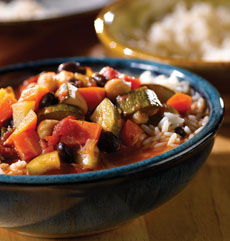
Add enough protein to a lentil or bean soup and you’ve got a main course. Ham and sausage pair deliciously with beans and legumes. Photo courtesy McCormick. |
|
As we published the post below, for acorn squash soup with gnocchi, we thought about soup as a main course.
To turn a first course into a main course, simply add more of the protein: beef, chicken, ham, sausage, tofu, etc.
It’s also an opportunity to double up on the veggies and to add whole grains like barley, brown rice or quinoa.
Serve it with a large and interesting side salad, and you’ve got a delicious lunch or dinner.
Here are 25 ideas to start; or create your own combinations:
Albondigas (meatball soup)
Bean & barley soup with choice Of protein
Black bean soup with ham or sausage
Bouillabaisse/cioppino
Borscht with meatballs
Chicken or sausage gumbo
Chicken rice soup (go whole grain: use brown rice)
Chicken matzoh ball soup with lots of chicken (switch out matzoh balls with rice or noodles)
Chili with meatballs
Fish soup (fish or vegetable stock with rice, poached white fish, vegetables)
|
|
Gazpacho with poached shrimp, scallops, lobster, crab, etc.
Greek meatball soup
Hot & hour soup with shiitakes and protein of choice
Kale or spinach and white bean soup with pork and pork sausage
Lentil soup with ham
Minestrone or pasta e fagioli with sausage
Paella soup
Pepperpot soup with beef chunks
Ravioli in brodo
Root vegetable soup with choice of protein
Salmon chowder with salmon chunks
Scallops & fennel in saffron-tarragon broth
Seafood bisque with shrimp
Southwestern bean soup with chicken
Split pea soup with ham
|
THE DIFFERENCE BETWEEN SOUP, STEW & RAGOUT
There’s a thin line between soup and stew. Both can be combinations of vegetables, proteins and starches (beans, dumplings, grains, legumes, noodles, potatoes, rice, etc). Both are cooked in, or with, a liquid. Both can be served in a bowl.
Stews are thicker, with the liquid reduced to a gravy. Because they are made to be main courses, the ingredients are cut into larger/chunkier pieces. Meat-based stews are an opportunity to slow-cook tougher (least expensive) cuts of meat. Soups cook for a shorter time at higher temperatures.
Yet, stew is not simply a thick or chunky soup. There is a different approach to cooking:
Stewing is a method of cooking the solids with a slow, moist-heat method. When you make a chicken stew, you are stewing the meat in a liquid.
When you make a chicken soup, however, you are extracting flavor from the chicken into a liquid—making a chicken-flavored liquid instead of cooked chicken.
Here are more differences:
|
|

Albondigas—meatball soup—is a Mexican classic. Photo courtesy Melissas.com.
|
|
SOUP: Any combination of ingredients cooked in a liquid base: fish/seafood, fruit, meats, starches and vegetables. Soups can be thick and hearty or thin and delicate. While cooked ingredients can remain in the soup, the objective of the ingredients is to flavor the liquid. Soup can be served warm, room temperature or chilled. Fruit soups can be served for dessert.
STEW: A hearty dish of meat or other protein and vegetables, optionally with grains, starches and/or fruits, simmered in a liquid until cooked. The liquid becomes the gravy. Stews are served warm. There are no dessert stews.
RAGOUT: The French name for a main-dish stew.
Both stews and soups may be thickened:
By reduction
With flour (by coating pieces of the protein with flour before searing, or by using a roux or beurre manié, a dough consisting of equal parts of butter and flour)
With thickeners such as arrowroot or cornstarch
Hot soups and stews are particularly suited to cold winter days. It looks like we’ll have more than enough left to pull out some favorite recipes, or try new ones.
|
|