A beautiful blue: fourme d’ambert is made
from pasteurized cow’s milk in Auvergne.
Each wheel is formed from unpressed curds
inoculated with a less spicy blue mold than
that of its cousin, Roquefort. Photo courtesy
Murray’s Cheese. |
|
We have friends who are French cheese snobs. They grew up on it, they love it, and they only vary their choice when in need of Parmigiano-Reggiano for pasta or risotto.
So we wondered what we would do without the Cheddar, cream cheese, mozzarella, ricotta and other standards in the American diet. We gave the experts at Cheeses Of France a long list of favorite American recipes with cheese, and asked them to “Frenchify” it.
The recommendations are below. Before jumping in, we have an editorial note:
Each publication creates its own “style sheet”—a consistent set of editing choices from the options available, such as p.m. versus pm and farmers market versus farmers’ market or farmer’s market. THE NIBBLE chooses to capitalize proper names, such as American cheese versus american cheese and Champagne versus champagne. Raclette is not the name of a place (it means “to scrape”) and chevre means “goat,” so they normally would not be capitalized under our conventions. Brie and Morbier are villages on France, so we typically would capitalize them.
|
But when we looked at the lengthy list below, we decided that consistency made more sense. So we’ve decided use the lower case for all of the cheeses.
Now, on to the cheese. If we’ve left out any of your favorite cheesy dishes, let us know. And if you haven’t heard of particular cheeses, great: The voyage of discovery starts here.
And these wonderful cheeses are not just for recipes: They belong on your cheese plate as well!
SO MUCH GREAT FRENCH CHEESE TO SUBSTITUTE
Breakfast Cheese On Bagel/Toast: brie, fromager d’affinois or the whipped cheese laita
Cheese Balls: comté trois comtois, des domes, fourme d’ambert, livradois, raclette
Cheese Biscuits: comté trois comtois (a.k.a. les 3 comptois)
Cheeseburger: abondance, beaufort, blue cheese (fourme d’ambert, bleu d’auvergne), cantal, comté, morbier, munster, raclette
Cheesecake: laita
Cheese Omelet: comté, fromager d’affinois with garlic and herbs or with truffles, young cantal (although any cheese could go into an omelet)
Cheese Dog: montboissier, morbier, raclette
Cheese Fries: melting cheese such as raclette, hard cheese such as comté, emmental, morbier
|
|
Cheese Sauce: blue cheese, fourme d’ambert
Cheese Straws: cantal, munster
Cottage Cheese and Fruit Salad: laita
Fondue: comté, emmental, tome de montagne
Fried Cheese: emmental, montboissier, morbier, raclette, tome de savoie
Grating: cantal, comté jeune, emmental
Ham & Cheese: brie, comté, fromager d’affinois (any variety), morbier, petit cantal, raclette, tome de savoie
Macaroni & Cheese: hard cheese—beaufort, cantal, comté
Macaroni & Cheese: semisoft cheese—morbier, montboissier, raclette
Mashed Potatoes: comté, laita, montboissier, morbier, raclette
Nachos: morbier, raclette
Pierogi/Ravioli: bleu d’auvergne, comté, emmental
Pizza: blue cheese—bleu d’auvergne, fourme d’ambert
|
|
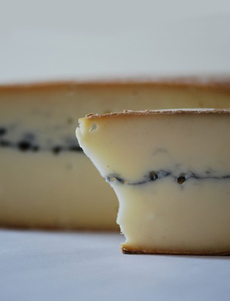
Morbier is a mild French cow’s milk cheese that is easily recognized by the dark vein of vegetable ash streaking through its middle. Photo courtesy Artisanal Cheese.
|
|
Pasta: grated hard cheese—abondance, beaufort, comté
Pasta: semi soft cheese—morbier, raclette
Pasta: blue cheese—bleu d’auvergne, fourme d’ambert
Risotto: grated hard cheese such as abondance, beaufort, comté; semisoft cheese such as raclette
Salad (Mild Cheese): hard cheese like cantal or comté
Salad (Strong Cheese): cubes of blue cheese—fourme d’ambert, bleu d’auvergne
Scones & Muffins: abondance, cantal, comté, emmental
Stuffed Chicken Breast: bleu d’auvergne, comté, fourme d’ambert, raclette
Stuffed Mushrooms: bleu d’auvergne, comté or mix (for topping, the melt under the grill)
Soup: cantal, comté
Tuna Melt: comté, morbier, raclette
Hungry yet? We’re off to make an omelet with one of our new discoveries, fromager d’affinois aux truffes. It was around for the holidays and we loaded up. It will be back again for Easter.
Look for it in gourmet/specialty food stores, Whole Foods Market, Trader Joe’s (theirs is called “truffle brie”) and some Costcos. If you love truffles, don’t miss it!
|
|