THE NIBBLE BLOG: Products, Recipes & Trends In Specialty Foods


Also visit our main website, TheNibble.com.

TIP OF THE DAY: Roots & Shoots

Even when nature isn’t in full bloom, you can add interest to meals by seeking out less ordinary versions of conventional foods.

All you have to do is look for them—at specialty produce stores, farmers markets and online (check out Melissas.com and OmahaSteaks.com, among others).

What will you find? The bounty varies by region, but you can find these veggies nationwide:

  • Baby leeks
  • Celery root
  • Microgreens
  • Mixed potatoes
  • Multicolor* beets
  • Multicolor* bell peppers
  • Multicolor* carrots
  • Multicolor* hothouse cherry tomatoes
  • Specialty radishes
  •  
    *Typically, they’re available in orange, purple, red or yellow. You can also find white carrots and brown bell peppers and tomatoes.

       
    celery-root-salad-kaminsky-230

    A double salad: celery root remoulade topped with vinaigrette-dressed baby greens. Photo by Hannah Kaminsky | Bittersweet Blog.


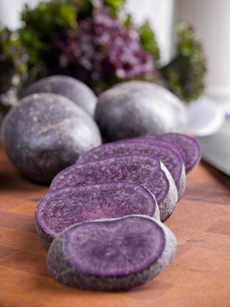
    Purple potatoes
    Purple potatoes can be served in any style conducive to waxy potatoes. How about purple mashed potatoes! Photo by Mona Makela | IST.
     

    You may also be able to find:

  • Garlic roots
  • Garlic shoots
  • Micro popcorn shoots†
  • Pea tendrils
  •  
    Whether you use these veggies to make exciting salads, roast them for sides or more complicated vegetable recipes, most of these artisanal veggies will add color splashes to the table during the winter doldrums.

    Proteins and starches tend to be brown or beige. That’s why you need the right veggies to enliven your meals.

    There are countless vegetable recipes online; or treat yourself to a vegetable cookbook. Take a look at Williams-Sonoma’s Vegetable of the Day: 365 Recipes for Every Day of the Year.

     
    *Used for many years in European, popcorn shoots are gaining popularity among top chefs in the U.S. The shoots are intensely sweet and attractive. They make a surprise garnish for any dish. Here’s more about them; click the second photo.
      

    Comments off

    ISSUE: Seafood Fraud

    There’s a reason you may not want to buy grouper or snapper, unless the establishment has purchased the whole fish and done its own filleting.

    Something similar goes for anything touted as wild shrimp or Gulf shrimp: There’s a 30% chance or more that it’s plain old farmed shrimp.

    It’s easy to fall victim to seafood fraud, a costly problem that won’t go away because of unscrupulous suppliers. Restaurants and retailers are victims, and unwittingly sell cheaper, mislabled varieties to consumers.

    The fraud exists when fish distributors deliberately mislable cheaper varieties for more expensive, popular ones. Imported basa and swai (whitefish species you’ve probably never heard of) are substituted for the much-in-demand grouper and snapper.

    Why the bait-and-switch? Because there isn’t enough domestic supply of the desirable varieties. Imported “fakes” are substituted, and the difference only becomes clear only after the fish is cooked. The flavor and texture is simply not as good.

    It’s easy to tell these varieties apart when they come out of the water. But once the fish is filleted, or the shrimp is cleaned, there is no head, scale, or other visual identifier to prove its variety.

    It’s not that you won’t get an edible piece of fish. It has no deleterious effect. But it won’t taste as good as the original, and you’ll the price of the better species.
     
    Studies & Solutions

       
    Fennel-Crusted-Grouper.ashx-230

    Grouper is a very popular fish, but unscrupulous dealers sell cheaper fish and claim it’s grouper. Photo of fennel-crusted grouper courtesy McCormick. Here’s the recipe.

     
    Food Hospitality, a restaurant industry website, reports on new studies conducted separately by the U.S. Food and Drug Administration and Oceana, the international ocean conservation organization. Both studies found extensive mislabeling problems at the wholesale level, largely focused on the easy-to-substitute species grouper and snapper.

    Last year, Oceana looked at 1,200 fish samples from across the U.S. and found that roughly one-third were mislabeled according to FDA standards. A separate study of shrimp, America’s most-consumed fish or seafood, showed that 31% of restaurants sold misrepresented products, while 41% of retail markets sold misrepresented products.

    Whatever species is being mislabled, retailers and restaurants get duped off as well as the consumer. Everyone overpays for lesser-quality fish and shellfish. Consumers, finding their dish less palatable than they had hoped, can bash the establishment online. Everyone loses.

    The FDA says that slow progress is being made on the mislabeling front. A presidential task force is looking at the problem.


    basa-timescolonist-230
    Basa, a type of catfish, is a cheaper fish often sold as grouper. Unfortunately, it lacks grouper’s particular flavor. Photo courtesy TimesColonist.com.
     

    But there is hope around the corner for fans of grouper.

    Checking The RNA Of The Fillet

    Researchers at the University of South Florida College of Marine Science have come up with a solution to the grouper problem. Their new product, GrouperChek, is a handheld sensor capable of sniffing out fish fraud on the fly.

    Wholesalers and others can assay seafood samples using real-time nucleic acid sequence-based amplification. The instrument identifies whether the RNA is a match.

    The researchers say the device is so sensitive, it can detect fake grouper even after the fish has been cooked, breaded and sauced.

    Hopefully, now, the seafood supplier will do this testing before agreeing to buy the fish.
    And hopefully, devices will be developed to test shrimp and other often-misrepresented species. Finally, there may be a cessation of the passing off of inferior species, which causes restaurants and retailers to unwittingly mislead and overcharge customers.


    Comments off

    TIP OF THE DAY: Black Radish

    As part of our Winter Vegetable Doldrums Series, today’s focus is the black radish*, Raphanus sativus niger. It’s a member of the anti-carcinogenic Brassica family of cruciferous† vegetables.

    Available year round, black radishes peak in winter and early spring. Significantly larger than traditional radishes, it average threes to four inches in diameter or length, and can be round or cylindrical and elongated, depending upon the variety.

    The skin is black or dark brown and the flesh is familiarly radishy, crisp, white and slightly bitter with a hot bite. A lot of the bite is int he skin, so the radish can be peeled for a milder flavor.

    SERVING IDEAS

    Black radishes can be enjoyed raw or cooked in a variety of different preparations.

  • Sauté or braise them as a side dish.
  • Cook them like turnips, and toss with butter.
  • Dice and add them to soups, stir-fries and stews. They’ll add some bite.
  • Grate or chop them into matchsticks and add to mixed green salads.
  • Slice them and add to the crudité plate.
  • Use slices as the base for canapés.
  •    

    black-radish-thechefsgarden-230

    It’s a black radish. Look for it in better produce sections (we found ours at Whole Foods) and farmers markets. Photo courtesy The Chef’s Garden.

     
    Here’s a general radish tip: If the radish has too much bite, you can tone down the peppery heat. Simply slice, salt and rinse with water.
     
    *Other names include Spanish radish, Gros Noir d’Hiver, Noir Gros de Paris and the Black Mooli.

    †Other Brassica family members include bok choy, broccoli, brussels sprouts, cabbage, cauliflower, collard greens, kale and mustard greens, among others.


    black-radish-salad-thechefsgarden-230
    Black radish salad. Photo courtesy The Chef’s
    Garden.
      BLACK RADISH RECIPES

  • Baked Black Radish Chips Recipe
  • Blood Orange & Black Radish Salad Recipe
  • Black Radish & Potato Salad Recipe
  • Black Radish & Shrimp Salad Recipe
  • Sauteed Black Radish Recipe
  • Smoked Fish, Horseradish & Black Radish Terrine Recipe
  •  
    BLACK RADISH HISTORY & NUTRITION

    Believed to be a relative of the wild radish, the black radish was first cultivated in the eastern Mediterranean. An ancient vegetable, radishes were grown in Egypt before the pyramids were built.

    Black radishes are an excellent source of vitamin C and also provide iron, magnesium, potassium and vitamins A, E and B. They are known for their ability to fight off infection and promote healthy digestive function. A component, raphanin, has been shown to be beneficial in treatment of thyroid imbalances. The leaves have a liver detoxifying effect.


    The black radish has long been used in folk medicine in both Europe and China, to stimulate bile function and improve gall bladder health promoting. In Chinese medicine, the black radish is also used to promote pulmonary and respiratory health.

    To store black radishes, remove the greens and wrap the bulbs in plastic. They will keep crisp if refrigerated, for up to two weeks.


    Comments off


    © Copyright 2005-2026 Lifestyle Direct, Inc. All rights reserved. All images are copyrighted to their respective owners.