THE NIBBLE BLOG: Products, Recipes & Trends In Specialty Foods


Also visit our main website, TheNibble.com.

PRODUCT: Chili Flakes Grinder

Some people use chili flakes—a.k.a. red pepper flakes or crushed red pepper—as frequently as they use salt and pepper. The spice a popular table condiment in countries as dispersed as Hungary, Korea and the Middle East. In the U.S., you’re more likely to find the liquid equivalent, a bottle of hot sauce.

A pinch of heat enhances the taste of dishes from pizza and pasta (the classics are Pasta Puttanesca and Seafood Fra Diavolo) to dips, eggs, salads, soups and cooked vegetables. You can make barbecue sauce, hummus and salsa spicier to taste.; you can create spicy mashed potatoes, spicy rice and spicy yogurt.

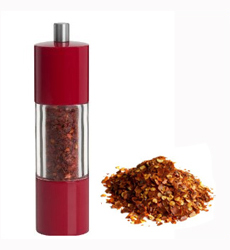
Here’s a gadget for people who’d prefer a finer sprinkling than the conventional chunks of crushed red pepper. The find grind creates a more even seasoning:

The Trudeau Red Chili Pepper Grinder has a ceramic grinding mechanism designed for just for chili flakes. For $19.99, it’s an affordable gift for those who like their heat. You can pick one up at Amazon.com.


Grind chili flakes into a more delicate grain—just as with peppercorns. Photo courtesy Trudeau.

 
WHAT ARE CHILI FLAKES?

Chili flakes are made by roasting red chiles—generally cayenne or New Mexico chiles—then crushing them. The heat comes from the seeds, which contain the chemical capsaicin (cap-SAY-sin).

Check out our Chile Glossary to discover the history, different types of chiles, and why it’s inaccurate to call them “peppers” or chile “peppers.”
  

Comments off

Ice Cream Cupcakes & More For National Spumoni Day

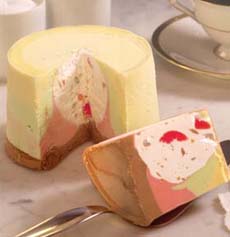
An individual round of Spumoni made up of 4 flavors of ice cream.
[1] Spumoni, an ice cream treat for the eye and the palate (photo © Lezza).
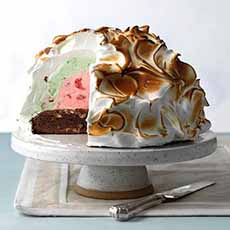
Spumoni Baked Alaska
[2] Spumoni Baked Alaska. Just use the conventional spumoni flavors in any Baked Alaska recipe. Here’s the recipe for this one (photo © Taste Of Home).
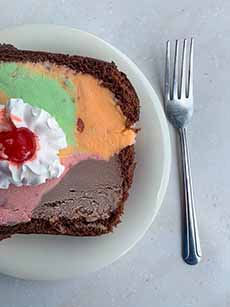
Spumoni Ice Cream Cake
[3] For an easy spumoni ice cream cake, layer the flavors in a loaf pan or terrine lined with parchment so you can pull the frozen loaf up by the parchment handles. Then, cover the ice cream with slices of your favorite cake, and re-freeze until ready to serve (photo © Buona Restaurants | Facebook).
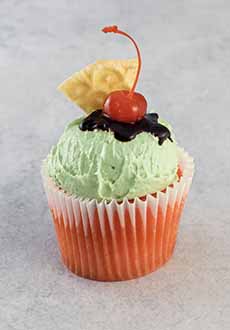
Spumoni Cupcake
[4] Spumoni cupcakes are a fusion of spumoni and ice cream cake, a miniature ice cream cake with spumoni’s multi-flavors. See how to do it below (photo © Hey There Cupcakes Shoppe).
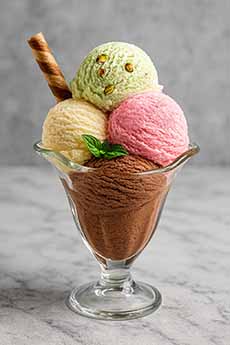
Spumoni Sundae
[5] The easiest way to celebrate: a spumoni sundae (A.I. photo).


August 21st is one of the year’s 50+ ice cream holidays: National Spumoni Day.

Spumoni (spoo-MOE-photo #1) is Neapolitan specialty, with layers of three or four different colored and flavored ice cream: Chocolate, pistachio, and cherry are a popular combination, with vanilla as a fourth.

But you can use any flavors you like, and even throw in some sorbet.

There’s much more to say about this charming ice cream creation, but first:

> The different types of frozen desserts.

> The history of ice cream.

> The history of spumoni is below.
 
 
SPUMONI: ONE OF OUR FAVORITE FROZEN DESSERTS

It’s a fancy dessert that’s easy to make. While photo #1 shows four flavors (cherry vanilla, chocolate, and pistachio ice creams, plus raspberry sorbet) in a fancy design, you can make a simple spumoni terrine by layering chocolate, pistachio, and cherry ice cream (3 cups each).

  • You can also add an optional 1-inch layer of pound cake to the as the first layer.
  • Line a large loaf pan with overlapping pieces of plastic wrap, leaving an overhang on all sides. Soften the ice cream one flavor at a time. Spread the first layer in the pan.
  • Cover with plastic wrap and freeze for about 30 minutes. Repeat with the other two flavors.
  • In between layers, you can add candied fruit, maraschino cherries, and/or chopped pistachio nuts.
  • Return to the freezer until ready to use; slice and serve.
  •  
     
    RECIPE #2: SPUMONI ICE CREAM CUPCAKES

    This spumoni cupcake has a cake base topped with three flavors of ice cream.

    Ingredients

  • Chocolate, pistachio, and vanilla ice cream, softened prior to use
  • Loaf cake: pound, chocolate, sponge, other
  • Optional garnish: maraschino cherry, chocolate kiss, mini meringue, other
  • Cupcake/muffin pan and cupcake liners
  •  
    Preparation

    1. Slice the loaf cake in 1″ wide pieces, and use a cookie or biscuit cutter to cut circles that will fit on the bottom of the cupcake liners. Top

    2. Scoop a round ball of ice cream atop each cupcake. Place in the freezer. Don’t garnish until ready to serve.

    3. At serving time, garnish with your favorite sundae toppings: chocolate sauce, butterscotch sauce, whipped cream and a cherry. If you like, gild the lily with chopped nuts, mini chips, sprinkles or other favorites.

    > There are more fun cupcake recipes below.
     
     
    THE HISTORY OF SPUMONI

    The predecessor of spumoni was a light Italian dessert called spuma (SPOO-mah singular, spume, SPOO-may, plural), meaning foam.

    In the days before freezing ice cream was easy, fruit sherbet was stabilized (blended) with a large amount of Italian meringue (cooked, beaten egg white sweetened with hot sugar syrup) or whipped cream.

    By the mid–late 19th century, pastry cooks were molding layered, semi-frozen “spumone napoletano” (Neapolitan, or “from Naples” spumoni), slicing it like a cake.

    Spumoni means “big foam.”

    The hand-cranked ice cream freezer had been invented in the U.S. in 1843, allowing the production of ice cream/gelato that was firm enough to mold.

    The culinary pioneer of spumoni was Naples, in the region of Campania in southwestern Italy, followed by efforts Salento in the region of Apulia in the southeast.

    The churned gelato was added to molds that were then placed in ice-and-salt freezers to set until firm enough to unmold and slice (a soft semifreddo† texture).

    The colorful desert was made from three or four different flavors/colors of gelato, typically cherry, chocolate, pistachio, and vanilla as a fourth flavor.
     
     
    Classic Additions

    Often added were candied fruits (amarena cherries, citron, orange peel), nuts (pistachios, almonds), chocolate bits, a ribbon of liqueur (typically maraschino or alchermes, a cinnamon-clove liqueur), and/or layer of sponge cake.

    As flavors of gelato increased, amaretto (almond), coffee, hazelnut (gianduja), stracciatella (vanilla with shards of chocolate), and strawberry were also used.

  • Naples popularized the classic layered style.
  • Salento created a wedding-and-holiday spumone with a cherry or chocolate center, and while we can’t find a photo of that variation, it reminds us of the ice cream dessert called tartufo.
  •  
    Spumoni Travels Abroad

    In the late 1800s–early 1900s, Italian immigrants brought their spumoni recipes to Argentina, Canada, and the U.S., where the frozen treat became a fixture in Italian bakeries and restaurants.

    In the U.S., a simplified variation without the extra nuts and fruits was developed. The “Neapolitan” ice cream brick of layered chocolate, strawberry, and vanilla ice cream, available at grocers to the delight of children (and all ice cream lovers).

    Today: Spumoni remains a holiday/special-occasion dessert in parts of Italy and a nostalgia dessert in North American Italian eateries. In the U.S. you’ll most often see the pistachio–cherry (amarena)–chocolate trio.

    We don’t understand why more Italian restaurants that have a freezer for ice cream don’t offer spumoni, too.

    It’s both elegant and fun. There are fine wholesalers who will deliver the spumoni ready-made to the restaurannt. Why the resistance?
     
     
    MORE CUPCAKE RECIPES

  • Black Forest Cupcakes With Whipped Cream Frosting
  • Carrot Cupcakes With Cream Cheese Frosting
  • Dark Chocolate Cupcakes With Chocolate Buttercream Frosting
  • “Hamburger” Cupcakes
  • Hello Flower! Cupcakes
  • Pumpkin Cupcakes With Pumpkin Cheesecake Frosting
  • Red Velvet Cupcakes
  • Strawberry Shortcake Cupcakes
  • Vanilla Cupcakes With Cream Cheese Frosting
  • ________________
     
    *It became possible to freeze ice cream at home in 1843 with Nancy M. Johnson’s patent for the first hand-cranked ice cream freezer. Her invention provided a practical and efficient way to churn and freeze ice cream by combining a metal cylinder, a crank-turned dasher, and an outer bucket for a mixture of ice and rock salt, replacing less efficient, labor-intensive methods.

    Semifreddo is called frozen soufflé in English. It may look like ice cream, but it isn’t ice cream per se. It is more of a frozen mousse, produced by combining equal parts of ice cream and whipped cream.


    CHECK OUT WHAT’S HAPPENING ON OUR HOME PAGE, THENIBBLE.COM.


    Comments off

    TIP OF THE DAY: Two Ideas From Belgium

    Recently, NIBBLE writer Leah Hansen joined a group of journalists on a press trip to Belgium. She came back very excited about the country, and used her camera to capture tips from everyday life.

    DECORATE DAIRY

    For a cheese board or a buffet, use fresh herbs to decorate cheese—and butter, too.

    Press fresh herbs or flowers into soft or semi-soft cheeses before serving.

    Lavender (in the photo) and rosemary look pretty and add a layer of aroma and hint of herb flavor. Don’t limit yourself to these choices, though: Use your eye and your palate to find herb-cheese pairings that please.

    You can turn cheese decorating into a party activity. Give each person or small group a Camembert or baby Brie to decorate. Provide some fresh herbs and whatever you have on the spice shelf. Serve the cheeses with fruit for dessert.


    Use fresh herbs from the market to decorate butter and cheese. Photo by Leah Hansen | THE NIBBLE.


    Switch out the mayo for some fresh,
    unsalted butter on a ham sandwich. Photo by
    Leah Hansen | THE NIBBLE.

      HOLD THE MAYO

    In Belgium and France, butter is the condiment of choice on a ham sandwich.

    The flavor of unsalted butter with ham on French-style bread (you need good bread!) is very elegant. Try it. We add a bit of Dijon mustard as well.

    Plan your own trip to Belgium to enjoy the history, the cuisine, and lots of great beer and chocolate. These websites will get you started:

  • Belgium: VisitBelgium.com
  • Brussels: VisitBrussels.be
  • Flanders: Visit Flanders
  •  

    BELGIAN WAFFLE TRIVIA

    In Belgium, there is no such thing as a “Belgian” waffle. Every region has its own style of waffle (called a gauffre, pronounced GO-fray or GAW-fray) based on two major styles: the Brussels waffle and the Liège waffle.

  • NOT FOR BREAKFAST. Belgians do not eat waffles for breakfast, but for dessert. What we think of as a “Belgian” waffle is the rectangular or square Brussels waffle. It is served with whipped cream and berries or other sweet toppings such as powdered sugar, ice cream, butter and sugar or syrup, with chocolate syrup or other fresh fruit; and is eaten with a knife and fork.
  • SNACK WAFFLE. Liège-style waffles are enjoyed as a snack, and sold from street carts and in coffee shops. They are somewhat irregular in shape, although they are quasi-square or round. Here’s a photo.
  • “BELGIAN” WAFFLE. The Belgian waffle got its name at the 1964 World’s Fair in New York City, where it was served with whipped cream and strawberries. The manager of the Belgian Pavilion, Maurice Vermesch, named it the Belgian waffle because he did not think many Americans were familiar with Brussels!
  • Belgian waffles have deep divots—that’s the official name for the pockets or wells created by the waffle press. The batter includes yeast and beaten egg whites, which give the country’s waffles a lighter texture and fluffier consistency than the typical American waffle, which tends to use baking soda or baking powder in the batter. They are also very crisp.
  •  
    Check out all the types of waffles in our Pancake & Waffle Glossary.


    Comments off

    TIP OF THE DAY: Pasta With Greens

    We were inspired by this picture in the beautiful photo gallery of Chicken Fried Gourmet, a blog featuring the cuisine of Shreveport, Louisiana-based chef Michael O’Boyle.

    An unusual concept today, pasta with greens dates back several centuries to Italian peasant fare. Meat was costly, greens were grown in the garden: Ecco! (That’s Italian for voilà.)

    In addition to adding new flavors to pasta, piling on some greens is a way for the Greens Police to get the family to eat more (or any) greens. Greens tossed in sauce and sprinkled with cheese go down more easily with the resistance.

    PASTA WITH GREENS RECIPE

    1. BOIL. Cook ravioli, tortellini or a favorite pasta shape, along with your favorite sauce. You can use a red sauce, white sauce, clam sauce, or simply olive oil.

    2. SAUTE. While the sauce is heating, lightly sauté baby arugula, beet greens, collard greens, mustard greens, spinach, chopped chard, kale or a mixture.


    Tortellini topped with baby spinach. Photo and concept courtesy ChickenFriedGourmet.com.


    3. TOSS. Drain the pasta and toss it in the sauce. Reserve some of the sauce and separately toss the sautéed greens in it.

    4. GARNISH. Top the pasta with a layer of greens. Serve with grated cheese.
    Let us know how you like the recipe, and any tweaks you devise.

    Find more of our favorite pasta recipes.

    Check out all the types of pasta in our delicious Pasta Glossary.
      

    Comments off

    COOKING VIDEO: Make A Retro Gelatin Mold


    Here’s a tribute to aspic: a savory, gelatin-like food made from meat or fish stock. A classic French dish created centuries before the day of commercial gelatin* it was very difficult to prepare. In the beginning, cooks relied on the natural gelatin found in the meat to make the aspic set. In modern times, unflavored gelatin is used to ensure success.

    *Gelatin was made in ancient times by boiling the bones; powdered gelatin was invented in 1682 by Denis Papin. The concept of cooking it with sugar to make dessert dates to 1845 and an inventor named Peter Cooper.

    Recipes dating back to the Middle Ages show that clarified meat broths were turned into transparent, savory jellies. To make aspic, beef, fish, pork or poultry is cooked slowly to make a dense consommé, which is strained and clarified with egg white until it is clear. The clarified broth is then molded, can be served sliced or diced, served with a salad or as a garnish with meat and fish.

    In the days before refrigeration, aspic covering boned meat or fish kept the proteins from spoiling: The gelatin keeps out air and bacteria.

    Vegetables, herbs, slices of meat or fish, sliced hard-cooked eggs and pieces of cheese can be added. Like the pretty Jell-O fruit molds that came much later, aspic was an opportunity for the cook to show off his or her creative skills.

    There are also vegetable aspics, the most popular of which is tomato aspic, made with tomato juice and gelatin. Unlike regular conventional aspics, tomato aspic is opaque.

    Aspic became popular in the early 20th century. Wealthy people had cooks who could spend the time to create them. Aspics were de rigeur on a buffet table.

    But with the wane of heavy French cuisine in the 1960s, in favor of California cuisine and International fare, savory aspics faded away.

    Make A Savory Aspic Or A Sweet Gelatin Mold

    You can find recipes and create a classic recipe, but most Americans prefer sweetened gelatin molds. Try this classic, made with orange juice, pineapple juice, lemon juice, chopped oranges and shredded carrots—plus unflavored gelatin, sugar and salt. We like to add diced cucumber, celery and sliced radishes for crunch and reduce the sugar for more of a sweet-savory balance.

    Gelatin molds are retro fun, and a cool dessert or snack in this hot weather. You can also serve it on the side with a green salad, or mound the salad on top of the sliced gelatin, as we showed in yesterday’s tip.

    For classic savory aspics, take a look at:

  • Chicken Aspic
  • Gazpacho Aspic, a variation on tomato aspic by Emeril Lagasse
  • Poached Salmon In Aspic
  • Shrimp Aspic
  •  

    UPDATE: Dang it! Two days after we published this post, the orange-carrot recipe was removed from circulation—can’t imagine why! Here’s a similar recipe:


    Comments off

    The Nibble Webzine Of Food Adventures
    RSS
    Follow by Email


    © Copyright 2005-2026 Lifestyle Direct, Inc. All rights reserved. All images are copyrighted to their respective owners.