|

[1] Party time! Check out this article (photo © Sally Roeckell | Heinen’s).

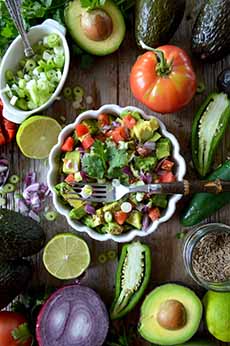
[2] Provide a plain bowl of chopped avocado and let guests pile on the toppings (photo © Nadine Primeau | Unsplash).
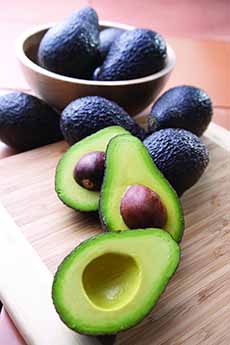
[3] Hass is the best avocado for creamy guacamole (photo © Hass Avocado Board).
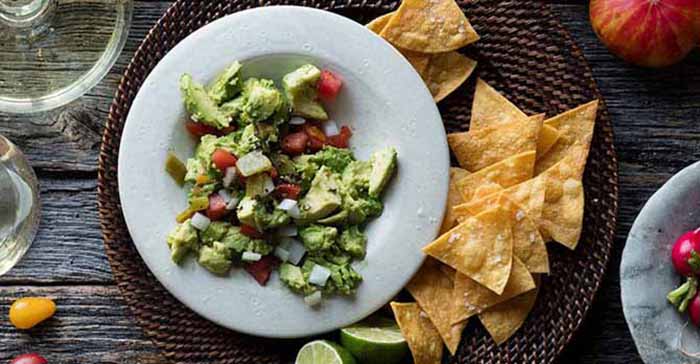
[4] You don’t have to mix or mash the avocado. Diced avocado can be served in bowls, with toppings piled on top (photo © California Avocado Commission). |
|
Updated September 2026
National Guacamole Day is September 16th, and we wondered: If there are salad bars and frozen yogurt bars, cereal bars, baked potato bars and chili bars*, why not a guacamole bar? Who doesn’t love the opportunity to customize their foods?
Individual bowls and an array of ingredients enable each person to start with a base of smashed avocado, and pile on the fixings. They can then be mixed in or eaten as is—a mountain of flavors and textures.
Whether for a general party or drinks, we like to include a crunchy salad base, to make a more substantial dish. We prefer shredded cabbage, a.k.a. coleslaw mix. You end up with “guacamole coleslaw” at the bottom of the dish.
More guacamole: November 14th is National Spicy Guacamole Day.
Below:
> Ingredients for a guacamole party bar.
> How to prevent guacamole from turning brown.
> The history of guacamole.
> How our guacamole compares to what the Aztecs made.
> Fun facts.
Elsewhere on The Nibble:
> Beyond Mexico: guacamole recipes with global influences.
> Beyond tortilla chips: more ways to serve guacamole.
> More about the Hass avocado.
> 18 ways to spice up guacamole.
> The history of the avocado.
> The history of tortilla chips.
> The year’s 7 avocado holidays.
> The year’s 25+ Mexican food holidays.
> 60 avocado recipes.
> Guacamole BLT crostini recipe.
1. INGREDIENTS FOR A GUACAMOLE PARTY BAR
To encourage creativity, mix some non-traditional items (bacon? mint? pineapple?) with traditional ones.
- Avocado: mashed, smashed or diced†.
- Cheese: crumbled cotija, goat cheese, queso blanco, queso fresco or queso oaxaca; shredded Cheddar or Jack.
- Diced veggies: bell pepper, carrot, cucumber, green and/or red onion, jicama, radish, tomatillo, tomato/sundried tomato.
- Seasonings: cayenne, chili powder, cumin, garlic powder and/or minced garlic, hot sauce, lemon and/or lime wedges, paprika, salt/seasoned salt, Worcestershire sauce.
- Heat: chile flakes, hot sauce, sliced jalapeño, minced chipotle‡.
- Herbs: chives, cilantro, mint, parsley.
- Salad base: arugula, chicory, escarole, iceberg, radicchio, romaine, shredded cabbage, watercress.
- Toppings: bacon, corn, crushed pineapple, diced mango, olives, salsa, seeds (pumpkin, sunflower), sour cream or plain yogurt, toasted nuts.
Plus:
- Chips and dippers: celery sticks, crostini (toasted or grilled baguette slices), endive leaves, pita chips, plantain chips, tortilla chips, flatbread.
- Drinks: beer, Margaritas, white wine (Sauvignon Blanc or other crisp, medium-body white wine), white sangria.
Set the dishes on a table or buffet in this order: bowls, salad, avocado, veggies, heat, seasonings and toppings; include serving utensils with each option.
At the end of the table, place the forks and spoons for blending and napkins, and dinner plates for the individual bowls and chips. Place large bowls of chips or other dippers on the tables.
2. HOW TO KEEP GUACAMOLE FROM BROWNING
There is a device called a Guac Lock that presses all the air out of a container of guacamole. No air = no browning.
But there are low-tech techniques that work just as well.
The Plastic Wrap Seal Method: Press a sheet of plastic wrap directly onto the surface of the guacamole or sliced avocados so that there are absolutely no air pockets underneath. When guests are ready to serve themselves, they simply peel back the wrap. (You can re-apply it in between if needed.)
Citrus Juice Protection: Toss diced avocados or mix lemon or lime juice directly into your guacamole. The citric acid and lower pH slow down the polyphenol oxidase enzyme responsible for the browning process.
The Water Barrier Trick: For a smooth bowl of guacamole, gently pour a thin layer of lukewarm water or lukewarm broth (about a half-inch) right over the top of the flattened guacamole before putting it out. Because water is less dense, it floats and blocks the oxygen. When it’s time to serve, gently pour the water off and give the top a quick stir.
Keep It Cool: Place the bowls of guacamole or diced avocado atop a larger tray or bowl filled with ice (an ice bath setup). Cooler temperatures slow down the enzymatic browning reaction significantly.
Serve In Batches: Instead of putting out massive bowls that sit out for hours, set out smaller portions and replenish them as needed from a batch kept tightly sealed in the refrigerator.
|
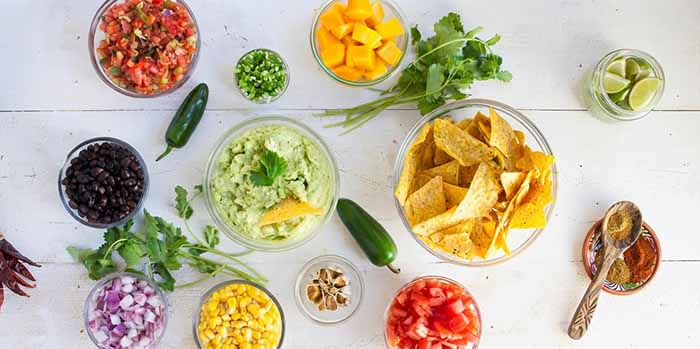
[5] Nutritionist Kara Lydon adds healthy toppings such as black beans, mango, and salsa. Here’s the recipe (photo © Kara Lydon).
3. THE HISTORY OF GUACAMOLE
Mesoamericans cultivated the avocado in what we now call Central America for thousands of years. The conquering Aztecs** called them ahuacatl; the “tl” is pronounced “tay” in Nahuatl, the Aztec language (so, ah-hwa-cah-tay). Guacamole was compounded in a molcajete, a mortar and pestle carved from volcanic stone.
When the Spanish conquistadors arrived in 1519 under Hernán Cortés, they heard ah-hwah-cah-tay as “aguacate,” the spelling and pronunciation they adopted.
The name guacamole comes from Mexican Spanish via the Nahuatl “ahuacamOlli,” a compound of ahuacatl [avocado] + mOlli [sauce]. The chocolate-based mole sauce comes from that same word, mOlli.
Aztecs saw the avocado as resembling testicles and ate them as a sex stimulant (ahuacatl means “testicle” in Nahuatl and was translated to ahuacate by the Spanish conquistadors).
When English sailors and travelers in the 17th century encountered the aguacate, they corrupted the pronunciation into words like avigato, avocato, and eventually alligator. By 1696, Sir Hans Sloane published his Jamaican botanical catalog referring to it as the “Avocado or Allegator Pear-tree.”
The name stuck informally among English speakers because the fruit had rough, reptilian green skin and was shaped like an orchard pear. Alongside alligator pear, sailors also called it midshipman’s butter and butter pear because of its oily texture.
By the 1910s, California horticulturists realized that the fruit had immense commercial potential, but they faced three major marketing problems:
- The “alligator” problem: In the 1910s, avocados were marketed as an elite luxury food, sold in high-end Los Angeles and San Francisco hotels for $1.00 to $1.50 apiece (roughly $30 to $40 in today’s money). Growers and chefs felt that linking an exquisite, buttery gourmet delicacy to a swamp-dwelling reptile was unappetizing and undignified.
- The “pear” problem: The pear portion of the name misled customers. People bought them expecting a sweet, juicy dessert fruit like a Bartlett pear, and were baffled (or repulsed) when they bit into something rich, oily, and savory.
- The Mexican Spanish hurdle: Some growers initially tried using the authentic Mexican name—even naming their inaugural meeting in May 1915 the California Ahuacate Association. However, they quickly realized that mainstream American consumers struggled to spell and pronounce ahuacate.
American avocado growers had to sponsor a public relations campaign before avocados could become popular. The California Avocado Association joined forces with the United States Department of Agriculture (USDA), championed by acclaimed plant explorer, botanist David Fairchild.
They issued formal resolutions urging hotels, grocers, and dictionary publishers to retire the names alligator pear, butter pear, and midshipman’s butter entirely, maintaining “avocado” as the single official trade name.
Because the average American consumer had no concept of ancient Nahuatl double entendres, “avocado” sounded sophisticated, exotic, and vaguely Mediterranean. It shed the reptilian imagery of the alligator, eliminated the misleading expectation of a sweet orchard pear, and provided the clean, upscale branding the nascent industry needed.
While the organized push by California avocado growers to officially rebrand “alligator pears” to the sleeker, more marketable “avocado” began in 1915, old habits and regional colloquialisms lingered for a long time.
Into the 1960s, “alligator pear” was still frequently used in American speech, particularly in parts of the American South and Florida, where locally grown tropical varieties were common. Older cookbooks, newspapers, and older generations clung to the name well after the agricultural industry had standardized “avocado.”
Interestingly, while the U.S. market transitioned faster due to marketing efforts, other English-speaking areas held onto variants longer. For instance, the term “avocado pear” (and occasionally alligator pear) remained common in parts of the U.K. into the 1970s.
As grocery store distribution centralized, commercial packing labels dtandardized, and massive marketing campaigns for California (and later international) avocados kicked into gear, “alligator pear” finally disappeared from mainstream commercial use and settled into the history books as a piece of culinary trivia.
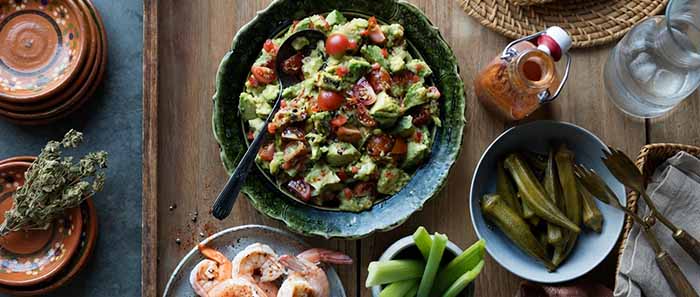
[6] You can add a fusion twist to your toppings. This Cajun guacamole adds shrimp, okra, hot sauce, scallions, and parsley. Celery and bell pepper (along with onion) are the “Holy Trinity” of Cajun cooking, but you can turn two of the three into crudités. Here’s the recipe (photo © California Avocado Commission).
4. HOW DOES TODAY’S GUACAMOLE DIFFER FROM WHAT THE AZTECS ATE?
The guacamole enjoyed today traces directly back to the Aztec Empire, where it was known as āhuacamolli (a compound of āhuacatl, meaning avocado, and molli, meaning sauce or mixture).
While the dish has retained its avocado base for centuries, modern variations incorporate several ingredients and consumption habits introduced during and after the Spanish colonization of the Americas.
In Aztec cuisine, āhuacamolli functioned primarily as a sauce, condiment, or filling folded into warm corn tortillas. The widespread practice of serving guacamole as a standalone party dip accompanied by fried tortilla chips emerged largely in 20th-century American and Tex-Mex dining.
Aztecs prepared āhuacamolli using a volcanic stone mortar and pestle known as a molcajete and tejolote. The ingredients—typically salt, chilis, and sometimes tomatoes—were pulverized into a paste before mashing in the avocados.
While traditional Mexican kitchens still use a molcajete, modern preparation often relies on forks, whisks, potato mashers, or food processors, yielding textures ranging from rustic and chunky to entirely smooth.
20th Century Ingredients
As the recipe evolved in the American Southwest, cooks added:
- Cilantro (coriander): Cilantro originated in the Mediterranean and Western Asia. It was unknown in pre-Columbian Mesoamerica, whereas today it is widely considered an essential herbal component of classic guacamole.
- Citrus juice: Aztec āhuacamolli did not include lime or lemon juice because citrus fruits are native to Asia. They were brought to the Americas by Spanish colonists in the 16th century. Modern recipes rely heavily on lime juice for acidity, flavor balance, and delaying enzymatic browning.
- Onions and garlic: Like citrus, standard alliums such as Old World onions (Allium cepa) and garlic (Allium sativum) were introduced by Europeans. While the indigenous peoples consumed native wild alliums (such as xonacatl), the prominent inclusion of chopped white, red, or yellow onions and minced garlic is a post-Columbian development.
- Salt and traditional seasonings: The Aztecs seasoned their mash primarily with sea salt, lake salt, and indigenous chilis (such as serrano or jalapeño), crushed together. Modern adaptations often incorporate black pepper, cumin, or even garlic powder.
- Tomatoes: Both versions include tomatoes. The Aztecs used both red tomatoes (tomatl) and green husk tomatoes (miltomatl or tomatillos) ground into the mixture. In contemporary recipes, diced red tomatoes are frequently folded in raw rather than thoroughly mashed.
4. FUN FACTS
- Avocados have been cultivated for more than 10,000 years.
- Avocados have more potassium than a banana, plus many other health benefits (here are the more health benefits of avocado).
- Leaving the pit in to keep it from browning doesn’t really work.
- The largest-ever bowl of guacamole weighed an astonishing 4,123 kg (more than 9,000 pounds). It was mixed together during a New York Jets NFL game in 2019. The prior winner weighed in at 2,669.5 kg (5,885.24 lbs), created in 2013 by the Municipality of Tancítaro Michoacan in Tancítaro, Mexico. The record is mute on how many tortilla chips were needed.
- During festivities for the last Super Bowl, 104.2 million pounds of avocados were consumed nationally, mostly as guacamole. It’s the year’s biggest day for avocado consumption.
- Guacamole has been served in outer space: NASA has included freeze-dried guacamole on astronaut menus.
- The best guacamole for avocados, the creamy Hass avocado, was patented in 1935 by Rudolph Hass, a U.S. postal worker in California. He purchased a seedling from a pioneer avocado grower after noticing it produced exceptionally flavorful fruit.
- Yes, the avocado is a fruit—actually, a berry, the fruit of an evergreen tree belonging to the laurel family (Lauraceae), that grows best in warm climates. The tree, Persea americana, is the best-known of some 111 trees in the Persea genus.
- Guacamole shares a linguistic ancestor with chocolate. The word guacamole comes from the Nahuatl ahuacamolli (ahuacatl [avocado] + molli [sauce]). Mexico’s famous chocolate-and-chile-based sauce, mole, comes from that exact same root word for sauce (molli).
*More food bar ideas: Breakfast & Brunch Bar, Lunch & Dinner Bar and Dessert Bar.
**The Aztecs, who probably originated as a nomadic tribe in northern Mexico, arrived in Mesoamerica around the beginning of the 13th century.
†Hass avocados are preferred. While other varieties are larger, the Hass variety is creamier, a desired characteristic for guacamole.
‡To accommodate those who just like a little heat, have two bowls of jalapeño: one minced and served as is, one with the heat-carrying seeds removed before mincing.
CHECK OUT WHAT’S HAPPENING ON OUR HOME PAGE, THENIBBLE.COM.
[7] How about a tortilla chip tasting along with the guacamole? Get three or four different brands and label the bowls. Here’s the recipe for this chunky guacamole (photo © California Avocado Commission).
|