THE NIBBLE BLOG: Products, Recipes & Trends In Specialty Foods


Also visit our main website, TheNibble.com.

Tipsy Scoop, A Boozy Ice Cream Treat For The Holidays

From the first spoonful, we’ve been huge fans of Tipsy Scoop, super-premium artisan ice cream imbued with alcohol.

It’s an easy way to get into the holiday spirit in your own home, and it’s a wonderful gift for any lover of ice cream and spirits.

This holiday season, Tipsy Scoop has a four-pack of limited-edition boozy ice cream that is perfect for everyone on your naughty and nice lists (yes, naughty people need ice cream, too).
 
 
TIPSY SCOOP HOLIDAY 4-PACK

All flavors contain up to 5% alcohol by volume and are meant to be consumed by those 21 and over.

The holiday gift pack includes four 16-ounce pints of liquor-infused ice cream and sorbet with festive flavors:

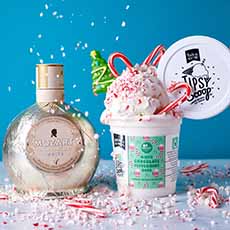
  • Mozart White Chocolate Peppermint Bark Martini: Peppermint white chocolate chip ice cream infused with Mozart White Chocolate Liqueur.
  • Coquito Dulce De Leche: Coquito (coconut) ice cream infused with spiced rum, swirled with dulce de leche
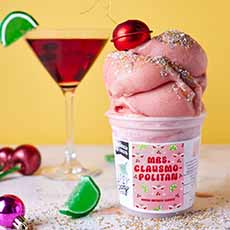
  • Mrs. Clausmopolitan Sorbet: Mrs. Claus’ signature cocktail—cranberry sorbet infused with vodka, orange liqueur, and fresh lime. Non-dairy/vegan.
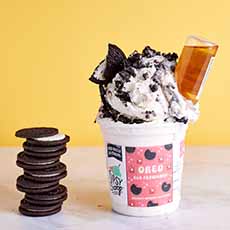
  • Oreo Old Fashioned Ice Cream: Vanilla Oreo cream ice cream infused with whiskey and Oreo cookie chunks
  •  
     
    GET YOUR TIPSY SCOOP!

    Nationwide delivery is available to all 50 states through Goldbelly.com for $99, including shipping.

    It’s worth it!

    Please note that an adult signature is required upon delivery.

    Scoop this gift pack up quickly (pun intended) before the holidays because the limited-edition holiday flavors will only be available—while supplies last—through New Year’s Eve.

    Beyond the holidays, Tipsy Scoop’s boozy ice cream is a memorable gift for anniversaries, birthdays, other celebrations, and client gifting.

    Check out the wonderful flavors on TipsyScoop.com.

    And if you’d like to have your own ice cream shop, check out Tipsy Scoop franchising.
     
     
    > The history of ice cream.

    > A glossary of frozen desserts with pictures.

    > The year’s 50+ ice cream and frozen dessert holidays.

    > The different types of whiskey.

    > The different types of rum.

    > The year’s 100+ cocktail and spirit holidays.


    A Pint Of Tipsy Scoop Coquito Dulce De Leche Ice Cream Made With Rum
    [1] Coquito Dulce De Leche Ice Cream, made with rum (all photos © Tipsy Scoop).

    A pint of Mozart White Chocolate Peppermint Bark Ice Cream
    [2] White Chocolate Peppermint Bark Ice Cream made with Mozart White Chocolate Liqueur.

    A Pint Of Tipsy Scoop Mrs. Clausmopolitan Cranberry Sorbet With Vodka
    [3] Mrs. Clausmopolitan, cranberry sorbet with vodka and lime.

    A Pint Of Tipsy Scoop Oreo Old Fashioned Ice Cream With Whiskey
    [4] Oreo Old Fashioned Ice Cream With Whiskey.


    CHECK OUT WHAT’S HAPPENING ON OUR HOME PAGE, THENIBBLE.COM.


    Comments off

    French Fries With Kimchi Sour Cream For National Kimchi Day

    A Plate Of French Fries With Kimchi Sour Cream For National Kimchi Day
    [1] Fries with kimchi sour cream. The recipe is below (photo © Roy Choi | Idaho Potato Commission).

    A Platter Of White & Sweet Potato Fries With 4 Different Dipping Sauces
    [3] You can serve a variety of fries with different dips (photo © Stonewall Kitchen | Facebook).

    Kimchi Side Dish
    [3] Classic kimchi showing two different cuts (photo license CC-BY-SA-2.0 KR).

    Head Of Napa Cabbage
    [4] Napa cabbage, the most commonly-used vegetable for kimchi (photo © MG Produce).

    Mother In Law's Kimchi Bottle
    [5] Mother-In-Law’s excellent kimchi is available at grocers nationwide. Here’s a store locator (photo © Mother-In-Law’s).


    November 22nd is Kimchi Day, a day dedicated to the Korean national dish that has been made for thousands of years. We’re featuring some fusion food to celebrate: French fries with kimchi sour cream. The recipe is below.

    The South Korean government designated Kimchi Day to celebrate and promote the salted and fermented napa cabbage that is made in most Korean homes around this time of the year.

    (Napa cabbage is the most commonly used vegetable, but other types of cabbage, plus carrots, cucumber, daikon radish, and scallion are also used. Garlic, ginger, and gochugaru (Korean chili sauce) are common seasonings.)

    According to the Korean Herald, gimjang, the process of making large quantities of kimchi before winter, has long been a major annual event in Korean households.

    Family members and/or neighbors gather to salt and drain the cabbage, make a spicy paste with hot chiles, mix it with the cabbage, and let it ferment.

    Koreans used to store gimjang kimchi in large earthenware jars called jangdok, along with soy sauce and other condiments, on jangdokdae, an outside space near the kitchen, where they could be preserved and kept fresh. Today, homes have a special kimchi fridge (indoors!).

    The recipe is from chef Roy Choi and sent to us from the Idaho Potato Commission.

    There are additional kimchi recipes below, from kimchi hot dogs and tacos to wings and waffles.

    > The history of potatoes.

    > The history of French fries.

    > The history of kimchi.

    > The different types of potatoes: a glossary with photos.


    RECIPE: BAKED FRIES WITH KIMCHI SOUR CREAM

    This recipe is a nice blend of regular French fries and sweet potato fries.

    You can purchase kimchi in many large supermarkets and in Asian groceries.

    Use the kimchi sour cream as a dipping sauce or topping.
     
    Ingredients For The Fries

  • 2 Idaho® (russet) potatoes, washed
  • 2 sweet potatoes, washed
  • Rice flour*
  • Oil
  • Sea salt
  •  
    Ingredients For The Kimchi Sour Cream

  • 6 cups kimchi puree (kimchi pureed with a little rice wine vinegar)
  • 1 tablespoon sesame seeds
  • 1 tablespoon salt
  • 4 cups sour cream
  •  
    Preparation

    1. PREHEAT the oven to 400°F oven.

    2. MAKE the sour cream sauce. Whisk together all ingredients. Set aside.

    3. BAKE the whole sweet potatoes for about 20 minutes and the Idaho® potatoes for about 30 minutes. Cook just until they are slightly fork tender, but not totally soft. When they are cool, cut them into large wedges.

    4. DREDGE the wedges in rice flour and deep them fry in oil at 330 °F for 3-5 minutes until slightly brown. Drain on paper towels and season with salt. Serve with kimchi sour cream.
     
     
    MORE KIMCHI RECIPES

  • Hearty Kimchi Soup
  • Kimchi Fried Rice
  • Kimchi Hot Dogs
  • Kimchi Nachos
  • Napa Cabbage Kimchi
  • Poutine With Kimchi Topping
  • Ramen Soup With Kimchi
  • Taco & Wing Bar With Kimchi
  • Teriyaki Meatball Hero With Kimchi
  • Waffles With Kimchi
  •  
     
    __________________

    *You can make rice flour simply by grinding rice in your food processor or spice mill. Here’s how. Rice flour is gluten-free, and can also be used as a thickening agent for soups and stews as well as tempura batters for frying vegetables, chicken, and more.


    CHECK OUT WHAT’S HAPPENING ON OUR HOME PAGE, THENIBBLE.COM.


    Comments off

    Chocolate Goat Cheese Log: Like A Tangy Chocolate Cheesecake

    Why don’t more cheese makers make chocolate goat cheese? It is a splendid indulgence, a more dense version of chocolate cheesecake.

    Since we had our first bite of Capri Chocolate Goat Cheese Log, we were hooked. (You can buy it from the producer, Westfield Farms, or from iGourmet or

    An entry from France, La Bonne Vie Chocolate Chip Goat Cheese Log, is available from Instacart and other retailers, but you might as well roll your own: a plain goat of goat cheese in mini chocolate chips.

    Thanks to Vermont Creamery for adding Chocolate and Cherry dessert goat cheese log to its first two sweet flavors, Honey Truffle and Strawberry Spritz.

    The goat cheese is blended with cocoa powder and dried tart cherries before being rolled in tiny semi-sweet chocolate chips.

    Says the Creamery: “Channeling the depth and decadence of a Black Forest cake and boasting a ridiculously rich fudge-like texture, Chocolate and Cherry is…ready to be eaten on its own, any old time and just because.”

    Say we: “Enjoying an inch-wide slice of the chocolate log, with or without a graham cracker or other cookie, is far more prudent than devouring a whole slice of chocolate cheesecake.”

    Yes, it’s a dessert, a snack, a chocolate fix, all rolled into one 4-ounce, heavenly delicious log.

    Among other fine food chains, Chocolate Cherry Goat Cheese is available at Albertsons and Whole Foods Markets.

    Here’s a store locator.

    > The history of chocolate.

    > The history of cheese.

    > The different types of cheese: a glossary.

    > The history of goats is below.
     
     
    HOW TO SERVE CHOCOLATE GOAT CHEESE

    Serve slices of chocolate goat cheese on a platter, board, or individual plates, with:

  • Fresh and/or dried cherries
  • Chocolate bark, breakup or squares
  • Cookies: cantucci (small biscotti), graham crackers, ladyfingers, sablés (sandies), spice/gingersnap cookies, stroopwafels
  • Strawberries
  •  
    Another nice presentation is to include a slice of log and a cookie on a mixed dessert plate with a macaron, meringue, tartlet, etc.
     
     
    THE HISTORY OF GOATS

    The history of goats is intertwined with the history of human civilization. Domestication of goats is believed to have occurred more than 10,000 years ago in the Fertile Crescent*, making them one of the earliest domesticated animals.

    Prehistoric mankind recognized the utility of goats for providing milk, meat, hides, and fiber (cashmere and mohair). Archaeological evidence suggests that goats were domesticated in the Zagros Mountains of Iran and Iraq around 10,000 to 11,000 years ago.

    The practice of goat domestication then spread to Africa, Asia, and Europe. Goats adapted well to diverse climates and landscapes, making them valuable for various agricultural and pastoral communities.

    Goats played a crucial role in early agriculture. They were prized for their ability to graze on a variety of vegetation, including grasses and shrubs that other livestock might avoid. Their adaptability allowed them to thrive in different environments.

    Goats are now found all over the world, having adapted to a wide range of climates and ecosystems. They are kept for various purposes, including subsistence farming, commercial agriculture, and even as pets.

    Over time, different breeds of goats have been developed for specific traits such as milk production, meat quality, or adaptation to certain climates. Examples include the Alpine, LaMancha, Nubian, and Saanen breeds known for their milk production; and the Boer, Kalahari Red, and Spanish breeds which are raised primarily for meat.


    A Plate Of Chocolate Cherry Goat Cheese With Fresh Cherries & Pieces Of Chocolate Bars
    [1] Oh, how delicious—we could eat the whole thing: Chocolate Cherry Goat Cheese (all photos © Vermont Creamery).

    A Cheese Board With Chocolate Cherry Goat Cheese & Cookies
    [2] Serve it as a dessert spread with cookies.

    A Package Of Vermont Creamery Chocolate Cherry Goat Cheese
    [3] The package is just 4 ounces. You’ll want several!

    An Adorable Alpine Goat In A Barn
    [4] An Alpine goat, whose milk contributes to the cheeses at Vermont Creamery.

     
    In 1493, Columbus brought goats to the Americas. In the 1590s, settlers to the continent brought Swiss breeds along with Spanish and Austrian goats.

    A 1630 census of Jamestown lists goats as one of the most valuable assets!

    Goats were brought to the southwestern U.S. in the 17th century by early Spanish explorers and clergy. These goats are the ancestors of the Spanish goats of Texas and the Lamancha breed of California.

    Other European settlers also brought their goat breeds to the U.S. as they moved into the eastern U.S. in the 18th century.

    The early 1900s was a period of explosive growth in the number of dairy goats being brought into the U.S.

    Goat popularity surged following the Louisiana Purchase Exposition (a.k.a. the 1904 World’s Fair in St. Louis), where the first dairy goat show in America was held.

    Most popular there was an exhibit of 300 Angora goats. Their appearance, with curly, heavy hair, drew hundreds of fans to the Louisana Purchase Exposition.

    As a plus, goats are also used for vegetation management in certain areas—including ours—as their “eat anything” grazing habits help control unwanted vegetation that is too difficult for man or machine to remove.

    According to the USDA, as of 2022, there were 2.55 million goats in the U.S., representing 200 different breeds.

    There are approximately 450 million goats worldwide.

    Goats are members of the Bovidae family, which also includes antelope, buffalo, cattle, and sheep.

    Goats are herbivores (they only eat vegetation). They are ruminants, and like cattle, they have four stomach compartments [source].
     
     
    __________________

    *The “Fertile Crescent” or “cradle of civilization,” are names given to the land between the Tigris and Euphrates Rivers. It was the original area for much cultivation of essential crops. Today, the area includes modern Iraq, northeastern Syria, southeastern Turkey, and southwestern Iran.

    †Pastoral societies are nomadic or semi-nomadic and rely heavily on herds of domesticated animals for food, labor, and trade.


    CHECK OUT WHAT’S HAPPENING ON OUR HOME PAGE, THENIBBLE.COM.


    Comments off


    © Copyright 2005-2026 Lifestyle Direct, Inc. All rights reserved. All images are copyrighted to their respective owners.