|
[1] Kings Family Distillery of Indiana took home the gold in the rye category at the 2026 The International Wine & Spirit Competition, for its Cask Strength 10 Year Old Rye Whiskey photo: The Nibble).

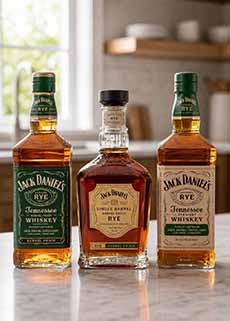
[2] Jack Daniel’s is known for making the world’s best-selling American whiskey, Old No. 7 Black Label Tennessee Whiskey. But they also make rye—three different expressions of it! (photo: The Nibble)
[3] A celebrity bottling: Sir Davis American Rye Whisky from Beyonce Knowles-Carter (photo: The Nibble).
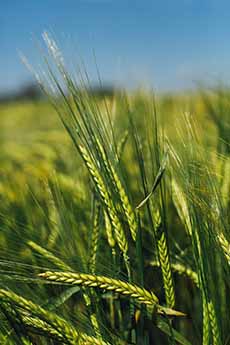
[4] A field of rye (photo © Markus Spiske | Unsplash).
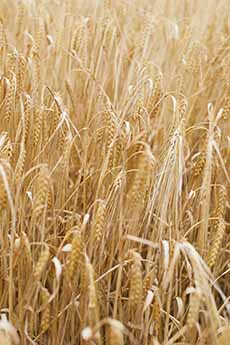
[5] The rye berries (grains) are ready to harvest and milled into a coarse meal to combined with hot water in the mash tun, eventually to be distilled into rye whiskey (photo © Natasha Arefyeva | Unsplash).
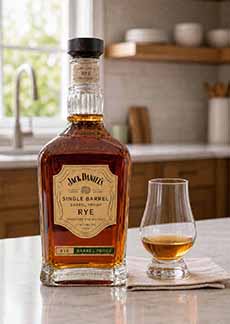
[6] The Glencairn whiskey glass is a special shape that concentrates the spirit’s aromas while diffusing harsh alcohol vapors. Its tulip shape and solid base allow for optimal swirling, nosing, and palate evaluation while fitting comfortably in the hand (photo: The Nibble).
|
|
National Rye Day—the spirit, not the bread, is celebrated annually on June 13th. This year, World Gin Day, the second Saturday of June, also falls on the 13th.
So what better day to look at the entire year of cocktails and spirits?
Surely, your favorites are on the list. Plan ahead to invite friends over for a Happy Hour of Cosmos, Martinis, Whiskey Sours, or whatever floats your cocktail boat.
Back to rye:
National Rye Day is on June 13th, but rye whiskey fans also celebrate a monthly holiday known as “Rye Day the 13th.”
National Rye Month is the month of August.
Below:
> The history of rye.
> Classic rye cocktails and prominent rye brands.
> The year’s 100+ cocktail and spirit holidays.
Elsewhere on The Nibble:
> The history of gin.
> The different types of gin.
> Gin terms a gin lover should know.
> The year’s 14 gin holidays.
> The year’s 40+ beer holidays.
> The year’s 25+ red wine holidays.
> The year’s 22+ white wine holidays.
> The history of individual cocktails, spirits, and other foods.
THE HISTORY OF RYE
Wild rye (Secale cereale), the cereal grain, originated in the Fertile Crescent: the Levant, central and eastern Turkey, and adjacent regions of Southwestern Asia.
It’s a member of the Triticeae tribe, which includes wheat and barley, which evolved in the same area. Rye and wheat diverged from a common ancestor approximately 7 million years ago.
Archaeological evidence from the Euphrates valley of northern Syria suggests that wild rye was being gathered and possibly systematically cultivated as early as 13,000 years ago (c. 11,000 B.C.E.), making it one of the very first cereal crops used by humans.
Its wild ancestors, Secale cereale subsp. vavilovii and Secale segetale, still grow in Turkey today.
Cultivation migrated to westward across the Balkan Peninsula into Eastern and Northern Europe, colder climates and poorer soils where rye grows well but wheat does not. It become a staple food in the colder northern regions.
Turning Food Into Drink
Distilling rye into spirits likely began in the late Middle Ages, particularly in regions that are now Belarus, Germany, Lithuania, Poland, Russia, and Scandinavia.
By the 15th and 16th centuries, rye-based vodkas and grain spirits were common throughout Eastern Europe. Polish distillers, in particular, developed a reputation for high-quality rye vodkas made from carefully selected rye grains.
Rye Crosses The Pond
European settlers brought rye cultivation and distilling traditions to North America during the 17th and 18th centuries.
Because rye grew exceptionally well in the Mid-Atlantic colonies—especially Maryland, Pennsylvania, and Virginia—farmers often converted surplus grain into whiskey. Distilling provided a way to preserve value and transport agricultural products more efficiently.
Rye whiskey was widely consumed across the young United States. George Washington operated one of the largest whiskey distilleries in the country after leaving the presidency.
By the late 1700s and throughout the 1800s, rye whiskey had become America’s dominant whiskey style.
The enactment of Prohibition in 1920 devastated the alcoholic beverages industry. After its repeal in 1933, many rye distilleries never reopened.
Consumer preferences shifted toward Bourbon and lighter spirits. Canadian whisky, which often incorporated rye grain, gained popularity. By the late 20th century, rye whiskey had become a niche category in the U.S.
The 21st Century Revival
Beginning in the early 2000s, rye experienced a major renaissance driven by the craft distilling movement, bartenders seeking authentic historical spirits, and a growing consumer interest in classic cocktails that helped fuel renewed appreciation for rye whiskey.
Compared with bourbon, rye whiskey is typically drier, more herbal (often notes of dill), more peppery, and spicier, with notes of citrus peel, cinnamon, clove, and mint.
In addition to American rye whiskey, the spirit is also distilled in Canada, Germany, Poland, and Scandinavia.
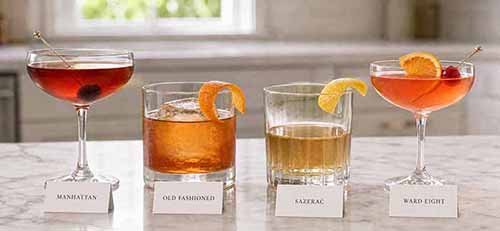
[7] Classic rye cocktails, from left: Manhattan, Old Fashioned, Sazerac, Ward 8 (photo: The Nibble).
TOP RYE COCKTAILS & BRANDS
Perhaps for the next Rye Day The 13th, you can host a party with the four most popular rye cocktails:
Manhattan (rye, sweet vermouth, Angostura bitters, and a brandied or Maraschino cherry garnish)
Old Fashioned (rye, sugar or simple syrup, Angostura bitters, and a thick slice of orange peel for garnish)
Sazerac (rye, sugar or simple syrup, Peychaud’s bitters, the glass rinsed with absinthe, Herbsaint or other anise-flavored liqueur, and a lemon peel garnish)
Ward Eight (rye, lemon juice, orange juice, grenadine, and a garnish of Maraschino cherries or an orange wedge)
Prominent American Rye Brands
These brands represent a variety of flavor profiles and price points:
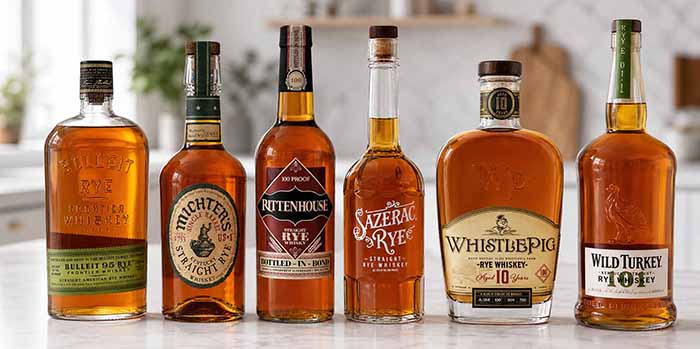
Bulleit Rye is known for its signature high-rye (95%) mash bill. It has a bold, spicy kick that cuts beautifully through mixers, making it a staple at most bars.
|
|
Michter’s US 1 Rye is a highly awarded, single-barrel whiskey that delivers incredible balance. Enthusiasts call it a top choice for drinking neat.
Rittenhouse Rye has been called “legendary,” a 100-proof Bottled-in-Bond whiskey. Bartenders at better establishments like it as the base for classic cocktails like the Manhattan or Old Fashioned.
Sazerac Rye, a New Orleans staple crafted by the Buffalo Trace Distillery, is known for its smooth, slightly sweet profile with notes of clove and candied citrus. The 18 Year Old Kentucky Straight Rye Whiskey was a gold medalist at the 2026 International Wine and Spirit Competition.
WhistlePig 10 Year is a premium, 100% rye whiskey aged for 10 years. It delivers a rich, complex flavor profile featuring deep oak, baking spices, and a long finish.
Wild Turkey 101 Rye is a bolder, higher-proof (101!) bottling that stays true to the classic Kentucky style. With robust spice and a weightiness, it holds up in any cocktail.
[8] Prominent brands of American rye whiskey (photo: The Nibble).
|
THE YEAR’S 100+ COCKTAIL & SPIRIT HOLIDAYS
|
|
January
January: Ginuary
January 1: National Bloody Mary Day
January 1: National Hangover Day
January 3: National Drinking Straw Day
January 8: National Bootlegger’s Day
January 11: National Hot Toddy Day
January 16: Prohibition Remembrance Day
January 17: National Hot Buttered Rum Day
January 25: National Irish Coffee Day
January 25: Burns Night
January 31: Brandy Alexander Day
February
February, 1st Saturday: International Pisco Sour Day
February 3: International Straw Free Day
February, Monday after Super Bowl Sunday: National Football Hangover Day
February 6: International Bartender’s Day
February 8: International Scotch Day
February 22: National Margarita Day
February 24: World Bartender Day
March
March 3: Bottled In Bond Day‡
March 3: National Irish Whiskey Day
March 3: National Moscow Mule Day
March 3: National Mulled Wine Day
March 5: National Absinthe Day
March 5: Cinco de Marcho*
March 13: National Rye Day
March 15: National Espresso Martini Day
March 21: Vermouth Day
March 24: National Cocktail Day
March 27: International Whiskey Day
March 31: National Après Day
April
April: Alcohol Awareness Month
April 9: National Gin & Tonic Day
April 11: National Ranch Water Day
April 19: National Amaretto Day
May
May 7: National Cosmopolitan Day
May 13: World Cocktail Day
May, 2nd Week: World Cocktail Week
May, 3rd Saturday: World Whiskey Day
May 15: National Pisco Day in Chile
May 16: National Mimosa Day
May 16: World Chartreuse Day
May 21: National Apéritif Day
May 22: National Craft Distillery Day
May 22: World Paloma Day
May 26: World Sherry Day
June
June 3: National Cider Day
June 4: National Cognac Day
June 5: National Moonshine Day
June, 2nd Saturday: World Gin Day
June 14: National Bourbon Day
June 14: National Old Fashioned Day
June 19: National/World Martini Day
June, 3rd Week: National Craft Spirits Week
June 26: Tropical Cocktails Day
June 30: National/World Mai Tai Day
|
July
July: Dry July
July: Rye July
July 2: National Anisette Day
July 7: National Dive Bar Day
July 10: National Piña Colada Day
July 10: Gin Basil Smash Day*
July 11: World Mojito Day
July 11: World Rum Day
July 12: National Michelada Day
July 14: National Grand Marnier Day
July 16: National Rum Day
July 19: National Daiquirí Day
July 21: Legal Drinking Age Day
July 24: National Tequila Day
July 25: Mezcalita Day
July 27: National Scotch Day
July, 4th Sunday: Día del Pisco in Peru
August
August 3: International Scottish Gin Day
August 8: International Hangover Day
August 9: World Baijiu Day
August 16: National Rum Day
August 25: National Whiskey Sour Day
August 30: National Mai Tai Day
September
September 10: National Canned Cocktail Day
September 13: National Cachaça Day
September 15: National Crème de Menthe Day
September 20: National Punch Day & National Rum Punch Day
September, 3rd Week: Negroni Week
October
October 1: International Scottish Gin Day
October 1: World Saké Day
October 4: National Vodka Day
October, 2nd Week: International Sherry Week
October 19: International Gin & Tonic Day
October, 3rd Week: National Calvados Week
October 21: National Mezcal Day
October, 4th Friday: World Champagne Day
October, last Saturday: Queensland Rum Day
October 27: National Henry C. Ramos Day (Ramos Fizz)
November
November 7: National Gin Day
November 8: National Harvey Wallbanger Day
November 12: National Happy Hour Day
November 18 : International Poitín Day†
November 20: World Gibson Martini Day
December
December 5: Repeal Day
December, 1st Friday: National Bartender Appreciation Day a.k.a. National Bartender Day
December 6: National Rhubarb Vodka Day
December 10: Trader Vic’s Birthday
December 14: National Screwdriver Day
December 20: National Sangría Day
December 21: National Coquito Day
December 24: National Eggnog Day
December 31: National Champagne Day (New Year’s Eve)
|
________________
*The Gin Basil Smash is a bright, herbaceous, and refreshing modern classic created in 2008 by Jörg Meyer at Le Lion bar in Hamburg, Germany. It’s celebrated as the ultimate warm-weather cocktail.
†International Poitín Day on November 18th honora Ireland’s ancient, historically illicit “moonshine” and the rebellious distillers who kept the spirit alive during centuries of prohibition. Dating to the 6th century, poitín (put-CHEEN) is considered one of the world’s oldest spirits in the world, traditionally brewed by monks. In 1661, the British Crown outlawed poitín in order to control and tax alcohol production. It remained strictly illegal in Ireland until it was re-legalized in 1997. Today, high-quality poitín is experiencing a major revival, distilled from a wide variety of grains and potatoes. Look for premium brands like Bán, Killowen, Micil, or Shortcross.
CHECK OUT WHAT’S HAPPENING ON OUR HOME PAGE, THENIBBLE.COM.
|