|
Ah, salted caramels—one of our favorite confections. Butter, heavy cream, sugar (avoid any made with corn syrup), perhaps a bit of vanilla, and a sprinkle of sea salt. Enrobe it in chocolate, and you travel from basic heavenly to the infinitely celestial.
Call it salt caramel or salted caramel, the first-ever National Salt Caramel Day celebration took place on November 13, 2023, established by Sanders Candy.
It was established by Sanders, a chocolate shop established in 1875 in Michigan by Fred Sanders*.
The history of salted caramel is below, but there wouldn’t be salted caramel if there hadn’t first been caramel. Let’s start at the beginning.
> November 13th is National Sea Salt Caramel Day.
> The year’s 60+ candy holidays.
> The history of candy.
THE HISTORY OF CARAMEL
The word caramel was first recorded in the English language in 1725. It comes from the Spanish caramelo.
The original Spanish word did not refer to the chewy soft caramel candy we know today, but more likely, to caramelized sugar†.
The Brits had butterscotch and toffee** but not soft caramel.
Americans Invent Soft Caramel Candy
We know that soft caramel candy is an American invention. We just don’t know exactly when it was invented.
By about 1650, Americans were boiling water and sugar in deep kettles in their fireplaces to make hard candies. Someone, at some point, added butter and milk to the pot and invented soft caramel.
By the mid-1800s, there were nearly 400 American candy manufacturers producing hard candies as well as soft caramels. Recipes for caramels abound in cookbooks of the era.
Milton Hershey’s first business was the Lancaster Caramel Company: He learned to make chocolate when seeking a coating for his caramels!‡
Caramels, or “soft toffee” so-named by the British, crossed the pond in the eastern direction in the 1880s. They created a demand for the soft, buttery treat in England.
Unfortunately, mass producers cut corners, substituting coconut oil for butter and cream until, as one writer of the time reported, “Competition stepped in with the usual result—the prices lowered, the quality suffered, until anything cut into the shape was called caramels…The very name has almost become a synonym for rubbish.”‡‡
Some 150 years later, one might say that most Americans have never tasted a real caramel—only mass-produced “rubbish” from the supermarket, the newsstand, and mass merchandise stores.
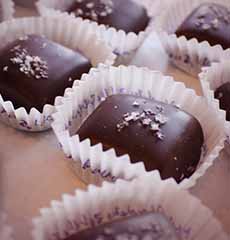
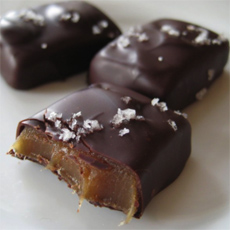
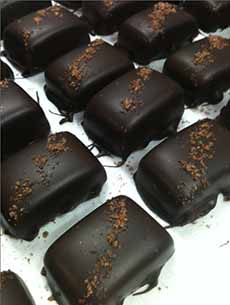
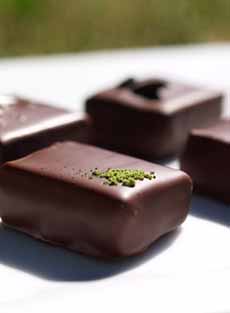
We’re happy to be able to turn back the hands of time, by introducing you to products that taste as good as—or better than—the ones made by artisans of generations past. Check out Fran’s Chocolates and Lillie Belle Farms, for starters. Lillie Belle’s lavender sea salt caramel (photos #1 and #2) is one of our favorites.
A French Chocolatier Invents Salted Caramel
From the creation of hard toffee in Britain to soft caramel in the U.S. to salted caramel from France: Voilà! We can thank Henri Le Roux, father of the salted caramel.
Le Roux’s father, Louis, was a noted pastry chef. Among other achievements, he prepared the dessert for the banquet served at the Biltmore Hotel in Asheville, North Carolina in 1933 to celebrate Franklin Roosevelt’s election.
After six years in the U.S. and one year in Australia, Louis Le Roux returned to France to open a pâtisserie in Brittany, in the town of Pont-l’Abbé, Finistère.
His son, Henri, grew up among wonderful sweets. After 3 years of formal apprenticeship training in his parents’ pastry shop, Henri went to Switzerland to learn the art of chocolate-making at the Coba Institute, which at the time was the only candy school in the world [source].
In 1965, after a short stay in Paris, Henri returned to Pont-l’Abbé to manage the family business. He sold it in 1977 to create his own chocolate factory, moving to Quiberon, a seaside resort in Brittany, the birthplace of his wife, Lorraine.
Next, Henri sought to develop a unique product that would help him stand out from his competitors.
Brittany produced delicious butter and Le Roux had the brainstorm of using salted butter instead of the conventional unsalted butter, to produce a salted caramel.
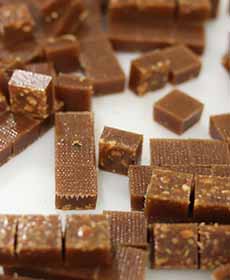
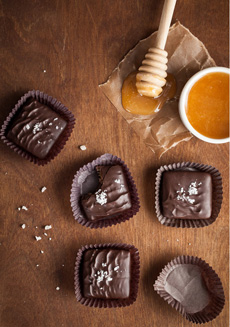
After months of testing, he came up with the perfect combination of sweet and salty: a salted butter caramel. He added crushed nuts added for a unique texture (photo #3).
In his first year, he sold 880 pounds (399 kilograms) of it, and it was going gangbusters.
By 1980, it was named “Best Sweet in France” by the Salon International de la Confiserie in Paris.
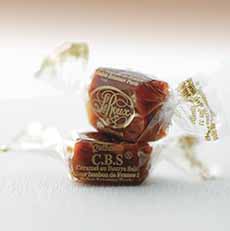
In 1981, he registered the name CBS for caramel au beurre salé (salted butter caramel).
Continued success followed, including a chain of chocolate shops and expanded factories. Here’s more of his story on the company website.
You can find one of the many Henri Le Roux candy shops in France to try the caramels and chocolates for yourself. (Warning: they’re extremely addictive.)
Salted Caramel Comes To The U.S.
While a limited amount of salted caramels from France were imported to the U.S. by French product specialists, American chocolatiers like Michael Recchiuti of San Francisco also made them.
In fact, Recchiuti may be the earliest-known American confectioner to coat his fleur de sel caramels in chocolate, in 1998.
Oh yes: In the U.S., the “naked” soft salted caramel of M. Le Roux became enrobed in chocolate in the U.S., making something already exceptional even better.
Instead of salting the caramel itself, Fran Bigelow, a chocolatier in Seattle, tweaked the concept in 1999, garnishing her chocolate-covered caramels with a sprinkle of French gray sea salt. This created a crunchy texture, which would otherwise melt into the caramel when cooked [source].
Fran used two different salts: gray sea salt sprinkled atop her dark chocolate caramels and smoked sea salt on her milk chocolate caramels (photo #9).
Other American confectioners took note, and soon salted caramels became a permanent, delectable, trend.
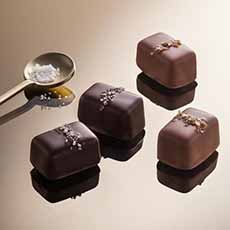
Some added different salts for aesthetics and flavor: black lava salt, fleur de sel (the queen of sea salts), matcha-flavored salt, Merlot-flavored salt, pink Himalayan salt, and so on (photos #5 and #6).
WHY IS SWEET-AND-SALTY A GREAT COMBINATION?
Our taste buds can identify five primary flavors: sweet, salty, sour, bitter, and umami. Salted caramel unites two of these.
Salt is also a basic flavor enhancer—that’s why we cook with it and shake it on our food. And that’s why it makes sweet, buttery caramel taste even better.
The trick is to get the sugar-to-salt ratio just right. It’s that barely-there sensation of salt that makes salted caramels (and salted chocolate bars) so special.
The next time you enjoy a salted caramel candy, or a salted caramel chocolate bar, ice cream, pastry, or coffee drink, dedicate a bite to Henri Le Roux.
__________________
*Sanders is now owned by a venture capital firm.
**Butterscotch is a butter-brown sugar mixture that’s cooked to a soft-crack stage. Toffee is produced by allowing that same butter and brown sugar mixture to reach the hard-crack stage. As a result, toffee is brittle and more breakable. While products called “butterscotch” may also be brittle, it’s the manufacturer who picks the name. Ideally, butterscotch should be chewy and pliable—not as soft as caramels, but softer than toffee.
†The source of the word caramelo is unknown, but some scholars believe it is related to the late Latin calamellus, a diminutive form of calamus, reed or cane—an implied reference to sugar cane.
‡Source: Madehow.com, Volume 6: Caramel.
‡‡Skuse’s Complete Confectioner, [W.J.Bush & Co.:London] 189? (p. 60-61).
|