THE NIBBLE BLOG: Products, Recipes & Trends In Specialty Foods


Also visit our main website, TheNibble.com.

TIP OF THE DAY: Bellini Cocktail For Summer

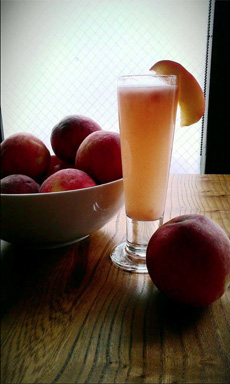
Is the Bellini the perfect summer drink? It’s made with sparkling Prosecco, a lighter alternative (and more lightly priced) than Champagne, and a purée of ripe summer peaches.

While you can purchase peach purée (The Perfect Purée makes a great one), with peaches plentiful and affordable, it’s cost effective to make your own.

We picked up a flat of a dozen peaches from Trader Joe’s for $5.99. We had planned to snack on them, but the more they ripened, the more we had other eating priorities.

The next thing we knew, we had a dozen very ripe peaches. When life gives you peaches, make peach purée. We peeled them and tossed them in the food processor.

We snacked on the tasty peelings, full of the antioxidants vitamins A, C, E and K and chlorogenic acid. (Peaches are also a rich source of calcium, fiber, folate acid and potassium.)
 
 
THE HISTORY OF THE BELLINI COCKTAIL

While many people use Champagne to make a Bellini, the original recipe, created in 1948 by Giuseppe Cipriani, head bartender at Harry’s Bar in Venice, is made with Prosecco.

The dry, sparkling Italian wine is lighter than Champagne and doesn’t contribute Champagne’s chalk and mineral flavors to the drink. (Some people confuse the Bellini with the Mimosa, a cocktail made of Champagne and orange juice.)


[1] Celebrate summer with Bellini cocktails. See the photo below to understand why it was named the Bellini (photo © Chocolate By The Bay | San Francisco).

 
The peachy color of the cocktail reminded Cipriani of the color of the robe of St. Francis in the 15th-century painting by Venetian artist Giovanni Bellini. Cipriani named the drink in Bellini’s honor.

It is said that the original Bellini was made with white peach purée. White peaches were plentiful in the area and were often marinated in wine as a dessert.

If you can’t find white peaches, don’t worry. When mixed with the Prosecco, the flavor difference between white and yellow peaches is indistinguishable. And yellow peaches provide more of the color for which the drink was named. Feel free to use whichever are more affordable.


[2] A detail from “St. Francis In Ecstasy” by
Giovanni Bellini. The painting is owned by the Frick Collection museum in New York City.
 

BELLINI COCKTAIL RECIPE

Ingredients Per Cocktail

  • 2 ounces white peach purée
  • Chilled Prosecco
  • Fresh lemon
  •  

    Preparation

    1. POUR purée into a Champagne flute.

    2. ADD a squeeze of fresh lemon.

    3. TOP with chilled Prosecco. You don’t need to stir, but if you do, do it just once and very gently so that you don’t break the bubbles.


    FIND MORE OF OUR FAVORITE COCKTAIL RECIPES.


    Comments off

    TIP OF THE DAY: Olive Oil Ice Cream, Cheese Ice Cream

    Celebrate National Ice Cream Month with something new and exciting, like the ice cream recipes below. They may sound unusual, but they’re absolutely delicious.

  • Blue Cheese Ice Cream (recipe)
  • Cheddar Ice Cream (recipe)
  • Cream Cheese Ice Cream (recipe)
  • Goat Cheese Ice Cream (recipe)
  • Olive Oil Ice Cream With Shaved Parmesan (recipe)
  • Parmesan Ice Cream Sandwiches With Parmesan Tuiles (recipe)
  • Stilton Ice Cream (recipe)
  •  

    Cheddar ice cream with grilled pineapple and balsamic reduction. Photo courtesy WMMB.


    Goat cheese ice cream. Photo courtesy
    Charlie Trotter | Chicago.
      GARNISHES

    Most of these ice creams don’t pair with caramel, chocolate or berry sauces. Instead:

  • Drizzleg a good, fruity olive oil over olive oil ice cream.
  • Add a pinch of sea salt, especially pink or red salts (Alaea Hawaiian salt, Himalayan or Peruvian salt).
  • Use a balsamic vinegar reduction for a tart-and-sweet sauce.
  • Make a tart fruit puree by adding balsamic vinegar to raspberry purée.
  •  
    FIND MORE OF OUR FAVORITE ICE CREAM
    RECIPES IN OUR GOURMET ICE CREAM SECTION.


    Comments off

    WINE: Summer White Wines You’ve Never Heard Of

    This guest post is from Jim Laughren: wine collector, former president of a Florida-based wine import and distribution company and founder of WineHead Consulting. A Certified Wine Educator, Jim has conducted hundreds of teachings, tastings and training sessions, and has visited wine regions throughout the world. He is the author of A Beer Drinker’s Guide to Knowing And Enjoying Fine Wine. He recommends three exciting white wines you’ve probably never heard of.

    As a kid in New England, growing up within earshot of chilly North Atlantic waves crashing onto the rocky shoreline, “summer whites” referred to lightweight, summer uniforms donned by the swabbies at nearby Newport Naval Base. While I’m sure the sailors were glad to trade in their peacoats and winter woolens for something a bit more comfortable, many modern day sailors—of the culinary variety—have grown tired of their summer whites and would love to find some delicious new wines for onboard entertaining.

    Whether grilling in the backyard, welcoming friends to the summertime table or lounging next to the pool. If you’re still reeling from the ABC syndrome (anything but Chardonnay), and have had your fill of not-too-exciting Pinot Grigios, take heart. There are some wonderful white wines out there just waiting to be discovered.


    Txakoli, pronounced cha-ko-LEE, from Spain’s Basque region. Photo © Jose Ortuza.

     
    Today’s recommendations are delicious, affordable and uniformly hard to pronounce. Pronunciation keys are provided, of course, so you can inquire with confidence at the wine store.

    Txakoli

    The Basque country of northern Spain us one of the world’s centers of great cuisine. When a light white is needed, the locals call for Txakoli. Ppronounced cha-ko-LEE, it’s a lively, light-to-medium bodied wine with a slight effervescence.

    Typically pale straw in color with dramatic, mouth-watering acidity, expect to find honey, citrus and stone fruit notes that go beautifully with light, simply prepared seafood. It’s the answer to the question of what wine is perfect with grilled octopus.

    If the wine’s name isn’t enough to give you pause, consider that it’s made from the grape variety Hondarrabi Zuri (onda-RAH-bee THOR-ry, with a rolled “r” on rabi).


    Edelzwicker, meaning “noble blend.” Photo
    courtesy Domaine Mauler | France.
      Edelzwicker

    Edelzwicker (AY-del-ZVEE-kur) is next in our lineup of who-named-these wines. The name means “noble blend.”

    Edelzwicker is a scrumptious, fuller bodied white that easily handles foods like smoked salmon, light pork and veal dishes. Higher in alcohol than Txakolis, these wines hail from Alsace, that northeast corner of France that’s been a ping-pong ball of territory batted back and forth between Germany and France since the Romans first established the region as a viticultural outpost around 50 B.C.E.

    Edelzwickers are a free-form blend of any or all of the best Alsatian varieties, including Riesling, Muscat, Gewurztraminer, Pinot Gris, Auxerrois and/or Sylvaner. Despite the lack of uniformity in composition, these wines are usually a lovely yellow color with open, fruity aromas. A similar, and more easily pronounced, wine, called Gentil, hails from the same region and is nearly indistinguishable.

     
    Moschofilero

    It may sound more Italian than Greek, but Moschofilero (moss-ko-FEE-leh-roe) hails from the highlands of the central Peloponnese peninsula in Greece. This rather marvelous white wine is vying to become my new, new favorite.

    Moschofilero, a pink-skinned grape descended from the ancient Filero grape family, produces wine that is light in color and known for its effusive aromas of roses and violets, followed by some nicely textured, spicy fruit flavors. This wine has presence; in fact, it’s hard not to be impressed with this particular wine, regardless of the wine styles you’re normally drawn to.

    There you have it: three unique wines, three excellent summer sipping options. While you may have trouble getting all the syllables in order, you shouldn’t have any problem finding them at most good wine shops.

    Let your retailer know you want the best examples of these wines. After all, life is short; why drink anything less than excellent? Txakoli, Edelzwicker and Moschofilero are able, exotic and ready for deployment as your new summer whites. Do your palate a favor and welcome them aboard.


    Comments off

    TIP OF THE DAY: Budget Tips For Barbecues

    Anyone who entertains knows how costly it can be to host a aimple barbecue. We can’t believe how much we spent for July 4th. We could have taken everyone to a really good restaurant!

    With much summer entertaining ahead, we’re publishing these budget-friendly tips from Jeanette Pavini, consumer savings expert for the philanthropic savings site, CouponsForChange.org, shares her tips for hosting a barbecue on a budget:

    TAKE ADVANTAGE OF SUPERMARKET SALES

    Don’t wed yourself to certain menu items. Be flexible, and build your menu around foods that are on sale. For double the savings, find coupons that match the sale items. Sites like CouponsForChange.org have printable coupons for thousands of grocery items. Plus, for every 3 coupons you clip, a free meal is provided to a needy person.


    Tailor your menu to items on sale. Photo courtesy 123rf.com.


    KNOW WHEN TO SHOP

    Ask your butcher what time of day the store marks down meat. It’s usually in the early morning or in the evening. Some stores have two rounds of markdowns. For example, a package of chicken might be marked down 30% in the morning, and if it doesn’t sell by evening, it will be further marked down to 60%.


    Be sure to put different veggies on the grill
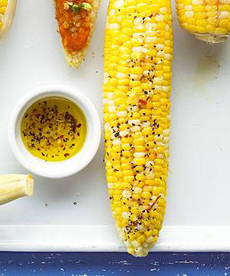
    Corn grilling cage available at Sur La Table.
     

    ADD COLOR TO THE GRILL

    The grill is not just for cooking meat. Make your grill do double duty with vegetables, so you get the most from your charcoal. Grilled vegetables are easy and delicious (we love the color of orange, red and yellow bell peppers). If you’re serving a large crowd, see if there is a wholesale produce market in your area. That’s where the restaurants shop, so you’ll get the same wholesale prices as they do as well as the freshest fruit and veggies available.

    BUY IN BULK

    Usually, a large cut of meat will be cheaper than the same amount cut into smaller pieces. If you don’t want to cut it yourself, you can always ask the butcher if he or she will cut it into smaller pieces for free. You can save even more if you buy bone-in cuts of meat.

     
    BE A BUDGET BARTENDER

    If you’re looking for a lower-cost beer and wine alternative, sangria is a popular and refreshing option—and a little goes a long way. Buy whichever fruit is on sale: apples, berries, oranges, pineapples, whatever. Combine with a bargain bottle of wine, add carbonated water and a sweetener like orange juice.

     
    Please share your budget barbecue tips!


    Comments off

    Thai Iced Tea Recipe With Sweetened Condensed Milk


    WHAT IS THAI ICED TEA?

    Thai iced tea, known as cha-yen (cha is the word for tea), is served in Thailand, Vietnam, elsewhere around the Pacific Rim and in Thai restaurants in the West and elsewhere around the world.

    It’s made from strong-brewed black tea and sweetened condensed milk, which adds body and creamy mouthfeel.

    The brewed tea can be enhanced with spices, such as cardamom, clove, nutmeg, star anise, and tamarind. If you like chai tea with milk and sweetener, you’ll equally like Thai iced tea.

    For visual appeal, the deep amber tea and white condensed milk are swirled together or layered. The drink can be topped off with evaporated milk, coconut milk, half and half, or whole milk.

    The countries where it’s most popular are known for hot, steamy summers. Thai iced tea is a welcome refreshment—and a complement to spicy food. If your neck of the woods is as hot and steamy as ours is, it’s time to try the recipe.

    > The different types of tea.

    > The history of tea.

    > The history of sugar is below.
     
    RECIPE: THAI ICED TEA

    Ingredients For 6 Servings

  • 3/4 cup black tea leaves (approximately 3 ounces)
  • Optional spices: cardamom, ground tamarind, nutmeg, star anise, or others (cinnamon works for us), to taste
  • 6 cups boiling water
  • 1/2 cup sugar (or equivalent noncaloric sweetener)
  • 1/2 cup sweetened condensed milk
  • 1 cup evaporated milk to top (you can substitute coconut milk, half-and-half, or whole milk)
  • Ice
  •  
    Preparation

    1. STEEP the tea leaves (and any optional spices) in boiling water for 5 minutes. Strain out the tea leaves. Using an infuser (tea ball) makes this step easier.

    2. STIR in the sugar until dissolved while the tea is still hot; then stir in condensed milk.

    3. COOL to room temperature or ideally, chill in the fridge.

    4. ADD ice to tall iced tea glasses and pour in tea mixture until glasses are roughly 3/4 full. Slowly top off glasses with evaporated milk.
     
    Variations

    If you find yourself in the Pacific Rim, you can have what Americans think of as iced tea.

  • Dark Thai iced tea (cha dam yen) is simple iced tea without milk, sweetened with sugar.
  • Lime Thai tea (cha manao) is dark Thai iced tea flavored with lime. Mint may also be added.
  •  
    If you’re looking for unsweetened iced tea in the Pacific Rim, you may be out of luck. It’s the birthplace of sugar.
     
     
    A BRIEF HISTORY OF SUGAR

    Sugar is native to Southeast Asia, with three species seeming to have originated in two locations: Saccharum barberi in India and Saccharum edule and Saccharum officinarum in New Guinea, part of modern Indonesia.

    Some scientists believe that cane sugar actually originated in New Guinea and spread to India.

    Indian sailors carried sugar along various trade routes. In 326 B.C.E., Alexander the Great and his troops saw farmers on the Indian subcontinent growing sugar cane and making the crystals, which were called sharkara, pronounced as saccharum.

    The Macedonian soldiers carried “honey-bearing reeds” home with them. But sugar cane remained a little-known crop to most Europeans for the next thousand years, a rare and costly product that made sugar traders wealthy.

    Originally, people chewed on the raw sugar cane stalks to enjoy the sweetness from the sap. Refined sugar appears around 500 B.C.E. when residents of what is now India began to make sugar syrup from cane juice. They cooled it to make crystals that were easier to store and transport. These crystals were called khanda, which is the source of the word candy.

    In 510 B.C.E. Emperor Darius of Persia invaded India, and was delighted to find “the reed which gives honey without bees.” Returning to Persia with the bee-less reed, the secret of cane sugar was kept a closely guarded secret.

    When Arabs invaded Persia in 642 C.E., they discovered sugar cane and learned how it was grown and produced. As the Arab conquerors expanded their empire, sugar plantations appeared in North Africa, Spain, and elsewhere.

    Sugar was only discovered by western Europeans as a result of the Crusades in the 11th century C.E. The first notice of sugar was recorded in England in 1069 [source].

    Although sugar arrived in Europe around 1100, it was very expensive and not widely used except by the wealthy, who used it both to sweeten foods and as a medicine.

    Venice began to produce sugar in Lebanon to supply Europe, where honey had been the only available sweetener. By the 15th century, Venice was the chief sugar refining and distribution center in Europe.

    It should be noted that sugar did not arrive granulated, in a box. It was originally sold in cones because the refining process involved pouring the boiled sugar syrup into inverted conical molds.

    This allowed the molasses—the by-product of sugar refining—to drain out through a small hole at the bottom of the mold.

    The result: a solid cone of white sugar, called a loaf (hence the term sugarloaf). the cone shape facilitated the purification and drying of the sugar crystals, and the loaf that could be easily stored. It was portioned by shaving at the pointed end.

    In the 16th century, the price of sugar, though still high, was affordable by the middle class. By the mid-16th century, recipes for baked goods and confectionery showed sugar being used freely.

    And, many experts today would say, it is now used far too freely.

    Perhaps use was slower then, due to the challenge of shaving rock-hard sugar from the cone. There had to be a better way, and in 1843 by Jakub Krystof Rad who was a director of a sugar refinery in Dačice, Bohemia, Austria-Hungary, developed it.

    As the story goes, his wife sliced her finger cutting a lump of sugar and complained that sugar should be made in a convenient size for a cup of tea.

    He went to work inventing the process and machinery to cutting large blocks of sugar into small, uniform pieces: the sugar cube.

    Great, but there was still a better way. Refining techniques improved due to the development of new technologies and large-scale sugar production in the Americas, and granulated sugar finally became widely available in the late 19th century.
     
     
    HOW MANY TYPES OF SUGAR HAVE YOU HAD?

    Check out the different types of sugar in our Sugar Glossary.


    [1] The milky swirl of Thai iced tea is a visual treat (photo © Arbor Teas).


    [2] Sweetened condensed milk is added to the top of the tea, where it swirls down into the glass, creating arresting visuals (photo © Other Things | CC BY-NC-SA 2.0 License).


    [3] Sweetened condensed milk is a key flavor in Thai iced tea, although coconut milk can be used as a non-dairy alternative (photo © Nestlé).

    Sugar Bowl
    [4] There’s lots of sugar in Thai iced tea. Make your own to control the amount or use a sugar substitute (photo © Hannah Kaminsky | Bittersweet Blog).

    Cardamom Pods On Spoon
    [5] Cardamom pods are a favorite spice to brew in Thai iced tea (photo © Farmgirl Gourmet).

    Making sugar before modern technology
    [6] Making sugar. Molds were used to turn liquid sugar into cones. You can still purchase it that way in some parts of the world (image via Creative Commons Public Domain license).

    Sugarloaf, a cone of sugar
    [7] You can still purchase a sugarloaf in some parts of the world. This one was sold in Tabriz, Iran (image © Petr Adam Dohnalek | Wikipedia).


    CHECK OUT WHAT’S HAPPENING ON OUR HOME PAGE, THENIBBLE.COM.


    Comments off

    The Nibble Webzine Of Food Adventures
    RSS
    Follow by Email


    © Copyright 2005-2026 Lifestyle Direct, Inc. All rights reserved. All images are copyrighted to their respective owners.