THE NIBBLE BLOG: Products, Recipes & Trends In Specialty Foods


Also visit our main website, TheNibble.com.

RECIPE: Pumpkin Spice Brownies For Halloween & Thanksgiving


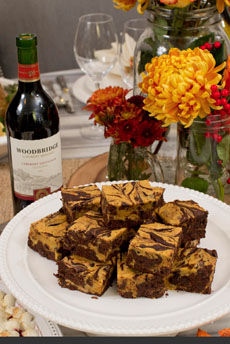
[1] Pumpkin spice cream cheese brownies (photo © Woodbridge by Robert Mondavi).


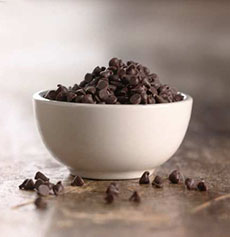
[2] They even have chocolate chips (photo © King Arthur Flour).


These seasonal brownies combine elements of pumpkin pie and chocolate cream cheese brownies.

The recipe is courtesy of Woodbridge by Robert Mondavi, where the team enjoys the brownies with a glass of Woodbridge Cabernet Sauvignon.

Pumpkin purée, pumpkin pie spices, cream cheese, cocoa, chocolate chips…how can you resist?
 
 
RECIPE: PUMPKIN SPICE BROWNIES

Ingredients

  • ¾ cup all-purpose flour
  • ½ teaspoon baking powder
  • ½ teaspoon salt
  • ¾ cup butter, melted
  • 2/3 cup brown sugar, packed
  • 1 teaspoon vanilla extract
  • 3 eggs
  • ¼ cup unsweetened cocoa powder
  • ½ cup semi-sweet chocolate chips
  • ½ cup pumpkin purée
  • ¼ cup granulated sugar
  • 4 ounces cream cheese, softened
  • ½ cup chopped, toasted hazelnuts or pecans
  • ¾ teaspoon ground cinnamon
  • ½ teaspoon ground cloves
  • ½ teaspoon ground nutmeg
  • ¼ cup unsweetened cocoa powder
  •  
    Preparation

    1. PREHEAT oven to 350°F. Butter an 8″x 8″ baking dish.

    2. WHISK together in a bowl the flour, baking powder and salt. In another bowl, stir together butter, brown sugar and vanilla extract. Mix in eggs one at a time. Gradually add flour mixture; stir to combine evenly. Divide batter into two bowls.

    3. BLEND the cocoa powder and chocolate chips into the first bowl. In second bowl, stir in pumpkin purée, granulated sugar, cream cheese, nuts, cinnamon, cloves and nutmeg.

    4. SPREAD half of the chocolate batter into the bottom of the baking dish. Follow with half of pumpkin batter. Repeat layers, ending with a pumpkin layer. Gently pull a long kitchen knife or skewer through the layers in a wavy motion to create a marbled pattern.

    5. BAKE until a toothpick inserted into the center comes out clean, 40 to 45 minutes. Cool brownies in pan on a wire rack.


    Comments off

    Chocolate Covered Strawberries Recipe & Christmas Strawberries

    If you typically bake a cake or cookies to bring along as a house gift, how about a better-for-you alternative: chocolate-dipped strawberries?

    We were inspired by these festive Holiday Chocolate Dipped Strawberries from Harry and David ($39.95 + shipping) to make our own.

    And all you need to do is melt chocolate and dip! Just as you need tasty fruit, quality counts with the chocolate. While strawberries with their leaves are particularly pretty, you can substitute any other fruits, including seedless orange slices and dried apricots.

    Note that even if you prefer milk chocolate, dark chocolate provides a better flavor contrast with the berries. Dark chocolate lovers: For similar reasons, no matter how bittersweet you like your chocolate, keep the cacao content in the 50% to 70% cacao range.

    It’s best to make these on the same day as they will be consumed. If you don’t feel up to piping red and green decoration, serve them plain: Everyone will love them just as much.

     
    Chocolate covered strawberries with a holiday embellishment (photo © Harry And David).
     
     
    RECIPE: CHOCOLATE COVERED STRAWBERRIES

    Ingredients

  • 1 pound strawberries with attractive green leaves and stems
  • 8 ounces dark chocolate
  • Christmas Garnish: piped red and green royal icing or colored white chocolate, green and red sprinkles or sanding sugar, silver or gold dragées
  • Hanukkah Garnish: piped blue and white royal icing or colored white chocolate, blue and white sprinkles or sanding sugar, silver or gold dragées
  •  
    Preparation

    1. PURCHASE strawberries on the day of preparation, if possible, so leaves will remain perky. Buy the largest berries you can find. If you can’t find berries with fresh leaves, default to orange segments or dried apricot slices.

    2. CAREFULLY WASH the strawberries and pat them dry with a paper towel, leaving the stems intact.

    3. CHOP the chocolate and melt in a double boiler, or in a small bowl placed over a saucepan of gently simmering water. Take care that the chocolate does not get too hot. Remove from the heat. You can also microwave the chocolate at 30-second intervals, stirring in-between.

    4. DIP the berries into the chocolate, holding the stems very gently. Place onto sheets of baking parchment or waxed paper to cool and set.

    5. KEEP the berries in a cool place (but not the fridge, or the chocolate may bloom) until ready to serve.


    CHECK OUT WHAT’S HAPPENING ON OUR HOME PAGE, THENIBBLE.COM.


    Comments off

    Chestnuts Roasting On An Open Fire (How To Roast Chestnuts)

     
    Chestnuts In Bowl
    [1] Chestnuts drop from the trees in the fall. See photo #4 (photo © Tijana Drndarrski | Unsplash).

    Slicing the X Before Roasting Chestnuts
    [2] Before roasting, make a cut in the shell so the steam can escape (photo © Chef Eddy).

    Chestnuts Roasting On A Grill
    [3] You can roast the chestnuts in the oven, on the stovetop, or on a grill (photo © Sid Wainer).

    Chestnuts With Husks a.k.a. Burrs [4] The husk of the chestnut, also called the burr, is bright green and snazzy (photo © Umami Information Center | Facebook).

       
    How would you like to roast your own chestnuts at home? Just the fragrant aroma of them is enough to make mouths water and fingers itch to peel them for snacking.

    You don’t need a working fireplace to roast the chestnuts. Back in the old days, the fireplace was the only source of heat in the kitchen. Today, we have other options.

    You can roast chestnuts in the oven in a pan, or on the stovetop with a special chestnut roasting pan. A chestnut roasting kit, complete with two pounds of chestnuts, is available at Melissas.com and elsewhere. It makes a nice family gift.

    Compared to other nuts, chestnuts are composed chiefly of starch; other nuts have a larger percentage of protein.

    The nutritional composition of chestnuts is similar to that of other starchy foods—corn, plantains, potatoes, etc. Yet, they are a better-for-you snack, a good source of minerals, vitamins, and some high-quality protein.

    December 14th is Roast Chestnuts Day.

    > The year’s 38 nut holidays.

    Below:

    > The history of chestnuts.

    > Sing “Chestnuts Roasting On An Open Fire.”
     
     
    HOW TO ROAST CHESTNUTS

    1. PREHEAT oven to 350°F. Cut an X on the flat side of each nut using a small, sharp knife. Be careful not to cut into the nutmeat.

    2. OVEN ROASTING: Place the nuts in a single layer on an ungreased baking sheet and roast until the scored portions begin to curl up and the nuts release their fragrance, 15 to 20 minutes.

    CHESTNUT PAN ROASTING: Heat the pan over medium-low heat and add the chestnuts. Cook, tossing the chestnuts frequently until the shells crack and the chestnuts are cooked through. The timing is 30 to 35 minutes over a gas flame burner or 35 to 40 minutes over an electric or induction burner.

    3. REMOVE the nuts to a plate and eat immediately. Peeling the nuts is part of the fun, and each person may want to peel his or her own (or, you can peel all of them in the kitchen before serving). However, they are hot.

    If the nuts are very hot, pick up individual nuts using a kitchen towel or other protection. Then with fingers or a knife, peel away the shell. Remove the inner skin, pop a nut into your mouth and enjoy.
     
     
    THE CHRISTMAS SONG: LYRICS

    “Chestnuts Roasting on an Open Fire” is the informal name of “The Christmas Song”; it was originally subtitled “Merry Christmas to You.” This Christmas classic was composed by Mel Torme and Bob Wells in 1946.

    The most popular recording remains the first one, recorded by Nat King Cole. Here’s Nat King Cole on YouTube—the vocal track over a Christmas tree and fireplace visual.

    You can sing along:

    Chestnuts roasting on an open fire,
    Jack Frost nipping on your nose,
    Yuletide carols being sung by a choir,
    And folks dressed up like Eskimos.

    Everybody knows a turkey and some mistletoe,
    Help to make the season bright.
    Tiny tots with their eyes all aglow,
    Will find it hard to sleep tonight.

    They know that Santa’s on his way;
    He’s loaded lots of toys and goodies on his sleigh.
    And every mother’s child is going to spy,
    To see if reindeer really know how to fly.

    And so I’m offering this simple phrase,
    To kids from one to ninety-two,
    Although its been said many times, many ways,
    A very Merry Christmas to you.


    THE HISTORY OF CHESTNUTS

    Chestnut trees first appear in the fossil record roughly 85 million years ago, long before the extinction of the dinosaurs (about 66 million years ago), and far before the appearance of mankind*.

    From the beginning of mankind’s migration to the Northern Hemisphere, chestnuts were a dietary staple throughout temperate regions.

    The European sweet chestnut (Castanea sativa), the Chinese chestnut (Castanea mollissima), the Japanese chestnut (Castanea crenata), and the American chestnut (Castanea dentata) had long been integral to local ecosystems and, eventually, to humans.

  • The Romans cultivated European chestnuts extensively, spreading them across their empire and perfecting preservation techniques. They ground chestnuts into flour, which could be stored through winter and baked into a nutritious bread. Chestnuts proved invaluable in mountainous regions of Italy, Corsica, and parts of France, where wheat cultivation was difficult. There, chestnuts earned the nicknames “bread tree” and “grain that grows on trees.”
  • During the Middle Ages, chestnut cultivation intensified across Europe. Monasteries maintained vast chestnut groves, and feudal lords often demanded chestnuts as tribute from their tenants. As always, the nuts provided crucial calories during lean winter months, and their versatility—boiled, dried, milled, roasted—made them indispensable. European peasants relied so heavily on chestnuts that famines often followed poor chestnut harvests.
  • Across the ocean, the American chestnut dominated the forests of the eastern U.S. These majestic trees, which could reach heights of over one hundred feet with trunks six feet in diameter, comprised roughly one in four hardwood trees in Appalachian forests. Native American tribes gathered chestnuts as a food source and used the rot-resistant wood for building.
  • In the 16th century, European settlers to the U.S. valued the chestnut for food and timber, and tannin‡ production from the bark.
  • The 19th century saw the apex of chestnut culture in the U.S. Corner street vendors in cities roasted chestnuts during winter months, filling the air with alluring aroma. The timber industry prized American chestnut for its straight grain, workability, and natural resistance to decay. It was used for everything from railroad ties to fence posts to fine furniture.
  • The 20th century began in disaster. In 1904, a fungal blight (Cryphonectria parasitica) was discovered in the Bronx Zoo, likely introduced on imported Japanese chestnut trees. Within 50 years, the disease had killed an estimated four billion American chestnut trees, functionally eliminating the species from its native habitat. The ecological and economic impact was catastrophic, altering eastern forests and ending a way of life for countless communities that had depended on chestnut harvests.
  • Europe faced similar threats from ink disease and blight, though not to the same devastating extent as America. Asian species, having co-evolved with the blight pathogens, had natural resistance, which has made them central to modern restoration efforts.
  •  
    Roasted Chestnuts
    [5] Roasted chestnuts from a street vendor (photo © F Zaytt | Pexels).

    Today, organizations like The American Chestnut Foundation work tirelessly to breed blight-resistant American chestnuts by crossing them with Chinese varieties, hoping to restore these giants to their native forests.

    Meanwhile, chestnut cultivation continues globally, with China now producing the vast majority of the world’s chestnuts, followed by South Korea, Turkey, and Italy. The majority of chestnuts sold in the U.S. come from Italy and Turkey.

    To a small extent, European sweet chestnuts, introduced by Thomas Jefferson in 1773, have become the primary source of commercial chestnuts grown domestically.

    The U.S. also grows Chinese chestnuts and American-Chinese hybrid varieties that are resistant to chestnut blight. Domestic production comes mainly from Michigan, Florida, California, Oregon, Virginia, and Washington state.
     
    ________________
     
    *The earliest members of our genus, Homo habilis, first appeared in Africa roughly 2.4–2.8 million years ago. However, the first human species to appear in temperate Eurasia, Homo erectus and relatives), only arrived to discover chestnuts around 2 million years ago.

    Tannins were used for tanning leather, dyeing fabrics, clarifying wine/beer, and making ink, among other things.


    CHECK OUT WHAT’S HAPPENING ON OUR HOME PAGE, THENIBBLE.COM.

     
    Chestnuts On A Grill
    [6] Chestnuts grilling on a street cart (photo © Frans Van Heerden | Pexels).


    Comments off

    PRODUCT: Cheeky Monkey Peanut Butter Puffs


    A tasty, gluten-free snack—organic and
    kosher, too. Photo by Elvira Kalviste | THE
    NIBBLE.

      Imagine if cheese puffs tasted like peanut butter instead of cheese, and you’ve got Cheeky Monkey Peanut Butter Puffs.

    They’re airy, peanutty, kosher, gluten free and organic.

    The ingredients are simple: organic corn, organic palm oil, organic peanut butter and salt. Produced by Hasadeh Organic, the melt-in-your-mouth snack is good for everyone from toddlers to grown-ups.

    The bags, graced with a humorous monkey juggling peanuts, make fun stocking stuffers and party favors.

    The snacks are gluten free certified by Gluten Free Certification Organization, and certified kosher (parve) by OU.

  • A 2.12-ounce bag is $2.49 on Amazon.com.
  • A case of 12 bags is $31.55.
  • For those who like a spicy kick, there are Peanut Butter Chili Pepper Puffs.
  •  
    Learn more at CheekyMonkeyOrganic.com.


    Comments off

    GIFT: Sriracha Candy Canes

    When Santa comes down your chimney, leave him something more interesting than cookies and milk.

    Warm up his—and your—taste buds with J&D’s Sriracha Candy Canes. Sriracha, the popular Thai hot sauce has been used to create a fiery candy cane for those who like heat with their sweet.

    Give a box to heat-loving friends, serve them crushed over ice cream or hot chocolate, or use them as as a spicy-sweet holiday cocktail stirrer.

    Each box has 12 individually wrapped sriracha candy canes, $7.99 at BaconSalt.com.

    They’re made by J&D Foods, the people who brought you bacon salt and our beloved Baconaise (which you can also purchase on the website).

     
    Sweet and hot: sriracha candy canes. Photo
    courtesy J&D Foods.


    Comments off

    The Nibble Webzine Of Food Adventures
    RSS
    Follow by Email


    © Copyright 2005-2026 Lifestyle Direct, Inc. All rights reserved. All images are copyrighted to their respective owners.