THE NIBBLE BLOG: Products, Recipes & Trends In Specialty Foods


Also visit our main website, TheNibble.com.

PRODUCT: Pistachio Chewy Bites

pistachio-tea-3-230
A favorite snack: chewy pistachio bites.
Photo by Elvira Kalviste | THE NIBBLE.
 

While several of us tried to determine the name of the company, we all agreed: These Pistachio Chewy Bites are good stuff.

Simple and nutritious, they’re a blend of roasted pistachios and dried cranberries, bound in a honey-like mix of two low-glycemic* sweeteners, agave and brown rice syrup.

The bites are small—2″ x 1-1/2″—but nutrient dense and filling. One is enough, really, although the serving size is two.

We’ve been enjoying them as an on-the-go snack, for breakfast and at tea time. We have afternoon tea at THE NIBBLE, and these snacks can hold their own with biscotti, cookies and other sweets we sample each day.

If you need a quick dessert garnish, you can dice the bars as a topping for cupcakes, ice cream or sorbet.

The only confusion is the name of the company, only visible on the bag in the logo. There’s no URL, no company name in the marketing copy on the bag.

We don’t have room for a photo here, but look at it.


Is it Seffon Farms? Selton Farms? Setton Farms.

It’s the latter. We had to Google it.

The line is certified gluten free and certified kosher by OK.

Learn more about Setton Farms, a California pistachio grower,

Buy the bites on Amazon.
 
*The glycemic index of table sugar is 60-65. The glycemic index of agave is 32, and brown rice syrup is 20. Honey is 58 and pure maple syrup is 54. Agave is 1.4 to 1.5 times sweeter than sugar and honey, so you don’t need to use as much.


Comments off

RECIPE: Burrata & Fruit Dessert

We love burrata, and love it all the time since our local Trader Joe’s always has it in stock.

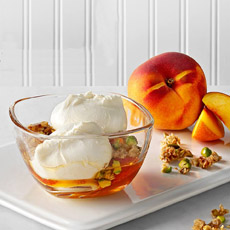
In this recipe from EatWisconsinCheese.com, burrata provides a different take on a fruit and cheese dessert. It’s more special than simply putting out a platter of cheeses and fruits, but not much more difficult.

  • Using lush summer peaches or nectarines.
  • Instead of burrata, you can substitute fresh goat cheese, mascarpone or ricotta—or a bit of each!
  •  
    > The history of burrata.

    > The history of mozzarella.

    > The history of cheese.

    > The different types of cheese: a photo glossary.

    > The year’s 30 cheese holidays.

    > The year’s 80 fruit holidays.

    While there isn’t yet a National Burrata Day, some burrata lover out there should make it happen!
     
     
    WHAT IS BURRATA

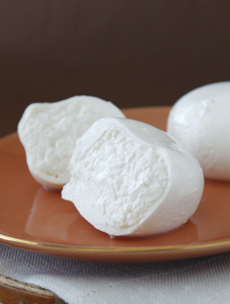
    Burrata is a fresh Italian cheese, creamy and luscious, made in the Apulia region of Italy. The name means “buttery” in Italian. It’s a hollow ball of mozzarella di bufala, filled with panna, cream that contains scraps of mozzarella left over from mozzarella-making.

    How Burrata Is Made

    Small pieces of mozzarella curd are soaked in a bath of hot water and sea salt. The cheese is then cooked and stretched with a wooden spoon until the curds can be stretched to create a pouch. The pouch is filled with a combination of mascarpone cheese, ricotta cheese and heavy cream, and tied off with a knot.

    Some cheese makers use different recipes, but the center is always a rich, oozing cream. When you cut into the ball, the cream oozes out.

    In Italy, the cheese is packed into plastic bags with a bit whey to keep it moist, and the bag is tied with a fronds of an Italian plant called asphodel, a relative of the leek. The cheese is highly perishable, and the leaf is an indicator of freshness. As long as the leaf is still fresh and green, the cheese within is still fresh. Dried-out leaves mean a cheese is past its prime.
     
     
    RECIPE: BURRATA & FRUIT

    Ingredients

  • Burrata
  • Granola
  • Sliced fresh fruit
  • Honey
  • Optional garnish: pistachio nuts
  •  
    Preparation

    1. SCOOP granola into an individual bowl or onto a dessert plate.

    2. SLICE fruit and arrange atop granola.

    3. TOP with two quarters of a burrata.

    4. DRIZZLE with honey and garnish with chopped pistachio nuts.
     
     
    WHO INVENTED BURRATA?

    This addictively good cheese was created by a mother (or father) of invention, in the Puglia region of southern Italy. Cheesemakers had curds left over from making mozzarella.

    Somewhere around 1920 in the town of Andria, a member of the Bianchini family figured out how to repurpose the curds, and burrata was born. It was a local product, premium priced, and remained the delight of the townspeople only for some thirty years.

    In the 1950s, some of the local cheese factories began to produce burrata, and more people discovered its charms. Only in recent years, thanks to more economical overnighting of refrigerated products, did we find it in New York City’s finest cheese shops.

    It was love at first bite.

       
    burrata-peaches-eatwisconsincheese-230
    [1] A simple dessert with delicious, fresh flavors (photo © Wisconsin Cheese).

    sliced-whole-230
    [2] Burrata: a shell of mozzarella with a creamy center (photo by Elvira Kalviste | © The Nibble).

    Plates of prosciutto, melon, and burrata cheese
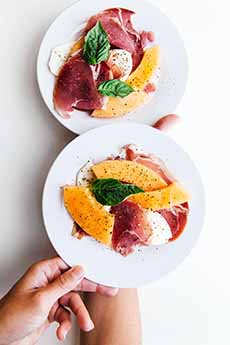
    [3] Burrata is delicious with prosciutto, and makes a dish of melon and prosciutto even better (photo © Chris Ralston | Wesual | Unsplash).

    Roasted Beets & Burrata
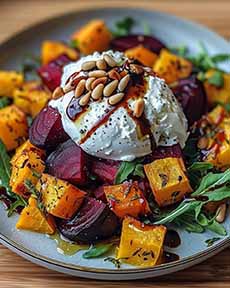
    [4] Roasted beets and butternut squash with burrata and pepitas on a bed of arugula. Here’s the recipe (photo Facebook).

     
    Burrata Today

    When we first wrote about burrata seven years ago it was hard to come by, made only in Puglia and flown to the U.S. The limited amount that was imported went straight to top cheese stores; the minute it appeared on store shelves, it was snatched up by burrata lovers on the prowl. (We knew what day of the week the plane set down.)

    But that’s old news. Since then, American cheese makers have been making burrata, and much of it is just as delicious and creamy as the Apulian product.

    Burrata works with sweet or savory pairings. In addition to fruit (figs, pears…any fruit, really), serve it as a first course, cheese course, light lunch or snack:

  • With crusty bread and tomatoes
  • With prosciutto
  • In a “deluxe” Caprese salad
  • With a salad garnished with beets and toasted pecans or walnuts
  •  
    Once, at the end of a trade show, we were given several burratas to take home. We used three of them to top a pizza: a memorable luxury.

    For breakfast the next day, we married the burrata with pan-fried slices of herbed polenta and sundried tomatoes, but it could just as easily have been fruit and honey.

    The memories still resonate happily, whenever we pass a cheese case.


    CHECK OUT WHAT’S HAPPENING ON OUR HOME PAGE, THENIBBLE.COM.


    Comments off

    RECIPE: Cookie Dough Ice Cream Sandwiches

    We often make a “double cookie dough” ice cream sandwich: chocolate chip cookies with cookie dough ice cream. But this recipe from McCormick uses raw cookie dough—not baked—as the sandwich.

    You make the cookie dough yourself, and don’t need to add eggs since it won’t be baked. Or, you can use pasteurized eggs.

    RECIPE: COOKIE DOUGH ICE CREAM SANDWICHES

    Ingredients For 16 Bars

  • 1/2 cup (1 stick) butter
  • 1/2 cup firmly packed brown sugar
  • 1/4 cup granulated sugar
  • 3 tablespoons milk
  • 2 teaspoons vanilla extract
  • 1/4 teaspoon salt
  • 1-1/2 cups flour
  • 1 cup miniature chocolate chips
  • 2 cups ice cream, softened
  •   Chocolate_Chip_Cookie_Bar_Ice_Cream_Sandwich_mccormick-230
    A different take on cookie dough ice cream. Photo courtesy McCormick.
     
    Preparation

    1. MICROWAVE the butter and sugars in large microwavable bowl on HIGH 1 1/2 to 2 minutes, stirring after 1 minute. Stir until mixture is melted and smooth.

    2. STIR in milk, vanilla and salt. Add flour; stir until well blended. Refrigerate 15 minutes. Stir in chocolate chips.

    3. LINE an 8-inch square pan with foil, with ends of foil extending over sides of pan. Press 1/2 of the dough into pan.

    4. ROLL out remaining dough on lightly floured surface to 8-inch square. Gently spread ice cream over layer on pan. Place 8-inch square layer over ice cream. (If the dough layer is too warm, freeze for 15 minutes before placing over ice cream.)

    5. COVER with foil. Freeze 2 hours or until firm. Cut into 16 bars. Wrap each in plastic wrap. Store in freezer.
     
    NATIONAL ICE CREAM DAY IS AUGUST 2ND

    See all the food holidays.
    NATION


    Comments off

    Homemade Lollipops For National Lollipop Day

    red-clear-lollipops-230
    [1] Your homemade lollipops can be free-form with inclusions, like the bits of flower petals above (photo © Sacred Sweets).
     

    Looking for a fun activity? How about making lollipops?

    Today is National Lollipop Day July 20th, and Exploratorium has a recipe that lets you be a lollipop chef.

    You can make favorite flavors that aren’t often found in commercial products. We’ve got anise, banana, hazelnut, mint, and rum extracts that are just waiting to flavor lollys (the original spelling).

    The other ingredients include sugar, corn syrup, water, cream of tartar, and liquid food coloring.

    You can mix up standard or unusual colors with food coloring; but the idea that really appeals to us comes from Sacred Sweets in Greenport, New York.

    They turn lollipops into edible art with:

  • Clear or barely tinted candy that shows off the inclusions inside.
  • Inclusions (mix-ins) like edible flowers and glitter (you can use sprinkles and other decorations)
  • Free-form shapes
  •  
     
    LOLLIPOP HISTORY

    Lollipop sophistication has come a long way since prehistoric man licked honey off the stick he used to scrape it from the beehive.

    The ancient Arabs, Chinese, and Egyptians made fruit and nut confections candied in honey, which may also have been eaten from sticks, owing to the stickiness of the confection.

    But what we think of as a lollipop may date to Europe in the Middle Ages, when sugar was boiled and formed onto sticks as treats for the wealthy—the only people who could afford sugar.

     
    By the 17th century, sugar was plentiful and affordable. In England, boiled sugar (hard candy) treats were popular. The word “lollipop” (originally spelled lollypop) first appears in print in 1784, roughly coinciding with the beginning of the Industrial Revolution.

    Beginning in the later part of the 18th century, industry, including confectionery, became mechanized. Horehound drops, lemon drops, peppermints, and wintergreen lozenges became everyday candies.


    While we don’t know the inventor of the modern lollipop, the first automated lollipop machine was invented in Racine, Wisconsin in 1908. The Racine Confectionery Machine Company’s machine put hard candy discs on the end of sticks, producing 2400 lollipops per hour, 57,000 per day. Today’s machines can produce 3 million lollipops daily.

    Far beyond the specialty Blow Pops, Tootsie Pops, Sugar Daddys of childhood, today’s lollipops come in all shapes and sizes, from hand-crafted works of sugar art to caffeinated Java Pops and bacon lollipops.

    And handcrafted lollipops still exist, made by companies like Hammond’s Candies, where artisans coil ropes of boiled hard candy into colorful jumbo lollipops.
     
     
    SEE’S LOLLYPOPS: SOMETHING DIFFERENT

    See’s Candies chooses the original spelling for its “lollypops,” but perhaps that’s to differentiate the creamy candy-on-a-stick from conventional lollys.

      sees-lollipops-unwrapped-beauty-230
    [2] See’s creamy “lollypops,” made with butter and cream (photo © See’s Candies).
     

    See’s are made with butter and heavy cream, in a square shape (see photo at right).

    Available in butterscotch, café latté, chocolate, chocolate orange, root beer, and vanilla (plus holiday flavors), they have the consistency of butterscotch and are certified kosher by KSA.

    And they’re addictive! Treat yourself to some at Sees.com.


    CHECK OUT WHAT’S HAPPENING ON OUR HOME PAGE, THENIBBLE.COM.


    Comments off

    The Classic Daiquiri, History Of The Daiquiri & More Daiquiri Recipes

    Classic Daiquiri
    [1] No. 2 Daiquirí of the four recipes below. It’s the first variation of the original, created in 1920s Havana (photo © Bacardi Rum).

    Grapefruit Daiquiri

    [2] A recent take: the Grapefruit Daiquirí, substituting grapefruit juice for the lime (photo © Ruth’s Chris Steak House).

    Hawthorne Strainer Barware
    [3] A Hawthorne strainer. This one is from Williams Sonoma.


    July 19th is National Daiquirí Day.

    A Daiquirí (pronounced DAK-uh-ree in English, but die-kee-REE in the native Taíno language) is a combination of rum, lime juice, and sugar or another sweetener (we use agave nectar).

    It’s well known as one of the favorite drinks of writer Ernest Hemingway, and less well known as a favorite of President John F. Kennedy (Jackie trained the White House staff to make them).

    > The original recipes and three popular variations are below.


    DAIQUIRÍ HISTORY

    The cocktail was invented in 1898 at the El Floridita bar in the tropical heat of the Cuban town of Daiquirí, near Santiago, Cuba, home of an iron mine.

    Jennings Cox, an American mining engineer working at the mine, had the bartender shake Bacardi rum, sugar, and lime with ice.

    A tall glass (Collins glass) was packed with cracked ice; a teaspoon of sugar was sprinkled over the ice and the juice of one or two limes was squeezed over the sugar. Two or three ounces of white rum were added, and the mixture was stirred with a long-handled spoon. (Later versions used a shaker and other proportions*.) 

    The group of mining engineers declared it a hit and named it after the town (or was it the mine? There’s also a beach there called Daiquirí).

    Word spread and the top bartenders in Havana were shaking it up in no time. It is also possible that William Astor Chanler, Sr., a U.S. congressman who purchased the Santiago Iron Mines in 1902, introduced the Daiquirí to clubs in New York at that time.

    In 1909, Rear Admiral Lucius W. Johnson, a U.S. Navy medical officer, introduced the drink to the Army and Navy Club in Washington, D.C. [source].

    The Daiquirí is one of the six classic cocktails highlighted in The Fine Art of Mixing Drinks, first published in 1948 and still in print (here’s the 2008 edition). The others included:

  • Jack Rose (applejack, lemon juice and grenadine)
  • Manhattan (whiskey, sweet vermouth and Agnostura bitters)
  • Martini (gin and dry vermouth)
  • Old Fashioned (whiskey, simple syrup and Angostura bitters, garnished with the lemon peel and a maraschino cherry
  • Sidecar (Cognac or Armagnac, lemon juice, Cointreau or triple sec)
  •  
    The Daiquirí is the basis for all Tiki drinks (Mai Tai, Planter’s Punch, Scorpion, etc.

    ________________

    *Original Daiquirí Recipe. For 1 drink: 1-1/2 ounces light/white rum, 2 tablespoons fresh lime juice, 1 ounce of simple syrup. Place the sugar and lime juice into a cocktail shaker and stir until the sugar has dissolved. Add the rum and fill the shaker with ice: half of ice cubes, topped with half of crushed ice. Shake vigorously until thoroughly chilled; strain into a chilled coupette (cocktail glass).


    DAIQUIRÍ VARIATIONS

    As with just about any cocktail, many variations of the Daiquirí have proliferated.

    One of the easiest ways to enhance the flavor is by substituting the lime juice for another citrus. Grapefruit and yuzu are our two favorites. Try this delicious Yuzu Daiquirí Recipe.

    Another of our favorite substitutions uses 2 tablespoons of triple sec or other orange liqueur instead of the sugar.

    And, a with the Margarita, fruit purées can be introduced to create a Lychee Daiquirí, Pineapple Daiquirí, Strawberry Daiquirí, etc. Add pomegranate juice for a Pomegranate Daiquirí.


    THE ORIGINAL DAIQUIRÍ EVOLVES

    After the recipe traveled from Daiquirí to Havana, Constantino Ribailagua, a bartender at El Floridita bar and restaurant in OldHavana, created three variations. We got these recipes from Bacardi, whose rum was used. You’ll need a cocktail shaker and a strainer.
     
     
    RECIPE: NO. 2 DAIQUIRÍ

    Ingredients

  • 2 parts Bacardi Superior rum
  • 1/2 part orange Curaçao liqueur
  • 1/2 part freshly squeezed orange juice
  • 1 heaping tsp fine white sugar
  • 1/2 part freshly squeezed lime juice
  • Orange zest
  •  
    Preparation

    1. COMBINE all ingredients except zest in a cocktail shaker filled with ice cubes and crushed ice. Give it all a good, hard shake until the cocktail shaker is cold.

    2. STRAIN the mixture into a chilled glass. Garnish with orange zest.

      daiquiri-no.4-ConstantinoRibailagua-bacardi-230
    [4] No. 4 Daiquirí, a classic from 1920s Havana (photo © Bacardi Rum).
     
    RECIPE: NO. 3 DAIQUIRÍ

    This variation on the classic Daiquirí is often referred to as the Hemingway Daiquirí. Serve it in a rocks glass.

    Ingredients

  • 2 ounces white rum
  • 1 ounce fresh lime juice
  • 3/4 ounce simple syrup
  • 1 teaspoon maraschino liqueur
  • 1 teaspoon fresh grapefruit juice
  • Ice cubes
  • Crushed ice
  • Garnish: lime wedge, maraschino cherry
  •  
    Preparation

    1. COMBINE the first five ingredients and shake vigorously with ice cubes, until the cocktail shaker is cold.

    2. STRAIN into a rocks glass filled with crushed ice. Garnish and serve.
     
     
    RECIPE: NO. 4 DAIQUIRÍ

    Ribailagua tweaked the No. 3 Daiquirí to achieve subtle variations. No. 4 Daiquirí is a more perfumed aroma and a slightly sweeter drink.

    Ingredients

  • 2 parts Bacardi Superior rum
  • 1/3 part maraschino liqueur
  • 1 heaping tsp fine white sugar
  • 1/3 part freshly squeezed lime juice
  • Garnish: maraschino cherry
  •  
    Preparation

    1. COMBINE the ingredients in a cocktail shaker filled with ice cubes and crushed ice. Shake vigorously until the cocktail shaker is cold.

    2. DOUBLE STRAIN the mix into a chilled glass by passing it through a hawthorne strainer (bar strainer) and then through a tea strainer. If you don’t have a hawthorne strainer you can just pass it once through a tea strainer. Garnish with a maraschino cherry.
     
    How to celebrate National Daiquirí Day? Try all four—split with a friend, of course.


    CHECK OUT WHAT’S HAPPENING ON OUR HOME PAGE, THENIBBLE.COM.


    Comments off

    The Nibble Webzine Of Food Adventures
    RSS
    Follow by Email


    © Copyright 2005-2026 Lifestyle Direct, Inc. All rights reserved. All images are copyrighted to their respective owners.