|
April 24th is National Sauvignon Blanc Day, a grape that grows easily around the world and makes wines that are popular wherever they are made.
Sauvignon Blanc (SAW-vin-yawn BLON) is an AOC-classified* French wine that’is planted around the world. Its origin is the eastern part of France’s Loire Valley, where it abuts Burgundy.
In France, where wines are known by their region or city, the Loire produces two major appelations: Sancerre after the city in Sancerre on the left bank of the Loire River, and Pouilly-Fumé from the town of Pouilly-sur-Loire, on the opposite bank. Elsewhere in the world, wines are known by their grape varietal names (i.e., Sauvignon Blanc).
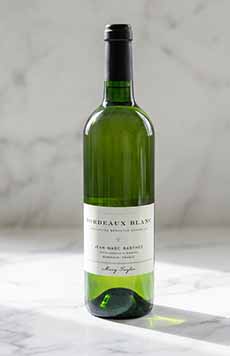
In France, the grape is also used to make White Bordeaux (Bordeaux blanc), commonly blended with Semillon and Muscadelle, and often barrel-fermented and aged.
A smaller amount of Sauvignon Blanc is grown in the southwest of France, in Languedoc-Roussillon.
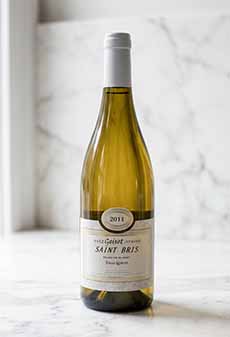
There is one White Burgundy made from Sauvignon Blanc: St. Bris, and its about $12 (photo #4).
The Loire Valley also grows a smaller amount of red wine grapes (about 25% of total production), used to make red Sancerre and rosé.
Below:
> Styles of Sauvignon Blanc by world region.
> The history of Sauvignon Blanc.
> The six noble grapes.
> Sauvignon Blanc food pairings: Part 1.
> Sauvignon Blanc food pairings: Part 2.
Elsewhere on The Nibble:
> The history of wine.
> The year’s 22+ white wine holidays.
> The year’s 25+ red wine holidays.

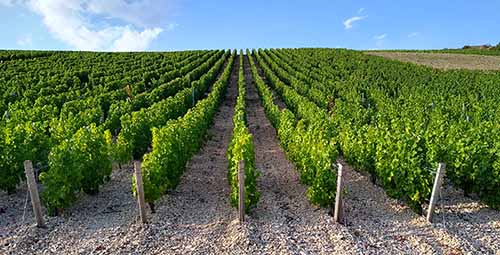
[13] Verdant vines growing Sauvignon Blanc grapes (photo © Winkler Christopher | Pixabay).
THE DELIGHTS OF SAUVIGNON BLANC: AN INTRODUCTION
The Sauvignon Blanc grape produces refreshing, dry, white wines with one of two key flavor profiles: grapefruit/citrus or grassy/herbaceous, depending on the terroir†. Both are delicious.
The wine is known for high acidity, light to medium body and medium alcohol. It is most often unoaked.
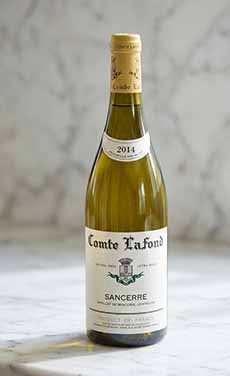
It is also very affordable, with bottles available from around $10, many in the $12 to $15 range, and the finest of the breed (such as Sancerre’s Ladoucette Comte Lafond) in the $35 to $45 range.
By comparison, Chablis is double the price, with Grüner Veltliner in the middle.
If you like white wines such as Chablis and Grüner Veltliner, you’ll likely be a fan of Sauvignon Blanc.
Its acid backbone complements everything from plateaux de fruits de mer (raw seafood platters) and grilled chicken and fish to buttery sauces and rich cheeses; although the AOC cheese of the Loire, chèvre (goat cheese), is its most popular pairing.
We go deep into food pairings at the end of this article. First, it’s important to understand the styles of Sauvignon Blanc.
STYLES OF SAUVIGNON BLANC BY REGION
We start off with the tip to have a tasting get-together. If your group shares in the work, you can assign everyone a Sauvignon Blanc from a different region, and a food that goes with it.
The grape is relatively easy to grow, and thus is grown in more than 10 countries, from Canada to Italy to New Zealand to South Africa—even in Romania, Moldova.
With so many different terroirs and national preferences, you can find Sauvignon Blanc in a wide range of styles and flavors.
Sauvignon blanc delivers minerality and very high acidity. From there:
Cool regions like the Loire and New Zealand produce grassy and herbaceous flavors, with notes of lime, minerals and sometimes, honeydew melon.
Warm climates like California and South Africa produce fruity, citrussy wines.
The best regions for Sauvignon Blanc beyond the Loire Valley are California and Chile—but don’t let that stop you from trying examples from everywhere.
Many thanks to Wine Folly for making these invaluable distinctions.
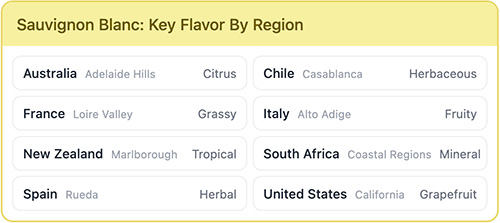
Before drilling down into the roots, here’s a summary chart:
[14] Dominant flavor by region (chart: The Nibble).
1. Australia’s Sauvignon Blanc Wines
Australia overall is a hot climate region, but there are cooler climate areas within Australia (Adelaide Hills, South Australia) suitable for growing good Sauvignon Blanc.
These terroirs generate flavors of kiwi, honeydew, and white peach with medium-high acidity and light body.
Wines from Western Australia (including Margaret River) have both vegetal and fruity flavors. Nuances of bell pepper and chervil mingle with passionfruit and minerality. The wines have high acidity and light body. Some high-end producers use oak for creaminess and texture.
2. Chile’s Sauvignon Blanc Wines
Most exported Sauvignon Blancs come from Chile’s Central Valley. The terroir generates flavors of grass, lime juice, green banana and pineapple, and, unique to the area, a bit of salinity.
3. France’s Sauvignon Blanc Wines
France is the world’s largest grower of Sauvignon Blanc. In the cooler climate of the Loire Valley, the wines yield flavors of cut-grass, nettles, elderflower, blackcurrant leaf and gooseberries combine with flinty minerality.
These are the classic flavors of Sauvignon Blanc. But you may prefer flavors from other regions.
Further south in Bordeaux, the terroir generates flavors of lemon pith, grass and gravelly minerals with high acidity and a simple light body. The high-end wines are often aged in oak, and develop other fruit flavors (gooseberry, kiwi, lemon curd, lemongrass, honeyed grapefruit) with a subtle nutty-creamy texture from the oak.
4. Italy’s Sauvignon Blanc Wines
The majority of Sauvignon Blanc in Italy is produced in Friuli-Venezia Giulia, in the northeast bordering Austria. It is usually labeled as Sauvignon, as opposed to Sauvignon Blanc.
The primary flavors are fruity: gooseberry, orange blossom, pear and white peach. The acidity is very high and the body is light. High acidity and light body characterize more stringent wines, making this our least favorite country for Sauvignon Blanc.
5. New Zealand’s Sauvignon Blanc Wines
New Zealand is a cool climate country and Sauvignon Blanc is the country’s most planted grape. It is grown in the northern part of the South Island, in the Marlborough region.
It’s here that the wine is made in the most assertive style anywhere. Dpending on ripeness levels it can be more vegetal (e.g. green pepper) or smack of tropical fruit (grapefruit, guava, mango, passionfruit).
6. South Africa’s Sauvignon Blanc Wines
The warm, warm climate of South Africa produces high-quality Sauvignon Blanc, mostly in the Western Cape region.
Most are aged in stainless steel, but there are several smaller, more distinct areas that are known for producing barrel-fermented and aged (i.e., oaked) wines. Look for wines from Elgin, Franschhoek and Stellenbosch for these powerful oaked wines.
Most Sauvignon Blancs from the Western Cape have a light-medium body and acidity. Flavors include green herbs, green bell pepper and guava. High-end wines may show you jasmine, honeysuckle, Meyer lemon and nuttiness.
7. Spain’s Sauvignon Blanc Wines
The majority of Spanish Sauvignon Blanc comprises value-driven bulk winegrows in the south, in La Mancha. However, there are a few quality producers elsewhere.
Look for wines from Castilla y Leon: medium-high acidity and medium-light body, with dusty minerality and flavors of bell pepper and honeydew melon.
Rueda produces high quality Sauvignon Blanc and Verdejo wines. The Verdejo grape produces wine with that tastes very similar to Sauvignon Blanc.
8. The United States’ Sauvignon Blanc Wines
Numerous wine-growing regions in the U.S. grown Sauvignon Blanc; but the best wines come from the North Coast region of California (Mendocino, Napa, Sonoma) and the Columbia Valley of Washington State.
The California wines have medium acidity and body. In Napa, you’ll find flavors of grapefruit, honeydew and white peach. In Sonoma, the wines deliver light-medium body and medium-high acidity, with notes of green apple, honeydew and pineapple.
Head north to Washington for light body, high-acidity wines with flavors of lime, grapefruit, and gravelly minerals.
SAUVIGNON BLANC: A NOBLE GRAPE
What makes a grape noble?
The term is used to describe the grapes that are grown internationally, yet retain their fundamental characteristics regardless of growing region and the local terroir. The French term is cépage noble” (SAY-paj NOBL).
There are six noble grapes (all grown in France), with an argument for a seventh. They are:
Cabernet Sauvignon (red)
Chardonnay (white)
Merlot (red)
Pinot noir (red)
Riesling (white)
Sauvignon Blanc (white)
Syrah (red—the seventh contender)
THE HISTORY OF SAUVIGNON BLANC
The vineyards of the Loire Valley date back to the Roman era, where the grapes that grew wild were first cultivated.
Sauvignon Blanc is likely a mutation of that wild grape cultivated by the Romans. “Sauvignon” derives from the French word sauvage, wild; blanc is white.
With the collapse of the Roman Empire until the 12th century, monasteries became the main keepers of viticulture and winemaking; sacramental wine (vinum theologium) was essential to celebrate the mass.
Monks had the resources, education and time necessary to improve their viticultural skills. slowly over time. Throughout the Middle Ages, monasteries owned the best vineyards. Their wine was superior to others, and they also produced large quantities for sale, to support their orders [source].
In the Loire Valley, Sauvignon Blanc vineyards (and other grapes still grown there today) were maintained and enhanced by Benedictine monks.
Red wine lovers will be interested to know that the white Sauvignon Blanc grape is one of the parents of the red Cabernet Sauvignon grape. The other parent is the the red Cabernet Franc grape.
|
|
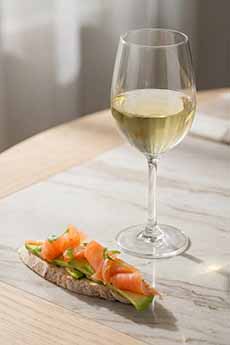
[1] Sauvignon Blanc is a medium-bodied white wine that’s our go-to in warmer weather, or with lighter fare year-round (photo The Nibble).
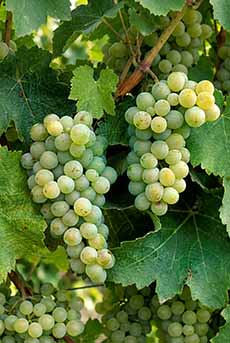
[2] Sauvignon Blanc grapes on the vine (photo © Italian Recipes [website no longer active]).
[3] Our favorite Sauvignon Blanc is Comte Lafond Sancerre from France’s Loire Valley (photo The Nibble).
[4] The only Sauvignon Blanc-based white Burgundy, Goisot’s Saint Bris AOC (photo The Nibble).
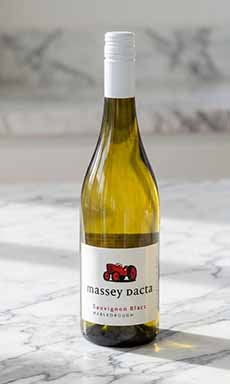
[5] Massey Ferguson is a New Zealand manufacturer of agricultural equipment, including tractors used in vineyards. The slang word for the tractor in New Zealand is “dacta.” Yes, the vineyard is named after its tractor! It’s a favorite Sauvignon Blanc of one of our wine consultants, Mary Taylor, and it’s very affordable—$15 at the time of this writing (photo The Nibble).
[6] Another Mary Taylor favorite: this Sauvignon Blanc-based Bordeaux Blanc from Jean Marc Barthez (photo The Nibble).
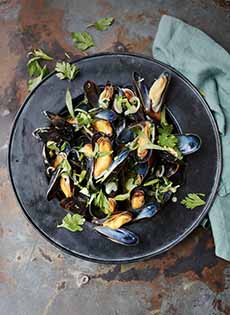
[7] Serve Sauvignon Blanc with seafood, cooked or raw. Here’s the recipe for these Mussels à la Normande (photo © Sea Tales).
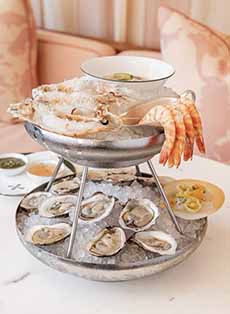
[9] You don’t have to think twice about ordering Sauvignon Blanc with a plateau de fruits de mer (photo © Oceans Restaurant | NYC).
[10] Serve it with salmon or any fish (photo © Preserved Cherries [website gone]).
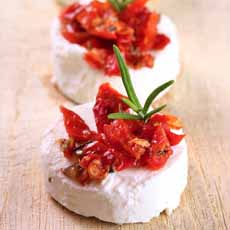
[11] With any and all goat cheeses, including these cocktail bites (photo © Bella Sun Luci).
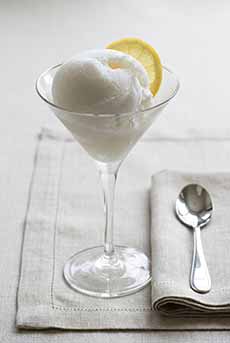
[12] Add a splash of Sauvignon Blanc to the bottom of a dish of citrus sorbet, or stir some into a slightly softened pint and refreeze (photo The Nibble).
|
SAUVIGNON BLANC FOOD PAIRINGS: PART 1
It is a truth universally acknowledged, that wines pair best with foods from their regions in which they are produced. That’s why winemakers bring out particular flavors, acidity levels, and so forth.
In the Loire, this cuisine is noteworthy for its:
Fish: The ancient rivers have always provided fish, cooked simply: bream, eel, pike, perch (zander) and shad are common. In more modern times, beurre blanc, a butter sauce flavored with shallots and vinegar, has become a standard accompaniment. Pair with Sauvignon Blanc, of course! Major appellations include Sancerre and Pouilly-Fumé.
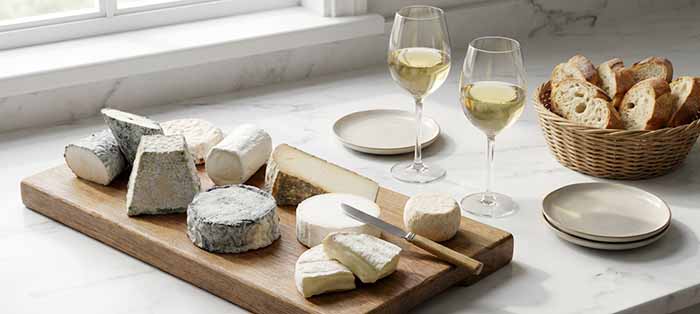
Goat Cheeses: Crottin de Chavignol, young and spreadable or old and dry (this cheese was originally created for Sancerre: a perfect pairing); Pyramide de Valençay, a pyramid-shaped goat’s cheese also dusted with ashes; Sainte-Maure, a cylinder shape coated with ashes; Selles-sur-Cher, a tangy goat also dusted with ashes. Sauvignon Blanc: ditto.
Red Wine-Friendly Foods Of The Loire
Game: The Loire is full of duck, pheasant, pigeon, quail, rabbit, venison, and wild boar. Rich sauces made with the area’s wild mushrooms are classic. The leading red wines of the Loire Valley are predominantly made from Cabernet Franc (locally known as Breton), producing light-to-medium-bodied, aromatic wines. They offer high acidity, moderate tannins, and flavors ranging from savory herbs to bright red fruits. Major red appellations include Chinon, Bourgueil, Saint-Nicolas-de-Bourgueil, and Saumur-Champigny.
Rillettes: A shredded, textured pâté served in a crock for spreading on bread. Pork is the principal meat, but duck and salmon rillettes are also classics. The best Loire wines for rillettes are high-acid, crisp whites—specifically Sancerre (Sauvignon Blanc) and Vouvray (Chenin Blanc, dry or sparkling) which cut through the rich, fatty pork. For red wine lovers, pair a light, fruity Chinon or Saumur-Champigny (Cabernet Franc).
[15] A selection of goat cheeses pair beautifully with Sauvignon Blanc. What’s with the ashes? Goat cheese is very fragile, and before modern packaging, plant-based ashes covered the cheeses to protect them on their way to market, over bumpy roads in horse-driven carts (photo: The Nibble).
For Dessert
While you likely don’t want to have dessert with a dry wine like Sauvignon Blanc, the Loire region offers sweet, Chenin Blanc-based wines to end a Loire-focused feast. Look for:
Anjou-Coteaux de la Loire AOC, moelleux, doux or liquoreux‡
Bonnezeaux AOC, liquoreux
Coteaux de l’Aubance AOC, liquoreux and sélection de grains nobles (SGN)
Coteaux de Saumur AOC, moelleux to liquoreux
Coteaux du Layon AOC, liquoreux and sélection de grains nobles (SGN)
Quarts-de-Chaume AOC: Liquoreux
Vouvray moelleux, doux or liquoreux
There are other sweet wines made in the Loire, but this is an excellent starter list.
Two noteworthy desserts:
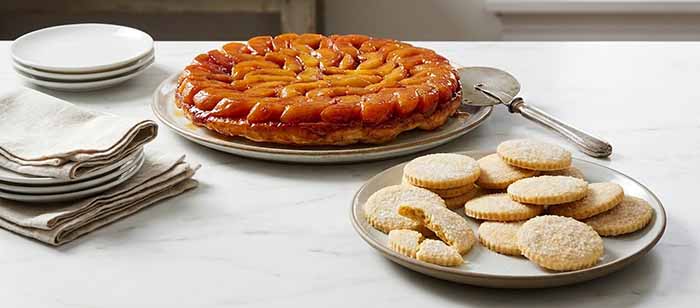
Sablés: The cookie, which originated in Normandy, has become very popular in the Loire. Sablé is a buttery, shortbread-like cookie that is often flavored with almonds, lemon or orange zest. The treat originally hails from the Normandy region but has also become quite popular throughout Loire. In the translation, “sand,” refers to the cookie’s crumbly texture. It is served plain, dipped in chocolate or sandwiched with jam.
Tarte Tatin: An apple tart with caramelized apples, this beloved dessert was an accident. It is now also made with different fruits and savory versions are also made. Here’s the history of Tarte Tatin.
[16] Pair these French dessert classics—Tarte Tatin and sable cookies—with the Loire’s sweet Chenin Blanc-based dessert wines (The Nibble photo).
SAUVIGNON BLANC FOOD PAIRINGS: PART 2
Because Sauvignon Blanc is tart and tangy, it is the best wine to serve with salad, including Caesar salad topped with chicken or salmon. Its acidity complements the vinegar in a vinaigrette.
Other classic food pairings are:
Cheeses: In addition to fresh and aged goat cheeses, look for goat cheddar and nutty cheeses such as Gruyère and Alpine (a.k.a. Swiss mountain) cheeses. There are also cow’s milk cheeses made in the Loire. If you’re there, look for Cendré d’Olivet and Feuille de Dreux.
Citrus sauces (e.g. on chicken or fish).
Dairy: butter, crème fraîche, sour cream, yogurt.
Chicken and fish, especially roasted or grilled, and/or with beurre blanc.
Garlicky recipes.
Greek mezze (spreads), anything with yogurt and dill.
Herbed recipes, including those with basil, chives, cilantro, dill, fennel, mint, parsley and rosemary, tarragon, thyme.
Pork, pan-fried, grilled or roasted.
Veal, chops or scallops.
Smoked fish, including smoked salmon.
Spices: coriander, fennel, saffron, turmeric, white pepper.
Spicy foods and spicy international cuisines (Indian, Mexican, Vietnamese, e.g.).
Veggies: asparagus, mushrooms.
In addition to being drunk as is, Sauvignon Blanc is also popular in spritzers and white sangria.
________________
*AOC, an abbreviation of appellation d’origine contrôlée, is a legal designation that places rigid standards on how and where a French product can be produced. This ensures consistent quality and preserves its reputation.
†Pronounced tuhr-WAH, terroir is the French expression for sense of place, the unique environment in which something grows—its specific soil composition and microclimate. Microclimate includes temperature, amount of sunshine and rain. The flavor nuances of agricultural products, from grapes to olives to milk to cacao, is a function of its terroir.
‡Both moelleux (moy-YOO)/moelleux doux (DOO) and liquoreux (lih-coe-ROO) are general French terms for sweet wines. The translation of moelleux is sweet, soft, tender, smooth, mellow. A wine labeled doux in sweeter still. A liquoreux designation indicates the richest, most luscious sweet wines. Labels of sélection de grains nobles (selection of noble berries, abbreviated as SGN) indicates that the grapes were affected by noble rot (botrytis). These are the sweetest and richest wines, with the most concentrated flavors (and greatest cost).
CHECK OUT WHAT’S HAPPENING ON OUR HOME PAGE, THENIBBLE.COM.
|