THE NIBBLE BLOG: Products, Recipes & Trends In Specialty Foods


Also visit our main website, TheNibble.com.

TIP OF THE DAY: Bunless Burgers

Most store-bought burger rolls are pretty blah: a form of white bread used to hold the burger.

Earlier, we suggested 25+ alternatives to the burger bun, from baguette to brioche to pretzel roll.

Even when the roll is special, it begs the question: Does the bread serve any purpose other than enabling utensil-free eating?

We love good bread: At a top restaurant, we’d rather have the bread than the meat. But over the years we’ve found that it doesn’t add to the burger experience. Even the best bread gets soggy with all the condiments and burger juice.

Drumroll: Today, we suggest burgers without the bun—at least, without a bread bun.

The original hamburger steak served in the U.S., essentially the Hamburg steak from Hamburg, Germany, was served on a plate with a fork and knife: no bun (here’s the hamburger history).

So how about going bunless—or rather, breadless?
 
 
NON-BREAD BUN ALTERNATIVES

Whether gluten-free, low-carb or paleo, we’ve seen every burger bun substitute imaginable, from homemade cauliflower buns to potato pancakes.

Alternatives To The Burger Bun

Look to different vegetables:

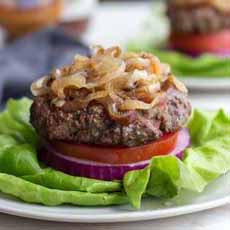
  • Lettuce leaves (photos #1 and #2), along with tomato and onion
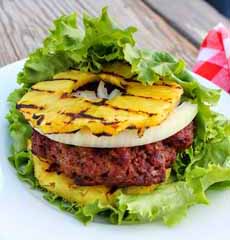
  • Grilled pineapple (photo #3)
  • Grilled portabella mushrooms (photo #4)
  • Other grilled vegetables (photo #5)
  •  
    For the “other grilled vegetables,” look for the widest eggplant, potato or zucchini. You may be able to find one that can be sliced to hold an average burger.

    Otherwise, you may end up with sliders.

    TIP: While bread buns keep your fingers clean, the lettuce leaves do the same (at best a bit of water residue). If you don’t want to touch the oil-brushed grilled veggies, the solution is simple: an open-face burger with a knife and fork.
     
     
    TASTY TOPPINGS

    We enjoy trying new burger toppings. These work whether you serve conventional buns or the “vegetable buns” above.

    You can start with your favorite condiments (ours are curried ketchup*, sriracha mayo* and sweet and savory pickles).

  • Caramelized onions
  • Cheese
  • Chili
  • Grilled fruit (pineapple, peaches)
  • Guacamole
  • Hummus
  • Salsa
  • Slaw
  •  
    SLAW ALTERNATIVES

    If you call yourself a foodie, bypass the commercial cabbage slaw with a few flecks of carrot, dripping with diluted mayonnaise. Instead, go for a homemade slaw. If you don’t have time to make it, assign one or two recipes to someone else.

  • Apple Ginger Cole Slaw
  • Blue Cheese Slaw (add crumbled blue cheese to any classic cole slaw recipe)
  • BLT Slaw
  • Broccoli Slaw (substitute store-bought shredded broccoli for the cabbage in any cole slaw recipe)
  • Crunchy Asian Slaw
  • Lime-Cumin Cabbage Slaw
  • Pepper Jelly Slaw
  • Vanilla Slaw
  • Vietnamese Cabbage Slaw
  • Two-Color “Mexican” Cabbage Slaw
  •  


    Burger In A Lettuce Bun

    Bunless Burger

    Pineapple Burger

    Burger On Portobello Bun

    Burger On Grilled Eggplant
    [1] Trade the bread for lettuce leaves (photo courtesy Burger Fi). [2] For onion lovers, a double-onion burger with raw and caramelized onions. [3] A tropical burger. Use two slices of grilled pineapple instead of the bread. Here’s the recipe from Fit Views. [4] Spell it portabella or portobello, it’s a delicious bread substitute. Here’s the recipe from Sew Lets Cook. [5] Grilled eggplant as a bun (photo courtesy Our Four Forks).

     
    BUNS, ROLLS AND BISCUITS: THE DIFFERENCE

    Are the halved breads that surround hot dogs and hamburgers properly called rolls or buns?

    There is no official difference, meaning that there are no specific USDA standards. Both rolls and buns are single-serve breads, and the USDA only stipulates that buns and rolls weigh less than one-half pound. (Loaves of bread, on the other hand, must weigh one pound or more).

    Manufacturers and retailers use whichever term they want. However, the American Institute of Baking uses this distinction

  • Rolls is the term generally used for individual breads that hold a filling—either pre-filled like cinnamon rolls or sandwich bread like Kaiser rolls. The notable exception is hot cross buns, which are filled with currants or raisins and thus should be hot cross rolls. However, the first recorded use of the term “hot cross bun” appears in 1733, when there was no distinction.
  • Buns typically do not contain a filling, but can be eaten plain, with a spread (butter, jam), or used as a sop, i.e., to wipe up a liquid food: gravy, sauce, soup, stews.
  • Bunne was the word used in Middle English. The use of roll to describe a small bread came much later. The oldest reference we could find is to Parker House rolls, in 1873.
  • Biscuits use a different leavening. Biscuits use baking powder to rise; buns and rolls use yeast.
  • Texture: Rolls can be hard (crusty) or soft, buns are soft, and biscuits are pillowy soft (from the baking powder).
  •  
    It is true that “burger bun” rolls off the tongue more easily than “burger roll.” But the more accurate term is roll.

    Just for the record.

    ________________

    *Just mix the seasoning into regular ketchup or mayonnaise to your desired intensity.
      

    Comments off

    A Recipe To Make Patriotic Ice Pops, Red, White & Blue

    Red, White & Blue Ice Pops
    [1] Patriotic ice pops for July 4th (photo © Zulka minimally processed sugars).

    Blueberry Yogurt Pop
    [2] If you’re buying new molds, we prefer “groovy” ones like this style, from Tovolo. The pop is bluebery-yogurt; hence, a lighter color than the pure, puréed berries in photo #1.

    Ice Pop Mold Substitute
    [3] No molds? Use a loaf plan and slice the pops! Here’s how from Lynne at And Then I Do The Dishes.


    If you have no plans this weekend, consider making something fun—like red, white, and blue ice pops.

    The vivid colors in these pops (photo #1) come from berries, strawberries, and coconut milk. The berry purées can be made using either fresh or frozen berries.

    Simply de-stem, wash and pat dry the fruits; then purée in the food processor [need we add, purée separately?).

    If you’re serving them to a sophisticated crowd, you can get creative with herbs and spices, e.g.:

  • Add cayenne or red chile flakes to the strawberry layer.
  • Add ginger to the white layer.
  • Adding basil or mint to the kiwi or blueberry layer.
  •  
    You don’t want a hodgepodge, so flavor only one layer. Our personal favorite: heat in the red layer.

    If you don’t want to use coconut milk, substitute plain or vanilla yogurt. If you use vanilla, don’t add additional sweetener.
     
     
    RECIPE: RED, WHITE & BLUE ICE POPS

    Ingredients For 10 Ice Pops

  • 1 cup strawberry purée, cold
  • 1 cup coconut milk, cold
  • 1 cup blueberry purée, cold
  • ½ cup sugar
  • ½ cup water
  •  
    Plus

  • 10 compartment ice pop mold (or substitute)
  • 10 wood sticks (if molds don’t have individual handles)
  •  
    Preparation

    1. MAKE the simple syrup: Bring water and sugar to a simmer in a small saucepan. Stir until sugar is dissolved and let cool.

    2. ADD 1 tablespoon of simple syrup to each of the purées and the coconut milk. Stir well. Fill molds 1/3 of the way with the strawberry purée. Place the lid on the mold and and the wood sticks, letting them protrude about 1/2 inch above the top. Let freeze 40-50 minutes or until somewhat firm.

    3. REMOVE the lid of the mold and fill compartments another third of the way with the coconut milk mixture. Replace the lid, making sure all of the sticks are in place; freeze another 40-50 minutes.

    4. REMOVE the lid and fill the compartments with the blueberry purée. Replace the lid and freeze completely, at least 8 hours or overnight. When ready to serve…

    5. RUN cool water over the sides of the mold and carefully loosen each pop by gently pulling on the handle or the stick. Remove all pops. If not serving immediately, wrap individually in plastic wrap and store in a freezer bag.


    WHAT IF YOU DON’T HAVE POPSICLE MOLDS?

    A friend saves small yogurt cups for this purpose; but if you haven’t planned ahead, you can use small paper or disposable plastic cups.

    You can also use a loaf pan (photo #3) and slice the pops.

    Don’t forget the wooden sticks!
     
     
    ICE POP VS. POPSICLE

    Popsicle® is a trademarked name owned by Unilever’s Good Humor Division (here’s the history of the Popsicle and the Creamsicle®).

    Everything else should be called by the generic term, “ice pop.”


    CHECK OUT WHAT’S HAPPENING ON OUR HOME PAGE, THENIBBLE.COM.


    Comments off

    TIP OF THE DAY: Bruschetta From The Grill

    Firing up the grill this weekend? Make bruschetta (pronounced broo-SKEH-tuh).

    We love a DIY bruschetta bar. Just rub the bread with garlic, brush it with extra virgin olive oil, grill, and place the slices on a platter along with all the fixings.

    Even easier, brush the bread with garlic olive oil! You can buy it, or infuse your own in advance by dropping halved garlic cloves into a cup of olive oil (or however much you think you’ll need). Any leftover oil can go right into a vinaigrette.

    Bruschetta originated in the Tuscany region of Italy, where it is commonly served as a snack or appetizer. It may have been the original garlic bread.

    Plus, we have our own invention dessert bruschetta, below.

    BRUSCHETTA VS. CROSTINI: WHAT’S THE DIFFERENCE?

    There are two factors:

  • The size of the bread slice.
  • The cooking technique: grilling versus toasting.
  •  
    Bruschetta slices are larger, three or four inches in diameter) and grilled. Crostini, cut from a ficelle, a thinner baguette about two inches wide (the word is French for “string”).

    You can use bread of a different diameter; but if it isn’t grilled, it isn’t bruschetta.

    Here’s how to remember the difference:

  • The verb bruscare is Roman dialect meaning “to roast over coals.” But there’s something simpler.
  • Think of crostini as crust or crouton (which is its literal meaning). Toast has a crust. That’s how we taught ourself to recognize the difference.
  • While Italians serve bruschetta as a snack, the smaller crostini can be served plain with soup and salad, like the original melba toast.
  •  
    Note that some American manufacturers and others in the food industry misuse the term, selling jars of “bruschetta.” To be accurate, it should be labeled bruschetta topping). Bruschetta is the grilled bread, not the topping.

    RECIPE: DIY BRUSCHETTA BAR

    The simplest bruschetta topping is salt and pepper (i.e., seasoned garlic bread), but that’s for a bread basket.

    Almost any cheese, fruit, meat, spread or vegetable can be a topping. Toppings can be cooked, marinated, pickled, raw or smoked.

    For a DIY bar, offer at least three different toppings. We like everything, so tend to go overboard: Our toppings look like a buffet. Regarding bread, we prefer a crusty sourdough or rustic loaf.

  • Be sure the loaf will give you slices of a workable size.
  • If you’re not familiar with the particular loaf, ask to ensure that it doesn’t have holes for the toppings to fall through.
  • We have the loaves sliced at the store, then we cut the slices in half.
  •  
    Along with the bread, make sure you have fresh garlic and check your olive oil for freshness.

    Ingredients

  • Baguette or other loaves of bread
  • Olive oil, salt, pepper and peeled, halved garlic cloves
  •  
    For The Toppings

  • Avocado, mashed and seasoned (garlic, salt, pepper, lemon juice, etc.)
  • Caprese: quartered cherry tomatoes, fresh basil, balsamic glaze
  • Charcuterie: pâté, prosciutto, salume, etc.
  • Cheeses: ricotta, ricotta salata, soft goat cheese
  • Fresh basil, julienned/shredded
  • Fruit: sliced figs
  • Garnishes: capers, chopped herbs, chopped mixed olives
  • Greens: baby arugula or watercress
  • Heat: raw jalapeños slices, grilled chile peppers
  • Marinated artichoke hearts (chopped)
  • Mushrooms, marinated
  • Onions: caramelized, chives, chopped green onions (scallions)
  • Peppadews, sliced
  • Pimento, chopped or sliced
  • Raw and cooked veggies of choice: asparagus, grilled vegetables, sliced radishes, etc.
  • Spreads: bean, hummus, pimento cheese, tapenade
  • Tomatoes: sliced plain or marinated in oil and vinegar
  •  
     
    More options: shredded mozzarella or other cheese such as thinly-sliced Brie, fish (we have a passion for anchovies and herring salad on bruschetta), other marinated vegetables, mostarda.

    We also like eggplant caponata, pesto and sautéed mushrooms, but tend to use them more in cooler weather.

      Bruschetta Bar

    Rustic Loaf

    Rustic Loaf

    Bruschetta Bar

    Strawberry Bruschetta
    [1] Who needs a burger? We’re heading for the bruschetta bar (photo courtesy What’s Gaby Cooking).[2] Buy bread that has a pretty solid crumb (photo courtesy The Stone Soup). [3] This loaf is beautiful, but not for holding toppings (photo courtesy Bake Street). [4] A bruschetta bar from Countryside Cravings. [5] Dessert bruschetta, here with goat cheese (the recipe from Emily Bites). We use mascarpone.

    Preparation

    1. SET out the toppings and teaspoons for serving. We use ramekins; you can use any bowls you have.

    2. SLICE the bread from 1/2″ to 3/4″ thick. Rub each side with cut garlic clove and brush each side with olive oil. Add a pinch of salt and pepper. Grill to your desired toastiness.

    3. PLACE the bread on a platter next to the toppings and watch people create their appetizers.
     
     
    DESSERT BRUSCHETTA

    Most people won’t have seen dessert bruschetta. We don’t know if we invented it, but our sweet tooth gave us the idea years ago.

    Start with a loaf of bread with dried fruit, such as cherries or raisins. For toppings:

  • Artisan preserves
  • Flavored peanut butter (chocolate, cinnamon, maple, etc.)
  • Fruits: berries; sliced dates, figs, grapes and stone fruits
  • Honey
  • Mascarpone or sweetened sour cream
  • Nutella
  • Garnishes: chocolate chips, coconut, nuts, etc.
  •   

    Comments off


    © Copyright 2005-2026 Lifestyle Direct, Inc. All rights reserved. All images are copyrighted to their respective owners.