THE NIBBLE BLOG: Products, Recipes & Trends In Specialty Foods


Also visit our main website, TheNibble.com.

TIP OF THE DAY: Cut The Calories In Thai Iced Tea & Thai Iced Coffee

Thai Iced Tea
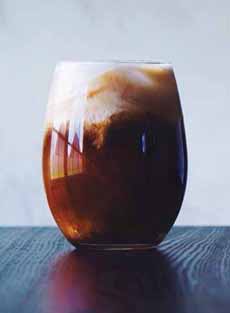
The milky swirl of Thai iced tea or coffee is a visual treat (photo © Wife Mama Foodie).

Thai Iced Coffee
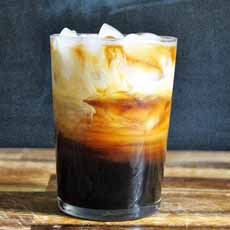
Sometimes the sweetened condensed milk is layered on top (photo © Hella Good).

Thai Iced Tea
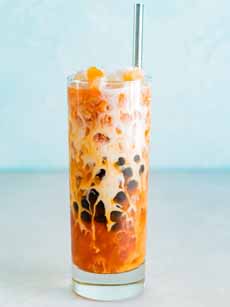
[3] Thai iced tea with boba (tapioca balls), which were invented in China. The orange color is a Thai tradition. Here’s the recipe for the iced tea with boba, plus the ice pops below (photos #4 and #5 © Pineapple And Coconut).

Thai Iced Tea Pops Recipe
[4] Iced tea ice pops. Just pour the tea in ice pop molds and freeze.

Homemade Sweetened Condensed Milk
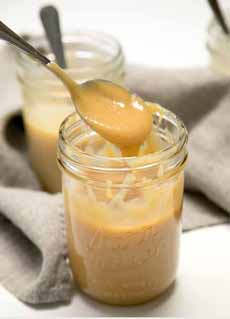
[5] Want to make your own sweetened condensed milk? Here’s the recipe (photo © Gluten Free On A Shoestring).


June is National Tea Month, time for an article on a type of iced tea not yet as broadly served in the U.S. as we think it should be. The easy recipe follows.

For those who already know and love Thai iced tea or coffee but not the overload of sugar, we have a solution below. But first, some history about the drinks.

Below:

> What is Thai iced tea?

> The history of Thai iced tea.

> The history of evaporated milk and sweetened condensed milk, and how they differ.

> Recipe for Thai iced tea or iced coffee.

> Low sugar recipe for Thai iced tea or coffee.

> A brief history of sugar.

Elsewhere on The Nibble:

> The different types of tea: a photo glossary.

> The history of tea.

> The history of iced tea.

> The history of Thai iced tea.

> Iced tea recipes for every type of tea.

> The different types of sugar: a photo glossary.

> The different types of sugar: a photo glossary.
 
 
WHAT IS THAI ICED TEA?

Thai iced tea, known as cha-yen in Thailand (cha is the word for tea), is served in Thailand, Vietnam, elsewhere around the Pacific Rim, and in Thai restaurants around the world. It is made from strong-brewed black tea—typically Ceylon tea—and sweetened condensed milk, which adds creaminess, body and mouthfeel.

For visual appeal, the deep amber tea and white sweetened condensed milk (and often, evaporated milk) are swirled together or layered. The drink can be topped off with evaporated milk, coconut milk, half and half, or whole milk. It is sweetened with lots of sugar (local to the the South Pacific), and often served over crushed ice.

The brewed tea can be enhanced with spices, such as cardamom, clove, nutmeg, orange blossom water, star anise, and tamarind. If you like chai tea with milk and sweetener, you are likely to enjoy Thai iced tea.

The countries where it’s most popular are known for hot, steamy summers. Thai iced tea is a welcome refreshment—and a complement to spicy food. If your neck of the woods is as hot and steamy as ours is, it’s time to try the recipe.
 
 
THE HISTORY OF THAI ICED TEA

In hot countries before refrigeration, where fresh milk was hard to come by, evaporated milk and sweetened condensed milk were used in coffee, desserts, and other recipes requiring milk (including Key lime pie).

The precise birth date of what is now known today as Thai tea is uncertain. Americans and Europeans living in Asia brought evaporated milk and sweetened condensed milk—first available in 1856—for their tea and coffee [source].

One source suggests that “It was probably introduced during the time of Field Marshall Pibul Songkram [1938 to 1944] who seemed to favor Western habits as being civilized” [source]—hence the ice and milk in tea, previously only a hot drink.

Tea is a relatively new crop in Thailand, brought in by the Chinese in the 1880s to supplant opium as a cash crop to [hopefully] curb drug trafficking. The tea became a street food staple [source]. The British and other foreigners in Thailand had their own supply of tea.

Why is the tea often very orange in color? After the tea was brewed for the master, the domestic workers took used leaves that would have been discarded, to brew tea for themselves. The flavor and color of this second infusion were faded, so orange color and flavoring were added to make a more appealing brew.

The tradition of orange color became a tradition of Thai brewed tea [source]. (See photo #4, below.)

Thai iced coffee followed much later, in the postwar 20th century.
 
 
WHO INVENTED EVAPORATED MILK & SWEETENED CONDENSED MILK?

Both products were invented by Gail Borden, who subsequently formed the dairy company that bears his name.

In 1852, Borden was traveling transatlantic when the cows aboard the ship became too seasick to provide milk (there was no refrigeration in those days to keep milk fresh). He began to experiment, and two years later produced a canned milk that did not go sour at room temperature for three days after the can was opened.

Borden received a patent for sweetened condensed milk in 1856 and began commercial production the following year. Unsweetened condensed milk, now called evaporated milk, took more time to perfect since it didn’t have the sugar to inhibit bacteria growth. It was finally canned successfully in 1885.

In the days before refrigeration, both evaporated and sweetened condensed milk were used more than fresh milk in households, because they were less likely to spoil and harbor harmful bacteria.


The Difference Between Evaporate Milk & Sweetened Condensed Milk

The quickest explanation is in the names: sweetened condensed milk has added sugar and evaporated milk doesn’t. It is also much thicker: Evaporated milk pours like regular milk, but sweetened condensed milk pours like molasses. They are not interchangeable in recipes, but both can be used in coffee.

  • Evaporated milk is fresh cow’s milk from which about 60% percent of the water has been removed by evaporation. It’s then homogenized, fortified with vitamins and stabilizers, canned, and sterilized. The heat from the sterilization gives the milk a bit of a caramelized flavor, and makes the color slightly darker than fresh milk. Evaporated milk was originally called unsweetened condensed milk, although that term is no longer used.
  • Sweetened condensed milk also has about 60% percent of the water removed, then sugar is added as well as vitamin A. Condensed milk contains 40% to 45% sugar, but it means that no (or less) added sugar is required in the recipe. Condensed milk requires no sterilization, since sugar is a natural inhibitor of bacteria growth. It is darker and more yellow in color than evaporated milk.
  •  
     
    RECIPE: THAI ICED TEA OR ICED COFFEE
     
    Substitute strong-brewed coffee for the tea, with spices as desired (here’s the recipe for Thai Iced Coffee).

    You can chill the drink in the fridge, for enjoyment without the dilution of ice cubes.

    Ingredients

  • 3/4 cup black tea leaves (approximately 3 ounces)
  • Optional spices: cardamom, ground tamarind, nutmeg, star anise or others (cinnamon works for us), to taste
  • 6 cups boiling water
  • 1/2 cup sugar (or equivalent noncaloric sweetener)
  • 1/2 cup sweetened condensed milk
  • 1 cup evaporated milk to top (you can substitute coconut milk, half and half or whole milk)
  • Crushed ice
  •  
    Preparation

    1. STEEP the tea leaves (and any optional spices) in boiling water for 5 minutes. Strain out the tea leaves. Using an infuser (tea ball) makes this step easier.

    2. STIR in sugar while the tea is still hot, until dissolved; then stir in condensed milk.

    3. COOL to room temperature or ideally, chill in the fridge.

    4. ADD ice to tall iced tea glasses and pour in tea mixture until glasses are roughly 3/4 full. Slowly top off glasses with evaporated milk.
     
    Variations

    If you find yourself in the Pacific Rim, you can have what Americans think of as iced tea.

  • Dark Thai iced tea (cha dam yen) is simple iced tea without the milk, sweetened with sugar.
  • Lime Thai tea (cha manao) is dark Thai iced tea flavored with lime. Mint may also be added.
  • Boba Thai iced tea, a modern fusion, adding the black tapioca balls used for Chinese bubble tea.
  •  
    For Low Sugar Thai Iced Tea

    If you’re looking for unsweetened iced tea in the Pacific Rim, you may be out of luck. It’s the birthplace of sugar.

    But use the low-calorie or low-glycemic sweetener of your choice (Splenda, agave), and use evaporated milk instead of sweetened condensed milk.

    You’ve created a low-calorie Thai iced tea.
     
     
    A BRIEF HISTORY OF SUGAR

    Sugar is native to Southeast Asia. Three species seeming to have originated in two locations: Saccharum barberi in India and Saccharum edule and Saccharum officinarum in New Guinea.

    Originally, people chewed on the raw sugar cane stalks to enjoy the sweetness. Refined sugar appears around 500 B.C.E., when residents of what is now India began to make sugar syrup from the cane juice. They cooled it to make crystals that were easier to store and transport. These crystals were called khanda, which is the source of the word candy.

    Indian sailors carried sugar along various trade routes. In 326 B.C.E., Alexander the Great and his troops saw farmers on the Indian subcontinent growing sugar cane and making the crystals, which were called sharkara, pronounced as saccharum.

    The Macedonian soldiers carried “honey bearing reeds” home with them. But sugar cane remained a little-known crop to most Europeans for the next thousand years, a rare and costly product that made sugar traders wealthy.

    In the 12th century, Crusaders brought sugar back to Europe from the Holy Land, where they encountered caravans carrying the “sweet salt.” Venice began to produce sugar in Lebanon to supply Europe, where honey had been the only available sweetener (beet sugar was not isolated until 1747). By the 15th century, Venice was the chief sugar refining and distribution center in Europe.


    CHECK OUT WHAT’S HAPPENING ON OUR HOME PAGE, THENIBBLE.COM.


    Comments off

    Salmagundi On A Platter & The History Of Salad

    Grilled Chicken Salad Platter
    [1] Salmagundi #1: a “hodgepodge” of dinner salad ingredients (photos #1, #2, #3, #5 and #6 © No Crumbs Left).

    Marinated Red Onions
    [2] Marinated red onions. These are so tasty, you may want to quadruple the recipe (below).

    Yogurt Salad Dressing
    [3] Making the dressing.

    Icelandic Provisions Skyr
    [4] The base of the dressing (photo © Icelandic Provisions).

    Steak Salad
    [5] Salmagundi #2: steak salad.

    Nicoise Salad
    [6] Salmagundi #3: Lobster Niçoise salad..

    Whole and halved red onions
    [7] We quadrupled the recipe for marinated red onions, and used the extras on burgers and sandwiches (photo © Burpee).


    [8] This recipe calls for dried oregano, but you can’t substitute it in equal proportions for fresh oregano. For 1 tablespoon of fresh oregano, substitute 1 teaspoon of dried oregano (photo © Savory Spice Shop).


    Updated August 2026

    When we received the following recipe from Icelandic Provisions Skyr, developed by No Crumbs Left, we looked at it and thought: dinner salad ingredients look so nice served family-style on a platter. Salmagundi, anyone?

    “Salmagundi” means a heterogeneous mixture or a mixed salad of various ingredients in addition to the greens. The word derives from the French salmigondis, meaning a hodgepodge or mixture.

    A Cobb Salad—avocado, bacon, blue cheese and chicken—is an example of salmagundi.

    Thus today’s tip: Get out your platters and serve family-style when appropriate—and not just salads.

    Food looks so much more festive on a platter than passing around bowls of sides or serving everything pre-plated (known as Russian-style serving). With a platter, people can take exactly what they want.

    Below:

    > The history of salad.

    > Salmagundi salad platter: a recipe.

    > Tangy skyr dressing recipe.

    > Marinated onions recipe.

    Elsewhere on The Nibble:

    > The history of Salmagundi salad.

    > More about salmagundi.

    > The year’s 40+ salad holidays.

    > The year’s 18 sauce, dips, and dressings holidays.
     
     
    1. THE HISTORY OF SALAD

    A little salad history: Since man first gathered wild greens, before the invention of fire*, mankind’s hominim ancestors ate what we call salad greens.

    Fast forward to ancient Greece and Rome: Salads—defined as mixed greens with dressing—were a common dish on the table.

    The Romans had many salad varieties, quite a few of which differed little from present-day ones: a selection of raw vegetables with a dressing of some sort.

    That dressing was oil, vinegar, and often brine. The brine actually gives salad its name:

    The key ingredient of salad, as opposed to raw vegetables (crudités), is the dressing. Our name for the dish derives from Vulgar Latin herba salata, literally, salted herb.

    Dinner salads, as they are called today—a salad with proteins (cheese, chicken, eggs, fish, steak) as the entrée—were popular during the Renaissance, and continued to be refined.

    By the early 17th century in England, composed salads (not tossed but laid out in a pleasing way) comprised of cooked meats, seafood, vegetables, fruit, leaves, nuts, and flowers and dressed with oil, vinegar, and spices [source].

    They were called salmagundi, from the French word salmagondis, meaning a hodgepodge of widely disparate items. In English, the word came to mean a mixture or assortment. Here’s more on salmagundi.

    The salmagundi recipe begins below, but first, here’s some salad history beyond salmagundi.

  • Mayonnaise, a popular salad dressing, was created as a sauce in 1756 by the chef of the French nobleman and soldier Duc de Richelieu as a celebration food to serve after a great victory in battle. The concept was refined into today’s mayonnaise by the great French chef Marie-Antoine Carême. Here’s more of the story.
  • In the 19th century, German immigrants to the U.S. brought recipes for “bonded” meat salads and potato salads—bonded, or bound, with a dressing consisting of oil, vinegar, and salt.
  • These were usually the main course for lunch or dinner, as opposed to dinner salads, green salads which were traditionally served as appetizers.
  • Some chefs who made Carême’s mayonnaise used it as a binder instead of oil and vinegar.
  • In 1863, Chef Liam Gray, proprietor of Town Meats in Wakefield, Rhode Island, combined leftover cooked chicken with mayonnaise, grapes, and fresh tarragon to create the earliest version of modern chicken salad. He served it in sandwiches at his meat market. The sandwiches were so popular that the entire market was transformed into a delicatessen [source 1, source 2].
  • In 1905, German immigrant Richard Hellmann opened a delicatessen in New York City, using his wife’s mayonnaise recipe as a sandwich spread and in prepared salads. Customers asked to buy the mayonnaise for home use. Within a few years, Hellmann’s Mayonnaise was on its way to becoming a packaged food icon. Other brands followed.
  • In the 1920s, with broader availability of bottled mayonnaise, American cooks and housewives made egg salad, tuna salad, seafood salad, potato salad, pasta salad, Waldorf salad, ambrosia salad, and more.
  • With dieting trends in the 1980s, reduced-fat and fat-free mayonnaise appeared. As Americans grew more creative with their cooking, specialty manufacturers began to sell flavored mayonnaise—bacon, chipotle, garlic, guacamole, habanero, harissa, lemon, sriracha, wasabi, and yuzu, among others. With the growth in veganism, vegan mayonnaise is also available, with aquafaba or soy milk substituting for eggs. This brings us to where we are today.
  •  
     
    RECIPE #1: SALMAGUNDI PLATTER

    Since this is salmagundi, you can use whatever ingredients you like. The recipe is just one of endless combinations: Any “hodgepodge” works.

    Pick vegetables and fruits as they come into season, vary the dressings, and take inspiration from global cuisines. You’ll eat healthfully and never be bored.

    The ingredients and instructions that follow start with the final assembly. Recipes for the components should be made before cooking the chicken. (We saved time with pre-cooked, boneless chicken breasts from Trader Joe’s—well seasoned, ready to slice, and our favorite time-saver).

    Ingredients For 2 Servings

  • 1/4-1/2 cup marinated red onions (recipe below)
  • 2 roasted chicken breasts, see recipe below
  • Potato crisps (recipe below)
  • 5 ounces baby romaine lettuce, or your favorite greens
  • 1 cup parsley (we used half parsley, half basil)
  • 5 radishes, thinly sliced (the photo shows watermelon radishes)
  • 6 pepperoncini
  • 12 kalamata olives, pitted
  • 1 bunch green grapes
  • 2 cups pomegranate seeds
  • Sliced fruits and vegetables
  • Skyr dressing (recipe below)
  •  
    Preparation

    1. ASSEMBLE the salad, arranging the greens and herb(s) on a platter. Add the sliced vegetables and fruits. Add the marinated onions (don’t worry if the marinade comes along with them) and sprinkle with pomegranate seeds.

    2. SERVE the dressing on the side, or drizzle it over the platter.


    RECIPE #2: TANGY SKYR DRESSING

    Skyr (pronounced skeer) is similar to yogurt, but has a slightly different recipe and more protein. Here’s more about skyr.

    Ingredients

  • 1/2 cup plain skyr (substitute Greek yogurt)
  • 2 tablespoons lemon juice
  • 2 tablespoons olive oil
  • 1 tablespoon white wine vinegar
  • 2 cloves garlic, minced
  • 2 teaspoons honey
  • 1/2 teaspoons Dijon mustard
  • 1 teaspoon horseradish
  • 2 tablespoons fresh mint, chopped
  • 1/2 teaspoon salt
  • 1/4 teaspoon freshly ground black pepper
  • 1-2 tablespoons water to thin, if needed
  •  
    Preparation

    1. PLACE all ingredients except the mint in a bowl; whisk to combine.

    2, ADD the the mint and stir. For a thinner consistency, add 1-2 tablespoons of water.
     
     
    RECIPE #3: MARINATED RED ONIONS

    Ingredients

  • 1 small red onion
  • 1 tablespoon dried oregano
  • 1 tablespoon red wine vinegar
  • ¾ cup olive oil
  •  
    Preparation

    1. Thinly slice the red onion. Place the slices in a container and top with the oil and vinegar. Add the dried oregano. Cover and let sit at room temperature to marinate for at least an hour.
     
     
    RECIPE #4: ROASTED CHICKEN BREASTS

    Ingredients

  • 2 chicken breasts, bone-in and skin-on
  • Olive oil
  • Kosher salt
  • Freshly ground black pepper
  •  
    Preparation

    1. PREHEAT the oven to 350°F. Rub every crevice generously with olive oil, then sprinkle with plenty of kosher salt and black pepper. Bake for about 35 minutes, then brush the top of the chicken with the juices. Return to the oven for 5 minutes to brown the tops. Remove from the oven. Let rest for 10 minutes, then slice.
     
     
    RECIPE #5: POTATO CRISPS

    Ingredients

  • 2 russet potatoes or 4 large Yukon Gold potatoes
  • 2 tablespoons olive oil
  • Salt
  • Freshly ground black pepper
  • Pinch of cayenne pepper
  •  
    Preparation

    1. PREHEAT the oven to 425°F. Slice the potatoes into 1/4 inch circles and place them in a bowl with the oil, salt, pepper and cayenne. Coat each potato slice evenly.

    2. PLACE the slices evenly on a baking sheet covered with parchment paper. Bake for 15 minutes, remove, flip, and return to the oven for 15 more minutes. Repeat this step until the edges are brown and crisp and the inside of the potato is soft.

    ________________

    *The oldest unequivocal evidence of man-made fire, dated to 300,000 to 400,000 years ago, was found at Qesem Cave in Israel. It was used at different times by both Homo sapiens and Neanderthals. However, archaeologists have discovered what appear to be traces of campfires that are 1 million years old, with charred animal bones and ashed plant remains. These fires were found in South Africa’s Wonderwerk Cave, a site of early hominin, and later human (Homo sapiens) habitation dating back two million years [source].


    CHECK OUT WHAT’S HAPPENING ON OUR HOME PAGE, THENIBBLE.COM.


    Comments off

    TIP OF THE DAY: When Life Gives You Limes, Make Limeade

    Summer is lemonade season. But what about limeade, it’s oft-ignored sister?

    You can easily make a quart of limeade with a can of frozen concentrate. Limeade is a refreshing base for a cocktail. Fill a rocks or highball glass with limeade and ice; then add gin, tequila or vodka to taste.

    While frozen concentrate is slightly easier, this limeade recipe can be made in 15 minutes. Give it a try: Friends and family will find it more special, since its so much more rarely served than lemonade.

    RECIPE: LIMEADE

    We adapted this recipe from one by Elise Bauer of Simply Recipes. Prep time is just 15 minutes, plus chilling (or if you can’t wait, add ice cubes).

    As with any cold drink, it’s easier to make simple syrup rather than trying to get straight sugar to completely dissolve. It takes only as much time as the water to boil. If for whatever reason you don’t want to make simple syrup, superfine sugar is a second choice.

    For a more exciting lime flavor, the simple syrup is infused with lime zest. Grate extra lime zest for a glass rimmer.

    The proportion of sugar is a guideline. You can use less if you like your drink less sweet. Also, limes can have different levels* of tartness. If you want to hedge your bets, use only 3/4 of the simple syrup, taste the finished limeade, and decide if you want to add the rest.

    Ingredients For 1 Quart

  • 1 tablespoon grated zest (from 1 lime)
  • 1 cup lime juice (from about 4-6 Persian/Tahitian limes)
  • 3/4 cup to 1 cup granulated sugar
  • 3 cups water
  • Fresh mint sprigs
  •  
    Preparation

    1. MAKE the simple syrup: In a small saucepan, combine the sugar, one cup of water and the lime zest, and bring to a boil. Stir to dissolve any remaining sugar granules, remove the pot from the heat and set aside to cool.
    The amount of sugar is a guideline, it depends on how sweet you like your limeade and how tart your particular limes are.

    2. STRAIN out the lime zest: Place a strainer over a bowl or serving pitcher and pour the sugar syrup through it, straining out the zest.

    3. ADD the lime juice and 2 cups of water and taste. If it’s too sweet, add a bit more lime juice. Add several sprigs of fresh mint.

    4. CHILL or serve immediately over ice.

    Variations

  • Berry lemonade: Mix in berry purée (recipe). The limeade in photo #3 is deep purple from a cup of blueberries. Raspberry limeade is also terrific.
  • Cucumber lemonade: Peel and dice 1 large cucumber and purée in a blender with the simple syrup and lime juice [photo #4]. Garnish with a cucumber wheel. Add some gin or vodka!
  • Fizzy lemonade: Substitute sparkling water for one or both cups of the tap water.
  • Glass rim: Mix equal amounts of zest and coarse sugar in a shallow bowl. Dip the rims of the glasses 1/4 inch into a bowl of water, then twist in the zest-sugar blend [photo #2].
  • More intense flavor: Muddle mint leaves or cucumber slices in the pitcher for more mint/cucumber flavor.
  • Patriotic lemonade: For Memorial Day, Independence Day and Labor Day festivities, set out three pitchers: raspberry lemonade (red), plain lemonade (white) and blackberry lemonade (blue).
  • ________________

    *Limes have a slightly higher acid content: On average, it’s about 6% for limes and 4.5% for lemons. Lemons have more fructose (fruit sugar): 2% for lemons, and between 0.5% and 0.75% for limes. Sugar has a suppressive effect on the perception of sourness, so lemon juice will appear to taste a bit less sour than lime juice. The composition of acids in the two also differ. The acid in lemon juice is almost entirely citric acid, which also makes up most of the acid in limes. However, limes include about 10% each of succinic acid and malic acid which have an effect on their flavor. Source: Craft Cocktails at Home by Kevin Liu.

      Limeade Recipe
    [1] Mint is a delicious complement to limeade (photo Elise Bauer | Simply Recipes).

    Limemade Lime Zest Rim
    [2] Make a lime zest and sugar rim (photo courtesy Saint Marc Pub-Cafe | Huntington Beach, CA.

    Blueberry Limeade
    [3] Blueberry limeade, Here’s the recipe from Ciao Florentina.

    Cucumber Lemonade

    [4] Cucumber limeade: Just add sliced cucumbers. Here’s a recipe from Saveur.

     
    THE HISTORY OF LIMES

    It is believed that lemons derived from limes. In fact, if limes are left on the tree to fully ripen, they turn yellow and are indistinguishable from lemons. They’re harvested when green to prevent confusion at the market.

  • Persian lime. The principal supermarket lime, the Persian/Tahitian lime, originated somewhere in the Pacific Rim but more than that is unknown. It is believed to be a hybrid of the Key/Mexican/Bearss lime and citron, a variety of lemon. It may or may not have been hybridized in Persia; the Key/Mexican lime appears to have arrived in the Middle East and Africa, via Arab traders, by 1000 C.E. Crusaders brought it to Western Europe in the 12th and 13th centuries; however, mosaics of lemon and lime trees have been found in remains of Roman villas. The lime was first grown in large quantities in Persia (Iran) and Babylonia (Iraq).
  • Key lime. The Key lime/Mexican lime lime (small, round, yellow flesh) arose in South East Asia, in the Indo-Malayan region.
  • The names lemon and lime are derived from the same Arabic word, limun.
  •  
    The first known mention of limes in Western literature is Sir Thomas Herbert’s Travels, published in 1677. He speaks of finding “oranges, lemons, and limes” on the island of Mohelia off Mozambique.

    Here’s a full lime history, the difference between Persian/Tahitian and Key/Mexican limes, and a photo glossary of the different types of limes the world over.

    Our favorite example: The blood lime of Australia is red inside and out!


    Comments off


    © Copyright 2005-2026 Lifestyle Direct, Inc. All rights reserved. All images are copyrighted to their respective owners.