|
Updated June 2026
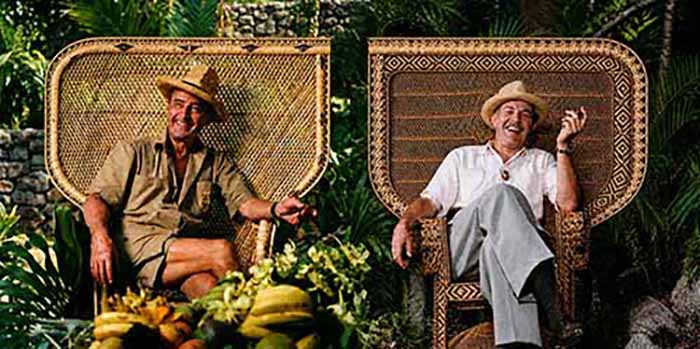
June 30th is National Mai Tai Day, a drink that is attributed by most experts to Victor J. Bergeron, a.k.a. Trader Vic (1902-1984).
Bergeron was the founder of the Trader Vic’s restaurant chain that was so popular in the 1950s and 1960s. It grew to some 30 Trader Vic restaurants worldwide, plus a wholesale food products business.
But someone beat him to the title of “founding founder of tiki culture.” Donn Beach opened the first Don the Beachcomber restaurant in Hollywood in 1933.
Trader Vic and his “amicable rival” Don introduced mainland America to “tiki” drinks: plenty of rum and sweet mixers, garnished with baby orchids and mini Japanese paper umbrellas.
Bergeron, son of a San Francisco grocer, entered the restaurant business at age 32 in 1934—the year following the end of Prohibition. He used $300 of his own money and $800 borrowed from an aunt to open Hinky Dink’s, a hole-in-the-wall restaurant and beer joint in Oakland.
He began inventing and improving his vision of South Seas food—largely, the Cantonese cooking he had come across there.
To go with the food, he invented exotic, rum-based drinks with catchy names: Doctor Funk of Tahiti, Mai Tai, Missionary’s Revenge, Queen’s Park Swizzle, Scorpion, and Sufferin’ Bastard, among others.
Below:
> 1. Two Mai Tai drinks, much confusion.
> 2. The history of tropical/Polynesian drinks.
> 3. The history of the tiki bar.
> 4. The invention of the Mai Tai.
> 5. The original Mai Tai recipe.
> 6. The 5 tropical drink holidays.
> 7. The recipe for the fruity “resort-style” Mai Tai.
Elsewhere on The Nibble:
> The year’s 49 cocktail holidays.
1. THE CONFUSION: TWO DIFFERENT MAI TAI DRINKS
The Mai Tai is one of the world’s most misunderstood cocktails. Although many bars and restaurants serve drinks called Mai Tais, there are actually two very different styles.
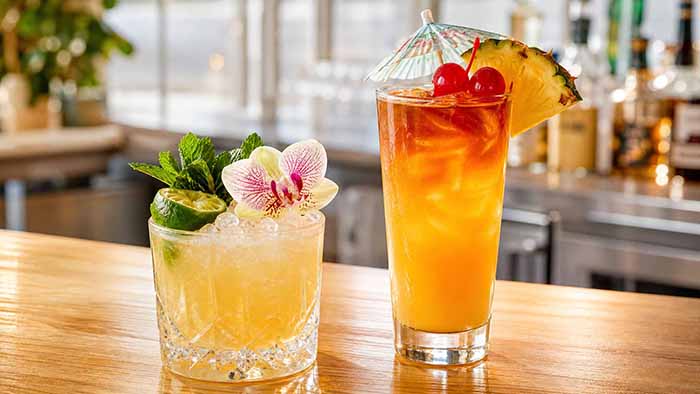
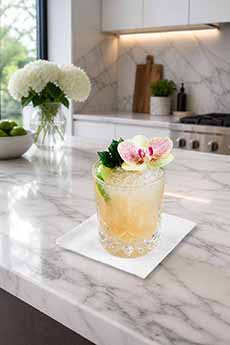
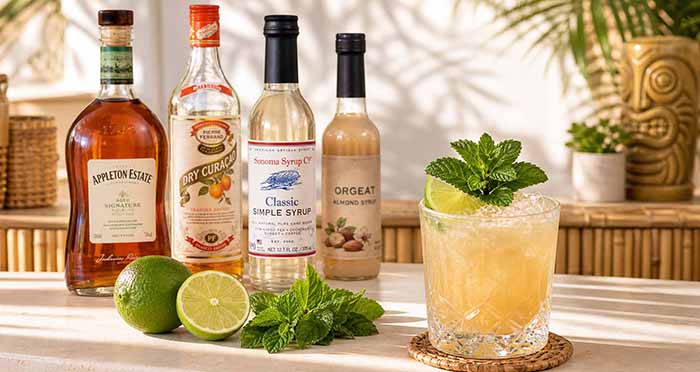
The original Mai Tai was created by Victor J. “Trader Vic” Bergeron in Oakland, California, in 1944. His recipe was a simple, rum-forward blend of aged Jamaican rum, fresh lime juice, orange Curaçao, orgeat (almond syrup), and a small amount of simple syrup, shaken with crushed ice and garnished with a spent lime shell and a sprig of fresh mint (photos #1, #2). It contained no pineapple juice, orange juice, grenadine, or dark rum float.
The almond flavor from the orgeat is one of the defining flavors of a classic Mai Tai.
Bergeron’s original 1944 recipe called for two ounces of aged Jamaican rum, specifically J. Wray & Nephew 17-year-old rum. In fact, the drink was specifically designed to showcase the “hogo” (a savory, funky, tropical fruit flavor) characteristic of pot-still Jamaican rums. This rum is no longer available, so another aged rum is substituted. We use Appleton Estate 12-Year Rare Casks or their less expensive 8-Year Reserve. See the discussion in the footnote.
The pale gold-color drink is served in a short) (rocks glass over more crushed ice.
The orchid garnish was not part of Trader Vic’s original 1944 recipe. It was added gradually through the 1950s–1960s as tiki culture spread to Hawaii, where fresh orchids were abundant and inexpensive. Hawaiian hotels and bars began to use them as a signature tropical garnish. Over time the orchid became so associated with the “authentic” tiki aesthetic that even serious craft bartenders adopted it.
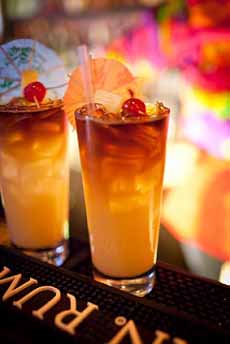
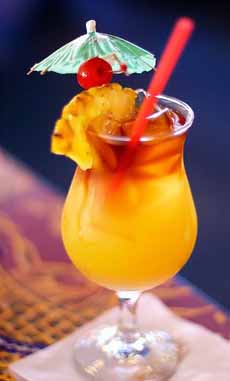
The Mai Tai is revised. Over the years, especially as tiki culture (an entirely California invention) spread to Hawaii and tropical resorts, the elegant almond flavor of the original was replaced by a sweeter, fruitier version that appealed to vacationers (photos #3, #5, #6). These modern Mai Tais often include pineapple and orange juices, a float of dark rum, and colorful garnishes such as cherries, orange slices, paper umbrellas, and optionally an orchid.
This resort-style Hawaiian Mai Tai is served in a tall (Collins) glass, deep amber-orange with a dark rum float, paper umbrella, cherries, and pineapple. The recipe is in the ‡‡‡footnote below.
While these tropical variations are enjoyable in their own right, they are quite different from Trader Vic’s original creation. Bergeron himself commented, regarding the fruity, colorful modifications to his drink: “The flavor of this great rum wasn’t meant to be overpowered with heavy additions of fruit juices and flavorings.” Alas, bar owners and bartenders could care less, as long as the customer is happy [source].
And thus the confusion.
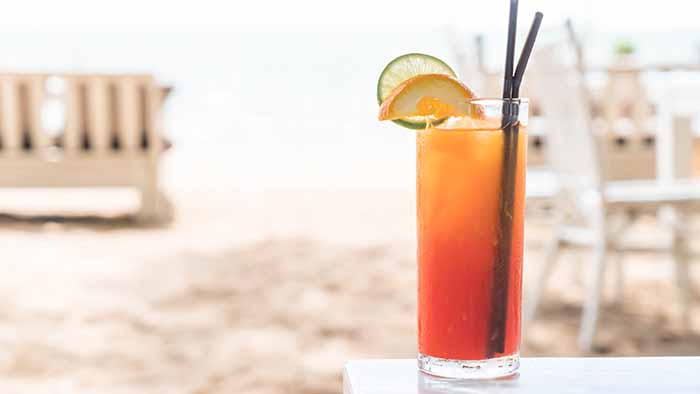
Today, both styles are commonly called a Mai Tai, which explains why photos and recipes can look so different. In appearance you could mistake the original for a Margarita and the newcomer as a Tequila Sunrise.
How Do You Get The Version You Want?
If you want the original, Trader Vic-style Mai Tai with almond flavor, ask:
Do you make the classic 1944 Trader Vic style? If the bartender is confused, ask:
Do you build your Mai Tai with orgeat and fresh lime, or is it a juice-based version?
You can clarify, “No pineapple or orange juice, please, and give me a mint garnish.”
If you want the fruity, resort-style Mai Tai, ask for:
A Hawaiian-style Mai Tai, the version with the dark rum on top, an umbrella and cherry.
Another description: the tropical, fruit-juice version with pineapple and a dark rum float.
Tips:
If the description lists fruit juices or grenadine” it’s the resort version. If it lists orgeat and Curaçao, it’s likely the authentic 1944 version.
If the bar doesn’t have fresh mint or a bottle of orgeat, they almost certainly cannot make a classic Mai Tai, and you’ll be getting the juice version by default.

[8] At the left, Trader Vic’s original Mai Tai, flavored with orgeat (almond syrup). The orchid was a later addition. At the right, the fruity version that was subsequently created at resorts, with the umbrella and the cherry (photo: The Nibble).
2. THE HISTORY OF POLYNESIAN / TIKI DRINKS
In 1937, Hinky Dink’s morphed into an upscale South Pacific theme restaurant with a menu and Polynesian decor, intended to provide “complete escape and relaxation” [source].
Theme-oriented restaurants had been established a few years before then (the history of theme restaurants), based on concepts from hot rods to fishing villages.
Don The Beachcomber, and then Vic Bergeron, pioneered the Polynesian theme restaurant.
Polynesian restaurants were known for their “tiki drinks,” so-called because the restaurants were decorated with tiki statues, along with other theme items such as South Seas-style wood surfboards, fake palm trees, and fish-shaped lights floating above, “trapped” in fishing nets.
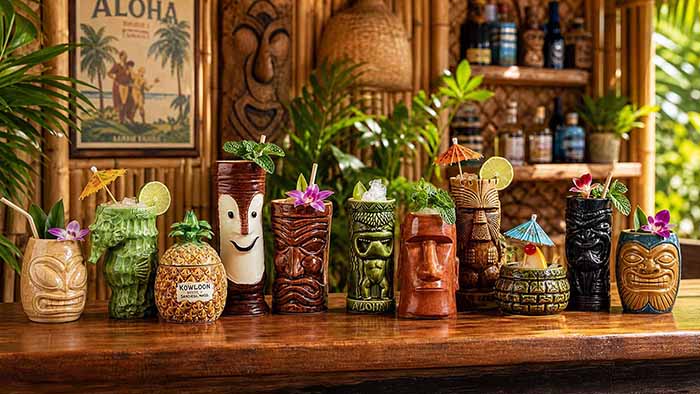
Even the cocktail glass gave way to tiki-style ceramics (photo #9 below).
The exotic drinks added excitement to the overall category of rum drinks, which was focused on the Daiquiri, Dark and Stormy, Mojito, and Rum and Coke/Cuba Libre (the Hurricane, Piña Colada, and others had not yet seen the light of day).
|
|
[1] A Mai Tai based on the original recipe—except for the orchid, a later addition. The recipe is below (photo: The Nibble).
[2] Another Mai Tai based on the original recipe, here with red and pink rose petals and orange marigolds. Be certain to use only organic flowers (edible flowers), which have not been sprayed with pesticide (photo © Turntable Kitchen).
[3] A modern Mai Tai, looking like a Tequila Sunset—not what Trader Vic created (photo © Real Restaurant Recipes).
[4] Ceramists had a heyday designing ceramic vessels for tiki drinks (photo © Dan Lasner | Unsplash).
[5] Not the original Mai Tai: The original (photos #1, #2, #8, #11) had no orange or pineapple juice, no umbrella. This is the fruity or “resort-style” Mai Tai. The recipe is in the ‡‡‡footnote below (photo © Flick River).
[6] If it uses blue Curaçao, it’s a more recent innovation (but here’s the recipe for this “Blue Hawaii” from Culinary Creative).
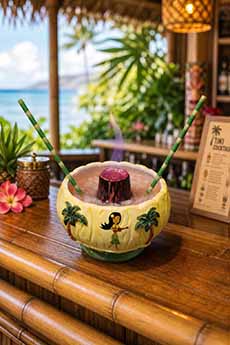
[7] As tiki culture evolved, so did the drinks—into flaming “volcano” bowls equivalent to six or more drinks, served with jumbo straws. The Scorpion is a popular choice for a volcano bowl and the recipe is in the ‡‡footnote. Here’s a different tiki recipe (photo: The Nibble).
|
Others included Navy Grog, invented by Don the Beachcomber in Hollywood in 1944; Planter’s Punch, invented in Jamaica by 1878); Rum Runner, created in the 1950s at the Holiday Isle Tiki Bar in Islamorada, Florida; Tahitian Rum Punch, invented by Don The Beachcomber; and the Zombie, invented by Don the Beachcomber and popularized at the 1939 New York World’s Fair.
Tiki-inspired ceramic glasses, mugs, and drink bowls were designed to fan the flames, as it were. Some bowls even had a center well into which Sterno could be poured for flaming drinks. Other drinks were flamed with a tablespoon of high-proof rum, which was added to the surface.
[9] Tiki paradise (photo: The Nibble).
3. THE HISTORY OF THE TIKI BAR
Ernest Raymond Beaumont Grant (1907-1989) a Texas native, began to travel the world—including the islands of the Caribbean and the South Pacific—in 1926. A bootlegger during Prohibition, he moved to Hollywood and when Prohibition in 1933, opened a bar called Don’s Beachcomber, the first tiki bar.
Grant changed his name to Donn Beach, and in 1937 changed the name of the establishment to Don the Beachcomber.
He then opened what became a very popular bar on Hollywood Boulevard in Los Angeles. It was decorated with items from the South Pacific, and Beach developed a cocktail menu that developed “secret recipes” inspired by the many types of rum drinks he had experienced during his years of island travel.
In 1934, Victor Bergeron, who had also toured the South Seas, transformed his Oakland, California saloon Hinky Dinks into Trader Vic’s upscale Polynesian bar and restaurant. He created his own menu of rum drinks.
Located some 380 miles apart, the two pioneers of “tiki culture” became amicable rivals.
Following World War II, the interest in South Pacific culture blossomed and the tiki boom took off. Tiki bars popped up all over the country, each attempting to outshine one another with lavish decor and rum cocktails served in mammoth bowls with floating orchids and tiny paper umbrellas [source].
Both of the original bars expanded into restaurant chains. Don The Beachcomber had 25 locations, the last of which closed in the 1980s (two short-lived locations opened in 2001 and 2004, and a restaurant in Huntington Beach licensed the name in 2009 [source].
Tiki culture peaked in the 1970s, and if you were of drinking age at the time, you may be missing those delightful drinks.
So throw together a Mai Tai, and celebrate June 30th, National Mai Tai Day.
[10] Don The Beachcomber & Trader Vic (Photo: Abacus).
4. THE INVENTION OF THE MAI TAI
The Mai Tai (pronounced my tie), was created in 1944 by Trader Vic. He tested the recipe on two friends from Tahiti, one of whom exclaimed “Maita’i roa a’e”, or “out of this world—the best” in Tahitian. Bergeron shortened that to Mai Tai—“the best.”
Trader Vic’s recipe is the one that endured, combining dark and light rums, lime juice, orange curaçao, orgeat syrup (almond-flavored simple syrup), and regular simple syrup. The original had a simple garnish (a mint spring) or none at all.
There is another drink called Mai Tai Swizzle, from Don the Beachcomber. It was invented in 1933, but it seems to have disappeared from his menu sometime before 1937 [source]. But the recipe was quite different, augmenting the rum with grapefruit juice, lime juice, Pernod, and bitters. Here’s the recipe.
Over the years, Trader Vic’s Mai Tai has been further “developed” by bartenders, into a fruitier and more colorful drink.
As with every drink called Margarita or Martini—when in fact the ingredients stray far from those recipes—these recipes “borrow” the Mai Tai name but give you a very different rum drink, with pineapple juice, orange juice, and grenadine.
Why? Because fruity drinks are downed more quickly, leading to another and another (i.e., more drinks sold). To add to the colorful drink, a baby orchid and/or miniature Japanese umbrella appeared as garnish; or at least, a pineapple slice, orange slice, and/or maraschino cherry.
As one article noted, “The flavor is often dominated by fruit, and that helps hide the heavy taste of alcohol. This is perfect for drinkers who prefer less alcoholic flavor…They end up tasting so good that a person can almost forget how potent they really are” [source].
[11] Trader Vic’s original Mai Tai ingredients (Photo: The Nibble).
5. RECIPE: THE ORIGINAL MAI TAI RECIPE
“Trader Vic” Bergeron invented the Mai Tai to showcase a favorite aged rum—the 17-year-old J. Wray and Nephew Ltd. Jamaican rum, golden and medium-bodied (the brand is now owned by Campari America).
The name was allegedly taken from maita’i, the Tahitian word for good or excellent.
He also used rock candy syrup, which is sweeter and thicker than regular simple syrup: 2 parts sugar and 1 part water instead of a 1:1 ratio (recipe).
However, the Mai Tai was such a smash hit that “A couple of years after the cocktail’s invention, the world ran out of the 17-year-old rum…so [Bergeron substituted] a 15-year-old J. Wray and Nephew.” [source]
But once that, too, dwindled in supply, Bergeron created a blend of Jamaican rum and aged molasses-based Martinique rum to emulate the Wray and Nephew rum.
Thus, here’s a current approximation of Bergeron’s revised Mai Tai:
Ingredients Per Drink
2 ounces aged Jamaican rum*
1-1/2 teaspoons (1/4 fluid ounce) orange Curaçao**
1-1/2 teaspoons orgeat syrup†
1-1/2 (1/2 ounce) teaspoons simple syrup‡
Juice of one fresh lime (1-1/4 ounces)
Optional garnish: mint sprig (later, lime wheel and sugar cane stick became options, and sometimes a baby orchid)
Crushed ice
Preparation
1. SHAKE the ingredients vigorously with the ice. Strain into an ice-filled double-old fashioned glass. Add a sprig of fresh mint.
[12] The fruity “resort” Mai Tai. The recipe is in the ‡‡‡footnote below (photo: Magnific).
6. THE YEAR’S 5 TROPICAL DRINK-RELATED HOLIDAYS
March 24: National Cocktail Day
June 26: National Tropical Drinks Day
June 30: National Mai Tai Day
July 18: National Piña Colada Day
August 16: National Rum Day
|
________________
*The rum Trader Vic used in 1944 was J. Wray & Nephew 17-Year-Old Jamaican Rum. That particular expression was discontinued decades ago after its stocks were exhausted. By the 1950s, it had become so scarce that Trader Vic had to reformulate the Mai Tai using other aged Jamaican rums. The “disappearance” of the 17-year rum became part of Mai Tai lore. Trader Vic himself lamented that he could no longer make the drink exactly as he had originally intended because the rum was no longer available.
Substitute rums: Appleton Estate 8 Year Reserve, Appleton Estate 12 Year Rare Casks, Hampden Estate 8 Year, Plantation/Planteray Xaymaca Special Dry, or Smith & Cross Traditional Jamaican Rum (for a funkier profile). For a home bartender, Appleton Estate 8 Year or 12 Year is the closest widely available substitute. It also has a historical connection: Appleton Estate is produced by the same company—J. Wray & Nephew—that made the original rum Trader Vic used. So while it isn’t the 17-year expression, it’s about as close as you can reasonably get today.
J. Wray & Nephew is a Jamaican company founded in Kingston in 1825. Today it is owned by the Campari Group and continues to produce several well-known rums, including Wray & Nephew White Overproof Rum, Appleton Estate rums, and Coruba rum.
**Trader Vic used Holland DeKuyper Orange Curaçao.
†Simple syrup lets the bartender fine-tune the sweetness without adding more almond flavor. The original recipe used 1/4 ounce Trader Vic’s Rock Candy Syrup, which is a fancy name for double simple syrup: a very thick, high-concentration simple syrup, with a concentration of 2:1 sugar:water versus the standard 1:1 ratio. What Trader Vic branded as Rock Candy Syrup is known in the industry as rich simple syrup or double simple syrup: much thicker, more syrupy, and significantly sweeter than standard simple syrup. Rock Candy Syrup also contained a small amount of vanilla to mirror the taste of actual rock candy. He used Rock Candy Syrup in his original 1944 Mai Tai recipe specifically for the texture and viscosity; a lesser proportion of water prevents the drink from becoming over-diluted as the crushed ice melts.
If you use standard simple syrup (1:1), you may find the drink tastes slightly thin and less sweet than Trader Vic intended—although still delicious. If you want to re-create Rock Candy Syrup, combine 2 parts granulated sugar with 1 part water, heat until the sugar is fully dissolved (do not boil), and add a drop of vanilla extract after the syrup cools.
‡The original orgeat brand used in the Mai Tai was Garnier Orgeat, which is no longer made. Orgeat, the preferred simple syrup in France, is smade with almonds and a little orange flower water. The almond it imparts one of the defining flavors of a classic Mai Tai.
Why use both? Because they do different things: Orgeat contributes almond flavor, a silky mouthfeel, and some sweetness. This was especially important in 1944 because Trader Vic was using an exceptionally rich, aged Jamaican rum. A small amount of plain syrup balanced the acidity of the lime while allowing the rum and the almond notes to remain in harmony.
For home bartenders today, many recipes omit the rich simple syrup and simply increase the orgeat to 1/2 ounce. That makes an excellent drink and is easier because it uses one less ingredient. Purists, however, often prefer the original approach because it produces a drier cocktail with a more restrained almond flavor.
‡‡Scorpion recipe, per drink: 2 ounces light rum, 1 ounces brandy or Cognac, an optional ounce of gin [Trader Vic used it], 2 ounces fresh orange juice, 1 ounces fresh lemon juice, 1/2 ounce orgeat syrup, 1 cup crushed ice. Combine all ingredients in a cocktail shaker or blender. If blending, blend until slushy but not fully liquid. If shaking, shake vigorously to chill and slightly dilute. Pour into a cocktail glass, tiki mug, or a shared Scorpion/volcano bowl. Garnish with your choice of an orange wheel, maraschino cherry, pineapple, cinnamon stick, a fresh mint sprig, and the inescapable baby orchid.
‡‡‡The fruity “resort-style” Mai Tai recipe, per drink (photos #3, #5, #8, and #12):
Ingredients: 1½ oz light (silver) rum, ½ oz dark Jamaican or aged rum, ½ oz orange Curaçao or triple sec, 1 oz orange juice, freshly squeezed, 1 oz pineapple juice, ½ oz fresh lime juice, ½ oz orgeat (almond syrup), ¼ oz simple syrup (optional, depending on the sweetness of your juices), ½ oz dark rum (Myers’s, Coruba, Goslings Black Seal, or similar) for the float; garnishes of choice (maraschino or Luxardo cherry, mint leaves, orange wheel, pineapple wedge, paper umbrella).
Preparation: Fill a cocktail shaker with ice and add all ingredients except the dark rum float. Shake vigorously for 10–15 seconds and pour into a double old-fashioned glass or tiki mug filled with crushed ice. Slowly pour the ½ oz dark rum over the back of a spoon to float it on top. Top with additional crushed ice if needed. Garnish as desired.
CHECK OUT WHAT’S HAPPENING ON OUR HOME PAGE, THENIBBLE.COM.
|
|