THE NIBBLE BLOG: Products, Recipes & Trends In Specialty Foods


Also visit our main website, TheNibble.com.

TIP OF THE DAY: A Blueberry-Blackberry Pie With Meringue Dot Topping

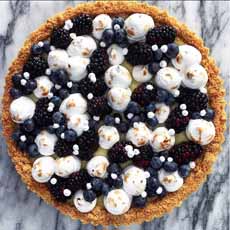
Fun and beauty combine in this blueberry-blackberry pie, from Kindred Restaurant in Davidson, North Carolina.

Just looking at the cuisine at Kindred makes us want to head to the charming lakeside college town for a week’s vacation of dining and enjoying the view.

For now, we’ll have to content ourself with copying the pie, which is pretty easy to follow:

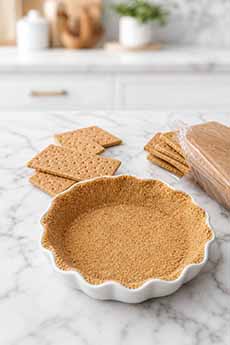
  • Graham cracker crust
  • Custard or lemon meringue base
  • Topping of blueberries and blackberries (the textural differences add to the charm, and you can substitute strawberries and raspberries)
  • Soft meringue and a piping bag
  •  
    You don’t need piping skills: The whole idea is different sizes of meringues.

    We’ll try a light garnish, too: a bit of lemon zest or a chiffonade of basil.
     
     
    THE DIFFERENT TYPES OF MERINGUE

    There are three basic types of meringue: French, Italian and Swiss. A sub-tip of the day is to try them all, and decide which you prefer.

    Here are meringue details.
     
     
    THE HISTORY OF MERINGUE TOPPING & COOKIES

    Some sources say that that meringue (muh-RANG) was invented in the Swiss village of Meiringen in the 18th century, and subsequently improved by an Italian chef named Gasparini.

    Not all experts agree: The Oxford English Dictionary, for example, states that the French word is of unknown* origin. Meringue wasn’t invented in France.

    Even Larousse Gastronomique, The New American Edition of the World’s Greatest Culinary Encyclopedia, acknowledges the Swiss possibility along with:

  • Poland: Created by an unknown chef in the court of King Stanislas I Leszcy?ski of Poland, who later became Duke of Lorraine. While this theory says that “meringue” derives from the Polish marzynka, we were unable to find that word in a Polish dictionary.
  • England: The earliest written recipe for a baked “beaten-egg-white-and-sugar confection” is a handwritten recipe from 1604 called white bisket bread, from Lady Elinor Poole Fettiplace (1570-c.1647) of Oxfordshire, which later appeared in her book, “Elinor Fettiplace’s Receipt Book — Elizabethan Country House Cooking.”
  • In a later generation, Lady Rachel Fane (c. 1612–1680) of Kent has a recipe called “pets.” Slowly-baked meringues are still referred to as pets in the Loire region of France (the reference appears to be their light fluffiness, perhaps like a bunny or kitten, or for pétillant [sparkling] wine).
  • The first evidence of the confection called meringue first appeared in print in Chef François Massialot’s seminal 1691 cookbook, available in translation as . The English first saw the word in 1706, in an English translation of Massialot’s book.
  •   Blueberry Meringue Pie
    [1] Blueberry and blackberry pie with meringue garnish, at Kindred restaurant in North Carolina.

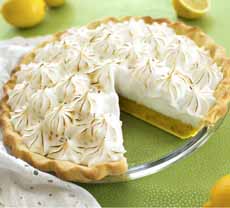
    Passionfruit Meringue Pie
    [2] One of the benefits of dots of meringue (photo #1) is that you don’t need the skill to pipe evenly (photo by Hannah Kaminsky, Bittersweet Blog).

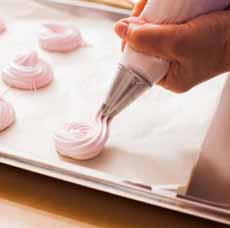
    Piping Meringue
    [3] Meringues can be baked into hard cookies or pavlovas, or cooked or torched briefly as a soft topping (here’s the recipe from Raw Spice Bar).

     
    Until the early 19th century, meringues cooked in the oven were shaped between two large spoons. Meringue piped through a pastry bag was introduced by the great French chef Marie-Antoine Carême (1784-1833—he preferred to be called Antonin), the founder of the concept of haute cuisine and the four mother sauces. He invented mayonnaise and many other recipes, including charlotte Russe, coeur à la crème, croquembouche, éclairs, mille-feuille and other iconic French recipes.

    No one can find a historical derivation of the word “meringue*,” but the latest suggestion is that it comes from Middle Dutch meringue, meaning light evening meal—possibly from the Latin merenda, “light evening meal.”

    Our personal favorite is the Middle Low German “meringe,” from mern, “to dip bread in wine.” Who wouldn’t like to dip a meringue in a glass of wine?
     
    ________________
    *Contenders from include 1700 on include, from the Walloon dialect, maringue, shepherd’s loaf; marinde, food for the town of Meiringen (Bern canton, Switzerland). While they have a few letters in common with meringue, evidence for both is completely lacking. A source that makes more sense is the Latin merenda, the feminine gerund of merere, to merit. Who doesn’t merit a delicious confection? But as our mother often said: “Who cares; let’s eat!”


    Comments off

    TIP OF THE DAY: Holiday Ice Cream

    Red White & Blue Ice Cream
    [1] Mix in sprinkles for holiday-themed ice cream, like this patriotic flavor from OddFellows Ice Cream.

    Red White & Blue Ice Cream Cones

    [2] Make matching cones. Here’s the recipe from Sweet Estelle.


    You can create special ice cream for any special occasion, using store-bought vanilla ice cream and mix-ins in holiday colors.

    The easiest way is to buy sprinkles, confetti and confetti shapes (hearts, pumpkins, stars, etc.—photo #2).

    For example:

  • July 4th, Labor Day & Memorial Day: red and blue sprinkles.
  • Halloween: orange and black sprinkles.
  • Thanksgiving: orange, red and yellow sprinkles.
  • Christmas: red and green sprinkles.
  • Valentine’s Day: red and pink sprinkles.
  • St. Patrick’s Day: dark and light green sprinkles.
  • Easter: pastel sprinkles.
  •  
    Preparation

    1. SET the container on the counter until the ice cream is soft enough to mix in the decorations.

    2. RETURN to the freezer until ready to serve.

    TIPS: It’s easier to mix two separate pints than a quart or larger container. And it’s even easier than that to dip the edges of ice cream sandwiches into the sprinkles.
     
     
    JULY 4TH TRIVIA

  • The first independence Day. The Declaration of Independence was formalized on July 2, 1776, when Congress voted for independence from Great Britain. Two days later, on July 4, 1776, the final wording of the Declaration of Independence was approved, and the document was published. The first public reading of the Declaration of Independence was on July 8, 1776. Delegates began to sign the Declaration of Independence on August 2, 1776. While John Adams wanted it to be July 2nd, Congress agreed on July 4th for the holiday.
  • The term “Independence Day” was not used until 1791.
  • The first description of how the holiday would be celebrated was in a letter from John Adams to his wife Abigail, on July 3, 1776. He described “pomp and parade, with shows, games, sports, guns, bells, bonfires, and illuminations” throughout the United States.
  •  

  • If July 4th falls on a weekend, the celebration is moved: to Friday, if the date falls on a Saturday; to Monday, if it falls on a Sunday. The date was maneuvered to provide federal employees (and subsequently, most of us) with a three-day weekend.
  • The Liberty Bell, housed in Philadelphia’s Independence Hall, hasn’t rung in 171 years. Instead, it is tapped 13 times every July 4 by descendants of the signers of the Declaration of Independence. It was ordered from England by the Pennsylvania Provincial Assembly (part of the state’s colonial government) to hang in its new State House (later known as Independence Hall). In arrived in 1751 and cracked at its first ringing—as had two prior bells tested in England. In 1846, when Philadelphia’s mayor requested that it be rung on George Washington’s birthday, attempts were made to repair an existing fracture and the bell reportedly tolled loud and clear at first, but then cracked beyond repair.
  • Calvin Coolidge, our 30th president, was born on July 4th, and three presidents died on it. John Adams and Thomas Jefferson both died on the 50th anniversary of the holiday, in 1829; James Monroe died on July 4, 1831.
  • The annual July 4th hot dog eating contest, sponsored by Nathan’s Famous, began as a disagreement among four immigrants at Coney Island, Brooklyn, on July 4th, 1916. The fight was over who was more patriotic. They were overheard by Nathan Handwerker, an immigrant with a hot dog cart, who offered them a challenge: Whomever could devour the most hot dogs would win the argument. The winner was an Irish immigrant named Jim Mullen who consumed 13 hot dogs in 12 minutes (it is not noted whether Nathan donated the hot dog or if the challengers paid the going rate, five cents apiece). In 2016, Joey Chestnut devoured 70 hot dogs and rolls in 10 minutes—–watched by some 30,000 fans at Coney Island and millions around the world on ESPN.
  •  
      

    Comments off

    Hot Dog Recipes For National Hot Dog Month

    Hot Dogs & Sauerkraut
    [1] The basic—hot dog, mustard, sauerkraut—at Murray’s Cheese.

    Hot Dog Toppings
    [2] Bacon hot dogs from Vermont Cure. Bacon is mixed with the beef.

    Chili Dogs
    [3] Chili-cheese on turkey dogs from Jennie O.

    Chicago Hot Dog

    [4] Chicago-style hot dog from Kindred Restaurant. Here are the signature hot dog recipes from 12 more cities.


    July is National Hot Dog Month, a comfort food served in 95% of homes in the U.S. (June 23rd is National Hot Dog Day.)

    According to the National Hot Dog & Sausage Council, Americans purchase 350 million pounds of hot dogs at retail stores—9 billion hot dogs!

    The actual number of hot dogs consumed by Americans is much larger, incorporating those purchased from street vendors, at sporting events, state fairs, carnivals, etc. The Council estimates Americans consume 20 billion hot dogs a year, more than twice the retail sales figures.

    That computes to about 70 hot dogs per person each year; which sounds like a lot but is just 6 hot dogs a month.

     
    HOT DOG BACKGROUND

  • Hot Dog History
  • How Hot Dogs Are Made
  • Why Are There 10 Hot Dogs Per Package But Only 8 Rolls
  •  
    HOT DOG BASICS

  • Bacon Hot Dogs
  • Homemade Hot Dog Rolls
  • Beer & Pretzel Hot Dog Rolls Recipe
  • Kobe Beef/Wagyu Hot Dogs
  • 20 Other Uses For Hot Dog Rolls
  •  
    FUN HOT DOG RECIPES

  • Bacon Cheese Dogs
  • Cubano Dogs
  • DIY Hot Dog Bar
  • Firecracker Hot Dogs
  • Gourmet Hot Dogs 1: Signature Recipes From 13 Cities
  • Gourmet Hot Dogs 2: Recipes Honoring China & Japan To Canada & Coney Island
  • Italian Hot Dogs
  • Mini Corn Dogs
  • Tater Tot Hot Dog Skewers
  • Top 10 Hot Dog Toppings

  •  
    HOT DOG VS. FRANKFURTER VS. WEINER

    The hot dog traces its lineage to the 15th-century Viennese sausage, or wienerwurst in German; hence, wiener.

    In the 17th century, Johann Georghehner, a butcher from the German city of Coburg in Bavaria, is credited with inventing the “dachshund” or “little dog” sausage—a slimmer version of wienerwurst. He brought it to Frankfurt, hence, frankfurter. Yet, it was still a sausage eaten German-style, with a knife and fork—no roll.

    The hot dog, a slender sausage in a roll, was undeniably an American invention. The attribution is accorded to a German immigrant named Charles Feltman, who began selling sausages in rolls at a stand in Coney Island in 1871.

    The 1893 World Exposition in Chicago marked the debut of the hot dog vendor. According to National Hot Dog and Sausage Council, around this time that the hot dog first made its first appearance at a ballpark, at a St. Louis Browns game. The first published mention of the term “hot dog” as a food appeared in print in a September 1893 issue of The Knoxville Journal. However, it was well established prior to then.

    As the legend goes, frankfurters were dubbed the “hot dog” by a cartoonist who observed a vendor selling the “hot dascshund sausages” during a baseball game at New York City’s Polo Grounds. Concessionaires walked through the stands shouting, “Get your red-hot dachshund sausages.”

    In 1906, Tad Dorgan, a cartoonist for a Hearst newspaper, was inspired by the scene and sketched a cartoon with a real dachshund dog, smeared with mustard, in a roll. Supposedly, Dorgan could not spell the name of the dog and instead wrote, “Get your hot dogs” for a caption.

    However, Dorgan’s cartoon has never been located. and some hot dog historians suggest the “dachshund” sausages were being called hot dogs on college campuses in the 1890s.

    “Little dog” sausages became standard fare at ballparks in 1893 when St. Louis bar owner and German immigrant Chris Von de Ahe, who owned the St. Louis Browns baseball team, began to serve them there…and started a tradition.


    Comments off


    © Copyright 2005-2026 Lifestyle Direct, Inc. All rights reserved. All images are copyrighted to their respective owners.