THE NIBBLE BLOG: Products, Recipes & Trends In Specialty Foods


Also visit our main website, TheNibble.com.

TIP OF THE DAY: Authentic Greek Salad Recipe & The “American” Greek Salad

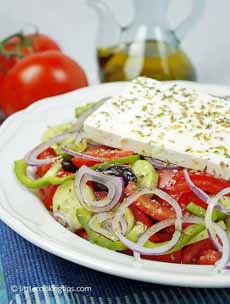
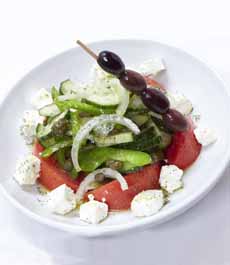
Authentic Greek Salad
[1] The real deal: an authentic Greek salad from Little Cooking Tips. Here’s the recipe.

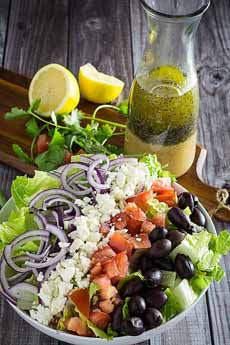
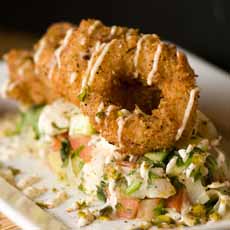
Greek Cobb Salad
[2] We love how Dishing Delish has arranged the Greek salad ingredients like a Cobb salad. Here’s her recipe for the Best Greek Salad Dressing.

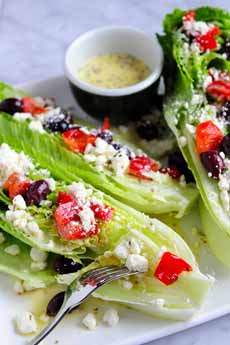
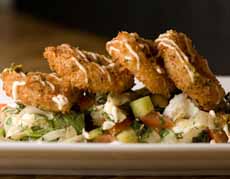
Deconstructed Greek Salad
[3] We also love this deconstructed Greek salad: an appetizer on a romaine wedge. Here’s the recipe from DeLallo.

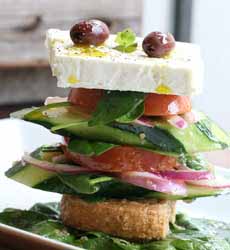
Creative Greek Salad
[4] All the ingredients of an authentic Greek salad, with some creativity in assembly, from Stix | NY.

  Our favorite luncheon salad is a Greek salad, most often homemade, sometimes at a diner or similar casual spot.

We follow the latter’s recipe: romaine, tomatoes, feta cheese, cucumber, green bell pepper, red onion, kalamata olives, peperoncini (the italian spelling; pepperoncini is the English spelling), and hopefully, a couple of grape leaves and pita or crusty bread on the side. For seasoning, a sprinkle of oregano and cruets of oil and red wine vinegar.

We’ve been known to substitute balsamic vinegar for the conventional acidic red wine vinegar, and add fresh basil or other herb when we have it.

We especially love a Greek salad in the summer, when the seasonal tomatoes are a joy in of themselves.
 
 
THE AUTHENTIC GREEK SALAD

Bloggers Mirella and Panos of Little Cooking Tips says: “The authentic horiatiki [Greek salad] is a very specific salad, with very specific ingredients. See the recipe below, from Chef Amanda Cohen.

The Authentic Greek Salad Ingredients

  • Tomatoes (not cherry tomatoes; whole tomatoes, cut in wedges)
  • Cucumbers (peeled and sliced)
  • Red onions (thinly sliced)
  • Green bell peppers (thinly sliced)
  • Kalamata olives (whole, not pitted)
  • Traditional Greek Feta (in a big slice or chunk, never crumbled)
  • Extra virgin olive oil (for dressing)
  • Dry oregano
  •  
    The above exist in any authentic horiatiki you’ll be served throughout Greece. There are only two optional ingredients in addition to the ones above:

  • Capers (added mostly in horiatiki salads that are served in Greek islands)
  • Red wine vinegar (for people who want extra acidity).”
  •  
    There is no lettuce, no stuffed grape leaves, no peperoncini, no radishes, no anchovies—nothing that isn’t in the bullet points above. Here’s their authentic horiatiki recipe (photo #1).

    Of course, there are other popular salads in Greece, including:

  • Lahanosalata, cabbage slaw, dressed with olive oil, lemon juice and garlic.
  • Maintanouri, parsley salad, usually used as a condiment.
  • Marouli, lettuce salad with onion and dill.
  • Pantzarosalata, boiled, sliced beet, sometimes with the beet greens, dressed with olive oil and red wine vinegar.
  • Patatosalata, potato salad with finely sliced onions, dressed with olive oil and lemon juice or vinegar.
  • Revithosalata, chickpea salad.
  • Roka salad, arugula/rocket (roka) dressed with olive oil and red wine vinegar or lemon juice, sometimes with added anchovies.
  •  
    Cypriot salad, native to the island of Cyprus, has similar ingredients to the horiatiki, exchanging the oregano for flat-leaf parsley.

    The other ingredients in Cypriot salad: finely chopped tomatoes (not sliced, as in horiatiki, capers, cucumbers, onions and feta cheese, dressed with olive oil and lemon or red wine vinegar.

    The bell peppers and olives: lost in translation.
     
     
    THE HISTORY OF GREEK SALAD, HORIATIKI

    Horiatiki is primarily a summer dish, using lush tomatoes off the vine. Since lettuce only grows in Greece during the cooler, winter months, a horiatiki salad does not include lettuce (source).

    And while horiatiki is ubiquitous in Greece, it is a relatively new combination. Some of the ingredients are thousands of years old, others as new as the last century.

  • Bell pepper—all peppers, including peperoncini and hot chiles—are new world produce. Pepper seeds were brought back to Spain in 1493 after a member of the Columbus expedition tasted hot chiles and called them “pepper,” after the heat of the black peppercorns used in Europe (the native name for the category is chilli). From there the pepper spread to other European, African and Asian countries. It may have gotten to Greece in the 16th century.
  • Feta cheese may be the oldest ingredient in the salad. References to Greek cheese production date to the 8th century B.C.E., and the items used to make cheese from sheep’s or goat’s milk, described in Homer’s Odyssey are similar to those used today’s handmade feta [source].
  • Lettuce was first cultivated in Egypt for food around 2680 B.C.E. Romaine lettuce was bred on the Greek island of Cos, an alternative word still used for romaine [source]. Romans usually cooked their lettuce, and the plant became known as Roman lettuce due to the Roman belief in its healthful and healing properties.
  • Olives have been cultivated in Greece for thousands of years. Kalamata olives are just one variety from a specific region. Greece produces both green and black olives, in addition to the purple kalamata. Here’s more about Greek olives.
  • Onion’s origin cannot be established for certain. The wild onion is extinct so botanists lack the markers used to track its origin and spread. Traces of onions recovered from Bronze Age settlements in China indicate that onions were eaten as far back as 5000 B.C.E., and may be a point of origin. Archaeologists, botanists and food historians point to are central Asia or Persia as the site of early cultivation. Onions have been cultivated for at least 7,000 years, and were probably simultaneously domesticated around the world [source].
  • Tomatoes didn’t arrive in Europe until the 16th century…but not planted until 1818 in Greece. They were brought back by from the New World by the conquistadors in 1529, but as a member of the Nightshade family were first thought to be poisonous. They were used as houseplants and not eaten for another two centuries. In Greece, they weren’t widely cultivated until the early 20th century [source]. Here’s the history of tomatoes.
  •  
    Now, on to a salad from one of America’s great vegetarian chefs, Amanda Cohen of Dirt Candy, in New York City.

    Her “American Greek salad” is layered with some ingredients that no Greek chef has likely thought of (photos #5 and #6).
     
     
    RECIPE: AMANDA COHEN’S GREEK SALAD

    “This recipe, while it might look intimidating, makes this salad a party on your plate,” says Chef Amanda. “Sumac and za’atar give this recipe its zip. Sumac is a dried berry with a bright citrusy flavor, and za’atar is a vibrant, intensely herbal seasoning. You can find them at any Middle Eastern or Indian grocery store.

    “You can always leave them out, but this salad is a lot more fun if they’re invited to the party.”

    In addition to sumac and za’atar, this recipe invites pickled onions and fried onion rings with a preserved lemon drizzle.

    Thanks to Wüsthof for the recipe. Wüsthof is Chef Amanda’s cutlery of choice; and THE NIBBLE has more than a few in its knife rack, as well. Brush up on your knife skills with these Wüsthoff videos.


    Ingredients For 4 Servings

    For The Pickled Onions

  • 1 large red onion, very thinly sliced
  • ½ cup lime juice
  • ¼ cup kosher salt
  •  
    For The Dressing

  • 3 cups extra virgin olive oil
  • ½ cup red wine vinegar
  • ½ cup fresh oregano
  • 1 tablespoon Dijon mustard
  • 2 tablespoons lemon juice
  • 2 teaspoons garlic, minced
  • Zest of 1 lemon
  • Salt and pepper, to taste
  •  
    For The Salad

  • 1½ cups plum tomatoes, diced
  • 1½ cups hot house cucumbers, diced
  • ¾ cup fennel, very thinly sliced
  • 1 tablespoon fresh dill, chopped
  • 1½ tablespoons fresh parsley, chopped
  • 2 teaspoons fresh oregano, chopped
  • 1 cup sliced black olives
  • 1 cup crumbled feta cheese
  •  
    For The Preserved Lemon Mayonnaise

  • ¼ cup chopped preserved lemons, seeds removed
  • 1 cup mayonnaise
  •  
    For The Mushrooms

  • 2 trumpet royale mushroom
  • 1 can (12 ounces) seltzer water
  • 8 cups canola oil
  • 2 cups all purpose flour
  • 1 cup panko crumbs
  • 1 tablespoon sumac
  • 1 tablespoons za’atar
  • 2 teaspoons salt
  •  
    For The Garnish

  • 1 teaspoon sumac
  • 1 teaspoon za’atar
  • 2 tablespoons toasted pistachios, crushed
  •  
    Plus

  • Pita or crusty rustic bread
  •  
    Preparation

    1. MAKE the pickled onions. Massage 1 tablespoon of the salt into the onions. Keep massaging until liquid starts to seep out of the onions and then squeeze all of the liquid out. Wash the onions a few times and repeat a second time. Then, add 1 tablespoon of the salt and ¼ cup of the lime juice to the onions and let sit for a few hours. Squeeze all of the liquid out of the onions. Repeat the above sequence. When ready, onions should be a bright pink color. If they are not, repeat the process again.

      Amanda Cohen Greek Salad

    Amanda Cohen Greek Salad
    [5] and [6] Chef Amanda Cohen’s take on “the best Greek salad” (photos courtesy Star Chefs).

    Vertical Greek Salad
    [7] Daunted by Chef Amanda’s recipe? Then take on this one, served at Death Ave in New York City. Just stack on a piece of toasted rustic bread and serve.

    Wusthof Serrated Chopper
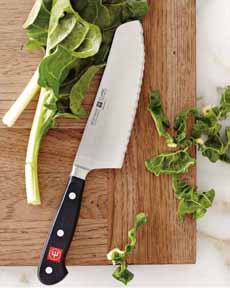
    [8] One of our favorite Wüsthof knives: the serrated chopper, available at Williams-Sonoma.

     
    2. MAKE the dressing. In a blender mix the garlic, mustard, red wine vinegar, lemon juice, lemon zest, salt and black pepper. Slowly stream in the olive oil. Add the oregano and blend until it is broken up into small pieces.

    3. MAKE the preserved lemon mayonnaise: Place all ingredients in blender and blend until very smooth. Put the mixture into a squeeze bottle.

    4. MAKE the salad. In a bowl mix the tomatoes, cucumbers, fennel, herbs and olives. Add the feta and adjust the salt levels.

    5. MAKE the mushroom rings: Slice the mushrooms into ¼” thick rings and punch the centers out, leaving about ¼” for an outer ring, so that each ring is ¼” thick and ¼” wide. Heat the oil in a heavy-bottomed pot until it reaches 375°F.

    Mix the flour and the seltzer in a bowl. In a separate bowl mix the panko, the salt, the sumac and za’atar. Dip the rings in the seltzer mixture first and then dip them in the panko mixture. Fry in batches for about 2-3 minutes each. When done, the mushrooms should be golden brown on the outside.

    6. ASSEMBLE: Toss the salad with the dressing; taste and adjust the salt level. Divide the salad onto four plates. Place 4 onion rings on top of each salad. Squeeze a few lines of the preserved lemon mayo across the salad. Garnish: Sprinkle with the sumac, za’atar and the pistachios. Place a tablespoon of the pickled onions on the side of the plate. Microwave the pita and you’re ready to eat!


    Comments off

    International Fusion Fries & French Fry Trends

    Baked Fries With Kimchi Sour Cream Dip
    [1] These Asian-fusion fries turn Korean kimchi into a dip. Here’s the recipe (photo © Idaho Potato Commission).

    Furikake-Seasoned Fries
    [2] These fries are seasoned with furikake, a Japanese seasoning blend you can see in the bowl. Here’s the recipe, which includes a sauce flavored with sriracha, native to Thailand (photo © Girl Carnivore).

    Daigaku Imo Fries
    [3] Daiguko imo, recipe #1 below, is a popular Japanese recipe that caramelizes the fries (photo © Idaho Potato Commission).

    Baked Harissa Fries Recipe With Harissa Aioli Dip
    [4] Harissa fries fuse two cultures: harissa spice from Tunisia on the fries, and aïoli from France (photo © Idaho Potato Commission).

    Carne Asada Fries
    [5] Carne asada fries, fully loaded, is recipe #2 below (photo © Idaho Potato Commission).

    Spiral Cut Fries
    [6] Want to make spiral cut fries? Try this recipe from the Idaho Potato Commission.


    Updated August 2026

    July 13th is National French Fry Day. In previous years we’ve created a glossary of the different types of French fries, and a variety of recipes from the Canadian favorite, poutine, to the two new recipes below.

    This year our focus is on fusion food, where fries are seasoned or otherwise prepared with the flavors or techniques of other countries. These examples were reported by Flavor & The Menu, a magazine for chefs.

    Below:

    > Fries in Asia.

    > Fries in the U.S.

    > Recipe: Japanese-influenced daigaku imo fries.

    > Recipe: Mexican-influenced carne asada fries.

    > What is fusion food?

    Elsewhere On The Nibble:

    > The history of French fries.

    > The different types of fries: more than 40!

    > Top 10 favorite dips for fries.

    > How to make the best French fries.

    > Make your own signature fries.

    > Non-ketchup dips for fries.

    > The history of potatoes.

    > The different types of potatoes: a photo glossary.

    > The year’s 30 potato holidays.

    > The year’s 24 fried food holidays.

    > Food fun: The world’s largest French fry.
     
     
    1. WHAT’S UP WITH FRIES IN ASIA

  • China: Chinese chain restaurants serve stir-fried fries, tossing fries into the wok with other ingredients. Examples: shoestring fries with Sichuan chicken, waffle-cut fries with roasted goose.
  • Indonesia: A&W Indonesia offers a side of “duo fries,” a combination of curly and straight fries in one package. Other restaurants similarly combine different forms of fries in one order. Want combo fries with that?
  • Philippines: Potato Corner, a franchise chain, has been serving customized fries since it began in 1992. There are choices of seasonings, from chile barbecue and cinnamon to garlic, Parmesan, and sour cream and onion. Fries include original and sweet potato, plus loopy, which are circular, like calamari rings. Want to try them? There are outposts in 10 American states. Here’s the menu of fries.
  • South Korea: McDonald’s serves honey butter fries, a sweeter flavor profile. Pizza Hut launched a potato-sausage pizza topped with seasoned, straight-cut fries. Rival chain Mr. Pizza has honey butter potato pizza, with a topping of potato chips. WaBar, a Western-style pub chain, has a potato-filled menu that includes bulgogi potato pizza, made with crinkle-cut fries and bulgogi (marinated, grilled beef).
  •  
     
    2. WHAT’S UP WITH FRIES IN THE U.S.

    Fries have always been on the menu in the U.S., and they’re moving on up. According to recent data from Technomic’s MenuMonitor, fries have shown a 46.5% growth on menus at better restaurants since 2010.

    Americans consumers are eating even more fries today than a few years ago. Technomic’s MenuMonitor finds an increase in the number of appetizer fry items on menus, as well as in the number of side fry items at fine-dining restaurants, up by 5% since 2013.

    Rather than using grapeseed oil or canola oil, some top chefs are frying their potatoes in duck fat or goose fat, even beef tallow, each of which give the fries a distinctive, luxurious flavor. Another trend…
     
     
    Loaded Fries

    These take inspiration from the loaded baked potato. Poutine, the beloved Canadian dish of fries topped with cheese curds and gravy, is currently the fastest-growing way of loading fries, according to Technomic.

    Fast-food versions of loaded fries have been noted, often as limited-time offers, such as Wendy’s BBQ Pulled Pork Fries and Baconator Fries, topped with Cheddar cheese sauce, bacon and shredded Cheddar.

    Regional or global fusion profiles also prevail, such as:

  • Berliner fries at Spitz in Los Angeles, topped with Berliner red sauce, tzatziki sauce, cabbage-carrot slaw, cucumber, tomato, feta, olives and pepperoncini—with a choice of meat as an option. (Frankly, we’re confused: Most of the ingredients are Greek but the dish is named for its spicy tomato sauce used in German-style döner kebabs and gemüse kebabs.)
  • Paleek paneer fries at Potato Champion in Portland, Oregon, topped with curried spinach and paneer cheese, and cilantro chutney. The restaurant also services PB&J Fries, topped with satay sauce and a smoky chipotle-raspberry jam.
  •  
    The only limit is your imagination.
     
     
    Fries With Heat

    As Americans consume more and more hot sauce, spicy fries—like Five Guys’ Cajun fries—have become a popular option at chain restaurants.

    You can shake cayenne or hot sauce on your fries, or use sriracha ketchup, but here’s what the professionals are doing:

  • Kimchi fries can be found across the country, and recipes abound online.
  • King Noodle in Brooklyn, New York serves Mapo Tofu Chile Cheese Fries. combining the numbing heat of Sichuan peppercorns with chile and American cheese.
  • Log Cabin Inn in Harmony, Pennsylvania serves Fire Fries, with a hot-hot crunchy cayenne crust and a mouth-cooling ranch sauce alongside.
  • Furikake fries, Japanese style fries with sriracha mayonnaise, bonito and other Japanese ingredients, emulate Japanese street food.
  •  
    “Fries as a base are a no-brainer,” says chef Charlie Baggs of Chicago-based Charlie Baggs Culinary Innovations. “If you use fries like you use bread in a sandwich, you have the base, garnish, protein, sauce. If we look at fries like that—and you vary the color, temperature and textural elements—you can build exponential flavor systems.”

    Chef Brian Goodman of Sawyer’s Street Frites and The Greenhouse Tavern in Cleveland advises: “Anything that can be on pasta, you could also make into a frite dish.” His carbonara frites are inspired by the pasta favorite—with black pepper, pecorino cheese and pancetta pepato—and are a huge draw at Cleveland Browns’ FirstEnergy Stadium.

    Now, how about some recipes?


    3. FUSION FRIES

    RECIPE #1: JAPANESE DAIGAKU IMO FRIES

    Daigaku imo is a Japanese dish of caramelized potatoes, traditionally made with sweet potatoes and black sesame seeds. The name translates as “university potatoes”: The dish was a popular snack at universities in Tokyo in the early 1900s.

    This recipe, which came to us from the Idaho Potato Commission, is from Chef Eric Yung of Elite Catering in Dayton, Ohio. He uses white russet potatoes and “tones the sweetness of the dish down to a kettle corn level.”

    Ingredients

  • 1 medium russet potato
  • 2 tablespoons white sugar
  • 1 tablespoon corn syrup or honey
  • ½ teaspoon soy sauce
  • 5 tablespoons gomashio (black sesame seed, salt and sugar)
  • 1 tablespoon salt
  •  
    Preparation

    1. COMBINE the sugar, syrup and soy sauce in a small pot until the mixture is reduced and nappe consistency. Nappe, a French term meaning “layer,” is a consistency that allows a sauce to coat the food evenly. It should be neither too thick nor too thin.

    2. SCRUB the potato well and cut into wedges, leaving the skin on for color (you can peel it if you want). Place the cut pieces in cold water. When ready to fry, drain the pieces and pat dry. Place in the fryer until cooked through and lightly browned.

    3. REMOVE the potato from the fryer, drain and combine with the syrup mixture. Toss to coat (you can stir the potato into the syrup); the potato will shine if coated properly. Sprinkle with some gomashio. Separate the potato pieces so they don’t get stuck to each other, and serve.
     
     
    RECIPE #2: MEXICAN CARNE ASADA FRIES

    This recipe, from food blogger Jonathan Melendez of The Candid Appetite, was also sent to us by the Idaho Potato Commission.

    In his take, Jonathan tops French fries with all the ingredients for Carne Asada (not unlike the Chinese-Peruvian dish, lomo saltado, photo #6). To save time, use store bought salsa and guacamole.

    Ingredients

  • 1 pound Idaho potatoes, peeled and cut into thin fries
  • Vegetable oil for frying
  • 2 pounds flap steak or skirt steak
  • 1 teaspoon salt
  • 1-1/2 teaspoons black pepper
  • 1-1/2 teaspoons granulated garlic
  • 1-1/2 teaspoons granulated onion
  • 1-1/2 teaspoons paprika
  • 1/2 teaspoon dried oregano
  • 1 tablespoon Worcestershire sauce
  • 1-1/2 cups sharp cheddar cheese, shredded
  • 1-1/2 cups Monterey jack cheese, shredded
  • 2 tomatoes, diced
  • 1 cup guacamole
  • 3/4 cup sour cream
  • Optional: 1/4 cup sliced pickled jalapeños
  • Optional: 1/4 cup crumbled queso fresco (substitute mild feta*)
  •  
    Preparation

    1. HEAT a Dutch oven or other large pot over medium-high heat. Fill it a bit less than halfway with vegetable oil. Attach a deep fryer thermometer and heat the oil to 350°F.

    2. PEEL the potatoes and slice them into thin fries. Immediately place the fries into a bowl of cold water to prevent them from turning brown, and to rinse away the excess starch. Drain the potatoes and dry them thoroughly with a clean kitchen towel. Make sure they’re completely dry; you don’t want any moisture in the oil.

    3. FRY the potatoes in batches until light golden brown, about 3 to 5 minutes. Stir with a slotted spoon and transfer to a wire rack set over a baking sheet. Continue frying the rest of the fries. Heat the oil to 375°F and fry the potatoes a second time (also in batches) until deep golden brown and crispy, 1 to 2 minutes. Transfer the fries back to the wire rack and sprinkle with salt to taste.

    4. HEAT an outdoor grill or a stovetop grill pan over medium-high heat until hot. In a large bowl, combine the flap steak with the salt, pepper, granulated garlic, onion, paprika, oregano and Worcestershire sauce. Mix until evenly seasoned. Cook the meat until charred on both sides, about 5 to 7 minutes. Transfer to a cutting board and allow to rest for a few minutes before chopping.

    5. ASSEMBLE: Arrange the fried potatoes on an oven-safe platter, baking sheet or individual ramekins. Sprinkle with shredded cheese and place in a 350°F oven for about 5 minutes to melt the cheese. Top with chopped carne asada, sour cream, guacamole, tomatoes, pickled jalapeños, cilantro and queso fresco. Serve immediately.
     
     
    4. WHAT IS FUSION FOOD?

    Fusion food combines (“fuses”) ingredients, cooking techniques, or culinary traditions from two or more distinct food cultures in a single dish. Since the world became a global village, chefs and home cooks have looked for new ways to bring excitement to conventional dishes.

    Fusion food can be intentional and innovative, or it can develop naturally through migration, trade, and cultural exchange. The term is broad, so not every dish influenced by another cuisine is necessarily “fusion”—in fact, we question the inclusion of Tex-Mex (see the ‡footnote).

    Here are some undeniably fusion dishes:

  • Korean tacos: Korean-style meat and sauces served in Mexican tortillas.
  • Indian pizza: pizza topped with ingredients such as tandoori chicken and paneer (there are many adaptions of Italian pizza with the toppings of other cuisines).
  • Sushi burritos: sushi ingredients wrapped in a tortilla and folded into a burrito.
  •  
    There are entire fusion cuisines, such as Chifa, a Peruvian-Chinese culinary style born from Chinese immigration to Peru, featuring dishes like arroz chaufa, Peruvian-style fried rice. It combines Chinese wok-cooking methods and ingredients (say-old white rice, scallions, scrambled eggs, soy sauce, sesame oil, garlic and proteins like chicken, beef, pork, or shrimp) with Peruvian ingredients like amarillo chiles.

    If you’re a creative cook, consider the fusion dishes you like to create—and create them!

    ________________

    *If the feta is too salty, soak the block in fresh water for 15 minutes. Rinse, taste, and soak again as necessary.

    Döner vs. Gemüse kebab: The traditional Döner kebab is made with lamb or minced veal/beef. Gemüse kebab is made with chicken thigh meat.

    Tex-Mex is referred to as “Mexican culinary traditions adapted with ingredients and techniques associated with the U.S.” When we pursued the “American ingredients and techniques” side of Tex-Mex, we are told that it “reflects Texas ingredients, ranching culture, U.S. food production, and adaptations made by Mexican American cooks in Texas. It is not simply Mexican food with unrelated American ingredients added; Tex-Mex developed as its own regional cuisine.”

    Aha: It’s a regional cuisine, but it could be a region of Mexico. Go back before 1845, before the Texas Annexation, and it was! The Republic of Texas had declared independence from the Republic of Mexico in 1836, which led directly to the Mexican-American War (1846–1848). Mexico lost; Texas went from a region of Mexico to a region of the U.S.

    Common American or distinctly Texan influences include a larger amount of meat due to Texas ranching. Yellow cheeses (Cheddar and cheese sauces made from processed cheese) are associated with Tex-Mex, rather than Mexico’s white cheeses (cotija, queso fresco, queso Oaxaca, or cotija, e.g.). Wheat-flour tortillas are Mexican, but their widespread use in Texas, especially for burritos, breakfast tacos, and fajitas, became a hallmark of Tex-Mex.

    Is this “fusion?” Not IMHO. By the way, a food that isn’t Tex-Mex, but Cal-Mex, is tortilla chips. They were invented by a Mexican-American woman in L.A. Here’s the scoop.
     
    Tex-Mex Buffet
    [7] A Tex-Mex buffet. Top row: burritos, chile con carne, tacos. Bottom row: queso dip (formally, chile con queso) with tortilla chips, fajitas, and enchiladas. A note: tortilla chips are actually Cal-Mex (photo © The Nibble).
     

    CHECK OUT WHAT’S HAPPENING ON OUR HOME PAGE, THENIBBLE.COM.


    Comments off

    FOOD FUN: Breakfast Ice Cream Sandwiches

    Breakfast Ice Cream Sandwiches
    Time for breakfast: waffles, bacon and [frozen] yogurt (photo courtesy King Arthur Flour).


    This idea comes from the savvy bakers at King Arthur Flour: Breakfast Waffle Ice Cream Sandwiches (as if you needed an excuse to have ice cream for breakfast!).

    Cook some waffles and bacon, and sandwich with frozen yogurt instead of topping them with an egg. We adapted the recipe by adding some bacon jam (buy it or make it) and maple syrup.
    RECIPE: BREAKFAST ICE CREAM SANDWICHES

    Ingredients Per Waffle Sandwich

  • 2 waffles
  • 1 cup frozen yogurt, slightly softened
  • 2-3 pieces cooked bacon, chopped
  • Optional: bacon jam (recipe)
  • Optional: maple syrup drizzle
  •  
    Preparation

    1. MAKE the waffles and let cool. When cool…

    2. SPREAD 1 cup of frozen yogurt over one waffle. If using bacon jam, spread it on the underside of the top waffle.

    3. COMBINE the two waffles into a sandwich, wrap in plastic and freeze for 20 minutes. When ready to serve…

     
    4. CUT the waffle into quarters, and roll the yogurt edge in the bacon.
     
     
    Take a look at more ice cream sandwich ideas from King Arthur Flour.
     
     
    HOW MANY DIFFERENT TYPES OF WAFFLES HAVE YOU HAD?

    American, Belgian, Hong Kong, Liège and more: Here are the different types of waffles.
     

    THE HISTORY OF WAFFLES

    The waffle emerges in the Neolithic Age as a rustic hotcake. The ancient Greeks cooked them between two hot plates.

    But it took until the 1200s for a creative French craftsman to create the “honeycomb” pattern we use today.

    Check out the history of waffles.


    Comments off


    © Copyright 2005-2026 Lifestyle Direct, Inc. All rights reserved. All images are copyrighted to their respective owners.