THE NIBBLE BLOG: Products, Recipes & Trends In Specialty Foods


Also visit our main website, TheNibble.com.

TIP OF THE DAY: Homemade Ice Cream Sandwiches & An Ice Cream Sandwich Social

Ice Cream Sandwiches
Adapt the concept of an ice cream social to a DIY ice cream sandwich social (photo courtesy King Arthur Flour).

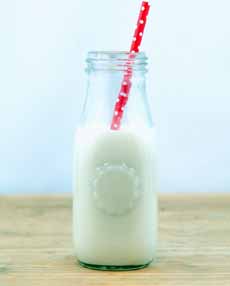
Vanilla Milk
This vanilla milk is made with honey. Here’s the recipe from A Well Fed Life. You can use your sweetener of choice (ours is Splenda).

Coffee Milk

An easy way to make coffee milk: Just add coffee syrup, as in this recipe from Cocktail Crafty.


July is National Ice Cream Month. In our neck of the woods, gourmet ice cream sandwiches have been the rage for a while.

What makes them “gourmet,” beyond the super-premium ice cream, is the sandwiching—usually homemade cookies in chocolate chip, chocolate chocolate chip, oatmeal, peanut butter and snickerdoodle.

When we make our own cookies for homemade ice cream sandwiches, we make chocolate-dipped graham crackers. When people ask what they can bring, we assign them a batch of cookies.

There’s plenty of time to invite friends and family for a casual ice cream social* this weekend or next. You set out the fixings, and let guests make their own sandwiches.

Then, make up your menu:

  • Cookies: 3″ diameter, plus mini-cookies if desired*
  • Waffles, quartered*
  • Ice cream
  • Sprinkles, mini-chips, chopped nuts
  •  
    Limit the cookie, ice cream and garnish choices the first time out. See what gets consumed most; then you can vary the choices next time.
     
    UTENSILS

  • Ice trays/bins for ice cream
  • Scoops, spoons, spatulas for ice cream
  • Large plates or trays for adding garnishes
  • Paper plates and napkins
  • Tablecloths
  • Trays
  •  
    BEVERAGES

    What beverages go best with ice cream sandwiches?

    Youngsters might clamor for soft drinks, but coffee and tea, hot and iced, go best.

    You know your guests: Are they insistent on beer and wine, or would they be happy with an iced coffee—with a shot of vodka or coffee liqueur?

    Consider these options, each of which can be enjoyed plain or with a shot:

  • Iced coffee
  • Iced tea
  • Vanilla milk and/or coffee milk (recipe follows)
  •  
    RECIPE: VANILLA MILK or COFFEE MILK

    Ingredients Per 8-Ounce Glass

  • 1 cup milk (0%, 1%, 2%) or nondairy milk
  • 1/2 teaspoon of pure vanilla extract
  • 1 teaspoon sugar or substitute
  • For coffee milk: black coffee to taste
  • ________________

    *To estimate how many cookies or waffle quarters you’ll need, multiply 2 cookies/sandwich times 2 sandwiches/guest.

     
    ICE CREAM SOCIAL HISTORY
     
    An ice cream social is a party where people come to eat ice cream.

    Ice cream socials date back to 18th-century America, long before the dawn of electric freezers—not to mention electric ice cream makers. The ice cream was hand-cranked.

    While a laborious undertaking, ice cream socials were very popular, traditional gatherings. According to Wikipedia:

  • The first ice cream social in America was in 1744, when Maryland governor Thomas Bladen served ice cream for a dinner party.
  • The first ice cream social in the White House was in 1802 by President Thomas Jefferson.
  • When ice cream became more available to the middle classes in the mid-1800s, schools and churches began to host ice cream socials. Those held outdoors by the well-to-do became known as ice cream gardens.
  • Some churches and communities still hold ice cream socials today, but an ice cream social is an easy party to throw at home—no “community effort” required.
  • If you have neither garden nor other outdoor space, you can still host a delightful ice cream social.
  •  
    ICE CREAM TRIVIA: THE FIRST FLAVOR

    Many people would guess that vanilla was the first ice cream flavor, but that is far from the case.

    You have to think back to the origins of ice cream, around 2000 B.C.E. in China, when the first ice cream was made from snow, flavored with fruit syrups.

    The concept reached the Middle East via traders, and Alexander the Great brought it to Greece after conquering Persia in 331 B.C.E., where it became a treat for the nobility, who had the servants to fetch snow and ice from the mountains and turn it into dessert. The shaved ice and snow were combined with fruit toppings, honey and nuts—the first sundae, perhaps.

    Vanilla, which originated in Mexico and was used to flavor the cacao drink, didn’t become a flavor in Europe until the 1600s. As in Mexico, only the wealthy could afford it.

    Thomas Jefferson is credited with introducing vanilla to the United States in the late 1700s. He became familiar with vanilla at the court of King Louis XVI, while serving as U.S. minister to France (from 1785 to 1789). When he returned to the U.S., he brought 200 vanilla beans with him, and his cook had learned to make ice cream.

    Here’s the history of vanilla.


    Comments off

    An Adult Snow Cone Recipe & The History Of Snow Cones

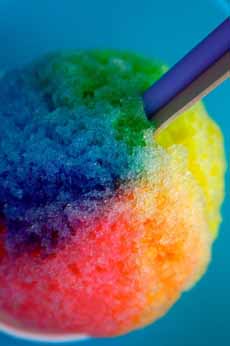
    Remember your childhood summers, and how happy a snow cone made you? The rainbow snow cone (photo #3) was our personal favorite.

    Alas, when one’s palate evolves, those overly-sweet syrups from street vendors no longer bring pleasure. And the day-glow colors? Sheesh!

    One way we’ve worked around this is to make adult snow cones with a better syrup like Monin or Torani—still pretty sweet—combined with a matching liqueur, in a 1:1 proportion.

    If you have an ice crushing machine or a snow cone machine, it’s a great idea for a casual summer cocktail party.

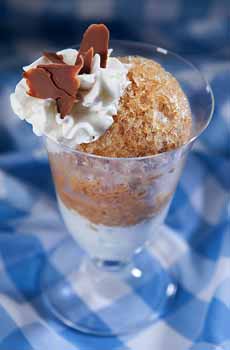
    And then, there’s the iced coffee snow cone, a riff on one of America‘s favorite warm-weather beverages.

    We adapted this recipe from one by Nuggets Market—12 locations in northern California.

    You can have a family-friendly iced espresso, or add Kahlúa or your favorite coffee liqueur.

    Instead of coffee, you can make a variation with chai concentrate (we use Original Oregon Chai Tea Latte Concentrate), or with strong-brewed tea.

    Serve them in a vessel of choice. Since we never got around to buying paper cones, we use a rocks glass and a spoon.

    The recipe follows. Elsewhere on The Nibble:

    > The different types of ice cream and other frozen desserts.

    > The history of ice cream.

    > The year’s 50+ ice cream holidays. December 21st is National Snow Cone Day.

    > Here’s how ice cream was made, 4,000 years ago.

    > Make snow cones at home with the Little Snowie machine.

    > What are snow ice and shave ice?

    > A recipe for papaya shave ice.
     
     
    RECIPE: ESPRESSO SNOW CONES

    Ingredients For 2 Servings

  • 2 shots espresso or chai coffee mate
  • ½ teaspoon vanilla extract
  • 2 tablespoons Coffee Mate (flavor of choice, e.g. cinnamon, hazelnut, vanilla)
  • 4 cups shaved ice
  • Optional: coffee liqueur
  • Garnish: whipped cream, chocolate shavings
  •  
    Preparation

    1. COMBINE the 2 espresso, vanilla extract, Coffee Mate and optional liqueur, and let chill in the fridge for 10 minutes. Once the mixture is chilled…

    2. SHAVE the ice. Fill a blender halfway with ice cubes and use the “crush” setting. Don’t fill the blender more than halfway or the top ice won’t get crushed.

    3. FILL the serving cups one-third full with whipped cream. Add the ice, pour the espresso mixture over ice, top with whipped cream and chocolate shavings.
     
     
    THE HISTORY OF SNOW CONES

    Snow cones are the oldest form of ice cream—if you substitute a bowl or cup for the a cylindrical cone, which came much later (the history of ice cream).

    The original “ice cream,” made in China some 4,000 years ago, consisted of flavoring snow with syrup. Fast forward to the 1850s, and you have ice shaved from large blocks into a paper cone or cup, topped with syrup.

    Shaved Ice In 11th Century Japan

    In 11th-century Japan, kakigori, a shaved ice dessert, is believed to have already existed. It was made from ice harvested in winter and stored in ice houses: a luxury available only to the wealthy nobility.

    Ice was shaved into a metal bowl and eaten with a sweet sap from vines, hydrangeas, and ivy, with some golden syrup on top.

    Around the 19th century, with the ice-making technology of the Industrial Revolution, kakigori was finally affordable to the general public.

    The first kakigori shop was opened in 1872. The ice was flavored with fruit syrup, and optionally topped with adjuki beans and sweetened condensed milk.

    Kakigori became a common treat, leading to modern versions of Japanese shaved ice and Hawaiian shave ice [source].
     
    Snowballs In 19th Century Baltimore

    On the other side of the world, in the U.S., historians trace the snow cone to Baltimore in the 1850s. When blocks of ice first began to be manufactured commercially, ice wagons would transport the huge blocks from factories to businesses—not just locally, but interstate.

    On hot days in Baltimore, on the route from New York to Florida, children would run up to the ice wagons and ask for small scrapings of ice. Mothers began to top them with syrups, and called them snowballs.

    One of the easiest toppings to make at home was egg custard, a simple mix of eggs, vanilla and sugar (hold the cream!). It gave the “snow” a creaminess, closer to ice cream than the bright-colored fruit flavors that subsequently became popular.

    Sources name Baltimore as the home of the “egg custard snowball,” where it remains a prevalent summer snack (photo #4—it’s now often topped with melted marshmallows).

    By the 1870s, Baltimore theaters would sell snowballs in warm months. According to Wikipedia, “Signs in theaters instructing patrons to finish their snowballs before coming in to the second act are the earliest tangible evidence of snowballs.”

    Around the city, snowballs were served on newspaper, but in the classy theaters, butchers’ boats were used. In the 1890s, patents for electric ice shavers were filed as Baltimoreans sought faster alternatives to hand-shaved ice.

    Snow Cones In Texas

    As the recipe spread, the name evolved. Plop the shaved ice into a paper cone or cup and call it a snow cone.

    In 1919, Samuel Bert, who would invent an ice-crushing machine the following year, sold snow cones at the State Fair of Texas. But ice continued to be largely hand-shaved until Ernest Hansen of New Orleans patented the first block-ice shaving machine in 1934.

    According to Wikipedia, during the Great Depression, snowballs became more readily available around the U.S. A cheap treat, they were nicknamed Hard Times Sundae and Penny Sunday.

    Hansen’s ice shaver produced ice that had the consistency of snow, unlike the other ice shavers, which produced rough, crunchy ice (think )—a true snow cone [source].

    With milk rationing during World War II, snow cones became a go-to icy treat.

    Today’s snow cone syrups, available in dozens of flavors, have one thing in common: They’re all made in vibrant—not necessarily natural—colors.

      Espresso Granita
    [1] An espresso snow cone, a fun alternative to iced coffee (photo © Nuggets Market).

    Snow Cones
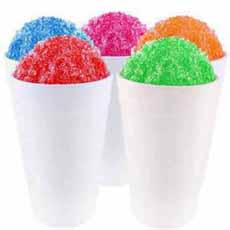
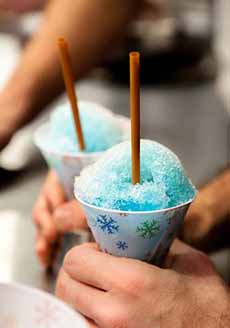
    [2] Classic snow cones: super-sweet, in day-glow colors (photo © La Estrella Bounce).

    Snow Cone
    [3] Favorite childhood treat: a rainbow snow cone (photo via Katlin Cockrell | Pinterest).

    Snow Cone
    [4] A Baltimore specialty: egg custard snowball with marshmallow topping (photo © Scott Suchman | Baltimore Magazine).

    Sangria Snow Cones
    [5] Tequila snow cones (photo © World Market).

    Strawberry Rum Snow Cone
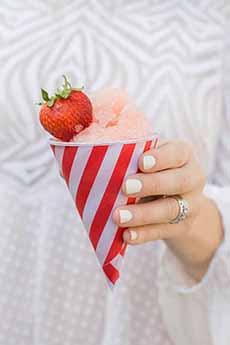
    [6]Strawberry, rum and Grand Marnier snow cone. Here’ the recipe (photo © Sugar And Charm).

    Blue Curacao Snow Cone
    [7] Blue Curaçao snow cone (photo © The Aviary | Chicago)

     
    Snow Cones With Liquor
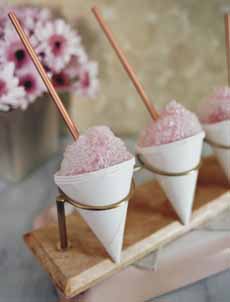
    [ ] Not just for kids: You can make cocktail snow cones by pouring your favorite cocktail, spirits or wine over the shaved ice. Here are recipes (photo © Honestly Yum).


    CHECK OUT WHAT’S HAPPENING ON OUR HOME PAGE, THENIBBLE.COM.


    Comments off

    TIP OF THE DAY: Easy Zucchini Pan Pizza

    Zucchini White Pizza
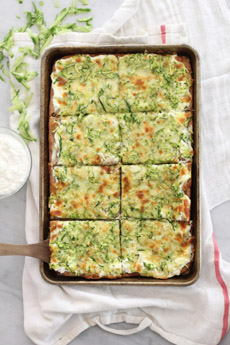
    [1] We can almost guarantee you’ll want to make this pizza over and over again (photo courtesy The Baker Chick)..

    Zucchini On Vine
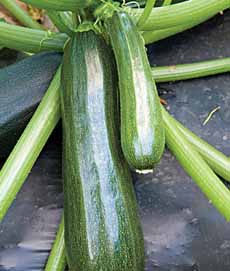
    [2] Zucchini on the vine. Zucchini is very easy to grow, with a large yield (photo courtesy Burpee).

      We buy zucchini year-round. It’s one of our favorite diet foods, easy to steam, turn into “pasta” noodles, slice into salads, and make into microwave zucchini parmesan (just top slices with sauce and cheese).

    What we like even more is summer zucchini, which we can often find for half the price of the winter offerings.

    For a party or a family dinner—or to whip up quickly when friends drop by for a beer or glass of wine—try this cheesy zucchini pizza from The Baker Chick, one of our favorite food bloggers. Sign up for her emails at TheBakerChick.com. It’s well worth getting her recipe emails every week or two.

    Shredded zucchini and mozzarella are spread on pizza crust over a ricotta/garlic mixture. (We also made a version with red sauce and kalamata olives—equally delish.)

    The zucchini dries out a bit first, but it totally crisps up with the bubbly cheese.

    “This is really simple but just so good,” says Audra, The Baker Chick. “I didn’t quite realize how much I would love this.”

    You will, too! Audra made this as a pan (square or rectangle) pizza, but you can use whatever pan you have.

    We added a different garnishes on different slices of the pizza. We loved them all!

    We added the garnishes both after the pizza came out of the oven, and during the last 5 minutes of baking, with a slight preference for the latter (except for the fresh basil, which shows best then added out of the oven).

    Bonus Tip: You can mix the ingredients the day before. Then, it takes just five minutes to roll the dough, sprinkle them on top and pop into the oven. In 15 minutes, it’s ready.

    RECIPE: EASY ZUCCHINI WHITE PIZZA

    Ingredients

  • Olive oil
  • 2 medium-sized zucchini
  • 2 cups shredded mozzarella cheese
  • Salt and pepper
  • 1 cup ricotta cheese
  • 2 cloves garlic, minced
  • Red pepper flakes
  • 1 ball pizza dough
  • Flour for rolling
  • Optional garnishes: fresh basil or chives, halved cherry tomatoes, kalamata olives, oregano, raw zucchini julienne
  •  
    Preparation

    1. PREHEAT the oven to 500°F. Drizzle a quarter sheet pan with olive oil, using a paper towel, basting brush or your fingers to make sure the entire surface is coated. Set aside. (You can also use a pizza stone.)

    2. GRATE the zucchini and squeeze out all the water, either by pressing in a fine mesh strainer or with a paper towel.

    3. MIX the zucchini with the mozzarella, adding salt and pepper to taste. In another bowl…

    4. COMBINE the ricotta and garlic. Add salt, pepper and red pepper flakes to taste.

    5. ROLL out the dough on a floured surface and stretch into the pan. Spread the ricotta mixture over the dough, and top with the zucchini/mozzarella mixture.

    6. REDUCE the oven temperature to 450°F and bake for 12-14 minutes, or until the cheese is golden and bubbly.
      

    Comments off


    © Copyright 2005-2026 Lifestyle Direct, Inc. All rights reserved. All images are copyrighted to their respective owners.