THE NIBBLE BLOG: Products, Recipes & Trends In Specialty Foods


Also visit our main website, TheNibble.com.

Honey Caramel Corn Recipe: No Refined Sugar!

Most caramel corn is not drizzled with caramel sauce, as the name may suggest, but made by caramelizing sugar into a syrup that coats the popcorn and dries to a lovely crunch.

Caramel and corn based on sugar or molasses dates back at least to the 1890s; an early version of Cracker Jack, made with molasses, was sold at the Chicago World’s Fair in 1893. Kettle corn, seasoned with salt and un-caramelized sugar, dates to Colonial times.

This recipe is courtesy Bee Raw Honey. For Halloween, toss in some candy corn and your choice of candied nuts.

> The history of popcorn.

> The year’s 13 popcorn holidays.

> The different types of honey: a photo glossary.

> The history of honey.
 
 
RECIPE: HONEY CARAMEL CORN

Ingredients

  • 1/2 cup clover honey
  • 1/2 cup butter
  • 1/2 cup brown sugar, packed
  • 1/4 teaspoon baking soda
  • 3 quarts popped popcorn
  • Fleur de sel or other fine sea salt
  • Optional mix in: nuts, candy corn, M&Ms, Reese’s Pieces
  •  
    Preparation

    1. PREHEAT oven to 250°F. Melt the butter in large saucepan; stir in sugar, honey and salt. Cook and stir until mixture comes to a boil. Place a candy thermometer into the mixture. Reduce the heat to medium; boil without stirring about three minutes, to 265°F.

      caramel-corn-zulka-recipe-230
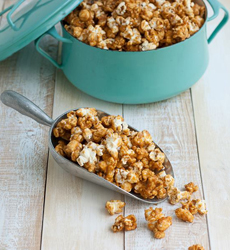
    [1] Homemade caramel corn (photo courtesy Zulka Sugar).

    Jar Of Honey With Drizzler
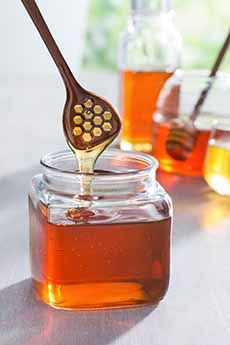
    [2] Each varietal flavor has its own charm. Try different varieties (photo © National Honey Board | Facebook).

     
    2. REMOVE the honey mixture from heat and stir in the baking soda. Place the popcorn in a large bowl. While stirring, slowly pour the honey mixture over the popcorn.

    3. TURN the popcorn onto greased baking pan. Bake at 250°F for 45 minutes; stir every 15 minutes. Cool. Sprinkle with fleur de sel and break the popcorn into bite-sized pieces.
     
     
    ABOUT CARAMEL CORN

    Like popcorn, caramel corn is an American invention: popcorn coated with a sugar- or molasses-based candy shell. A white sugar-based candy coating provides a lighter (if more cloying) flavor than traditional caramelized brown sugar or molasses.

    Typically, a sugar solution is heated until it becomes a thick and brown caramelized candy syrup. Before the syrup cools, it can be mixed with an endless number of flavorings, from chocolate and coconut to blueberry and watermelon. The hot syrup is then mixed with popped popcorn, and allowed to cool.

    Nuts are a popular addition. While peanuts are the most popular (think Cracker Jack), almonds, cashews and pecans offer a more sophisticated flavor.


    CHECK OUT WHAT’S HAPPENING ON OUR HOME PAGE, THENIBBLE.COM.


    Comments off

    TIP OF THE DAY: Vadouvan

    vadouvan-spice-blend-ingredientfinder-230
    This simple blend, from IngredientFinder.com,
    contains only four ingredients: cumin, garlic,
    fenugreek and onion.
      We must admit, this was a new one for us. We received a recipe for deviled eggs for our consideration. One of the ingredients: vadouvan.

    Vadou-what? We had to look it up.

    Vadouvan, also called French curry, is a French interpretation of an Indian masala that mixes cardamom, coriander, cumin, curry, curry leaves, fenugreek, garlic, marash chiles, mustard seeds and roasted onion, among other ingredients. Its flavor is more familiar to Western palates than many Indian spice mixtures.

    A key difference is in dried onions or shallots. The spice is thought to have originated due to French colonial influence in the Puducherry region of India. [Source: Wikipedia]

    Use it in place of curry powder on fish, lamb, chicken, pork, sauces, stews, soups and vegetables. It’s a delicious pairing with dairy, potatoes, starchy grains and anything grilled.

    Give a tin or jar as a holiday gift to your favorite cooks. There’s an attractive tin for $8.32 on Amazon, with free shipping on orders over $35. (Tins are preferable to jars, since light is one of the factors that reduces the potency of the spice, along with proximity to heat and moisture.)


    MASALA VS. GARAM MASALA: THE DIFFERENCE

    Masala or massala is a South Asian term for a spice mix or a seasoning of any sort. It is used extensively in the cuisines of Bangladesh, Burma, India, Nepal, Pakistan and Sri Lanka.

    The word is of Arabic origin (maslahah), originally meaning “a thing which is good and right.”

  • Masala refers to any fragrant spice blend. It can be wet (a paste) or dry (a blend of dried—and usually dry-roasted—often toasted and ground spices). The pastes frequently include fresh ingredients like chiles, cilantro, garlic, ginger, mint, onion and tomato, along with dried spices and oil. Dishes made with such pastes sometimes have “masala” in their names, such as Chicken Tikka Masala and Vindaloo Masala.
  • Garam masala refers to dry spice blends. There are many variations, from region to region and cook to cook (examples: Tandoori masala, chatt masala and even panch phoron, the Bengali five-spice blend). Popular ingredients include bay leaf, cardamom, cinnamon, clove, coriander, cumin, nigella and nutmeg/mace and pepper.
  •   masala-cauliflower-paperchef-230
    Masala cauliflower. Photo courtesy The Paper Chef.
     
    THE HISTORY OF VADOUVAN

    Vadouvan is a fusion food—or rather, spice. It was created following the French colonization of Pondicherry*, the capital city of the Indian union territory of Puducherry, in southeast India.

    The French took a liking to the Indian spices they encountered and brought them back home. What began as a curry blend made its way into French cuisine as a fusion blend that became known as vadouvan (VAH-doo-von).

    The fusion typically includes Indian spices such as curry, coriander, turmeric and cumin; along with French favorites shallots and garlic. It became known as “French curry powder.”

    Other French seasonings can be added, from fenugreek and mustard seeds to red peppers and onions.

    Vadouvan was used in traditional curry applications—meat, poultry, seafood, vegetables. As it has grown in awareness, the spice blend is now used to season everything from olives tossed to fried chicken.

    Ready to spice things up?

    ________________

    *The French East India Company established Pondicherry as their headquarters in 1674. Pondicherry has changed hands frequently over the centuries, in battles between Britain and France. France finally turned governance over to the Indian Union took place in 1954.
      

    Comments off

    HOLIDAY: National Chocolate Day

    harvest-truffles-2014-230sq
    Harvest Truffles. Photo courtesy Recchiuti Confections.

      It’s National Chocolate Day, an excuse for anyone to run to the newsstand to pick up a Hershey Bar or some M&Ms.

    But the chocolate connoisseur deserves something better, and we’ve found it in these delicious Harvest Truffles from Recchiuti Confections of San Francisco, which we received as a gift.

    Each bite of these beautifully flavored bonbons is a bite of heaven. The medley of three new flavors inspired by autumn includes:

    • Cinnamon Malt Truffle, made with cassia cinnamon and barley malt
    • Mandarin Truffle, infused with mandarin orange oil
    • Cranberry Pomegranate Strata, with layered pomegranate and cranberry gelée atop chocolate ganache (strata means layer)

    A nine-piece gift box, three of each flavor, is $26.00. It was all we could do to save some pieces for Day 2.

    Get yours at Recchiuti.com. They are a lovely gift for any lover of fine chocolate.

     
    BONBONS VS. TRUFFLES: THE DIFFERENCE

    It’s easy to get confused when terms like bonbon, praline and truffle are used interchangeably to describe filled chocolates—and all three terms have alternative meanings as well.

    The differences, describing filled or enrobed individual chocolate pieces, are country-based:

    • Assorted Filled Chocolates, the English term.
    • Bonbons, a French word describing a variety of confections including hard candy, chocolates, chocolate-covered confections, taffy and more.
    • Pralines, a word that was originated in Belgium by Jean Neuhaus to describe his molded filled chocolates (but also refers to caramelized nuts in France).
    • Truffle, a word that originated in France to describe balls of chocolate ganache, because they resembled the mushroom cousin, truffles.

    Thus, when chocolatiers immigrated to the U.S., they might be selling pralines, truffles, bonbons or assorted chocolates, depending on their nationality. And, although the name of what they sold differed, the product might be the same.

    In the interest of clarity, it would be ideal to stick with “bonbons” or “filled chocolates” for the filled chocolates, use “pralines” for caramelized nuts and nut patties, and reserve the term “truffles” for the balls of ganache.

    But given all the imported candy, we can’t escape our chocolate Tower of Babel. If you receive a box of candy from Germany or Switzerland labeled “pralines,” for example, will it be filled chocolates or caramelized nuts? You may be surprised!

    Here’s a detailed explanation.
      

    Comments off

    TIP OF THE DAY: Choucroute Garnie

    Now that there’s as chill in the air, the people of Alsace have been cooking up their famous recipe, Choucroute Garnie—pronounced shoo-CROOT gar-NEE and translating to dressed sauerkraut.

    The “dressing” consists of sausages and other salted meats and, typically, potatoes. It’s stick-to-your-ribs goodness on a chilly day. You know it’s autumn when the dish appears on restaurant menus (call your local French restaurant to check). If you don’t have time or inclination to make your own, it’s available throughout France microwavable packages and canned form.

    Sauerkraut originated in German and Eastern Europe, the but the French annexation of Alsace and Lorraine added it to the repertoire of French chefs. It has since become popular throughout France.

    Like cassoulet and pot au feu, it’s an inexpensive, everyday dish. Any combination of hot sauerkraut, meat and potatoes works, but traditional recipes utilize:

    • Three types of sausage, such as Frankfurt sausages, Strasbourg sausages and Montbéliard sausages (use whatever sausages you like—we used boudin blanc, knockwurst and smoked sausage).
       
    choucroute-garni-tourdefrancenyc-230

    Pork chop, back bacon, potatoes plus a bonus of baby carrots on a bed of sauerkraut. Photo courtesy TourDeFranceNYC.com.

    • Fatty, inexpensive or salted cuts of pork: back bacon, ham hocks or shank, pork knuckles and shoulders, salt pork.
    • Boiled potatoes (toss them with fresh parsley).
    • Seasonings: bay leaf, black peppercorns, cloves, garlic.
    • Sauerkraut, simmered in Riesling and juniper berries (we added some caraway seed, a personal favorite with sauerkraut).
    • Optional: chopped onion, sliced apples.
    • Mustard: we served three options, Dijon, grainy and horseradish mustards.

     
    Plain shredded cabbage can be added along with the sauerkraut to produce a less tangy, less acidic version. Hungarian recipes include stuffed cabbage leaves in addition to the other ingredients.


    choucroute-garni-quentinbacon-foodandwine-230

    Individually plated, with sliced potatoes. Photo © Quentin Bacon | Food & Wine. Here’s the recipe.

      For a high-end variation, Choucroute Royale is made by augmenting the basics with some more expensive ingredients:

    • Champagne instead of Riesling
    • Foie gras, goose, wild game
    • Fish
    • Duck choucroute garni, replacing the pork products with duck confit leg, duck sausage and duck breast.
    • A newer riff, seafood sausage choucroute is a meat-free option that includes seafood sausage, scallops, shrimp and flaky white fish on a bed of braised cabbage (not sauerkraut) with lobster sauce.

    While it takes a bit of time to prepare, the steps to a delicious choucroute garnie are easy:

    1. SIMMER sauerkraut with Riesling and juniper berries. Riesling has a very distinctive flavor, but if you don’t want to buy a bottle and drink the rest with dinner, use another dry white wine. We like to snip fresh parsley, sage or thyme into the cooked sauerkraut before plating.

    2. COOK your favorite cuts of pork: pork belly, pork chops, sausages, whatever. Boil the potatoes.

    3. PLACE the sauerkraut on a serving plate and top with the meat and potatoes. Uncork a bottle of Rieling. Voilà.


    Choucroute garnie can be served individually plated or family style, on a large platter.

    Here’s a complete recipe from Jacques Pépin for Food & WIne magazine.


    Comments off

    TIP OF THE DAY: Pumpkin Custard With Maple Pecan Crunch

    As an alternative to pumpkin pie—or perhaps in addition to it—how about some pumpkin custard? It’s eggier and richer than conventional pumpkin pie filling, and because there’s no crust, it’s gluten free. This lovely recipe, from Nielsen Massey, is a guaranteed crowd pleaser. If you don’t have ramekins or custard cups, use 6-ounce teacups.

    How is this custard different from flan and other custards? Check out the different types of custard in our delectable Custard Glossary.
     
     
    RECIPE #1: PUMPKIN CUSTARD WITH MAPLE PECAN CRUNCH

    Ingredients For 8 Servings

  • 1½ cups half-and-half
  • 2 tablespoons Irish cream liqueur
  • 4 large eggs, lightly whisked
  • 2/3 cup packed light brown sugar
  • 2 teaspoons pure vanilla extract
  • 1½ teaspoons ground cinnamon
  • ½ teaspoon freshly grated nutmeg
  • ¼ teaspoon ground cloves
  • ¼ teaspoon salt
  • 1 can (15-ounces) 100% pure pumpkin
  •    
    pumpkin-custard-maple-pecan-crunch-nielsenmassey-230

    [1] Pumpkin custard topped with maple pecan crunch (photo © Nielsen-Massey).


    nielsen-bourbon-230
    [2] Nielsen-Massey pure vanilla extract (photo by Claire Freierman | © THE NIBBLE).
     

    Preparation

    1. PREHEAT oven to 325°F. Place 8 six-ounce ramekins onto a rimmed sheet pan or a roasting pan; set aside.

    2. COMBINE the half-and-half and liqueur in a small saucepan over medium-low heat. Heat and stir, just until the mixture is warmed. Remove from the heat.

    3. COMBINE the eggs, sugar, vanilla extract, cinnamon, nutmeg, cloves and salt in a large bowl. Whisk thoroughly until well combined. Add the pumpkin and whisk until it is incorporated. Slowly pour the heated half-and-half mixture into the pumpkin mixture; whisk continuously until combined.

    4. POUR the custard mixture into ramekins. Place in the oven; then carefully pour warm water into the sheet pan, so custards are surrounded and the water depth is about ¾-inch high (this technique is known as a bain-marie). Bake until done, about 40-45 minutes. Remove ramekins from pan, cool completely on wire rack and place in the refrigerator to chill. You can serve the custard chilled or at room temperature.

     
    RECIPE #2: MAPLE PECAN CRUNCH

    Ingredients

  • ¼ cup pure maple syrup
  • ½ teaspoon pure vanilla extract
  • 1/8 teaspoon cayenne pepper
  • 1 cup pecans, chopped
  • Garnish: coarse sea salt
  •  
    Preparation

    1. LINE a rimmed baking sheet with parchment paper; set aside.

    2. COMBINE syrup, vanilla and cayenne pepper in a small bow. Whisk to combine; set aside.

    3. LIGHTLY COAT a large skillet with cooking spray; place over medium heat. Add the nuts to skillet and toast until golden brown, about 2 to 3 minutes, stirring occasionally.

    4. CAREFULLY POUR the syrup mixture over the nuts. Cook and stir until the nuts are coated; then remove from heat. Place the nut mixture evenly onto the prepared baking sheet and cool.

    5. TO SERVE: Top the cooled custards with Maple Pecan Crunch. Finish with a pinch of coarse salt.

    Store any unused Maple Pecan Crunch in an airtight container. You can use it to top anything from baked sweet potatoes to green salad to vegetables to ice cream.
     
     
    EVERYTHING YOU NEED TO KNOW ABOUT VANILLA

    Did you know that vanilla beans are the fruit of a species of orchid? Of the 110 species in the orchid family, the vanilla orchard is the only one used for food.

    While the fruit is called a vanilla “bean,” it has no close relationship to the actual bean family. After the plant flowers, the fruit pod ripens gradually for 8 to 9 months, eventually turning black-brown in color and giving off a strong aroma. Both the exterior of the and the seeds inside are used to create vanilla flavoring.

    Check out the history of vanilla, types of vanilla products (including vanilla paste and different terroirs of vanilla extracts and vanilla beans), how to buy vanilla, and our reviews of the best vanilla extracts and vanilla beans.

    Start here.


    Comments off

    The Nibble Webzine Of Food Adventures
    RSS
    Follow by Email


    © Copyright 2005-2026 Lifestyle Direct, Inc. All rights reserved. All images are copyrighted to their respective owners.