|
Updated August 2026
August 15th is National Lemon Meringue Pie Day, celebrating one of America’s favorite pies. It’s a lemon custard single crust pie topped with fluffy meringue, made from egg whites and sugar.
Below:
> America’s favorite pies.
> The history of lemon meringue pie.
> The recipe for Lemon Meringue Pie and variations.
> Tips for a better pie.
> The three types of meringue.
> Five techniques to brown the meringue.
AMERICA’S FAVORITE PIES
What are the top 10 pies in America? No one has done that survey in a truly scientific way. Mrs. Smith’s released a survey of their top 10 based on sales, but it only included frozen pies in the flavors made by Mrs. Smith.
One thing we do know: Look at every list of the top pies in the country and you’ll find these nine (in alphabetical order):
- Apple Pie
- Banana Cream Pie
- Blueberry Pie
- Cherry Pie
- Coconut Cream Pie
- Key Lime Pie
- Lemon Meringue Pie
- Pecan Pie
- Pumpkin Pie
What’s the 10th favorite? Depending on how the list was compiled and by whom, here are some from Top Ten Pies:
Chocolate Mousse/Silk Pie
Oreo Pie
Peach Pie
Peanut Butter/Snickers
Raspberry Pie
Strawberry Pie
Strawberry Rhubarb Pie
Sweet Potato Pie
Some flavors are seasonal (including berry and stone fruit pies). Peppermint pies come out during the holiday season.
Some of our favorites, such as Black Bottom Pie, Grasshopper Pie and Tarte Tatin (a French upside-down pie with caramelized apples) aren’t even on the Top 20 list of sweet pies.
Pie Trivia: Boston cream pie is a layer cake, and cheesecake is a custard pie. The misnomers go back centuries, when people sometimes used the terms like pie and cake interchangeably. Check out the different types of pie.

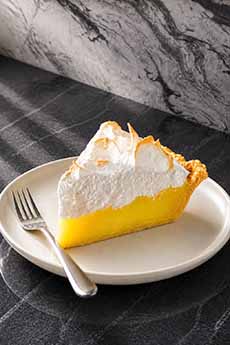
[8] You can vary the proportions depending on whether you prefer more lemon filling or more meringue (photo © The Nibble).
RECIPE: CLASSIC LEMON MERINGUE PIE
Prep time is 30 minutes, and cook time is 20 minutes.
Ingredients For 8 Servings
1 basic 9-inch pie crust*, baked and cooled
For The Filling
1-1/2 cups sugar
1/3 cup cornstarch
1/4 teaspoon salt
1-1/2 cups cold water
1/2 cup fresh lemon juice
5 egg yolks, well beaten (save the whites for the meringue)
2 tablespoons butter
1 tablespoon freshly grated lemon zest
For The Meringue
1 tablespoon cornstarch
1/3 cup cold water
5 egg whites, room temperature
1/4 teaspoon cream of tartar
1/2 cup sugar
1/2 teaspoon vanilla extract
Optional Garnishes
Lemon peel curls/twists
Fresh mint, whole leaves or julienne
Preparation
1. PLACE the oven rack in the top third of the oven, and preheat the oven to 325°F. Prepare the filling: Mix the sugar, cornstarch, and salt in a large, heavy saucepan. Gradually stir in the water and lemon juice until smooth. Add the egg yolks; stir until blended, and add the butter.
2. COOK over medium heat, stirring constantly, until the mixture thickens and comes to a boil. Reduce the heat and simmer, stirring constantly, for 1 minute. Remove from the heat and stir in the lemon peel.
3. IMMEDIATELY MAKE the meringue. Dissolve the cornstarch in cold water in a one-cup glass measure. Microwave on High for 30 seconds; stir. Microwave until the mixture boils, 15 to 30 seconds more. Remove and cover.
4. BEAT the egg whites and cream of tartar in a mixer bowl with the whisk attachment on high speed, until foamy. Beating constantly, add the sugar, 1 tablespoon at a time, beating after each addition until the sugar is dissolved before adding the next.
5. CONTINUE beating until the whites are glossy and stand in soft peaks. Beating constantly, add the cornstarch paste, 1 to 2 tablespoons at a time. Beat in the vanilla.
6. POUR the hot filling into the pie crust. Quickly spread the meringue evenly over the filling, starting at the edge of the crust. The meringue should overlap the rim of the crust. Swirl with the back of a spoon to provide waves.
7. BAKE in the upper third of a 325°F oven until the meringue is lightly browned, 16 to 18 minutes. Cool on a wire rack for 30 minutes to 1 hour; then refrigerate until serving. Garnish as desired.
Variations
Crust: Substitute a chocolate cookie crust, coconut crust, graham crust, or nut crust.
Filling: Mix in lemon zest, lime zest, orange zest or shredded coconut.
Topping: Instead of meringue, you can substitute whipped cream. This turns it into a lemon pie.
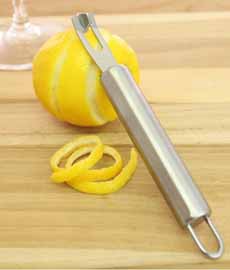
Garnish: If you have candied lemon peel, use it! If not, make it. In fact, make a double batch: You can use it to garnish just about any dessert, and we add a slice to the saucer of a cup of espresso.
|
|
[1] One of America’s favorite pies. The classic recipe below is from the American Egg Board, The Incredible Egg, the website of the American Egg Board (photo © The Nibble).
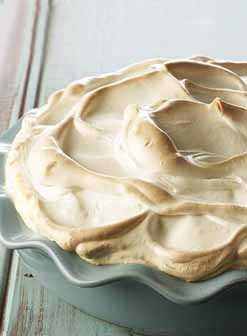
[2] You can brown the meringue as much or as little as you like (photo © McCormick).
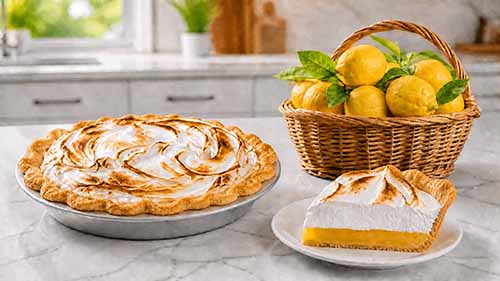
[3] You can also make pretty peaks (photo © The Nibble | DALL-E).
[4] If you have a springform pan, you can make an elegant pie like this. Bonus: It’s easier to slice (photo © The Nibble).
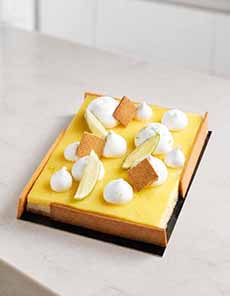
[5] How about a modernist/avant-garde lemon meringue pie (photo © The Nibble)?
[6] Tips: Before you juice lemons for a recipe, zest them and save the zest in the freezer. Use it to perk up everyday foods like salad dressings, juices, soft drinks, hot and cold tea. Placing the whole lemon in the microwave for 10-15 seconds yields more juice (photo © Good Eggs).
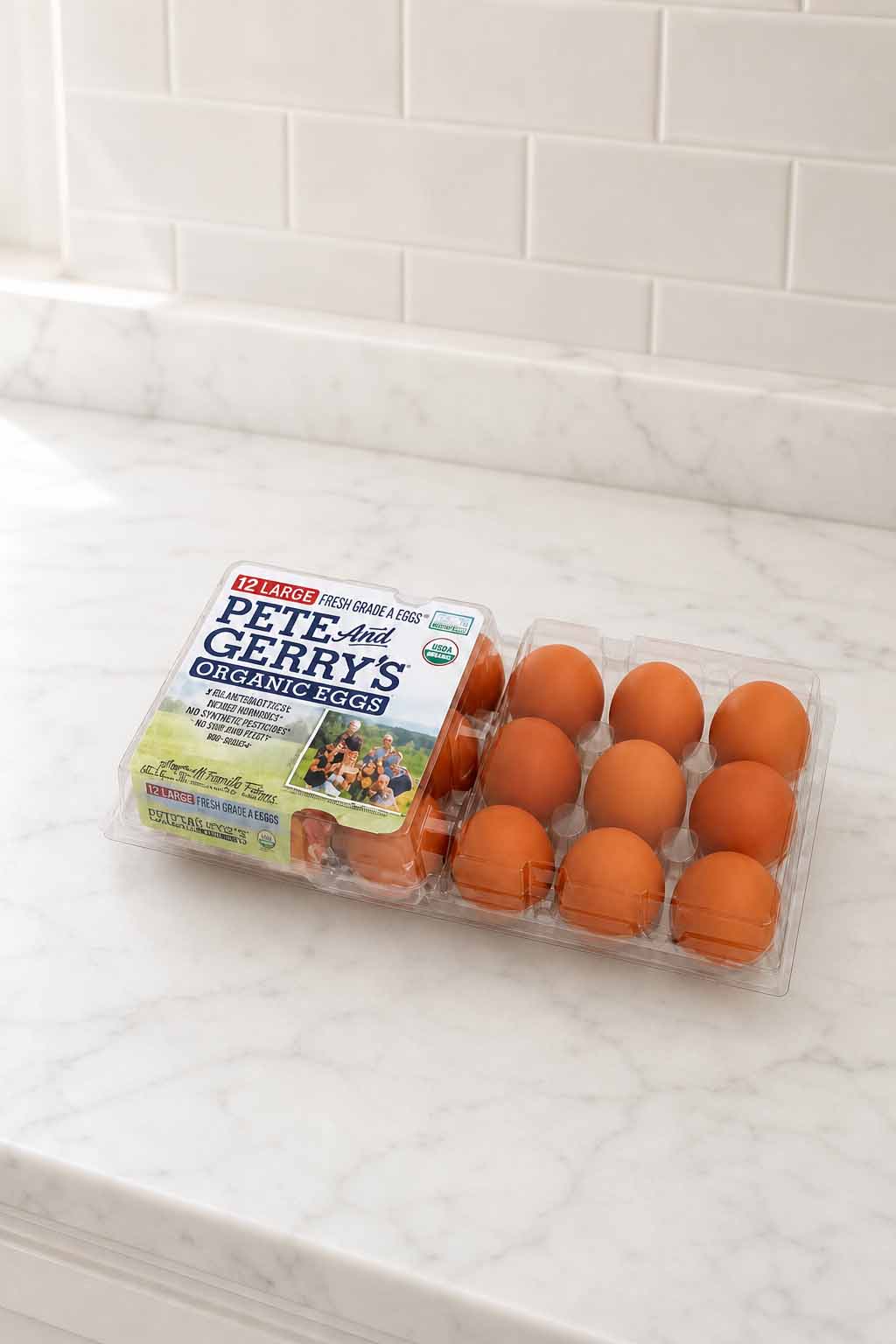
[7] Do organic eggs taste better? Frankly, yes, if you’re cooking them for breakfast; their superior flavor disappears into the cake batter (photo © The Nibble).
|
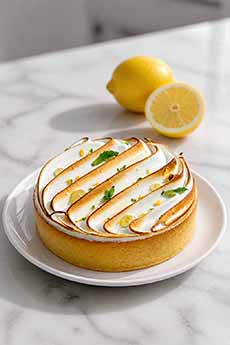
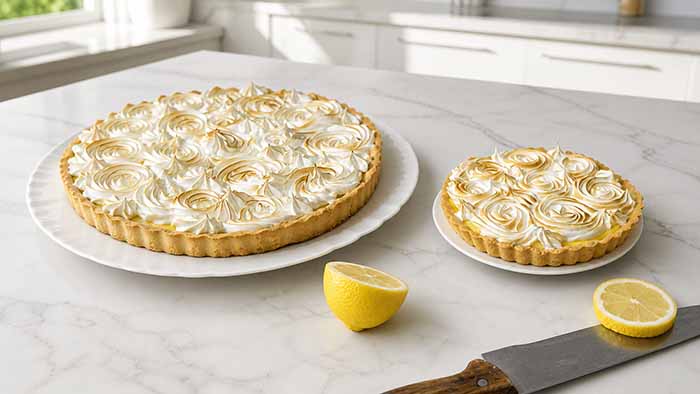
[9] If you prefer tart crust to pie crust, here’s some inspiration. You don’t have to pipe meringue roses; the conventional topping is just fine (photo © The Nibble).
TIPS FOR A BETTER PIE
Serve freshly made pie at room temperature, or refrigerate, uncovered, until ready to serve. Let the pie warm up on the counter.
For neat slices, dip the knife into a glass of water, letting the excess water drip off, before each cut. This prevents the meringue from sticking to the knife and tearing it. Be sure to cut completely through the crust.
A hot filling is important. The heat of the filling cooks the bottom of the meringue and prevents it from weeping and creating a slippery layer between filling and topping. Set up your equipment and measure meringue ingredients before you make the filling and work quickly to make meringue before the filling cools.
To check if the sugar is dissolved, rub a bit of meringue between your thumb and forefinger. If the sugar is dissolved, it will feel completely smooth. If it feels grainy, continue beating.
To check for soft peaks, stop the mixer and lift the beater. The peaks left in the meringue should curl at the tips. If the peaks stand straight and tall (stiff peaks), the meringue has been overbeaten.
Anchor the meringue. Be sure to attach the meringue to the crust all around the edge of the pie. This prevents the meringue from pulling away from the edge during baking.
If beads form on the refrigerated meringue, gently blot them with the tip of a paper towel.
Refrigerate any leftover pie promptly.
FIVE TECHNIQUES TO BROWN THE MERINGUE
With a fully baked pie, a kitchen torch is usually the best option because it browns the meringue without significantly reheating the filling. For a traditional preparation in which the meringue is meant to cook as it browns, use the oven. The broiler is a good middle ground when you want quick, even color without using a torch.
That being said, here are all five options with an important distinction: French or Swiss meringue benefits from thorough baking or broiling, while Italian meringue is already cooked by the hot sugar syrup and usually needs only light browning for appearance. The differences between the three are in the †footnote below.
1. In the oven. The traditional method is to spread the meringue over the hot lemon filling and bake the pie until the meringue is lightly browned, usually at about 350°F (175°C). This method browns the surface gradually, helps set the meringue, and produces an evenly cooked topping.
The drawback is that the crust and filling continue baking, which can lead to over-browning or a firmer filling if the pie is already fully cooked.
2. Use the oven broiler. Place the assembled pie under a preheated broiler for a short time, watching it constantly. The intense overhead heat quickly colors the peaks with minimal additional cooking of the filling.
The drawback is that the meringue can burn very quickly, so the pie should remain under close observation and may need to be rotated.
3. Use a kitchen torch. A culinary torch gives the most precise control and creates a dramatic toasted appearance. Move the flame continuously over the meringue rather than holding it in one spot. A torch is most useful when the pie has already been baked, you want to brown only the peaks, or you want to avoid reheating the crust and filling.
The drawback is that uneven torch movement can leave dark spots.
4. Use a butane torch. A small brûlée torch works much like a kitchen torch but usually produces a more concentrated flame. That makes it effective for browning individual ridges and peaks, although it requires careful movement to prevent scorching.
5. Brown it with a preheated oven or salamander
Professional kitchens may use a salamander or an overhead broiler—a more powerful, controllable version of the home broiler—and it produces an even golden finish.
THE HISTORY OF LEMON MERINGUE PIE
Lemon-flavored custards, puddings, and pies date back to the Middle Ages, though meringue was not documented until the 17th century.
Before lemon meringue pie existed as a single cohesive dessert, its components evolved through British and French cooking:
Lemon curd, also called lemon cheese, was one of the fruit curds popularized by early 19th-century English cooks. It provided a more intensely tart, glossy filling than medieval dairy custards.
Chester Pudding, also called Duke of Cambridge Pudding, is a British recipe from the 18th and early 19th centuries. It featured candied citrus and lemon custards topped with whipped egg whites or meringue crusts.
The modern lemon meringue pie took shape in the 19th century.
Online articles often credit Alexander Frehse, a baker from Romandy in Switzerland. This only appears as a vague statement, that “a Swiss baker from Romandy combined lemon custard and meringue in the 1800s.”
One investigation explicitly reported that it found so little material on Frehse that it could not establish even a date range for his work. Another food-history discussion observes that the Frehse story is widespread online but is generally repeated without a supporting reference.
This means it’s likely inaccurate. If someone invented a new pie, surely it would appear in recipe books. So let’s turn to the United States. Culinary historians point to Philadelphia pastry chef and cooking instructor Mrs. Elizabeth Goodfellow, an influential Philadelphia pastry shop owner and cooking school founder, credited with early lemon custard puddings in the early 19th century (circa 1806–1820s), which helped lay the groundwork for what would become lemon meringue pie.
She reportedly whipped leftover egg whites from her yolk-rich lemon puddings with sugar into a meringue-style topping, an approach that influenced the American desserts that followed.
However, the Goodfellow story needs qualification. She left no published cookbook, and an examination of the recipe passed on by her student Eliza Leslie reportedly found no meringue topping in her 1857 cookbook.
Eliza Leslie published Mrs. Goodfellow’s style of lemon pudding in 1828 and explicitly credited Goodfellow in her 1857 cookbook. Both recipes used whole eggs and lacked a meringue topping. Therefore, they document an important precursor—a rich lemon custard baked with pastry—but do not document modern lemon meringue pie.
She published recipes for lemon custard pies and meringue-topped lemon puddings in her landmark 1828 and updated 1837 cookbooks, but no “lemon meringue pie.” She did, however, help to spread the meringue topping style across America.
19th-Century Developments
The widespread popularity of the lemon meringue pie was accelerated in the mid-19th century by two key kitchen innovations:
Cornstarch. The commercial refinement of cornstarch in the 1840s allowed bakers to create a thick, stable lemon curd filling that could hold its shape when sliced, rather than relying strictly on egg yolks and flour.
Mechanical Egg Beaters. Before the invention of gear-driven rotary whisks (i.e., the egg beater, which evolved from the 1850s to the 1870s), beating egg whites into stiff meringue by hand with birch twigs or wire bundles took up to 30–45 minutes of intense labor. Rotary beaters turned the laborious task of whipping egg whites into a quick kitchen routine, making meringue an everyday household reality.
The First Published Recipes
By the late 1860s, recipes for lemon pies topped with sweetened beaten egg whites were appearing in American cookbooks and periodicals, although they were often called lemon cream pie, iced lemon pie, or simply lemon pie. One of the earliest currently documented recipes using the name “Lemon Meringue Pie” appeared in the American Agriculturist in 1869.
1866: One of the earliest clearly documented recipes points to an early published recipe for what we would now recognize as lemon meringue pie, although it was published under another name. “Kitty May’s Lemon Cream Pie” appeared in Jane Cunningham Croly’s “Jennie June’s American Cookery Book,” published in New York in 1866. The directions say to bake the lemon pie until nearly done and then “take from the oven, and pour over it a frosting made of the beaten whites of the two eggs, and two table-spoonsful of powdered sugar.” The pie is then returned to the oven to “brown lightly.” Despite calling the topping “frosting,” this is functionally a meringue: beaten egg whites sweetened with sugar and browned over a lemon filling. It therefore qualifies as an early published lemon meringue pie recipe, even though the recipe title does not include the word “meringue.”
The cookbook also reportedly includes “lemon meringue pie” in suggested menus, indicating that the name was already familiar by 1866. The transcription and bibliographic details are discussed by food historian Patricia Bixler Reber at Researching Food History.
1871: The first recipe called “Lemon Meringue” appeared in Marion Harland’s “Common Sense in the Household: A Manual of Practical Housewifery,” published in New York in 1871. It’s not quite the modern translucent lemon-curd pie, though. Its filling contains bread crumbs, milk, sugar, lemon juice and rind, butter and egg yolks. The reserved egg whites are beaten with sugar, spread over the baked lemon pudding and browned. Structurally, however, it has the defining elements of lemon meringue pie: a lemon-and-yolk filling, a topping made from the reserved egg whites and sugar, and a final baking to color the meringue.
Because the filling includes bread crumbs and milk, lemon meringue pudding might be a more precise modern description. Nevertheless, the 1871 publication is significant because it explicitly uses “Lemon Meringue” as the recipe name. It’s documented in the same Researching Food History article.
1879: Marion Cabell Tyree’s “Housekeeping in Old Virginia,” published in 1879, includes another early version of lemon pie with a sweetened beaten-egg-white topping. This book is especially useful evidence because it compiled recipes contributed by Southern household cooks. Its inclusion suggests that meringue-topped lemon pie was no longer an isolated cookbook novelty.
1887/1889: Lemon Pie No. 1 (Superior), an unmistakably modern lemon meringue pie, appears in F. L. Gillette and Hugo Ziemann’s “The White House Cook Book.” The book was first published in 1887, although the readily available recipe is often cited from its 1889 edition. The recipe, attributed to Washington’s Ebbitt House, uses lemon rind and juice, sugar, flour or cornstarch, egg yolks, boiling water and butter. After the filling is baked in pastry, the cook is instructed: “Have ready the whites, beaten stiff, with three small tablespoonfuls of sugar. Spread this over the top and return to the oven, to set and brown slightly.” This is very close to the standard 20th-century lemon meringue pie: a starch-thickened, yolk-enriched lemon filling in pastry, topped with sweetened egg whites and browned. A transcription of the 1889 text is available from Edible Pantry.
Ebbitt House was a prominent hotel in downtown Washington, D.C., from 1856 to 1926. It hosted U.S. presidents Ulysses S. Grant, Andrew Johnson, Grover Cleveland, Theodore Roosevelt, and William McKinley.
1896: The first edition of Fannie Merritt Farmer’s “The Boston Cooking-School Cook Book” included several lemon pies, at least two of which were finished with meringue. The recipe called “Lemon Pie” uses sugar, boiling water, cornstarch, egg yolks, lemon juice and rind, and butter—similar to the Lemon Pie No. 1 (Superior) recipe in the prior bullet. The mixture is placed in pastry and baked. Farmer then instructs the cook to cool it slightly, cover it with meringue and return it to the oven. This resembles the modern pie particularly closely because it uses egg yolks for the starch-thickened filling, leaving the whites available for the topping.
Farmer’s “Lemon Pie IV” uses whole eggs rather than a separated-yolk filling. “Beat eggs slightly, add sugar, lemon juice, grated rind, and water. Bake in one crust. Cool slightly, cover with Meringue II, then return to oven and bake meringue.” The separate “Meringue II” recipe calls for egg whites beaten stiff with powdered sugar and flavoring. The Smithsonian Libraries And Archives reproduces this recipe from a later edition. CKBK, a curated collection of the world’s great cookbooks, identifies Meringue II as appearing in the edition published in 1896.
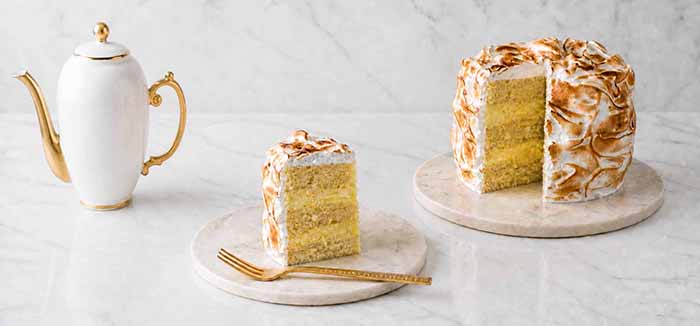
[10] Lemon meringue pie begat lemon meringue tarts, cakes, and cookie bars, for starters. Here’s a recipe for a similar cake (photo © The Nibble).
________________
*Take a look at this Egg & Lemon Juice Pie Crust from the Incredible Egg (the American Egg Board).
†The three types of meringue. For lemon meringue pie, French meringue is traditional in many home recipes, while Swiss or Italian meringue produces a more stable, polished topping for professional pies.
French meringue: Raw egg whites are whipped with sugar to produce a light, airy, and relatively delicate meringue. It’s the least stable of the three, which is why a bakery or pastry chef would use Swiss or Italian meringue.
Swiss meringue. Raw egg whites and sugar are heated together over a double boiler until the sugar dissolves, then whipped. The result is smoother, glossier, and denser than French meringue. It’s also more stable than French meringue.
Swiss meringue is often used for meringue cookies, pavlova, and some pie toppings, as well as in buttercream and for decorative piping.
Italian meringue. A hot sugar syrup is slowly poured into already-whipped egg whites. This produces a very smooth, glossy, and marshmallow-like meringue, which is the most stable of the three. It’s used for toppings, as well as buttercream, mousses, and desserts that need a firm, polished finish.
CHECK OUT WHAT’S HAPPENING ON OUR HOME PAGE, THENIBBLE.COM.
|