|
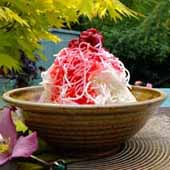
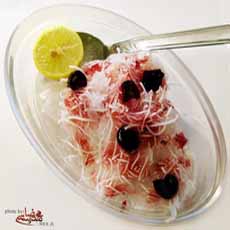
[1] Faludeh with a sour cherry topping at The Persian Fusion.

[2] A squeeze of fresh lime juice blances the sweetness of the sobet (photo courtesy Tishineh, a site for Irani tourism).
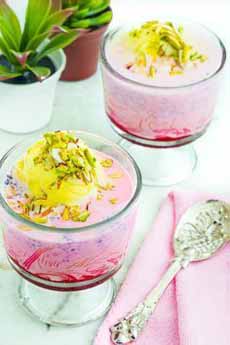
[3] A “sundae” of faludeh combined with saffron ice cream (bastani in Arabic; photo courtesy Fun Love And Cooking). The combination of flavors is called makhloot.
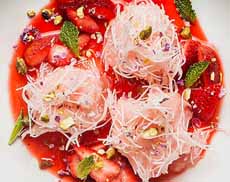
[4] An elegant update. Here’s the recipe from Tasting Table.
|
|
We first encountered faludeh, a Persian rosewater sorbet, years ago. It was an eye-opening frozen dessert among the many jewels at the ice cream emporium of Mashti Malone, in Los Angeles—to us, the most magical ice cream emporium in America.
We couldn’t believe how good it was—as is everything at Mashti Malone. Transliterated from the Arabic, you may also see it spelled faludeh or faloodeh, and also falude or palude.
A sidebar: The Mashti Malone ice cream shop is owned by Mashti and Mehdi Shirvani, two brothers from the northeastern Iranian city of Mashhad. In 1980, Mashti bought an ice cream shop called Mugsy Malone on the corner of La Brea and Sunset in Hollywood. Because he had little money left over for a new sign, he simply replaced “Mugsy” with “Mashti,” and a legend was born.
The recipe to make your own faludeh is below, as is the history of faludeh.
WHAT IS FALUDEH
Faludeh is one of the earliest known frozen desserts; it has been dated to ca. 400 B.C.E. in Persia. Flavored with rose syrup, which also delivers a flowery scent, it’s a cross between shaved ice or granita, and sorbet.
Raw angel hair or vermicelli noodles, made from rice starch or cornflour and water, are mixed in. The result: a unique frozen dessert and sensory eating experience.
We’ve had Asian and Middle Eastern ice cream flavors before, but the rosewater sorbet is a truly refreshing experience. The sorbet melts on the tongue, leaving the al dente rice starch noodles to crunch.
Unusual as it may sound, the noodles provides are so delightful that you may try adding them to other granita and sorbet flavors.
In its region of origin, it is a favorite dessert and party food.
Faludeh is served in one of two ways: ba limoo, with a splash of fresh lime juice or lime wedges; or ba albaloo, with a drizzle or sour cherry syrup. Or both!
We tried it with lemon juice and yuzu juice, too. Our favorite was yuzu juice and a lime wedge. The acidic citrus balances the floral, sweet flavors of the sweet rose flavors.
Pistachios and mint are popular garnishes.
Variations in texture, syrups, and other ingredients exist across the Middle East, India, and Pakistan.
In Iran, a scoop of faludeh is often served with a scoop of saffron-pistachio ice cream, a combination known as makhloot. It can be turned into a sundae with a splash of sour cherry syrup, and maybe a few sour cherries.
Mashti Malone also makes saffron ice cream, and it is divine. Field trip, anyone?
MAKING FALUDEH
We tried a few different recipes in preparation for this article. The recipe below is a hybrid, taking what has worked for us to attain the best flavor with the simplest technique.
Serve it in a bowl, on a plate, in a coupe or Martini glass.
These days, faludeh can easily be made into granita; but we think that churning it into a smooth sorbet makes it even more magnificent.
The rose water and rose syrup purchased for the occasion also are delicious enhancements to vanilla ice cream.
Add rose water if you make your own vanilla ice cream.
You can also soften a pint of store-bought vanilla and vigorously whisk in the rose water, returning it to th4 freezer to harden.
In addition to refreshing yourself in the heat of the summer, also make faludeh on Valentine’s Day and Mother’s Day. It is, in essence, edible roses.
|
RECIPE: FALUDEH
This recipe is granita-style, for those who don’t have an ice cream maker.
If for some reason you don’t want to use noodles, you can substitute pistachio nuts or just enjoy the rose granita plain.
If you’re a kitchen over-achiever, here are recipes to make your own rice starch noodles and cherry syrup.
Ingredients For 4 Servings
1 cup sugar
1 cup water
1 tablespoon rose water
1 ounce dried rice sticks or rice vermicelli noodles
Fresh lime juice or lime wedges
Traditional garnishes: lime wedge, sour cherries and/or sour cherry syrup (but you can substitute raspberries and/or raspberry syrup), pistachios (whole or chopped), mint leaves
Western-style garnishes: fresh berries, mint leaves
Preparation
1. COMBINE the sugar and water in a small saucepan. Simmer over medium heat until sugar is dissolved. Remove from the heat and stir in the rose water. Set aside and let the syrup cool completely.
2. PLACE the noodles in a heatproof bowl. Cover with boiling water and let stand until soft, about five minutes. Drain and rinse under cold water. Cut or tear noodles into two-inch pieces. Next time, if wish, you can try longer noodles. When softened, drain.
3. PLACE the noodles and syrup in a shallow pan or metal ice cube tray (anything that works for granita) and place it in the freezer for an hour. Then remove it, stir it with a fork and return to the freezer for another hour.
4. RAKE the granita with a fork, and return to the freezer until the desired consistency is reached, about one to three hours. To serve…
5. RAKE with a fork (like granita), and scoop the faludeh into bowls. Garnish as desired and serve with fresh lime juice or lime wedges.
|
HISTORY OF FALUDEH
Faludeh is originally from Shiraz in southwestern Persia/Iran, known as the city of poets, literature, wine, and flowers. The dessert is is also known as Shirazi Paludeh.
Faludeh is one of the earliest forms of frozen desserts, with references found as early as 400 B.C.E.. At that time, ice was brought down from the mountains and stored in tall refrigerated buildings called yakhchals, which were kept cool by windcatchers.
The recipe for faludeh was brought to the Indian subcontinent during the Mughal period, the 16th to 18th centuries. Their cooks adapted it into a cold dessert beverage called falooda.
The History Of Sorbet
A brief history of ice cream and its predecessor, frozen fruit juice (sorbet), begins around 2000 B.C.E. Around 4,000 years ago, the Chinese elite enjoyed a frozen dessert. The earliest may have been a frozen syrup, mixed with overcooked rice and spices, and packed in snow to harden.
Later, a mixture of snow and saltpeter was poured over the exteriors of containers filled with syrup. In the same way that salt raises the boiling point of water, it lowers the freezing point to below zero.
Fruit ices were also developed, prepared with fruit juices, honey, and aromatic spices. Through trade routes, frozen desserts were introduced to the Persians about 2,500 years ago.
(The Persian Empire includes the countries now known as Iran, Afghanistan, Azerbaijan, Turkey, and portions of western China and northern Iraq.)
The Persians drank syrups cooled with snow called sharbat (“fruit ice” in Arabic, and the derivation of sherbet, sorbet, and sorbetto). Alternatively, you can envision fruit syrups poured over a dish of snow.
The Macedonian king Alexander III (Alexander the Great) battled the Persians for 10 years before finally toppling the Persian Empire in 330 B.C.E.
In Persia, he discovered fruit “ices” sweetened with honey and chilled with snow, and brought the concept back to Greece—although the early form of faludeh he knew probably had no noodles.
Three centuries later, Roman Emperor Nero’s famous banquets always included fruit juices mixed with honey and snow. At that point, it was granita, roughly-shaved ice. Italian granita was born, flavored with fresh citrus, a wide range of fruits, and coffee. The Italian cooks left out the noodles.
As technology improved, smooth sorbet emerged in Renaissance Italy.
And the rest is sweet, sweet history (photo #7).
Back to faludeh:
Around the same time, during the Mughal Empire in 1526-1540, faludeh traveled to India with Muslim merchants who settled there.
|
|
[5] In India, faludeh was turned into a drink for Mughlai royalty, called falooda (photo © Merwyn’s Fotomac).
[6] Rice sticks (rice vermicelli) can be found in the Asian products aisle or online. You can similarly find rose water and sour cherry syrup.
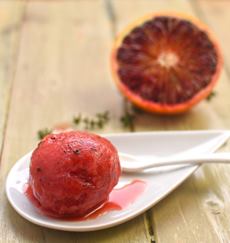
[7] Modern blood orange sorbet with thyme (photo © The Circus Gardener [now closed]).
|
There, it was transformed by locals into a drink, falooda (photo #5), a “float” rose syrup, vermicelli, sweet basil seeds, and pieces of jelly with milk.
Modern falooda is often topped off with a scoop of ice cream.
By the way, both sorbetto/sharbat and pasta arrived in Italy with the Arab invasions of Sicily, in the 8th century (the Marco Polo story is a myth—see the history of pasta).
Here’s more on the history of ice cream and other frozen desserts.
CHECK OUT WHAT’S HAPPENING ON OUR HOME PAGE, THENIBBLE.COM.
|
|