THE NIBBLE BLOG: Products, Recipes & Trends In Specialty Foods


Also visit our main website, TheNibble.com.

EVENT: Kids’ Food Festival

Get ready for the 2015 Kids Food Festival on February 28th and March 1st from 10 a.m. to 4 p.m. Held in the America Winter Village at Bryant Park (behind the New York Public Library, between Fifth and Sixth Avenue and 40th and 42nd Streets).

Presented by The Creative Kitchen, this is a fun-filled, flavorful weekend of family activities that showcase how delicious and easy it is to make better-for-you foods.

A celebration that educates families about making balanced food choices, it’s a great opportunity for adults to help create wholesome, lifelong eating habits for kids and adult family members alike.

With a fantastic line up of chefs, performers, and exhibitors, free general admission includes:

  • The Main Stage, featuring music and dancing, live
    entertainment and cooking demonstrations
  • The Balanced Plate Scavenger Hunt
  • Fun activities and kitchen crafts for the whole family
  • Samplings of delicious foods
  • Giveaways and more
  •   kids-food-festival-2015-230
    Appetites of all ages will be satisfied, February 28th and March 1st.
     
    Tickets for hands-on cooking classes hosted by the James Beard Foundation at the Future Foodies Pavilion can be purchased separately here. The $25 per class includes admission for one child and one adult companion.
     
    The Kids Food Festival helps in the fight against childhood obesity. It’s a painless way to learn about the importance of achieving balance in food choices, through fun activities and sampling family-friendly foods.

    When kids are immersed in enjoyable activities, they absorb information more effectively. The Kids Food Festival embodies this philosophy of learning through fun events.

    Families will cook, dance, laugh and taste their way to making balanced food choices! Get your forks ready for a weekend full of flavorful fun!

    Discover more at KidsFoodFestival.com.
      

    Comments off

    RECIPE: Beet Tarte Tatin

    beet-tarte-tatin-taste.com.au-230r
    Beet Tarte Tatin. Photo and recipe courtesy
    Taste.com.au.
     

    If you love the combination of beets and goat cheese, try this recipe for Beet Tarte Tatin. We adapted it from one by Katrina Woodman, originally published in the October 2012 of Australian Good Taste.

    The Tatin sisters, Caroline and Stéphanie, ran the Hotel Tatin in Lamotte-Beuvron, southwest of Paris in the Loire Valley, not far from the town of Chambord. Tarte Tatin is a one-crust fruit pie invented by accident in France in the early 1880s. It is served upside-down; the fruit (initially, it was apples) are on the bottom with the crust on top.

    As the story goes, Stéphanie, preparing an apple tart, erroneously put the apples in the pan without the crust underneath. The apples caramelized, the customers loved it and the Tarte Tatin was born.

    It can be made with sweet vegetables as well: beets and carrots are delicious prospects.

    This vegetable Tatin, cooked in a skillet, serves four as an appetizer or as part of a light lunch, with a salad.

     
    RECIPE: BEET TARTE TATIN

    Ingredients For 4 Servings

  • 1 tablespoon butter
  • 8 small beets, peeled and halved
  • 1 tablespoon brown sugar
  • 1 tablespoon balsamic vinegar
  • 1 teaspoon fresh thyme leaves (removed from stalks)
  • 1 sheet frozen butter puff pastry, thawed
  • 2 ounces fresh goat cheese, crumbled
  • Optional garnish: fresh thyme sprigs
  •  

    Preparation
    1. PREHEAT oven to 390°F.

    2. MELT the butter in a ovenproof non-stick 7″ or 8″ frying pan over medium-high heat. Stir in the beets and cook for 2 minutes. Add the sugar, vinegar and thyme. Season. Cook, stirring, for 2 minutes or until mixture thickens.

    3. COVER with foil and bake for 20 minutes or until the beetroot is just tender. Set aside for 5 minutes to cool. Increase oven heat to 430°F.

    4. TRIM the pastry into a 9″ to 10″ disc, depending on size of pan. Arrange the beets evenly over the base of the pan. Top with pastry. Fold in excess. Bake for 20 minutes or until puffed and golden. Cool in the pan for 10 minutes.

    5. PLACE a plate turned upside down over the frying pan (it should be bigger than the pan). Holding the two together, flip the entire pastry over. Top with goat cheese and herbs and serve warm.

      ebkids two types of roots jangios167j4 23rd of February, 2006 cmmccabe
    A taproot system versus conventional fibrous roots. Here’s more about it from Britannica.com.

    BEET VS. BEETROOT

    Beetroot (Beta vulgaris) evolved from the wild seabeet, a leafy plant that grows at coastlines around the world. It was first domesticated in the eastern Mediterranean and Middle East, although it was only the leaves that were eaten back then. (The wild seabeet is also the common ancestor of spinach and chard.)

    The Romans began to cultivate beets in earnest, cooking them with honey and wine. Recipes in oldest surviving cookbook De Re Coquinaria by Apicius’s, included beetroot in broths and salads, the latter with a very modern-sounding vinaigrette of mustard, oil and vinegar.

    The beet is a plant with a taproot system. The taproot is a large, central, dominant root, typically straight and very thick, tapering downward (see image above). For most of its life, beetroot was long and thin like a carrot or parsnip—both taproots, along with burdock, radish and turnip, among others. The familiar round shape was developed in the 16th century.

    Beetroot continued to grow in popularity in Victorian times, favored for its dramatic color in salads and soups. It was also used as a sweet ingredient in cakes and puddings. Beet sugar, used more widely around the world than cane sugar, was made by boiling all the sugar out of the beets, then cooking down that sugary water into dry crystals.

    Today, as a result of mutation and selective breeding, beets are available in numerous shapes and sizes, including orange, yellow, white and candy-striped (with red and white concentric circles).

     
    BEET VS. BEETROOT VS. SUGAR BEET

    The term beetroot is used in the U.K., France and elsewhere. It is known by its shorter name, beet, in North America.

  • The table beet is a vegetable grown for human consumption.
  • The sugar beet has been bred for higher sugar content, from which granulated sugar and molasses can be made.
  •  
    You can eat a sugar beet as a vegetable, but can’t make sugar and molasses from a table beet.
      

    Comments off

    TIP OF THE DAY: Watermelon Radish

    mahi-mahi-eggplant-puree-dueforni-230
    Roasted mahi-mahi with baby squash,
    roasted eggplant puree, pistachios and
    watermelon radish. Photo courtesy Due
    Forni.
      Some vegetables light up any dish; watermelon radishes are one. Thanks to farmers markets, we’re seeing a lot more of them.

    Watermelon radishes are available year-round, with peak seasons in spring and late fall (meaning they’re more bountiful and less expensive). Work them into your Valentine’s Day menu: They’re a great special-occasion ingredient.

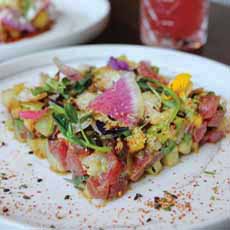
    A large Chinese radish, its exterior is creamy white with touches of pale green. But the flesh: ooh-la-la.

    The watermelon radish has a eautiful rosy pink-magenta flesh, reminiscent of the color of watermelon. It is patterned with bright circular striations of color that are captivating whether sliced, quartered or julienned.

    The texture is crisp and firm yet succulent. And the flavor is mild, lacking the peppery profile of conventional radishes. Instead, it tastes more like daikon, the white Japanese radish.

    The Chinese name is shinrimei, and the radish is known by several other names including Rose Heart and Beauty Heart.

    Depending on when harvested, watermelon radishes can range in size from golf ball to soft ball—up to three inches and more in diameter.


    The color and mildness of the watermelon radish make it a lovely surface for hors d’oeuvres (and a better-for-you alternative to a bread or cracker base). It perks up a green salad. It makes a beautiful garnish on anything savory.

    But there’s so much more you can do with watermelon radishes.

    Watermelon radishes can be served fresh or cooked, hot or cold. They pair well with apple, bacon, butter, citrus, egg dishes, cheeses such as feta and chèvre, cucumbers, creamy based dressings and vinaigrettes, fennel, mild salad greens, noodles such as soba and udon, white fish and a variety of seasonings, especially cilantro, mint and tarragon.

    That’s a lot to work with!


    WAYS TO SERVE WATERMELON RADISH

    You can cook radishes like turnips, but these beautiful radishes deserve to be enjoyed in all their bright color and crispness.
     
    Salads

  • Make a Radish “Caprese”: Serve slices of watermelon radish in lieu of mozzarella with sliced tomatoes, basil and balsamic vinegar—a change of pace that saves calories and fat. You can substitute slices of actual watermelon for the tomatoes.
  • Make a sophisticated salad: Toss thin slices with mâche or microgreens in a special vinaigrette—sherry or honey-dijon, for example.
  • Use as a salad base: Thinly slice large radishes, spread on the plate and use them as a base for other salad ingredients.
  • Try this Sesame Peanut Cucumber Salad recipe, an artistic delight of bright red radish matchsticks and shaved cucumber ribbons.
  • Pair with mushrooms in this Radish, Mushroom & Watercress salad recipe with a sherry-honey vinaigrette.
  • Pair with fennel in this Watermelon Radish & Fennel Salad with Lavender Vinaigrette recipe.
  •   blood-orange-watermelon-radish-lincolnbarbour-230
    A simple citrus salad with blood orange and watermelon radish. Here’s the recipe. Photo courtesy Lincoln Barbour.
     
    Sandwiches

  • Add sliced watermelon radish to sandwiches for color, flavor and crunch, instead of lettuce tomatoes.
  • Try watercress and radish tea sandwiches (or full size sandwiches) with unsalted butter or fresh goat cheese.
  •  
    STORING WATERMELON RADISHES

    To store watermelon radishes, discard the leafy tops and wrap the radishes in plastic. They’ll keep for several weeks.


    Comments off

    RECIPE: Red Velvet Pancakes

    red-velvet-pancakes-tasteofhome-230
    Red velvet pancakes: use seasonal garnish
    for July 4th, Christmas, Valentine’s Day or
    Mother’s Day. Photo courtesy Taste Of
    Home.
     

    For a special Valentine’s Day breakfast, brunch or lunch, Taste Of Home magazine suggests these red velvet pancakes.

    Red food works for July 4th and Christmas, of course. Just vary the garnish:

  • Christmas: mint leaf or sliced kiwi (or make green whipped cream!)
  • Valentine’s Day: red berries
  • July 4th: whipped cream, crème fraîche or mascarpone; plus blueberries
  •  
    Note that the recipe below is for a party-size batch of pancakes—five batches of 16 pancakes per batch.

    However, the mixed dry ingredients can be divided into five batches, which can be stored in a cool, dry place for up to 6 months. You can use the recipe as a guide to make smaller amounts.

    Or, make the five-batch lot, and give the four extra batches as Valentine gifts—tied with a red ribbon.

     
    RECIPE: RED VELVET PANCAKES

    Prep time is: 30 minutes, cooking time is 15 minutes per batch.

    Ingredients For 5 Batches (10 Cups Mix Total)

  • 10 cups all-purpose flour
  • 1-1/4 cups sugar
  • 2/3 cup baking cocoa
  • 6 teaspoons baking soda
  • 4 teaspoons baking powder
  • 5 teaspoons salt
  •  
    Additional Ingredients (For Each Batch)

  • 2 cups buttermilk
  • 2 eggs
  • 2 tablespoons red food coloring
  • Butter and maple syrup
  •  
    Preparation

    1. COMBINE the first six ingredients in a large bowl. Place 2 cups in each of five resealable plastic bags or containers.

    2. PREPARE pancakes: Pour the mix into a large bowl. In a small bowl, whisk the buttermilk, eggs and food coloring. Stir into the dry ingredients just until moistened.

    3. POUR the batter by 1/4 cupfuls onto a greased hot griddle; turn when bubbles form on top. Cook until the second side is golden brown.

    4. SERVE with butter and syrup.


    Comments off

    Homemade Peppermint Patties Recipe & Patty Vs. Pattie

    February 11th is National Peppermint Patty Day. Whip up a batch today, and make extras to hand out on Valentine’s Day. (For Valentine patties, top with heart-shaped sprinkles or Conversation Hearts.)

    > The recipe is below.

    > Most people get it wrong (including York): peppermint patty vs. pattie. Plus the history of peppermint patties.

    Elsewhere on The Nibble:

    > The year’s 9 mint holidays.

    > The history of chocolate.

    > The different types of chocolate: a photo glossary.

    > The year’s 69 chocolate holidays.
     
     
    IS IT PATTY OR PATTIE & THE HISTORY OF PEPPERMINT PATTIES

    It’s patty! Whether it’s candy, meat or veggies, to be perfectly correct, the spelling is patty. Patties is the plural form, so many folks assumed the singular to be pattie.

    The word first appeared in English around 1700-1710, derived from the French pâté (paste in English), a mix of finely-ground ingredients. Pasta is the Italian word for paste; and in modern French cuisine, pâté refers to a meat loaf as well as the more finely ground goose or duck liver pâté.

    Bonbons—creamy flavored centers enrobed in chocolate—appeared in the 19th century. However, the peppermint versions of the time were gummy.

    Henry C. Kessler of the York Cone Company in York, Pennsylvania set out to make a better peppermint center. In 1940 he developed a center that was firm. He called it the York Peppermint Pattie (alas, not the correct spelling, which is patty).

    Other companies followed suit, most notably James O. Welch, a candymaker in Cambridge Massachusetts who had created Milk Duds, Sugar Babies and Sugar Daddies. In 1949 he introduced Junior Mints, a small, round, bite-size version.

    Today the York brand is owned by Hershey and produces the Peppermint Patties in Monterrey, Mexico. Junior Mints are owned by Nabisco Brands, and still are produced in Cambridge [source].

    So you could run out and get a York Peppermint Pattie or a box of Junior Mints (we far prefer the flavor of York).

    Or, you could spend 40 minutes of prep time making your own (plus 9 hours of drying time).

    And if you’re not in a candy mood, how about a Peppermint Patty Martini?
     
     
    RECIPE: HOMEMADE PEPPERMINT PATTIES

    Because the recipe uses uncooked egg whites, you may wish to consider Safest Choice pasteurized egg whites.

    Ingredients For 30 Pieces

  • 3-1/2 cups powdered sugar, plus extra as needed
  • 2 egg whites
  • 1 teaspoon water, plus extra as needed
  • 1/4 teaspoon pure peppermint extract
  • 4 four-ounce dark chocolate bars, chopped into 1/2-inch pieces
  • 2 teaspoons vegetable oil
  •  
    Preparation

    1. LINE two baking sheets with parchment paper. Cut a separate 2-inch square of parchment paper. Set aside.

    2. COMBINE the powdered sugar, egg whites, water and peppermint extract in stand mixer on low speed until smooth. Increase the speed gradually to high, to form a stiff, smooth dough, adding ½ teaspoon of water at a time if mixture becomes too stiff.

    3. DUST a clean surface with powdered sugar and roll the dough into a log, approximately 12-inches long and 1-1/4-inches in diameter. Slice the log into 1/4 to 1/2-inch pieces, rolling the pieces into balls as you go. Arrange them on lined baking sheets, about an inch apart.

    4. PLACE the square of parchment paper on top of each dough ball and flatten it into a disk, using the bottom of shot glass. Repeat. Let the candies dry, uncovered, at room temperature for at least six hours. After the patties have dried…

    5. COMBINE the chocolate and vegetable oil in a small bowl over a pan of barely simmering water. Stir until the chocolate is smooth and melted. Allow the chocolate to cool slightly. Dip each candy into the melted chocolate, coating both sides.

    6. RETURN the candies to the parchment paper until the chocolate has set, about 3 hours. To set faster, place the candies in the refrigerator.
     
    Peppermint In A Planter
    [6] Consider growing peppermint at home (photo © Fashion Freak By E | Etsy).


    peppermint-patties-safeeggs-230
    [1] Homemade peppermint patties. Here’s the recipe. Make them if you love peppermint patties but want to elevate the chocolate enrobing with a great brand of chocolate (photo © Safe Eggs).

    Homemade Peppermint Patties
    [2] Make them inside-out. Be sure to use real white chocolate chips, not confectioners coating which is made with vegetable oil. Here’s the recipe (photo © Hannah Kaminsky | Bittersweet Blog).

    York Peppermint Minis
    [3] York Peppermint Pattie minis (photo © The Hershey Company).

    McCormick Peppermint Extract
    [4] Four more uses for peppermint extract: a drop in hot chocolate, a peppermint mocha, whipped cream or frosting. Soften a pint of vanilla extract and add extract and chocolate chips (Abacus Photo).

    deBrand-230
    [5] Semisweet (50% cacao or more) or bittersweet chocolate (70% cacao or more) are a better counterpoint to the lively mint than milk chocolate (photo © Debrand Fine Chocolates).

    Valrhona Chocolate Palets
    [7] You may think of chocolate as dark, milk, and white, but Valrhona, a top producer of the finest chocolate, makes eight varieties for chocolate professionals. Consumers can purchase bars or disks in dulcey (blonde), dark, milk, ruby, and white (photo © Valrhona).
     

    CHECK OUT WHAT’S HAPPENING ON OUR HOME PAGE, THENIBBLE.COM.


    Comments off

    The Nibble Webzine Of Food Adventures
    RSS
    Follow by Email


    © Copyright 2005-2026 Lifestyle Direct, Inc. All rights reserved. All images are copyrighted to their respective owners.