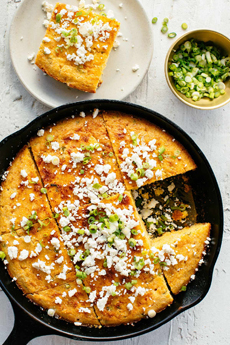
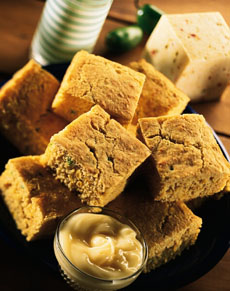
Settlers made their version in iron skillets. In the absence of a skillet—not easy to find on the frontier—hoe cakes (hoecakes) were baked on a garden hoe held or wedged up against an open fire. They were eaten with soups or stews.
The most basic hoecake was made with cornmeal, fat, water and a pinch of salt. It was made in a skillet without leavening resulting in dense corn pancakes. As ingredients and disposable income became more plentiful, butter, buttermilk, eggs, milk, molasses and sugar were incorporated into recipes. Wheat flour was added to lighten the taste and density of breads made only with cornmeal. [Source]
By the 1840s, chemical leavenings such as pearlash (potassium carbonate) and saleratus (potassium bicarbonate) were generally available to American cooks. In 1843, British chemist Alfred Bird invented baking powder (sodium bicarbonate). Modern commercial yeast was not available until the late 1800s, and the granulated active dry yeast we use today was invented during World War II by Fleischmann’s.
Finally, all the elements were in place to make modern cornbread. However, as a result of America’s modern taste for sugar and more sugar, most modern cornbread recipes are sweeter than those used by prior generations.
WHAT IS GHEE?
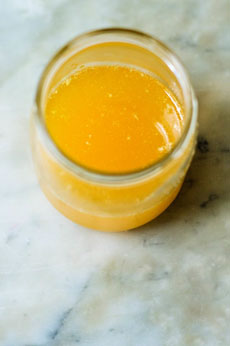
Ghee is similar* to clarified butter: It is butter that is melted and strained of its solids. It returns to a soft solid at room temperature.
Ghee has less moisture than butter, and for that reason is preferred in some recipes. It is also valuable when you want to pan fry in butter. By removing the milk solids, ghee has a much higher smoke point.
But if you’re making cake or cookies, you don’t want to use ghee: The buttery flavor largely comes from the milk solids, and the flavor will milder and less buttery.
Ghee is shelf stable (no refrigeration required). It lasts a good while on the shelf, and a very, very long time in the fridge. When you make it, you can make a double batch and stick the extra in the fridge. Or, give it to a friend who cooks: It will be greatly appreciated.
Here’s more about ghee.
__________________________________
*Traditional ghee is made from butter churned from cultured milk, somewhat different from European clarified butter. A few Indian dishes call for using both ghee and sweet butter.
|