|
Updated August 2026
Sponge cake is a light and airy cake with no fat, traditional flour, and no leavening. The rise comes from beating air into egg whites.
August 23rd is National Sponge Cake Day, and we’re celebrating this world-famous cake by pointing out the 16+ different styles of sponge.
A popular American version, the Jewish-style sponge cake—a Passover mainstay because it has no leavening and the all-purpose flour used year-round can be replaced by matzo cake meal—is not the same as génoise.
Génoise, the French sponge cake made with conventional flour and butter. There is no fat in a Jewish-style sponge, making génoise denser and richer.
Passover sponge cake substitutes potato starch and matzoh meal for conventional flour, and contains no fat.
And for certain, Jewish sponge cake and génoise are not the only types of sponge cake.
Party Idea: Get your friends who bake together and have a tasting of all of these for National Sponge Cake Day.
Below:
> The different types of sponge cake.
> Recipe: classic separated-egg sponge cake.
> Recipe: Passover/Jewish sponge cake.
> Garnishes for sponge cake.
> Are angel cake and chiffon cake sponge cakes?
Elsewhere on The Nibble:
> The history of sponge cake.
> The history of cake.
> The different types of cake: a photo glossary.
> The year’s 55 cake holidays.
1. THE DIFFERENT TYPES OF SPONGE CAKE
Most sponge cakes are made with eggs, sugar, flour, and sometimes a small amount of fat (melted butter or vegetable oil). They are usually leavened with beaten eggs so no baking powder or other leavening is needed (the difference between baking powder and baking soda).
While this article doesn’t propose to be a comprehensive treatise on sponge cakes, there are three ways of grouping them.
a. Foam Sponge / True Sponge
These include Australian (cornflour) sponge, castella, génoise, pan di Spagna, and Viennese sponge.
What designates them as foam/true sponge?
The rise: They rise from an egg foam, air whipped into whole eggs or separated yolks/whites. There is no chemical leavening (baking powder, baking soda).
Fat: None or minimal.
Mixing method: Eggs and sugar are whisked into a stable foam; then the flour is folded in, often with some cornstarch.
Texture: These cakes have a springy, drier crumb that’s flexible for roulades and ideal for syrup-soaking.
Greasing: The pans are often ungreased so the batter can climb the sides (the bottoms only can be lined). Angel food cake and Passover sponges need to be inverted when the pan comes out of the oven so they keep their volume (don’t shrink) while their starch/protein network sets firm.
b. Butter Sponge / Cream Sponge
These include the American/hot-milk sponge, any recipe called butter/cream sponge, the Victoria sponge (photo #9), plus variants (e.g. Madeira sponge cake, many “butter sponge” recipes.
What designates them as butter/cream sponge?
Because they contain butter (some people use oil), they also fall into the category of butter cakes.
The rise: They rise from creamed butter and sugar (mechanically aerated fat) plus baking powder/soda.
Fat: Butter is a main ingredient.
Mixing method: The eggs are added to the creamed butter and sugar, followed by the flour, and sometimes milk.
Texture: These cakes are moister and richer, with a finer crumb. They are meant to be filled/frosted without syrup (although syrup is optional).
Greasing: The pans are greased. No inversion is required.
c. Hybrids
Chiffon cake uses the egg foam from the foam/true sponge, and fat (typically oil) and baking powder from the butter/cream sponge.
Japanese shortcake sponge similarly uses egg foam, the foam/true sponge-cake aeration technique. Like a butter/cream sponge, it’s enriched with warm milk and melted butter (or oil)—these dairy ingredients creating a softer, moister, finer crumb. Often, a pinch of baking powder for “insurance”†.
The Types Of Sponge Cake
American sponge is a hot-milk sponge: Whole eggs are whipped until foamy, then hot milk and melted butter are added, and often a bit of baking powder. It is baked as layers to be filled, more like a classic layer cake than a syrup-soaked (i.e. brushed or poured on) European sponge. It has a moist, fine crumb. Fillings include jam, lemon curd, macerated berries, pastry cream, with frostings such as buttercream, chocolate ganache, ermine*, 7-minute, and whipped cream.
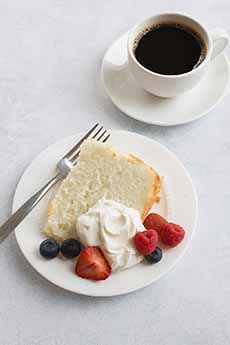
Angel food cake (photo #10). Is angel food cake a sponge? Culinarians don’t agree as to yes or no. See the discussion below.
Australian sponge is a firm whisked sponge (an “Australian sponge”—eggs and sugar whipped, flour folded in, sometimes a little melted butter/cornstarch)
Biscuit de Savoie, A classic French sponge that’s lighter than génoise, traditionally made without butter. This is closest in style to the Jewish sponge cake, but made with all-purpose flour instead of Passover matzoh cake meal.
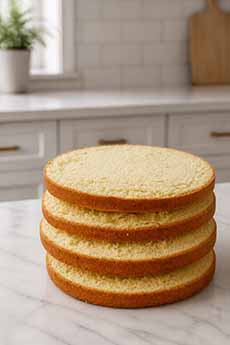
Biskuit, a German/Austrian sponge cake base used to make cakes in three-or-four layers and also used as a base for a torte (photo #2).
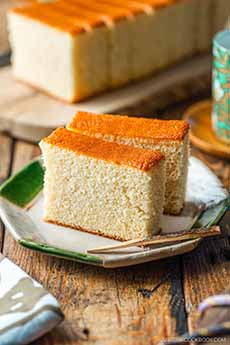
Castella (Kasutera) is traditional Nagasaki loaf cake descended from Portuguese pão-de-ló whole-egg foam, no added fat, sweetened with honey (often mizuame); it commonly uses bread flour (photo #3). The result is a tight, springy, elastic crumb with a glossy, browned top; subtly honey-sweet. It’s baked as a loaf or block mold and served plain in slices. Castella is not the same as Japanese sponge; it is a much older confection that traces to the mid-16th-century in the Nanban period when Portuguese traders and Jesuit missionaries reached Japan. They brought Iberian sponge cakes (like pão-de-ló/“bolo de Castela,” i.e., “Castile cake”), which confectioners in Nagasaki, a main port city adapted. In the early 1600s (early Edo period) local bakers refined the recipe into a fat-free, honey-sweetened loaf baked in wooden molds. The cake became a signature Nagasaki sweet that was later standardized and popularized nationwide by specialty bakers. The name kasutera is the Japanese name for a locally developed style.
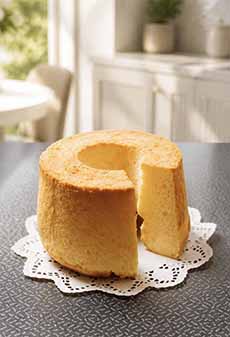
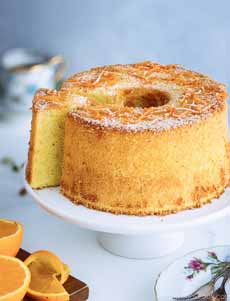
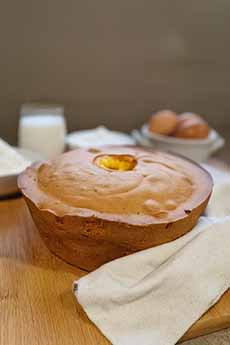
Chiffon cake (photo #4), an American invention, is a hybrid of sponge and génoise. It uses a leavening agent and oil, which makes the cake moist than a sponge. The yolks and oil are beaten with the dry ingredients; the whites are whipped separately and folded in. Here’s the history of chiffon cake.
Fatless Sponge is a British-style sponge made without fat, relying entirely on beaten eggs for leavening. The whole eggs are typically whipped together (or sometimes separated and recombined). Has a more substantial, albeit still light, texture than with a golden color from the egg yolks.
Genoese or Genovese or Italian sponge cake is made without leavening but with conventional flour and fat. It was invented in the Italian city of Genoa (one popular origin story says it was made in Spain, by the Genoese ambassador to Spain [i.e., his cook]). It is often confused with pan di spagna, but the two are different (pan di spagna, below).
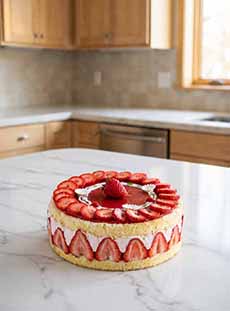
Génoise, the famous French sponge (photo #5), has added fat. Clarified butter enriches the batter and makes the cake moister. The eggs are beaten whole, sometimes with additional yolks. Génoise is used in layer cakes and roulades (rolled cakes), among others. Pan di Spagna (see below) is a variation.
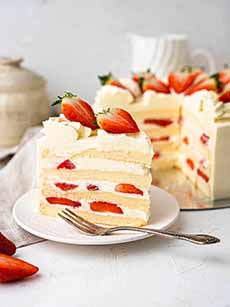
Japanese Shortcake Sponge is ultra-soft, very fine, moist, and designed to stay tender when chilled, e.g. with whipped cream for strawberry shortcake (photo #6). It is made with whole-egg foam and warm milk and butter (or neutral oil); some bakers use a bit of baking powder with the flour. The recipe is optimized for pairing with fresh whipped cream rather than buttercream, jam, or other filling. This soft shortcake sponge is different from castella, which is honey-forward, fat-free sponge cake.
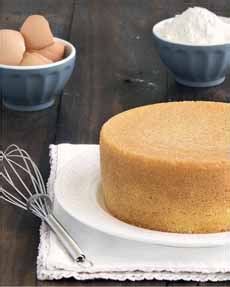
Jewish-style sponge cake or Passover sponge cake (photo #1) was adapted by Italian Jews for Passover (so were Italian amaretti—here’s an amaretti recipe), because it contains no leavening. It then spread through other European Jewish communities. The recipe for Passover contains no wheat flour, which is forbidden during the holiday. Instead, matzo cake meal is used, although year-round can use cake flour. It has no added fat, and the yolks and whites are beaten separately. It is typically baked in a tube pan.
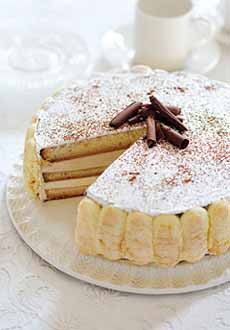
Ladyfingers or sponge fingers or savoiardi, a form of Italian sponge, are finger-shaped sponge cookies that originated at the Savoy Court in medieval times, believed to be the 14th century. They are eaten as plain or with a dessert with coffee and a dip (chocolate sauce, lemon curd, zabaglione; in layered and soaked desserts (icebox cakes, tiramisu, trifles/zuppa inglese; as a liner for charlottes, entremets collar (biscuit collar) as in photo #7; ice-cream cakes, ice cream sandwiches, or semifreddos; even as no-bake crusts and crunchy garnishes. Here’s more about them.
Pan di Spagna (“Spanish bread”—photo #8) is another type of Italian sponge cake. While genoese is made by cooking the eggs and sugar together, whisking them over a bain marie and then adding some melted butter, pan di spagna is made without heat. With pan di spagna, the eggs are whisked separately. The lightness is achieved by whipping the whites into stiff peaks, and there is no added fat. This technique is the same as with Jewish-style sponge cake, except that pan di spagna uses traditional flour. Zuppa inglese is an example of a dessert with pan di spagna.
Pão de Ló (photo #14) is a very light and airy Portuguese sponge cake that was the inspiration for castella.
Viennese Sponge (biscuit viennois, photo #13) has a flexible, slightly drier crumb than American sponge and takes syrup beautifully (e.g. for roulades). It uses little or no butter and no chemical leavener. Eggs whites and yolks whipped separately, then folded. There is often some cornstarch added to the flour.
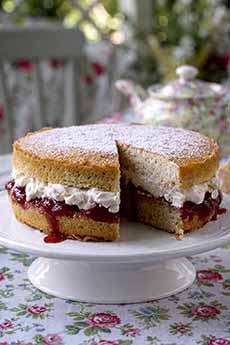
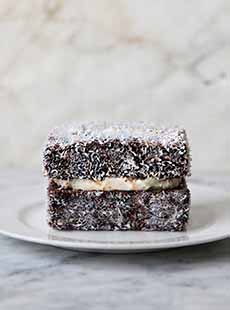
Other sponge cakes, which are variations of the above, include Lamington sponge (from Australia, a jam-filled sponge sandwich dipped in chocolate and covered in coconut, photo #12) and the Victoria sponge/Victoria sandwich (U.K., photo #9).
2. CLASSIC SEPARATED-EGG SPONGE CAKE
Here’s a bit of history, or skip down to the recipe ingredients.
The classic sponge cake (or biscuit de Savoie style in European baking) is made with all-purpose flour (or cake flour for a finer crumb).
The egg-foam principle associated with sponge cake is often traced to Moorish Spain (a.k.a. Al-Andalus, Islamic Iberia) in about the 11th century.
From there, related egg-and-sugar cakes emerged and developed in several European culinary traditions—but the exact routes of transmission and the origins of particular later cakes are difficult to determine. And we don’t know what the cakes looked like.
According to culinary historians like Gil Marks, Moorish confectioners pioneered the technique of vigorously beating eggs with sugar or honey to leaven batters without relying on yeast or sourdough.
This technique spread across religious communities in medieval Spain. Sephardic Jewish bakers eagerly adopted and refined it because egg-leavened cakes contained no yeast, required no dairy fat (pareve), and could easily be adapted for Passover.
This became the foundation for pan de España (“Spanish bread” / bizcocho), which Sephardic Jews later carried across the Ottoman Empire, North Africa, and Europe during the diaspora following the 1492 expulsion.
The early medieval Andalusian versions were dense, flat, and cracker- or biscuit-like compared to modern cakes. They relied primarily on whole eggs beaten for extended periods rather than modern meringue separation.
Ingredients For One 10-Inch Tube Pan (12–16 Servings)
8 large eggs, separated, room temperature
1 cup plus 2 tablespoons (225g) granulated sugar, divided
1 cup (120g) all-purpose flour
1/4 cup (30g) cornstarch
1/2 teaspoon kosher salt
1/2 teaspoon cream of tartar
1 tablespoon fresh lemon juice or orange juice
1 teaspoon finely grated lemon zest
1 teaspoon pure vanilla extract
Preparation
Use an ungreased 10-inch two-piece tube pan (angel food cake pan). Crucial note: Do not grease the pan; the batter needs friction to climb the sides as it bakes.
1. PREHEAT the oven to 325°F (165°C) with an oven rack in the lower third.
2. COMBINE the flour, cornstarch, and salt, sifting three times to aerate and ensure completely lump-free folding later. Set aside.
3. BEAT the egg yolks and 1/2 cup of the sugar with a electric beaters in a large mixing bowl. Beat on medium-high speed for 4–5 minutes until the mixture is pale, thick, and ribbon-like. Beat in the lemon juice, zest, and vanilla until just combined.
4. WHIP the egg whites and cream of tartar in a clean, grease-free stainless steel or glass bowl, on medium speed until foamy. Gradually sprinkle in the remaining 1/2 cup plus 2 tablespoons sugar, one tablespoon at a time, increasing the speed to medium-high until glossy, firm peaks form that hold their shape without being dry or curdled.
5. GENTLY STIR one-third of the whipped whites into the yolk mixture to lighten it. Sift one-third of the flour mixture over the batter and gently fold with a large rubber spatula.
6. ALTERNATE folding in the remaining egg whites and flour in two more additions, using wide, gentle sweeping motions from the bottom of the bowl upward until no dry pockets remain. Take care not to deflate the batter‡. Pour the batter into the ungreased tube pan and smooth the top. Run a butter knife or thin spatula through the batter in a circle to pop any large trapped air bubbles.
7. BAKE at 325°F (165°C) for 50 to 55 minutes, until the top is golden brown, springs back gently when lightly pressed, and a wooden skewer inserted in the center comes out clean.
8. IMMEDIATELY INVERT the pan onto its built-in legs or over the neck of a sturdy glass bottle. Let it hang upside down until completely cooled to room temperature (1.5 to 2 hours). This prevents the delicate, flour-light structure from collapsing under its own weight.
9. RUN a thin offset spatula around the edges and center tube to release and unmold onto a serving plate.
3. RECIPE: PASSOVER/JEWISH SPONGE CAKE
Jewish bakers created a kosher-for-Passover adaptation of the egg-leavened sponge. During Passover, when grains and chemical leaveners are prohibited, the foundational baking science of the sponge cake enabled them to substitute matzo cake meal and potato starch for the wheat flour.
Since the sponge cake on which it was modeled is egg-leavened, sponge cake became a popular Passover dessert.
The entire structure and dramatic rise in an ungreased tube pan come solely from the physical expansion of trapped air inside whipped whole eggs (separated and whipped to maximum volume).
Egg-aerated and leavened sponge cakes were established in Europe centuries before the Passover version was created. One account traces sponge cake’s egg-and-sugar aeration method to Moorish Spain around the year 1000, with the style later spreading through Europe and gaining popularity in Ashkenazi Jewish communities during the 1800s.
This recipe is from our mom. Although she is no longer here to bake it, she would be pleased if you did.
Ingredients
12 medium or small eggs, carefully separated
1 cup sugar
Juice and zest from 1 lemon
1/2 cup orange juice
1/2 cup potato starch
1/2 cup matzo meal
Pinch salt
Preparation
1. PREHEAT the oven to 325°F. Separate the egg yolks from the whites, being sure not to get a single drop of yolk mixed into the whites (otherwise the cake will not rise properly).
2. BEAT the yolks; then add the sugar, lemon and orange juices.
3. SIFT the matzoh meal and potato starch together, then add to the yolks. Using a clean bowl and beaters with no trace of the other ingredients…
4. BEAT the egg whites with a dash of salt in a large bowl, until they are fluffy and stiff (the peaks should separate from the sides of the bowl). Fold in the yolk mixture a bit at a time. Pour into an un-greased tube pan and bake for 50 minutes.
5. TURN the pan upside down to cool. Be sure the top of the cake does not touch the surface, or it will fall in.
|
|

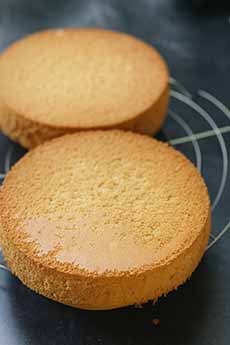
[1] A traditional sponge cake is made without leavening. The rise is due to beaten egg whites (photo © The Nibble).
[2] Biskuit or Biskuitboden, a German sponge made for a multi-layer cake Here’s the recipe (photo © The Nibble).
[3] Japanese castela (for “Castille cake”), also called kasutera. Here’s the recipe (photo © Just One Cookbook).
[4] Chiffon cake is a hybrid of sponge and génoise. Here’s the recipe for this beautiful Orange Chiffon Cake from Just One Cookbook.
[5] A génoise sponge is the base of this fraisier, French-style strawberry shortcake (many other French cakes use a génoise sponge) Here’s the recipe (photo © The Nibble).
[6] Japanese shortcake sponge is made to be paired with whipped cream. Here’s the recipe for this strawberry shortcake (photo © Zhang Catherine).
[7] In addition to other uses, ladyfingers are an ingredient in tiramisu (photo of tiramisu cake courtesy Mackenzie Ltd).
[8] Pan di spagna. The name is often used synonymously with a genoese sponge, but there is a difference (see bullet point). Here’s the recipe from Easy As Apple Pie.
[9] A Victoria sponge or Victoria sandwich comprises two sponge layers filled with jam and buttercream, popular at tea time (photo © The Nibble).
[10] Angel food cake, not to be confused with angel cake in the next photo. Here’s the recipe (photo © Taste Of Home).
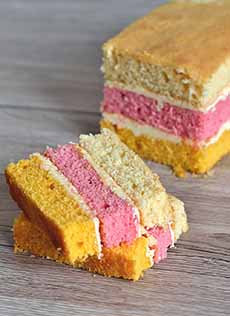
[11] Not to be confused with angel food cake, angel cake is a retro British specialty. Here’s the recipe (photo © Baking With Granny).
[12] Lamingtons are squares of Australian sponge iced in chocolate and rolled in desiccated coconut. Two squares can be filled with jam or whipped cream to make a Lamington sandwich.They have their own holiday—July 21st is National Lamington Day—and are widely considered to be the national dessert of Australia. Here’s more about them (photo © The Nibble).
[13] Viennese sponge or biscuit viennois. Here’s a recipe (photo © Combine Good Flavors).
[14] Pão de ló, a very light and airy Portuguese sponge cake believed to predate and inspire castella; recipes trace back for centuries in Portuguese convent baking. Here’s a recipe and more of the history (photo © Tasty Portugal).
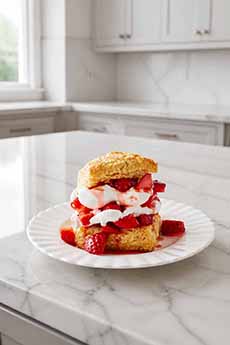
[15] Americans tend to use sponge cake as the base for strawberry shortcake, replacing the British tradition of placing the whipped cream and berries on a split biscuit or scone, shown here (photo © The Nibble).
|
4. GARNISHES FOR SPONGE CAKE
Our mom used sponge cake as the base for a strawberry shortcake topped with whipped cream, berries. The sponge took the place of the traditional British recipe that topped biscuit with the strawberries and cream.
The cake is so versatile that you can serve it plain, fancy or in-between.
Mix and match as you like:
Berries or other fruit (sliced stone fruit in the summer)
Citrus glaze and julienned peel (lemon, lime, orange—add some liqueur if you like)
Fruit curd
Fruit sauce
Ice cream (try vanilla, strawberry or other fruit flavor)
Ice cream sundae (sponge cake, ice cream, chocolate or butterscotch sauce)
Whipped cream
Garnishes: chocolate curls, nuts
5. ARE ANGEL & CHIFFON CAKES SPONGE CAKES?
This is an ongoing debate among bakers, culinary schools, and food writers about whether angel food is part of the sponge cake category.
Similar to sponge cake: it relies on beaten eggs (although whites only) for leavening rather than chemical leaveners. It uses the foam method of mixing, and is fat-free like many classic sponges. It delivers the light, airy texture characteristic of sponge cakes.
Not similar: Many culinary professionals classify angel cake separately from sponge. They call it a “foam cake” or “egg white cake,” as it uses only egg whites while traditional sponges use whole eggs. Then, it has a distinctly different texture, more ethereal and delicate than typical sponge cakes, with an ultra-light, snowy crumb.
Angel Cake Vs. Angel Food Cake
In American baking, the whites-only foam cake baked in a tube pan is properly called angel food cake. When the term “angel cake” is used for this cake, it can be problematic. That’s because…
In the U.K., “angel cake” a different type of cake: a pink/yellow/white striped butter sponge.
So remember to stick with angel food cake unless you’re specifically describing the colorful British cake (photo #11).
Chiffon Cakes
In bakery textbooks, cakes are often grouped as foam cakes, i.e., leavened with egg-foam–leavened. These books list angel food cake, chiffon cake, and sponge cake in this category.
Strictly speaking, chiffon isn’t a classic sponge because it adds oil and baking powder. Classic sponges (génoise/Viennese/Passover) rely on egg foam only, and little or no added fat.
A SPONGY SIGN-OFF
Whether leavened by the sheer mechanical might of whipped eggs, enriched with butter, or softened with oil, every variation of sponge cake shares a single, brilliant premise: transforming the simplest pantry staples into pure, airy architecture.
From the delicate lift of an angel food to the sturdy richness of a Victoria sandwich, mastering this versatile family of bakes is less about memorizing rigid formulas and more about understanding the alchemy of aeration—proving that with just a whisk and a little technique, simple batter can rise into an endless variety of classics.
Are you up for the challenge? Plan a sponge cake party for next August 23rd, and assign each of your baker friends to bring a different sponge.
It will be a memorable event.
________________
*Ermine frosting, also known as flour frosting or boiled milk frosting, is an old-fashioned recipe: a light, fluffy buttercream that uses a cooked flour-milk mixture to create a less sweet, more stable, and velvety smooth icing. It’s an eggless alternative to other types of buttercream, delivering milder sweetness and a creamy, whipped-cream-like texture without the richness of other frostings.
†A small amount of double-acting baking powder releases CO₂, which backs up the egg foam. The gas inflates the bubbles the egg foam has already created, providing the volume needed even if the foam was slightly under-whipped or lost some air while folding in the warm milk/butter.
Plus, while the hot milk and butter soften the texture, they also weigh down the foam. The baking powder supplies extra lift and spring. Finally, the second CO₂ release from the double-acting baking powder helps hold height of the cake until the structure firms—i.e., fewer collapsed layers.
‡The batter can deflate when you handle it too aggressively after whipping the egg whites. Specifically avoid stirring or beating instead of folding; making fast, forceful strokes that burst the air bubbles; pressing the spatula down through the whites rather than cutting gently through them; scraping or smearing the batter repeatedly against the bowl; mixing longer than necessary, especially after the flour is added; or tapping or banging the filled pan, which can knock out trapped air.
Those tiny air bubbles are what make the cake rise, so the goal is to incorporate the flour while preserving as many as possible. Use a wide spatula, cut down through the center, sweep along the bottom, and fold the mixture up and over itself, rotating the bowl as you go. Stop as soon as no large streaks of flour or egg white remain.
CHECK OUT WHAT’S HAPPENING ON OUR HOME PAGE, THENIBBLE.COM.
|