THE NIBBLE BLOG: Products, Recipes & Trends In Specialty Foods


Also visit our main website, TheNibble.com.

FOOD FUN: Easter Egg Cheese Plate

We can always rely on DiBruno Bros. in Philadelphia for the best specialty foods—and creative ways to use them.

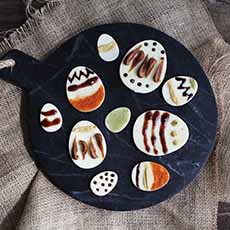
For Easter, they’ve used Easter egg cookie cutters (photo #2) to create an Easter cheese plate (photo #1).

The semi-hard cheese group includes young Asiago, Cheddar, Colby, Edam, Fontinella, Gouda, Manchego, Provolone (photo #1) and Queso Blanco, among others.

Semi-hard cheese is a classification of cheese based upon body. The terms semi-hard and hard refer mainly to moisture content, not to texture.

Because these cheeses contain less moisture than the soft and soft-ripened types, they hold their shape much better—good to cut with cookie cutters.

A cheese can start as semi-soft, then move to semi-hard via aging, which evaporates the moisture.
 
 
HOW TO MAKE CHEESE EASTER EGGS

1. PICK your cheeses. While DiBruno Bros. used only provolone, try at least two different colors: provolone and cheddar, for example.

2. PICK your toppings. You can use anything you have around, but here are some ideas. Use as much color as you can; e.g., green pimento olives instead of black olives, and sultanas (golden raisins) instead of dark purple raisins.

  • Balsamic glaze, for the dots and squiggles
  • Chili flakes
  • Chutney, honey, preserves, marmalade
  • Dried fruit: blueberries, cherries, cranberries, raisins
  • Figs, sliced into thin strips
  • Hot sauce
  • Mustard or mostarda
  • Olives, sliced
  • Pesto
  • Pimento, sliced into thin strips
  • Salt and spice blends
  •  
    Plus:

  • Bread or crackers
  •  
    You can also add colorful fruit to the plate: berries, dried apricots, orange/mandarin segments, red grapes, etc.

    3. CUT and decorate the cheese shapes.

    4. SERVE as a first course, with a salad course, or after the main course, before dessert.


    [1] Easter egg cheese plate, created by DiBruno Bros from provolone (photo © DiBruno Bros).


    [2] Easter egg cookie cutter set on Amazon (photo © Ann Clark Cookie Cutters).


    [3] The easy cheese platter: Surround rounds and wedges of cheese with Easter candy (photo © Murray’s Cheese).

     
    DON’T WANT EGG-SHAPED CHEESE?

    Put your favorite cheeses on a board and surround them with Easter candy (photo #3). This works best when cheese is served after the main course.

    Bite-size, foil-wrapped Easter eggs are best because chocolate is a good pairing with cheese.
     
     
    > CHECK OUT THE DIFFERENT TYPES OF CHEESE IN OUR CHEESE GLOSSARY <


    Comments off

    TIP OF THE DAY: Make A Dessert Parfait

    Blueberry Lemon Parfait
    [1] Blueberries and lemon curd are a delicious combination Here’s the recipe from Baking A Moment. Substitute ice cream, pudding or mousse for the yogurt (photo © Baking A Moment).

    Fruit & Yogurt Parfait
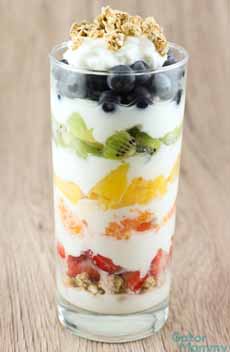
    [2] It looks like the Easter Bunny made this parfait. Here’s the recipe from Sugar Spice And Family Life. Substitute ice cream, pudding or mousse for the yogurt (photo © Sugar Spice And Family Life).


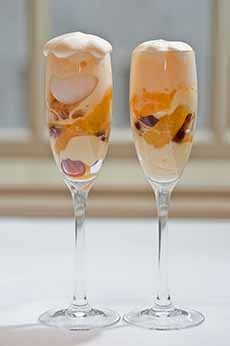
    [3] Use any glass vessel you have. We use our champagne flutes (photo © Davio’s | Boston).


    [4] These Cookies & Cream Parfaits With Chocolate Cream And Bailey’s Irish, for any occasion, are irresistable. Here’s the recipe (photo © Homemade Hooplah).


    If you’re sheltering in place for Easter—and most of us certainly are—here’s a dessert that is both festive and easy: a no-bake parfait.

    Originally (and still) made with ice cream, yogurt* parfaits were adapted as yogurt† became a popular food in 1977†.

    For dessert, there are chocolate parfaits, butterscotch and caramel parfaits, parfaits with most kinds of fruit and fruit sauces. But for Easter, bright colors complement the season.

    June 25th is National Strawberry Parfait Day.

    The History Of The Parfait.
     
     
    HOW TO CONSTRUCT YOUR DESSERT PARFAIT

    WANT A LAYER OF CAKE?

    The yogurt parfaits don’t use crumbled cookies or cake as a bottom layer, but it’s a good addition to a dessert parfait. If you want to add a cake or cookie layer(s) but don’t have any cake or brownies at home, substitute:

  • Bread crumbs, slightly sweetened and/or spiced
  • Muffins, diced
  • Dessert sauce: caramel, chocolate, strawberry, etc.
  • Fruit, diced
  • Jam, marmalade, preserves,
  •  
    DESSERT PARFAIT LAYERS & GARNISHES

    Start with ice cream and/or sorbet layers of choice. You can also use mousse or pudding.

    For the other layers, see what you have on hand—especially in bright Easter colors:

  • Berries, diced fruits, orange/mandarin segments
  • Brandied or maraschino cherries
  • Candies: Easter candy, M&Ms, Nerds, Skittles)
  • Sprinkles or dragées
  • Sweet herbs for the top: basil, chervil, lemon thyme, marjoram, mint, pink peppercorns, sage, sweet cicely, tarragon
  • Whipped cream, crème fraîche, mascarpone (here’s how to stabilize whipped cream so it doesn’t deflate)
  •  
    Some non-colorful options for another occasion:

  • Chocolate chips (or other flavor), toffee bits
  • Chocolate square, shaved or curled chocolate, cacao nibs
  • Coconut, grated
  • Mini biscotti, cookies, meringues
  • Mini marshmallows or a regular toasted marshmallow
  • Nuts
  • Spices: clove, cinnamon, garam masala, nutmeg
  •  
    Any combination is delicious.
     
    FOR ADULTS: LIQUEUR

    Add a hint of liqueur to:

  • Crumbs or other bottom layer
  • In-between layers
  • On top, as a garnish
  •  
    BREAKFAST & BRUNCH GARNISHES

    Any combination of fresh fruit, sliced or diced, works. Use two different flavors of yogurt for added flavors and colors.

    For additional layers and garnishes, try:

  • Crumbled graham crackers
  • Diced banana or mango
  • Dried blueberries, cherries, cranberries, coconut, raisins
  • Fruit purée
  • Jam, marmalade, preserves
  • Lemon or other fruit curd
  • Granola or crunchy cereal
  • Nuts or seeds
  • Pineapple, fresh or canned
  •  
    Bon appetit!
     
     
    ________________

    *Yogurt, a staple in Greek, Turkish and other Mediterranean cuisines, was made in those local communities and had low awareness among the general population.

    †While yogurt is an ancient food and had been available in the U.S. since the early 1900s, it was seen as a health food, available in health food stores, a century before healthy eating was adapted by consumers nationwide.

    Yogurt became a popular food as a result of Dannon’s famous “Georgians Over 100” advertising campaign (source).


    Comments off

    Beer 101: What Are Hops, For National Beer Day

    Hops are one of the four components of beer, along with malted barley, yeast and water.

    They are used primarily as bittering, flavoring, and stability agents. In addition to bitterness, they impart floral, fruity, or citrus flavors and aromas, based on the particular strain and the terroir*.

    Without hops, beer would be a sticky-sweet fermented barley drink—unattractive, says a source.

    Hops (Humulus lupulus) are climbing plants, much like grape vines (photo #2). Without hop flowers (photo #1), there would be no beer as we know it.

  • Used early in the brewing process, hops impart the bitterness and help to stabilize and preserve the beer.
  • Used at the end of the process, hops add aroma and flavor. They also balance the sweetness of the malt.
  • As an extra benefit, hops are also antibacterial and act as a preservative, extending the life of beer.
  •  
    There are hundreds of varieties and strains of yeast, which also contribute to the aroma and flavor of beer. Here’s more about them.


    THE HISTORY OF HOPS

    The first documentation of hop cultivation of hops is from 736, in Bavaria. But they are are not mentioned as a bittering agent for beer for three more centuries, until 1079.

    Prior to then, brewers used a variety of bitter herbs and other plants to impart bitterness: bog myrtle, borage, heather, spruce tips.

    Hops were then used medicinally and to impart bitterness to other beverages.

    In the Middle Ages, brewers flavored their beer with a mixture called gruit, that combined bitter herbs, spices and flowers: burdock root, dandelion, heather, horehound, ivy and marigold.

    Early documents mention a hop garden in his will; although at that time, hops were used to flavor other beverages, and for medicinal purposes (source).

    In the 11th century some creative brewer, to whom all beer drinkers are indebted, decided to use hops in the brew. But not until the 13th century did hops begin to edge out the use of gruit in brewing.

    Hops Beyond Germany

    Hop cultivation spread to other parts of Europe, and experimentation began to improve the quality of hop flavor.

    Beer was an essential part of the daily diet for both adults and children (water supplies were unreliable and often tainted).

    Hops came to America in 1629, and were grown by English and Dutch farmers.

    After then, there was not much of note to consumers in hops, which were used by what had become large breweries.

    But with the growth of microbreweries in the U.S., beginning on the West Coast in the 1980s, small-batch brewers discovered how different hops created different flavors and aromas in their beers.

    Hops began to move “from their position as the supporting actor in the beer ensemble to the starring role” (source).


    Hops Growing
    [1] Close-up on a hop flower (photo © USA Hops).


    [2] Trellises of hop bines. That’s not a typo: vines that don’t produce tendrils are called bines (photo © Rogue Ales).

    American IPA
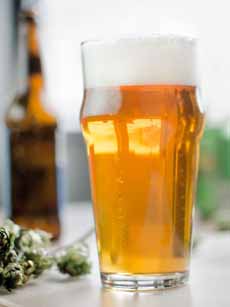
    [3] The end result of great hops: great beer (photo courtesy American Homebrewers Association).

     
    Today, craft brewers are so focused on the flavors yielded by hops from different terroirs* that they test a variety on new brews until they find what they’re looking for, and work to develop new strains that yield the characteristics they seek.

    Rogue Ales in Oregon, for example, one of America’s first microbreweries, grows 10 varieties of our proprietary hops. Some breweries grow their own hops, but most work with hop farmers to grow what they need.

    It’s no surprise that the global production of hops has risen, and more land is devoted to growing them (source).

    Here are some of the different types of hops grown in the U.S.

    You’ve been a good student, learning the history of hops and the part they play in brewing.

    You are now entitled to enjoy a cold one.
     
     
    < CHECK OUT OUR BEER GLOSSARY FOR THE DIFFERENT TYPES OF BEER >
     
     
    ________________

    *Terroir, pronounced tur-WAH, is the French word for soil, land or terrain. It can be loosely translated as “a sense of place,”the sum of the effects that the environment has on the creation of what is grown there. It has long been used in wine and coffee analysis to denote the special characteristics of soil, climate, weather, geology, aspect (how many hours it gets direct sunlight, e.g.) and altitude that give the grape or bean its individuality. The term is now being used, appropriately, to describe other agricultural products.


    Comments off


    © Copyright 2005-2026 Lifestyle Direct, Inc. All rights reserved. All images are copyrighted to their respective owners.