|
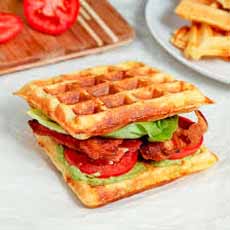
[1] BLT Wafflewich, a waffle sandwich (photo courtesy Elegant Affairs Caterers).
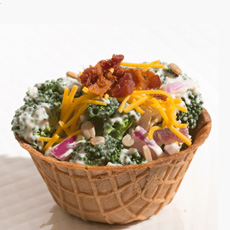
[2] Waffle cups aren’t just for sundaes. Use them to hold a crisp, healthy veggie salad (photo courtesy Joy Cone Company).
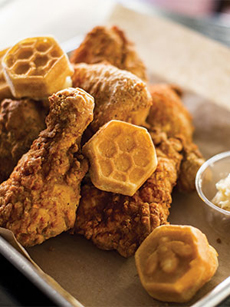
[3] You can take a gourmet approach to chicken and waffles with little touches like these (photo courtesy Honey Butter Fried Chicken | Chicago).
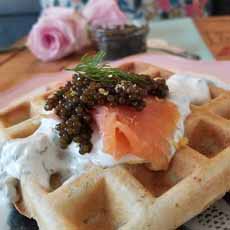
[4] Smoked salmon on top of scallion-dill Greek yogurt. If you’re flush, add some caviar, as they do at Tsar Nicoulai.
|
|
The ancestor of waffles dates back to the Neolithic age; the ancient Greeks invented the practice of cooking them between two hot metal plates.
But the waffle iron we know today, with the honeycomb pattern, was invented by some nameless hero metalsmith in the 13th century. Here’s the history of waffles.
National Waffle Day is August 24th, a good reason to enjoy a warm, fragrant, crusty waffle.
And a good reason to go beyond the original, simple waffle with maple syrup, to some of the more creative ideas below.
First, some tips from Krups, makers of small kitchen appliances including waffle makers, on how to make the best waffles.
WAFFLE RECIPE TIPS
1. Read the instruction manual before plugging in the waffle iron. Unless you use your waffle iron often, brush up. You need to know more beyond pushing the ON button.
2. Treat the batter gently. Don’t mix it too quickly or vigorously. Use a slow, even tempo to get the right consistency, or your waffles will be tough and chewy.
3. Don’t lift the lid while the waffles cook. As tempting as it may be to peek, it lets out steam needed to fully cook the waffle.
4. Don’t use cooking spray on your waffle iron. Instead, cover the surface lightly with vegetable oil, using a basting brush or a paper towel. You’ll get a better crust on the waffle; and perhaps more importantly, Your waffle iron will last much longer. Chemicals in the sprays can affect the surface over time, and cause even more sticking.
> BONUS: 10 MORE USES FOR YOUR WAFFLE IRON
THE DIFFERENT TYPES OF WAFFLES
American, Belgian, Brussels, Liege, Hong Kong, and more: If you’d like to know the different types of waffles, take a look.
WAFFLE RECIPE IDEAS
Some would say that any waffle is a good waffle, and we wouldn’t disagree. Others have never had anything beyond a plain waffle with maple or pecan syrup, butter and a side of bacon or sausage.
Let us provide some inspiration:
Look beyond plain wheat and buttermilk waffles to the more complex and interesting world of cornmeal, multigrain and whole wheat waffles.
Just as those breads are generally more interesting than plain white bread, you may find that you enjoy the waffles more.
Don’t add sugar to the batter: It’s added sugar you don’t need. You’re already topping a sweet waffle with syrup, jam, ice cream and fudge sauce or other sugar product that’s sweet enough, plus fruit.
The analogy is toast topped with jam versus cookies topped with jam—leave the sugar out. With savory waffles, definitely use a mix that has no sugar; or mix your own. It’s just flour, baking powder, water and a pinch of salt.
Get creative with toppings. Let your imagination be your guide. Our list below is only the beginning for whatever inspires you. Who says you won’t invent a great barbecue beef waffle, cornmeal guacamole waffle, kimchi and shredded pork waffle, nacho waffle, pickled tongue waffle or spicy poached egg waffle? (In fact, those all sound pretty good to us right now!)
|
SAVORY WAFFLE IDEAS FOR BREAKFAST, LUNCH & DINNER
These recipe ideas work for any meal:
BLT Waffle (photo #1): A regular or cornmeal waffle, topped with sliced romaine hearts, tomatoes and bacon. Serve with Caesar dressing (recipe.
Chicken & Waffles: A Southern classic. Generally made with a regular or buttermilk waffle, fried chicken breasts and brown gravy or sawmill gravy*. But we prefer it on a cornmeal waffle topped with a sliced grilled chicken breast, sauteed onions and peppers and a spicy gravy—add a teaspoon of Colman’s dry mustard to a basic white gravy recipe. Here are some “gourmet” chicken and waffles recipes (photo #3).
Ham & Cheese Waffles: A regular or whole grain waffle, with your favorite ham and cheese with dijon mustard or balsamic glaze. Or, mix balsamic glaze into regular mustard or mayonnaise)—recipe.
Malted Waffles:Malted Waffle: For a flavor lift, add 2-3 tablespoons of malt (the same kind you use for malted milk) to your basic recipe or mix.
Crunchy Nutty Waffles: Add your favorite nuts and seeds to the batter, or sprinkle them atop a plain waffle. Garnish with Greek or fruit yogurt.
Oatmeal-Nut Waffles: The “better for you waffle,” if there is such a thing, with whole grains and protein-packed nuts.
Serendipity Waffle
Serendipity Waffles: “Serendipity” is our word for leftovers. Anything you have in the fridge can be made into an exciting waffle topped with a sauce—cheese, tomato, mushroom or your favorite gravy.
Smoked Salmon Waffle (photo #4): We love a cornmeal waffle topped with smoked salmon, sour cream or crème fraîche, chopped chives (onion lovers can substitute chopped red onion) and dill.
South-Of-The-Border Waffle: A cornmeal waffle (white or blue corn) with a small dice of jalapeños in the batter. You can serve this with maple syrup for breakfast/brunch; and with queso (cheese sauce) or a queso-salsa blend for other meals.
Waffle Salad Bowls (photo #2): Waffle cups are not just for sundaes. Fill them with apple slaw, Asian chicken salad, broccoli carrot slaw, carrot and raisin salad, chicken salad with grapes, shrimp salad, etc. (recipes.
Waffle Stew: One of the oldest embellishments for waffles is to top them with your favorite stew. Garnish with grated cheese, chopped green onions and a dab of sour cream and/or a bit of mashed potatoes. Serve with a side of colorful mixed steamed vegetables and a big salad: a great way to make leftover stew special.
________________
*Sawmill gravy is a white gravy or béchamel sauce with added bits of mild sausage or chicken liver; the roux is made from meat drippings. It is also called country gravy. See the different types of gravy.
|
|
SAVORY WAFFLE TOPPINGS
Top savory waffles with:
Eggs: eggs and bacon, Eggs Benedict, sausage and eggs.
Cheese: blue cheese, goat cheese, melted mozzarella or other melting cheese.
Chicken: fried, pulled barbecue.
Fish/seafood: caviar, seafood (crab, lobster, scallops, shrimp), smoked salmon and other smoked fish, with a fresh dill garnish.
Pizza waffles: mozzarella, ricotta, marinara and favorite toppings (don’t forget the anchovies!).
Paté: garnished with cornichons, redcurrant jelly, fig jam or cherry preserves.
Tex-Mex: avocado, black beans, black olives, corn, crema (sour cream), guacamole, red onion, salsa, shredded or crumbled cheese.
Sandwich fixings: BLT, ham and cheese.
Thanksgiving fixings: cranberry sauce, stuffing, sweet potatoes, turkey and gravy.
Vegetable: asparagus with hollandaise sauce; mushrooms, spinach and Mornay sauce (béchamel with gruyère).
SWEET WAFFLES FOR BREAKFAST & LUNCH
Peanut Butter & Jelly Waffles: Another great base for PB&J. Here’s the recipe.
Trail Mix Waffles: Top with nuts, dried fruits, coconut and granola.
Tricolor Chocolate Chip Waffles: Update the standard with dark, milk and white (or butterscotch, cappuccino or PB chips).
Wholesome Waffles: Top whole-grain waffles with nonfat yogurt, fresh fruit and nuts or seeds (chia, flax, pumpkin).
SWEET DESSERT WAFFLES
Candied Pecan Waffles: Top waffles with Candy roasted pecans, chopped pecans and whipped cream, syrup optional. Alternatively, you can mix the chopped nuts into the waffle batter.
Cheesecake Waffles: Combine two treats in one recipe.
Chocolate Waffles: Here’s a recipe.
Hot Fudge Sundae Waffles: Serve with ice cream, top-quality fudge sauce, strawberries, nuts and whipped cream.
Key Lime Mousse Waffles: Here’s a recipe for any citrus mousse you desire.
Lemon Berry Waffles: Top with lemon curd (or other fruit curd) and seasonal berries. Garnish with whipped cream and fruit sauce (either puréed berries or a fruit syrup).
Orange Blossom Waffles: Add mangoes, mixed berries, and nutmeg cream. Here’s the recipe.
Sticky Bun Sundaes: Top with cinnamon or vanilla ice cream, raisins and walnuts, garnished with a sprinkling of cinnamon and brown sugar (mixed). Add a very light drizzle of caramel sauce and whipped cream.
SWEET WAFFLE TOPPINGS
Candy: brittle, toffee chips.
Chocolate: chips, ice cream, syrup, shaved chocolate.
Cream cheese: with chocolate chips, jam.
Ice cream or frozen yogurt: with sundae toppings.
Fall & winter 1: raisins or other dried fruits, sautéed apples or bananas, maple syrup.
Fall & winter 2: pumpkin pie filling, whipped cream, caramelized nuts and nutmeg garnish.
|
|
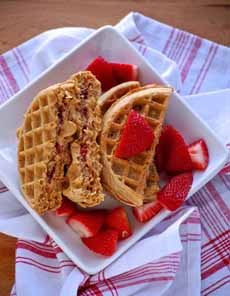
[5] For lunch: a PB&J wafflewich. Here’s the recipe from Cait’s Plate.
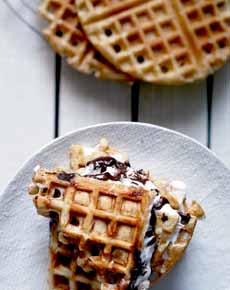
[6] For dessert: S’mores waffles. Here’s the recipe from Posie Harwood for King Arthur Flour).
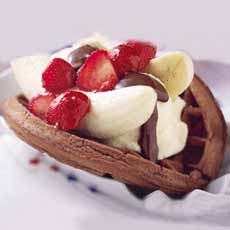
[7] Who needs a banana split dish? Roll the ingredients in a waffle. Here’s the recipe from Krusteaz).
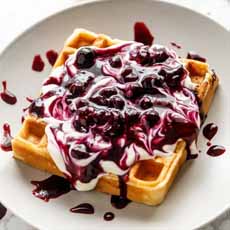
[8] Blueberry cheesecake waffles. Here’s the recipe from Cafe Delites.
|
|
Fruit: seasonal fresh fruit, caramelized fruit, fruit butter, fruit chutney, fruit curd, marmalade or preserves with whipped cream.
Fruit yogurt: with fresh fruit and fruit syrup or cinnamon syrup.
Sweet spreads: nut butter, Nutella, with coconut or honey and whipped cream.
|
|