THE NIBBLE BLOG: Products, Recipes & Trends In Specialty Foods


Also visit our main website, TheNibble.com.

RECIPE: Fruit Sushi For National Sushi Day

June 18th is National Sushi Day.

Creative cooks have taken the sushi concept beyond fish and vegetables to sweet versions like fruit sushi and candy sushi. There are also cooked meat sushi and poultry sushi, and beef tartare sushi).

Today, how about some fruit sushi?
 
 
RECIPE: FRUIT SUSHI

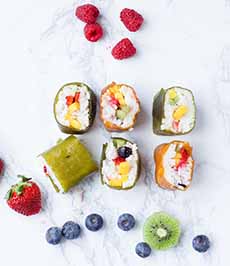
This recipe (photo #1), from the Blueberry Council, uses sushi rice plus avocado (yes, it’s a fruit), peaches and blueberries for an explosion of fruit flavor.

Of course, you can substitute any fruits you like.

The rice is sweetened with coconut milk, sugar and vanilla extract.

You can use your fingers to pick up the pieces; but as with conventional sushi, you may have more fun if you pick them up with chopsticks to dip in the blueberry sauce.
 
Ingredients

  • ¾ cup short grain rice
  • 1¼ cups water
  • 2 tablespoons sugar
  • Pinch salt
  • ½ cup coconut milk
  • ½ teaspoon vanilla extract
  • ½ cup blueberries
  • ½ avocado, cut into 2 inch batons
  • 1 small peach, apple or plum cut into small cubes
  •  
    For The Dipping Sauce

  • 1 cup frozen blueberries
  • 1/3 cup vanilla yogurt
  • 1 tablespoon honey
  •  
    Preparation

    1. MAKE the dipping sauce. Combine the blueberries, yogurt and honey in a blender. Purée until smooth.

    2. MAKE the rice. In a medium pot over medium-low heat, combine the rice, water, sugar and salt. Cook about 15 minutes until rice has absorbed the water and is cooked through, but still firm. Stir in the coconut milk and vanilla; the mixture should be thick. Let cool.

    3. SET a piece of parchment paper on a surface. With wet hands, pat half of the rice into a 7 x 5 inch rectangle. Lay half of the blueberries along the long end of the rectangle. Add half of the avocado and apple slices.

    4. ROLL up the rice in the parchment to enclose the fruit while forming a long tight roll or log. Unroll the parchment; cut the rice roll crosswise into 1 inch pieces to make “sushi rolls.”

    6. REPEAT with the remaining rice and fruit.


    MORE DESSERT SUSHI RECIPES

  • Banana Split Sushi
  • Grapefruit Sushi
  • Hostess Twinkie Sushi
  • Peanut Butter & Sushi Rolls
  •  


    [1] Fruit sushi with blueberry dipping sauce (recipe and photo © Blueberry Council).


    [2] Fruit sushi with Roll Ups wrap. Here’s the recipe from Oh So Delicioso (photo © Oh So Delicioso).


    [3] This candy sushi has a soft candy center surrounded by Rice Krispie Treat-style “rice” and fruit roll-up “seaweed.” Here’s the recipe from TipBuzz (photo © TipBuzz).


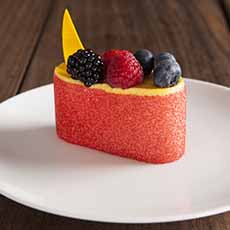
    [4] A fruit and sponge cake gunkan maki (boat sushi) in a roll-up (photo © L’Adresse Restaurant | NYC


    Comments off

    TIP OF THE DAY: Uses For Edamame


    [1] Most edamame is eaten like this: squeezed from the pod (photo © Sun Basket).


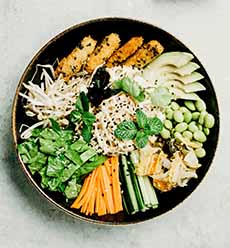
    [2] Add edamame to grain bowls, green salads, protein salads and salad bowls (photo © Cottonbro | Pexels).


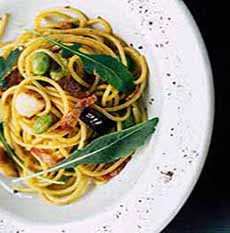
    [3] Add edamame to pasta and pasta salads (photo © Mgg Vitchakorn | Unsplash).


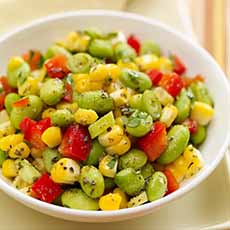
    [4] Edamame and corn salad with oregano vinaigrette. Here’s the recipe from McCormick.


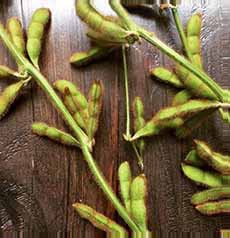
    [6] Edamame on its twig-like stem, from which it gets its name (photo © Vicia Restaurant | NYC).


    When we go to a Japanese restaurant, we always order an appetizer of edamame (eh-duh-MA-may—photo #1), which are baby soy beans.

    The name is Japanese for “twig bean” (eda = twig + mame = bean), referring to young soybeans that are harvested along on the twig/stem (photo #5). You can find them served this way in Japan.

    With the exception of a few ultra-premium Japanese restaurants that import them on the twig, you’ll see the “mame” but not the “eda.”

    The green soybeans in the pod are picked prior to ripening (when they turn into the familiar beige soybean color).

    Filling and rich in vitamins and minerals, a cup of shelled edamame has 189 calories—a better choice than dumplings, for sure.

    Edamame are the only vegetable that offers a complete protein profile, equal to both meat and eggs in its protein content. A bonus: They’re not expensive.

    Today they can be found nationwide in the frozen vegetables aisle of supermarkets. And the green jewel-like bites have quite a few uses.
     
     
    USES FOR EDAMAME

    Edamame For Breakfast

  • Garnish for eggs
  • Plain yogurt (add a pinch of sea salt or garlic salt)
  • Omelet or a frittata
  •  
    Edamame For Lunch

  • Chicken, egg, tuna/seafood salad
  • Cole slaw, potato salad, macaroni salad and other pasta salad
  • Corn salad and edamame with red onion and halved cherry tomatoes
  • Falafel
  • Fish tacos
  • Sandwiches and wraps
  • Soup garnish (or purée into soup)
  • Substitute for croutons or fried noodles, nuts
  • Vegetarian pizza
  • Veggie burgers
  •  
    Edamame For Dinner

  • Edamame salads (try with feta and dried cranberries, broccoli and cashews, cucumbers with ginger-soy vinaigrette, )
  • Edamame succotash
  • Garnish
  • Green salads and cabbage salads
  • Grain dishes, including risotto
  • Grilled fish
  • Pasta and zucchini noodles
  • Puréed as a side
  • Stir-frys and sautes
  •  
    Edamame For Snacking

  • Dip puréed with garlic, EVOO and basil or cilantro
  • Dip puréed with yogurt or yogurt-mayo
  • Guacamole puréed with edamame
  • Hummus
  •  
    MORE ABOUT EDAMAME

  • Edamame Nutrition
  • Edamame Recipes
  •  
    Recipes

  • Edamame & Corn Salad
  • Edamame Dips, Salads, Sides
  • Edamame Teriyaki
  • Asian Grilled Salmon With Edamame
  •  


    Comments off

    TIP OF THE DAY: Red, White & Blue Iced Tea For July 4th

    Today’s tip comes via one of our favorite artisan tea blenders, Tay Tea.

    It’s blue tea, an herbal tea from Thailand that made its way here a few years ago. It still remains largely under the radar, except at artisan tea shops and some spas.

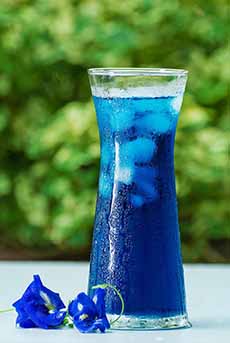
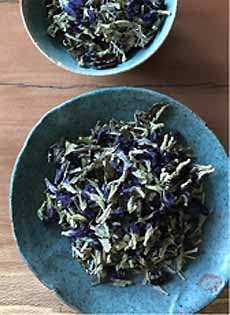
    The blue tea is steeped from the butterfly pea flower (photos #6 and #7). It can be served hot or iced (we vote for iced tea—the recipe is below).

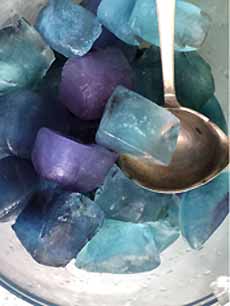
    You can use the same blue tea to make colored ice cubes for clear soft drinks or spirits (photo #4) they will add the flavor of the tea). You can add citrus juice to color the tea purple (photos #4 and #5 ).

    Blue tea is naturally caffeine free and tastes lightly floral, with a hint of earthiness.

    Adding lemon, lime or orange juice turns the brew purple. Both blue and purple colors are completely natural.

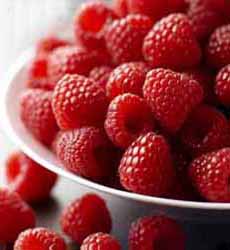
    For July 4th festivities, serve blue iced tea with regular (white) ice cubes and garnish with red raspberries. Or, swirl in some half-and-half to make the blue latte in photo #3.
     
     
    WHAT IS BLUE TEA?

    Blue tea has been used for centuries in Southeast Asia as a caffeine-free herbal beverage, as well as a plant-based food and clothing dye.

    It is brewed from the flower of the butterfly pea plant, commonly known as blue pea or butterfly pea (photo #7).

    The plant is native to equatorial Asia, and grows in India, Indonesia, Malaysia, Myanmar, the Philippines and Thailand (the sourcer of Tay Tea’s flowers).

    It is also known as Asian pigeonwings, bluebell vine, blue pea, butterfly pea, cordofan pea and Darwin pea [source].

    The plant species belongs to the Fabaceae family, commonly known as the legume, pea, or bean family. The family includes such familiar foods as beans, carob, chickpeas, licorice, peanuts and green peas.

    Now for the racy part: The botanical name of the butterfly pea plant is Clitoria ternatea. The botanist who named it saw that the flower had the shape of female genitalia (photo #7), and gave the genus the Latin name Clitoria, from clitoris.
     
     
    TAY TEA’S BLUE TEA

    Tay Tea makes a blue tea blend called Azul (Spanish for blue), a fragrant, lemony blend of three botanicals that’s more flavorful than plain blue tea.

    It includes:

  • Butterfly pea flowers from Thailand
  • Lemon verbena
  • Lemongrass
  •  
    YOU CAN PURCHASE IT HERE.

    Packed with antioxidants and vitamin C, blue tea is good for you and keeps you colorfully hydrated.

    Here are the health benefits of blue tea.

    Tay Tea’s recipe follows.
     

    RECIPE: BLUE TEA OR PURPLE TEA, ICED OR HOT

    Ingredients For 5 Cups

  • 2 tablespoons blue tea/Azul tea blend
  • For purple tea: 1/2 cup lemon, lime or orange juice
  • Ice (you can make blue ice cubes [photo #5] with more tea)
  • Garnish: citrus wheels for a pitcher, or wedges for a glass
  •  
    Preparation

    1. BOIL five cups of water and add to a heat-proof pitcher—ideally glass, to show off the color. Add two teaspoons of tea and let stand 10 minutes.

    2. STRAIN out the loose tea leaves and pour the tea back into the pitcher. Let it cool and refrigerate it, or try it hot.

    3. FOR PURPLE TEA: Add the citrus juice and watch the tea turn from bright blue to violet. Add a few wheels of citrus to the pitcher, and/or garnish the glasses with individual wedges.

    4. POUR over ice to serve.
     
     
    TEA NAME TRIVIA

    The tea plant, Camellia sinensis, originated in China. The word “tea” comes from there as well.

    (Note that herbal teas are not Camellia sinensis, but bear the botanical names of each individual plant).

    The Dutch traders who first brought tea to Europe in the early 1600s purchased it from tea traders in the port of Amoy (Xiamen) in the Fujian province.

    There are many dialects in China. In the Amoy dialect, tea was translated as te, pronounced tay.

    This pronunciation was used by the Dutch, and was the name by which the beverage was introduced to Europe.

    The French called it thé (pronounced tay); and it became te, pronounced tay, in Danish, Hungarian, Italian, Norwegian and Spanish.

    The “tee” pronunciation is found in English tea and the German thee.

    In those countries where the tea trade was mainly via the caravan routes that traveled overland, from China to the West, it’s the Mandarin Chinese cha that is the common root:

    Cha in Hindi, Japanese and Persian; ja in Tibetan, chai in Russian, chay in Turkish and shai in Arabic.
     
     
    TEA HOLIDAYS

  • January is National Hot Tea Month
  • January 12th is National Hot Tea Day
  • June is National Iced Tea Month
  • June 10th is National Iced Tea Day
  • British National Tea Day is April 21st
  •  
     
    > THE HISTORY OF TEA
     
     
    > KNOW YOUR TEA: A GLOSSARY OF TEA TERMS


    [1] Blue tea is tasty, pretty, and has a lot of health benefits (photo © Majestic Herbs).

    Raspberries
    [2] Raspberries make it red, white and blue (photo © Driscoll’s).


    [3] How about an iced blue latte? Here’s the recipe from Oh How Civilized. Add a cocktail pick of red berries for a red, white and blue drink (photo © Oh How Civilized).

    Blue Tea
    [4] Blue herbal tea turns purple by adding citrus juice (photos #4, #5, #6 © Tay Tea).

    Blue & Purple Ice Cubes
    [5] Turn the tea into colorful ice cubes.

    Butterfly Pea Flower
    [7] Dried butterfly pea flowers.

    Blue Tea
    [7] The butterfly pea flower (photo courtesy Indiamart).


    Comments off


    © Copyright 2005-2026 Lifestyle Direct, Inc. All rights reserved. All images are copyrighted to their respective owners.