|
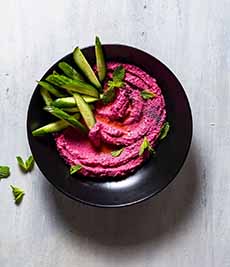
[1] Beet hummus, a passionate red purple for Spring, Easter, Mother’s Day, Christmas and Valentine’s Day (photo © California Olive Ranch).

[2] Add some equally bright crudites: colored cauliflower florets, multicolor cherry tomatoes, and crinkle-cut carrots, below (photo © Sid Wainer).
[3] Instead of buying baby carrots which often have little flavor, buy standard carrots and cut them with your crinkle cutter (photo © Ardo).
[4] Baby beets (photo © Heather Gill | Unsplash).
[5] Red, orange, yellow (golden), and striped chioggia beets (photo © Cibo e Vino | Facebook).
[6] White beets (photo © Silk Road Tavern | New York City [now closed]).
[7] Not all beets are round. Round became the shape of preference, but you can find heirloom varieties like these Forono beets (photo © Good Eggs).
|
|
For National Snack Day (March 4th), here’s an oh-so-healthy snack.
It’s a spin on hummus from California Olive Ranch, which adapted it from a Bon Appetit recipe.
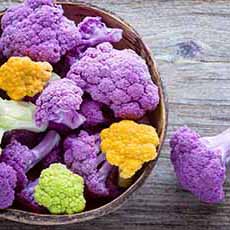
For a spring and Easter treat, add multi-colored cauliflower florets (photo #2) and other bright veggies like carrots (photo #3) and multi-colored cherry tomatoes.
National Hummus Day is May 13th. National Beet Day? None yet!
> The history of hummus.
RECIPE: BEET HUMMUS
While we’ve made other beet hummus recipes, this one has something special: ricotta, which gives the hummus a special texture and flavor (photo #1).
If you’re not keen on beets, here’s a conventional hummus recipe with ricotta.
You can also try the recipe with soft goat cheese instead of ricotta.
Ingredients
1 large red beet, about 6 ounces (baseball size)
1 can chickpeas, rinsed and drained
⅓ cup tahini
¼ cup fresh lemon juice
¼ cup ricotta
1 garlic clove, finely grated
1 teaspoon kosher salt
Freshly ground black pepper, to taste
¼ teaspoon ground coriander
Garnish: mint leaves, extra virgin olive oil
Preparation
1. PREHEAT the oven to 425°F. Wrap the beet tightly in foil and place it on a foil-lined rimmed baking sheet.
2. ROAST until the tines of a fork slide easily into the center of the beet, 60–70 minutes. Remove from the oven and let sit until cool enough to handle. Meanwhile…
3. BLEND the chickpeas, tahini, lemon juice, ricotta, garlic, salt,, pepper, and coriander in a food processor until smooth. When the beet is cool enough to handle…
4.RUB beet with a paper towel to remove the skin. It should slip off easily; scrub your hands under running water with soap or cleanser to remove any staining.
5. TRIM the root end and cut the beet into 8 pieces; add them to the food processor. Process until mixture is smooth, about 2 minutes.
6. TASTE and season with more salt, as desired.
7. TRANSFER the hummus to a serving bowl. Garnish with the mint, and drizzle with extra virgin olive oil.
THE HISTORY OF BEETS
The ancestor of the modern beet (Beta vulgaris) is the wild beet or sea beet (Beta maritima) which grows on the coasts of Eurasia.
Initially, the root (it looks like a bulb, but is a taproot†—photo #4) was not eaten. The original root was long and thin, like a skinny carrot or parsnip. The round root we enjoy today was bred over millennia.
Beets were domesticated in the ancient Middle East, primarily for their greens (photo #5), and were grown by the Ancient Egyptians, Greeks, and Romans.
The oldest archeological proof that beets were used in ancient times has been found in the Neolithic* site of Aartswoud in the Netherlands, and in the Saqqara pyramid at Thebes, Egypt, which dates to the third millennium B.C.E.
Assyrian texts that say that beetroots were growing in the Hanging Gardens of Babylon in the 800 B.C.E.; but as Vegetable Facts points out, we still don’t know if Hanging Gardens ever existed.
But at least the point is made that Mesopotamia knew about beetroot at that time.
Ancient Greeks cultivated beetroot around 300 B.C.E. Still, only the leaves were eaten; although Hippocrates (c. 460 B.C.E. to c. 370 B.C.E.) used leaves of beetroot for binding and dressing wounds.
The ancient Romans were among the first to cultivate beets and eat the roots as well. The tribes that invaded Rome after the fall carried beets throughout northern Europe. There, they were initially used as animal fodder and later for human consumption [source].
Romans, on the other hand, ate the roots, but mainly for medicinal purposes: as a laxative and to cure fever.
In the first century C.E. in Rome, De Re Coquinaria, a cookbook written by the Roman gourmet Apicius (believed to be a fictitious name and a group effort), featured beetroot recipes from broths and to salads with mustard, oil and vinegar.
The Hebrew Talmud, written in 4th and 5th centuries C.E., advises eating beetroot, among other things, for longer life.
In the Middle Ages, beetroot was used as a treatment for a variety of conditions, especially illnesses relating to digestion and the blood.
Bartolomeo Platina, an Italian Renaissance writer and gastronomist, recommended taking beetroot when eating garlic to nullify the effects of garlic-breath [source].
Consumption of the beetroot itself did not occur until the 1800s when its fiber benefits became known. The discovery of the beet’s high sugar content also led to its increased agricultural value.
Modern Beets
The beets we know today, with globular roots, appeared in Europe and the 16th and 17th centuries.
While beets as a crop became more popular in the 16th century, they really became prominent in the 19th century, when it was discovered that beets were a concentrated source of sugar.
In the Victorian era (1837 to 1901), beetroot was used to add color to an otherwise colorless (i.e. beige) diet, as well as a sweet ingredient in desserts.
Industrialization allowed for easier preparation and preservation of vegetables, so beetroot in jars and cans became more available—plain and pickled.
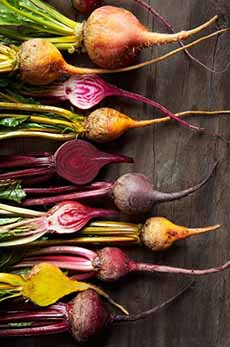
Today, the most common variant of beetroot is round and deep red, but beets can also be orange, purple, golden (orange skin), white, and even red-and-white circular stripes, the chioggia beet, pronounced kee-OH-juh and also known as candy stripe beets and bulls eye beets (photos #5 and #6).
These other colors were developed from mutations.
Golden beets were known from earlier times, but few farmers grew them due to the greater demand for red varieties. One had to search to find them in Europe as in the U.S.
In the 1940s, the U.S.-based Burpee Seed Company developed a variety of golden beets for commercial sale. They’re still hard to find, but farmers’ markets are a good bet.
Or grow your own! Beets are one of the easiest vegetables you can grow. They’re almost never troubled by pests or disease. They don’t need staking, pruning, or fussing. Just sow the seeds and let the plants grow for about 6-8 weeks [source].
What we call simply “beet” is known as beetroot in England.
Now that you know the history of beets, how about…
|