|

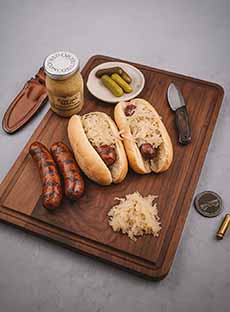
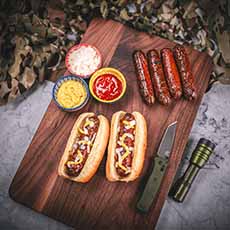
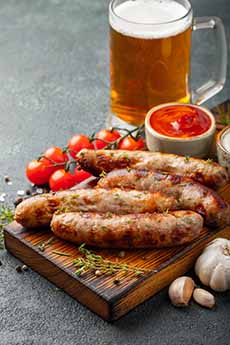
[1] Under the sauerkraut are bacon-cheese brats (photos #1 and #3 © KC Cattle Company).
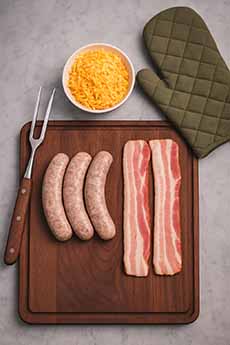
[2] Not your typical brat filling. In addition to bacon and cheddar, the beef is Wagyu (photo by A.I.).
[3] The company’s Wagyu hot dogs were voted “best in the world” by Bon Appetit magazine††.
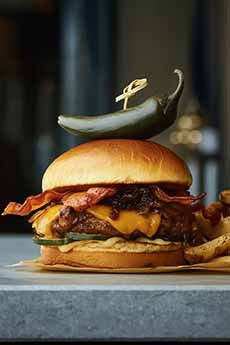
[4] The new brats were inspired by the popularity of the bacon cheeseburger (photo © Dave Spataro | Aussie Grill).
[5] In the U.S., many people cook their brats in beer, a custom that did not originate in Germany. as well as having a glass along side them.
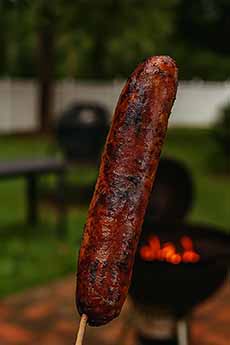
[6] Food fun: brat-on-a-stick (photo by A.I.).
[7] It might look like “brat paella” at first glance, but it’s brats and boiled potatoes on a variation of German potato salad, with bacon, onions, and a creamy vinegar-based dressing (photo by Mister Pitt | Pixabay).
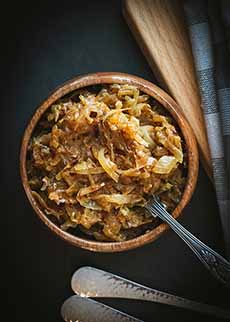
[8] Caramelized onions are delicious on brats. You can even combine them with chopped raw onions (photos #8 and #9 © Kelsey Todd | Unsplash).
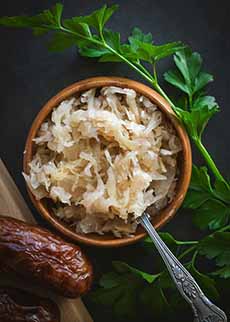
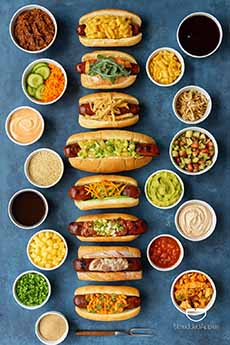
[9] Saurkraut is a popular topping for brats, along with mustard. But check out all the other faves in the footnote‡ below.
[10] A build-a-brat bar from Felton Angus Beef. Here’s how they do it (photo © Felton Angus Beef).
[11] An even more splendid DIY bar from Shared Appetite. Here’s how (photo © Shared Appetite).
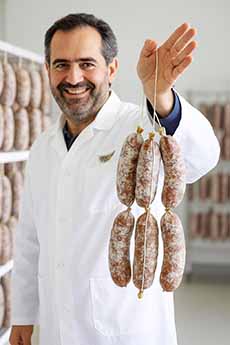
[12] Artisan sausage and salami are often still sold on the string. The white coating on artisan salami is beneficial mold, Penicillium nalgiovense or Penicillium candidum, that is intentionally applied during the curing process. It forms a protective barrier that prevents harmful bacteria from penetrating the salami, regulates moisture loss, and contributes to the complex, earthy flavor and textures that distinguish artisan products. It is completely safe to eat and has a slightly earthy, mushroom-like taste (photo of Master Artisan Cristian Creminelli © Creminelli Fine Meats).
|
|
Few will argue that a bacon cheeseburger (photo #4) ranks #2 on the list of America’s favorite cheeseburgers, unless you dispute that it should, in fact, be #1. (The plain cheeseburger is #1, the rest of the list is in the footnote* below.)
That juicy beef burger is topped with cheese and crispy bacon. But what if the cheese and bacon were tucked inside…bratwurst? And the brat was made with wagyu beef?
What if there were a hot dog made the same way? There is—or more precisely, it’s bratwurst (photo #1).
That’s what’s on offer from KC Cattle Company, a small veteran-owned-and-staffed ranch specializing in ultra-premium American Wagyu beef.
Their classic Wagyu hot dogs were voted the best in the world by the editors of Food & Wine Magazine††, so the brats arrive on the scene with plenty of street cred!
KC Cattle’s Brats are made with beautifully marbled 100% American Wagyu beef (no hormones or antibiotics) and stuffed with Cheddar and smoky bacon for a wondrous alternative to the cheeseburger.
Backyard grilling meets gourmet indulgence, delivering bold, juicy flavor. They come in a one-pound four pack for $18.99 and ship all over the U.S.
> Get your Wagyu Bacon Cheddar Bratwurst here.
> The differences between bratwurst and hot dogs follow.
> The history of bratwurst is below.
> So are great bratwurst-condiment pairings.
> And the year’s 16 sausage holidays!
> Food 101: The difference between rolls and buns. (Brats, burgers, hot dogs, and all sandwiches go on rolls, not buns.)
THE DIFFERENCES BETWEEN BRATWURST & HOT DOGS (FRANKFURTERS)
Bratwurst
Both bratwurst and frankfurters are types of German sausage‡‡. The original frankfurter is far removed from modern hog dogs, as you’ll see below. (It’s what happens when big American food companies remake a product for more profit.)
Bratwurst is essentially fresh sausage, made from coarsely-ground pork (sometimes mixed with beef or veal). They must be cooked before consuming. There is minimal processing and fewer additives than you’ll find in a hot dog. If you like texture, they offer much more than the “puréed” filling in hot dogs.
Brats are thicker and longer than hot dogs—a more substantial meal or snack. They have a richer, more complex “meaty” flavor with more prominent seasonings (garlic, ginger, marjoram, nutmeg).
Finally, bratwurst must be properly cooked through. They are often grilled or pan-fried, although a popular American tradition is to simmer them in beer first, often with onions.
Hot Dogs
Hot dogs are typically made from a mixture of meats (typically beef, pork, chicken, and turkey) that are finely ground into a smooth paste and mixed with fillers, preservatives, and various additives. They have a mild, processed taste.
Since they’re precooked, so they just need reheating (or can be eaten as is from the fridge—especially if you’re a fraternity guy).
Hot dogs can be boiled, grilled, or microwaved.
HOW DID THE GERMAN FRANKFURTER EVOLVE INTO THE PROCESSED FRANK?
While predecessors of the frankfurter originated in Frankfurt in the 13th century as “frankfurter würstchen,” traditionally made with pork and spices, one origin story credits a butcher from the German city of Coburg, in Bavaria, Johann Georghehner, with the modern version.
He crafted a thinner sausage, the slender “dachshund,” or “little dog” sausage, in the late 1600s, and later brought it to Frankfurt to promote it.
It was a classic sausage eaten with a knife and fork, no bun. That was an American addition (the history of the hot dog).
It’s recorded that from the 1860s-1880s, on New York City’s Bowery, German immigrants sold traditional frankfurter sausages from pushcarts.
In 1871, Charles Feltman, a baker who immigrated from Germany, launched the first Coney Island hot dog stand. He sold 3,684 “dachshund sausages” in a milk roll during his first year: an easy grab-and-go food for visitors there for recreation.
The transformation from the authentic German frankfurter to highly-processed American hot dog happened gradually over several decades, with the most dramatic shift occurring in the early 1900s.
Late 1800s-Early 1900s: The major shift in hot dog quality began with industrial meat processing and the rise of giant meat processing companies such as Chicago*-based Armour and Swift.
Sausages became cheap industrial products. Hot dogs, in particular, were made of the unused parts that were left over, including non-desirable parts like the intestines. Big factories processed millions of animals a year.
The nickel hot dog became omnipresent street food in Chicago. Cheap and filling, yet always suspect of being made of “mystery meat” (long before the advent of food labeling‡‡‡), hot dogs became notorious in the rumor mill for their questionable ingredients.
The hot dog had evolved from a raw sausage to processed meat product made by mixing chopped meat with various curing ingredients, flavorings, and colorants. The slurry or meat emulsion, as the result was called, was then stuffed into a long casing, typical a cleaned animal intestine, and cooked.
By the early 1900s, the German Frankfurter had been industrialized out of existence. The economic pressures of mass production, the need for shelf stability (they last much longer in the fridge, due to the precooking), and the desire for cheap food transformed it into the heavily processed junk† food we know today.
It’s a classic example of how American industrial food production prioritized cost, convenience, and preservation over traditional quality and ingredients.
Conclusion: If you’re a lover of hot dogs yet prefer less adulterated foods, choose organic dogs, switch to brats, and and even then eat them only occasionally.
Sausages were sold on strings until the 1950s.
Sausages, including the first wave of American frankfurters/hot dogs, were traditionally sold on strings before the advent of modern plastic film packaging. Some artisan producers still use this technique (photo #12).
In traditional European butcher shops, and subsequently in early American butcher shops, sausages were linked together in long chains and hung on strings or hooks. This served several practical purposes:
Hanging allowed air circulation around the sausages, helping them cure and stay fresh. It was also an efficient use of shop space.
Customers could buy exactly the number of many links they wanted. The butcher would cut the string between the links.
1920s-1940s: Hot dogs were still commonly sold loose from butcher cases or in simple paper wrapping
1950s: The rise of supermarkets and self-service shopping created demand for prepackaged foods. While cellophane had created in the early 1900s, plastic packaging technology and vacuum sealing advanced significantly in the 1950s-1960s, and became the standard packaging.
And now, the answer to the $64,000 question:
Why are hot dogs typically sold in packages of 10, while rolls come in packs of 8?
Hot dog manufacturers realized that 10 franks, weighing 1.6 ounces each, totaled one pound.
Rolls most often come eight to the pack, on the other hand, because they are baked in pans designed to hold eight rolls (be they hot dog or any other kind). While baking pans now come in configurations that allow baking 10 or 12 at a time, the eight-roll pan remains the most popular. Why?
Call it industry inertia: Both industries developed their packaging standards independently based on their own manufacturing logic. Neither has an incentive to change.
But there is a way to even things out: Buy 4 packs of hot dogs and 5 packs of buns to get an even 40 of each. What you don’t need immediately, you can freeze.
THE HISTORY OF BRATWURST
While documentation of sausages—ground meat and spices in casings—can be found as early as 228 C.E. in Roman cuisine, the first documented evidence of bratwurst dates to 1313 in the Franconian city of Nuremberg, Germany (that’s a tradition of more than 700 years).
However, different regions developed their own versions. Bratwurst in the city of Coburg in Franconia was first documented in 1498.
The original recipes were quite specific. For example, the Coburg bratwurst was made from coarse-ground meat: pork with a minimum of 15% beef, seasoned with only salt, pepper, nutmeg, and lemon zest, and bound with raw egg. It was 25 centimeters (about 10 inches) long.
Editor’s Note: At that time, “Germany” did not exist. The Holy Roman Empire comprised the entirety of the modern countries of Germany, Czechia, Austria, the Netherlands, Belgium, Switzerland, Slovenia, and Luxembourg, most of north-central Italy, and large parts of modern-day east France and west Poland. The modern nation of Germany came into being in 1871, when Otto von Bismarck unified the various German states into the German Empire.
The name “bratwurst” can be traced back to the Old High German words “brat,” meaning without waste, and “wurst,” which means sausage.
And that’s exactly what bratwursts and all sausages are: sausages made using scraps of beef, pork, and veal that would otherwise go to waste (or at least, fed to the animals).
Editor’s Note: Bratwurst is just one style of German sausage. Estimates range from 1,200 to 1,500 distinct types, differing in ingredients, textures, spices, and cooking methods. See the footnote‡‡ for the major categories.
Different regions developed their own styles. Each area prized its own flavoring, meat blend, and preparation method. For example:
Coburger Bratwurst includes lemon zest and is traditionally grilled over pine cones.
Fränkische Bratwurst has a coarser texture and is often unsmoked.
Nürnberger Bratwurst: are small, thin pork sausages, seasoned with marjoram.
Thüringer Rostbratwurst are longer and spicier, made with marjoram, caraway, and garlic.
By 1432, German cities had developed strict guidelines as to the creation of quality bratwursts. Fines were levied against butchers who did not comply.
Bratwurst became German street food, beer garden fare, and festival cuisine, as well as home fare. It remains symbolic of German heritage and comfort food, and became a “food ambassador” across Europe and North America.
Brats In America
German immigrants brought bratwurst recipes to the U.S. in the 19th century. In the midwest, they became a beloved part of cookouts and sporting events.
Traditional German bratwurst preparation focuses on grilling over charcoal or wood, or pan-frying. This was seen as sufficient to bring out the bratwurst’s flavor—with a beer to drink with it.
The American brat tradition includes beer brats—bratwurst simmered in beer before grilling. The custom emerged in Wisconsin and other areas with large German immigrant populations.
Beer brats became a way for German Americans to combine the two beloved foods while adding moisture, flavor, and a bit of fun.
Often, the bratwurst are simmered in beer with onions before or after grilling (sometimes both), enhancing juiciness and depth of flavor.
Festivals like the Bratwurst Festival in Bucyrus, Ohio and Sheboygan Brat Days in Wisconsin continue to celebrate the sausage’s cultural importance.
THE YEAR’S 16 SAUSAGE HOLIDAYS
February, 2nd Full Week: National Kraut & Frankfurter Week
March, 3rd Saturday: National Corn Dog Day‡‡‡‡
April 14: National Sausage Pizza Day
April 24: National Pigs In A Blanket Day
June 5: National Sausage Roll Day
July: National Hot Dog Month
July 13: National Beans ‘N’ Franks Day
July, 3rd Wednesday: National Hot Dog Day
July, last Thursday: National Chili Dog Day
August, 1st Saturday: National Mustard Day
August 16: National Bratwurst Day
September 7: National Salami Day
September 20: National Pepperoni Pizza Day
September 203: National Snack Stick Day
October: National Sausage Month
October, 2nd Wednesday: National Sauerkraut Day
October 11: National Sausage Pizza Day
________________
*Cheeseburger rankings based on A.I. search: (1) Classic Cheeseburger, (2) Bacon Cheeseburger, (3) BBQ Bacon Cheeseburger, (4) Double Cheeseburger, (5) Mushroom Swiss Burger, (6) BBQ Cheeseburger (7) Jalapeño Cheeseburger, (8) Blue Cheese Burger, (9) Patty Melt (technically a burger-sandwich hybrid), and (10) Avocado Cheeseburger.
The rankings can vary by region, restaurant type (fast food vs. casual dining), and demographic preferences, but the top 3-4 spots are pretty consistent across most surveys and industry reports.
**“Hog Butcher for the World” is the famous opening line from Carl Sandburg’s poem Chicago, describing the city’s role as the center of America’s meatpacking industry in the late 19th and early 20th centuries. The Union Stock Yards, a one-square-mile area on the South Side, was the heart of the industry, processing vast quantities of livestock. The gate is all that remains today.
|
An indelible image for anyone who has read Upton Sinclair’s The Jungle, an expose of Chicago’s meat-packing business, is that of rats, dung, and less desirable elements being incorporated into the meat, and workers being turned into lard:
“…and as for the other men, who worked in tank rooms full of steam, and in some of which there were open vats near the level of the floor, their peculiar trouble was that they fell into the vats; and when they were fished out, there was never enough of them left to be worth exhibiting—sometimes they would be overlooked for days, till all but the bones of them had gone out to the world as Durham’s Pure Leaf Lard!”
†Hot dogs are widely considered junk food by nutrition experts and health organizations. They fall into the “highly processed foods” category, “typically low in nutritional content…high in calories, fat, and sodium, and contain very little vitamins and minerals.”
None of these is heart-healthy, and The World Cancer Research Fund advises that we “eat little, if any, processed meat due to the associated risk of colorectal cancer.”
Hot dogs contain fillers, preservatives, nitrates, and often mystery meat scraps (one article we read included animal lips).
There are “better” options, minimally processed versions that are closer to actual sausage. But even the “better” ones are still processed meat and should be occasional treats rather than regular meals.
††KC Cattle Company’s Wagyu Hot Dogs were voted the “The World’s Best Hot Dog” by Food&Wine.com in 2020, right before the pandemic, in an article titled “We Found a Hotdog that Tastes like Steak.” “This hot dog blew us away. The umami! The spice! The beefiness! It was basically like eating a steak in a bun, or an elevated ‘tube steak,’ if you will.”
‡Bratwurst condiments for your consideration:
> Cheese: melted beer cheese or shredded Cheddar, smoked Gouda, Swiss.
> Mustard: Dijon, spicy brown, whole grain, yellow.
> Onions: caramelized, grilled, pickled red, raw chopped.
> Peppers: banana pepper rings, grilled bell, jalapeno (raw or pickled), roasted hot peppers.
> Pickles & slaws: coleslaw, cucumber salad, giardiniera, pickle relish, pickle slices, red cabbage slaw, sliced olives.
> Sauces: aïoli (garlic mayonnaise), barbecue sauce, beer cheese sauce, horseradish cream, pesto, salsa or hot sauce.
> Sweet: apple chutney or other fruit chutney, fruit salsa (mango, peach, pineapple), pickled fruit (apples, pears, stone fruits).
> More: bacon crumbles plus special rolls (brioche, ciabatta, demi-baguette, “everything” seasoning rolls, flatbread wraps or pita pockets, potato rolls, pretzel rolls, sourdough rolls).
‡‡There are major categories of German sausage, as well as regional specialties. Why are there so many types? They evolved with local ingredients (pork, veal, beef, game, regional herbs), different preservation needs (e.g., smoked for storage, fresh for markets), historical trade routes introducing new spices, and centuries-old guild rules.
Germany has hundreds of officially recognized sausage varieties, and counting all local and artisanal types brings that number well above 1,200. The basic categories:
> Rohwurst (raw sausage): Cured, often smoked or air-dried; eaten without cooking. Examples: Mettwurst, Salami Teewurst.
> Brühwurst (scalded/parboiled sausage): Made from cooked meat, often smoked. Needs to be cooked before eating. Examples: Bockwurst, Bratwurst (many regional types), Knackwurst, Weisswurst (Bavarian white sausage).
> Kochwurst (cooked sausage): Made from pre-cooked ingredients, often spreadable or sliced cold. Examples: Blutwurst (blood sausage), Leberwurst (liver sausage), Sülze (head cheese).
‡‡‡Today’s Nutrition Facts label first appeared in May 1994, but before then the 1938 Federal Food, Drug, and Cosmetic Act required labels for processed and packaged food to contain the name of the food, its net weight, and the name and address of the manufacturer or distributor. A list of ingredients was required only on certain products.
‡‡‡‡National Corn Dog Day takes place on the first Saturday of the NCAA Men’s Division I Basketball Championship.
CHECK OUT WHAT’S HAPPENING ON OUR HOME PAGE, THENIBBLE.COM.
|