THE NIBBLE BLOG: Products, Recipes & Trends In Specialty Foods


Also visit our main website, TheNibble.com.

Esquites Recipes: Ways To Use The Popular Mexican Corn Dish

While June 11th is National Elote Day, the available corn on the cob in our neck of the woods (the Northeast) is more than a month away from its summer best. August is our peak corn month.

So we saved this post until now, along with a query:

Do you want to find delicious ways to serve elote and their fraternal twin, esquites?
 
 
ELOTE VS. ESQUITES

What’s elote, the uninitiated may ask?

Elote is (ay-LOW-tay, plural elotes) means tender corn cob.

The word derives from the Nahuatl elotitutl (Nahuatl, the language of the Aztecs, is still spoken today).

Elote is a popular street food in Mexico, typically grilled on a stick on the vendor’s cart.

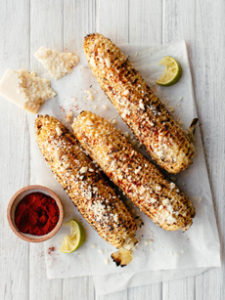
It’s then brushed with melted butter or mayonnaise, rolled in cotija or queso fresco crumbles, and dusted with chile powder and salt (photo #1).

You also get a lime wedge to squeeze over the corn.

Some vendors (and home cooks) serve a more elaborate topping for the base, or as a drizzle on top of the other ingredients.

This more elaborate cream base is made from sour cream, mayonnaise, lime juice, garlic, chili powder, pepper and cilantro. Yum!

Other toppings include Tajin tangy chile seasoning, chopped scallions and cilantro.
 
 
What About Esquites?

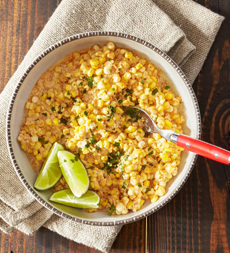
Esquites (es-KEE-tays) are the same corn kernels removed from the cob, seasoned the same way, and served in a dish with a spoon.

Ingredients like chorizo, which don’t work on a corn cob, can be added.

Also known as elote en vaso esquites are another way to enjoy the Mexican corn snack (antojito).

The word comes from the Nahuatl word ízquitl, which means toasted corn.

(Today, the kernels are just removed from the steamed or boiled cob.)

But take a modern look: Esquites can be used in any variety of ways beyond the street cart.
 
 
PARTY BAR

How to make corn on the cob even more popular?

You can serve either elote or esquites in a party bar format, allowing family and friends to add their toppings of choice.

We promise it will be a memorable event, as in, “Remember that great elote bar?”

Perhaps you’ll make it an annual event!
 
 
WAYS TO USE ESQUITES

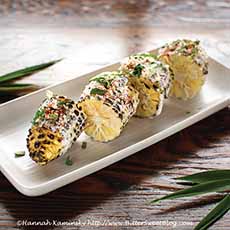
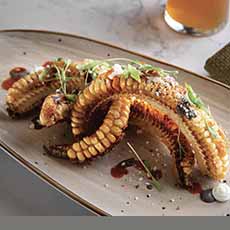
Photo #1 is the classic elote and photos #3 and #4 are serving variations. You can take the same creative approach with esquites.

It can be as simple as a garnish on top of a piece of grilled meat or fish. Or, how about:

  • Esquites croquettes (recipe).
  • Esquites grilled cheese, with a Mexican melting cheese substituting for American cheeses (or substitute gruyère).
  • Esquites on a grilled chicken breast salad with a lime vinaigrette (recipe).
  • Esquites atop a brat or hot dog in a toasted roll.
  • Esquites BLT on toast, with bacon, lettuce and tomato.
  • Esquites dip with mayo and sour cream, to serve with tortilla chips or crudités.
  • Esquites pancakes, savory corn pancakes topped with esquites; you can first mix esquites (or plain corn kernels) into the batter.
  • Esquites pizza topped with mozzarella, roasted corn kernels, cotija cheese, Tajin seasoning, snipped cilantro and chipotle mayonnaise.
  •  
     
    MORE ELOTE & ESQUITES RECIPES

  • Elote Toppings For A DIY Elote Bar
  • Stove Top Elote
  • Elote & Esquites Recipes
  • Uses For Corn Cobs
  • Uses For Raw Corn Kernels
  •  
    Oh que delicioso!


    Elote - Mexican Corn
    [1] Classic elote can be served with or without the stick. When buying from a street cart, a stick is a neater option. And we find that a stick is a superior option to the corn cob holders that are popular in the U.S. (photo © Good Eggs).


    [2] Our colleague Hannah Kaminsky of Bittersweet Blog made elote easier to eat by cutting the cob into four pieces. You can put each piece on a stick, or eat them with your fingers (and a good napkin) (photo © Bittersweet Blog).


    [3] At Manzanita in Silicon Valley, an elote innovation: Executive Chef Adam Ornellas cuts the cob into four strips, then frys them into dramatic curls. A charbroil finish lends a nice smokiness, and the dish is finished with a chorizo vinaigrette (photo #3 © Manzanita Restaurant).


    [4] Esquites served as a side, in a ramekin. Here’s the recipe (photo © Goya).


    [5] A simple dish of esquites (photo © Reynolds Kitchen).


    Comments off

    Prosecco & Prosecco Rose Wine For National Prosecco Day

    Guinigi Prosecco Rose Bottle & Flute
    [1] Prosecco is an ideal summer wine. It is made in both traditional white and rosé varieties; we prefer rose every time (photos #1, #2 and #4 © Guinigi Wines).


    [2] Some people like the old-style “sherbet Champagne” glasses instead of flutes; but the wide surface area enables the bubbles to escape more quickly.


    [3] The beautiful hills of Glera grapevines (photo © Jonas Van Der Wende | Unsplash).


    [4] Guinigi makes both white and rosé Prosecco.

    Sushi Plate
    [5] Prosecco and sushi: a great pairing (photo © Sushi Inoue).

    Caprese Salad
    [6] Caprese salad, another perfect pairing with Prosecco (photo © Balducci’s).

    Steamed Lobster
    [7] Serve Prosecco with your favorite seafood (photo © North River Lobster Company).


    August 13th is National Prosecco Day, celebrating Italy’s most famous sparkling wine from Italy (the next best-known is Asti Spumante). See the different types of sparkling wine below.

    With lively bubbles and nuances of fruit, Prosecco is also affordable, with bottles from just $7. You can enjoy it every day!

    While lovely bottles cost around $15, there are highly-rated labels that are pricey because of supply and demand—up to $50 and more (here’s more about them).

    In the summer, Prosecco’s medium-light body is perfect for an apéritif, to serve with lunch and dinner, for a break, and as a patio-and-pool refresher.

    > The history of Prosecco.
     
     
    WHAT IS PROSECCO WINE?

    Prosecco is named after the former village of Prosecco in northeast Italy, where it was first produced. The village is now part of the city of Trieste, a port city on the Adriatic that’s the capital city of the Friuli Venezia Giulia region.

    By E.U. law, Prosecco D.O.C. can be produced exclusively produced in a limited area around where it began: nine provinces in two Italian regions, Veneto (the main producing region) and Friuli-Venezia Giulia. It’s a beautiful area, lying between the Dolomite mountains and the Adriatic Sea.

    Also by law, Prosecco must be made from at least 85% Glera grapes, a white grape of Slovenian origin, which was brought to the village of Prosecco long ago from the Karst Plateau region, which extends across the border of southwestern Slovenia and northeastern Italy.

    While some Prosecco producers do make 100% Glera wines, many blend in varieties such as Chardonnay, Pinot Bianco, Pinot Grigio, Pinot Nero, or more obscure local grapes such as Bianchetta Trevigiana, Glera Lunga, Perera or Verdiso.

    Some researchers believe that the glera grape was cultivated in Roman times, and may have been the vinum pucinum praised by Pliny the Elder, which was produced “in the gulf of the Adriatic Sea” [source].

    Today, the grape ranks about 30th among the country’s some 2,000 grape varieties [source].
     
     
    D.O.C. VS. D.O.C.G.

    All Prosecco wines enjoy D.O.C. status, short for Denominazione di Origine Controllata, “controlled designation of origin.” This protected geographic designation signifies authentic Prosecco. No other wine can use the name.

    The names Prosecco D.O.C. Treviso and Prosecco D.O.C. Trieste can also be used, but only if 100% of the grape harvest, winemaking, and bottling take place within the provinces of Treviso or Trieste, respectively.

    Prosecco Rosé was made an official D.O.C. in 2020 and is expected to account for 10% of the half-million bottles of Prosecco produced this year.

    While all Prosecco wines are D.O.C., there’s a premium level called D.O.C.G., the “G” for “garantita,” guaranteed.

    That’s a guarantee, designated by the Italian government, that the wines are of especially high quality.

    Prosecco DOCG refers to two approved Prosecco wines: those from the Conegliano-Valdobbiadene area, and those from the Asolo area. Both zones are located in the Italian region of Veneto.

    As Prosecco became an enormously popular sparkling wine in the 1980s and 1990s, officials in Italy wanted to separate the traditional zones in Veneto from other areas where Prosecco was being produced (the neighboring region of Friuli, for example). Thus the DOCG stamp of approval was granted to Prosecco from Conegliano-Valdobbiadene in the northern Venetian province of Treviso. This is “the heart and soul of Prosecco,” and most of the finest wines come from this hilly area.

    A second DOCG was granted to the Prosecco of the Asolo area, also in Veneto but farther south and west. Known as Asolo Prosecco DOCG (or Colli Asolani Prosecco DOCG), this is an area near the Venetian Alps. Plantings here reach as high as 1500 feet above sea level.

    The thinking was that by creating separate DOCG zones, consumers would know that the finest examples of Prosecco are DOCG and not DOC. This is generally true; however, having two DOCG areas has certainly created some confusion [source].

    And no matter, there are some absolutely splendid D.O.C. wines. Don’t hesitate to try them.
     
     
    GUINIGI PROSECCO D.O.C. SPUMANTE BRUT

    The Guinigi Prosecco Rosé was a treat drink, and we look forward to having more. We may even try a bottle of Guigini’s regular (white) Prosecco, although our palate tends to prefer Prosecco Rosé.

    The 2020 vintage ($17)has a clean, refreshing profile: bright and delicate, with a soft hue and fine, lasting bubbles. The nose has notes of apple, white peach, citrus, and wild strawberries balanced against floral notes of peach blossoms.

    The mouthfeel is refreshing. with a high level of acidity cleansing the palate between each new sip.

    The wine was crafted from a blend of Glera and Pinot Noir grapes, harvested in mid-September. The Glera grapes come mainly from the hilly province of Treviso, the Pinot Noir grapes from Friuli.

    While you can enjoy the Prosecco Rosé with many foods, As an apéritif or a wine throughout a meal of lighter dishes, Guinigi suggests these specific food pairings:

  • Caprese salad
  • Fresh seafood
  • Sushi
  • Vegetable risotto
  •  
    The low A.B.V. (alcohol by volume) of 11.5% means that you can have a bit more, without intoxication.

    The name “Guinigi” and the label art are inspired by la Torre Guinigi, a historical landmark in the town of Lucca, Tuscany, where ancestors of the Sebastiani family resided. A typical example of local Romanesque-Gothic architecture, the tower is 45 meters (148 feet) high, with a total of 232 steps to reach the top. It is one of the few towers of its era still standing in Italy.

    Discover more at GuinginiWines.com.

     
    OTHER SPARKLING WINES

    The most famous sparkling wine—and the far most expensive—is Champagne from France. Consider these more affordable bubblies at half the price or less:

  • Asti Spumante and Prosecco from Italy.
  • Cava from Spain.
  • Crémant from France.
  • Espumante from Portugal.
  • Sekt from Germany.
  • Sparkling wines from Austria, New Zealand, South Africa, the U.S. and other countries.
  • Red wine sparklers such as Italian Brachetto and Lambrusco, and Australia’s sparkling Shiraz.
  •  
    Plus: English sparkling wine!

    England is not known as a producer of wine. However, they have had success in producing sparkling wines, using the same grapes as Champagne (primarily, Pinot Noir and Chardonnay).

    Five years ago, the first sparkling wines from England came onto the market. While there is not yet an official name for them, some in the English wine business suggest Britagne, pronounced Britannia or more precisely, bri-TAN-yuh, to rhyme with the French pronouncing of Champagne, shom-PAN-yuh. Here’s more about English sparkling wines.


    Comments off

    Smoked Salmon Spring Rolls Recipe

    Our friends at Petrossian shared with us this delightful recipe for smoked salmon summer rolls. They are as much a treat for the eye as for the palate (photo #1).

    Petrossian calls them maki, the Japanese word for roll; but they are more correctly namu harumaki that are sliced in the manner of sushi maki.

    The difference is in the wrapper.

  • Conventional sushi maki are wrapped in nori seaweed or thinly peeled cucumber wrap (naruto maki).
  • Namu harumaki, namu meaning raw and haru meaning spring, are Japanese spring rolls made with rice paper. In Vietnam, rice paper-wrapped rolls are called summer rolls (their spring rolls are fried).
  • Regular harumaki are made with wheat crêpes and are fried, similar to the more familiar Chinese egg rolls.
  •  
    Petrossian created the rolls with their smoked salmon carpaccio (photo #2). And they make the rolls pretty with edible flowers.

    The rolls are accompanied by a sesame oil vinaigrette for dipping. See recipe variations below.
     
    This is a lovely appetizer to serve with a cocktail, glass of wine or sake, or as a first course.
     
     
    RECIPE: SMOKED SALMON SPRING ROLLS

    Prep time is 45 minutes. Rest time is 30 minutes
     
    Ingredients

  • 500g of Petrossian Smoked Salmon Carpaccio (photo #2—substitute conventional smoked salmon, sliced thin)
  • 1 raw red beet (photo #4)
  • ½ black radish (photo #3—substitute red radish*)
  • 2 ripe avocados
  • Edible flowers and optional cilantro leaves
  • 8 to 10 sheets of rice paper (photo #5)
  • Optional garnish: snipped dill, tarragon leaves
  •  
    For The Vinaigrette Dipping Sauce

  • ⅓ cup of rice vinegar
  • ⅔ cup of sesame oil
  • Squeeze of lemon juice
  •  
    Preparation

    1. SLICE the beet and black radish into sticks. Cut the smoked salmon into ½ inch wide slices. Slice the avocado into thin slices.

    2. DIP the sheets of rice paper one by one into warm water. Once wet, place on a clean, flat kitchen towel. At the bottom of each sheet, lay a few edible flowers and cilantro leaves, a few slices of beet and radish, smoked salmon and finally the sliced avocado.

    3. FOLD the left and right sides of the rice paper inwards, and roll the spring roll up, squeezing tightly. Let sit in the refrigerator for 30 minutes uncovered. While the rolls are resting…

    4. MAKE the vinaigrette. Mix the ingredients in a small bowl. When ready to serve…

    5. SLICE the spring rolls into pieces of the same size. Serve alongside the vinaigarette. Garnish the plate with a few edible flowers and/or snipped herbs.
     
     
    RECIPE VARIATIONS

  • If you don’t want (or can’t get) the flowers, substitute dill and/or cilantro leaves, and perhaps some pomegranate arils.
  • If you prefer, substitute smoked salmon for raw salmon.
  • If you don’t have rice vinegar and sesame oil for the vinaigrette, substitute ponzu sauce or straight soy sauce. You can perk up the soy sauce with lemon or lime juice and/or zest.
  •  
     
    > THE DIFFERENT TYPES OF SUSHI
     
     
    > SPRING ROLLS VS. SUMMER ROLLS VS. EGG ROLLS
     
    ________________

    *The black radish (Raphanus sativus)—white flesh with a sooty-colored skin—is the oldest cultivated of all radishes. Its cultivation precedes the building of the pyramids in Egypt.

    It was commonly grown in the United States in the 1800s, as a winter crop, but dropped from favor in the 1900s, appearing mostly in farmers markets. black radish is grown as a winter crop.

    The flavor varies from mild to spicy, like red radishes, to almost as hot as horseradish. The texture is crisp but it is much tougher than other radishes.

    All radishes are members of the Brassicaceae plant family that includes the cruciferous vegetables, nutritional powerhouses packed with potent, cancer-fighting phytonutrients (antioxidants).

    They include arugula, bok choy, broccoli, Brussels sprouts, cabbage, cauliflower, horseradish/wasabi, kale, kohlrabi, mustard, radish, rapeseed/canola, rapini, rutabaga and turnips, among others.


    [1] Smoked salmon spring rolls with raw beet and black radish (photos #1 and #2 © Petrossian).


    [2] Petrossian’s smoked salmon carpaccio. You can purchase it here.


    [3] Black radish: a creamy white flesh with a sooty black exterior (photo © Good Eggs).


    [4] A red beet with beet greens (photo © Natalia Fogarty | Unsplash).


    [5] Once you see how it is to use rice paper wrappers, you’ll be making spring rolls all the time (photo © Denzil Green | Cooks Info).


    Comments off


    © Copyright 2005-2026 Lifestyle Direct, Inc. All rights reserved. All images are copyrighted to their respective owners.