THE NIBBLE BLOG: Products, Recipes & Trends In Specialty Foods


Also visit our main website, TheNibble.com.

Nachos Recipes For National Nachos Day

November 6th is National Nachos Day, a good occasion to have a nachos party. What’s that? An occasion to get together with friends and try different nachos recipes—with different types of beers, of course, and different Margaritas.

Who doesn’t enjoy a hearty plate of nachos for a snack, or even for a main course? They’re the easiest Mexican dish to make at home.

At the most minimal, you can simply cover tortilla chips with shredded Cheddar, Jack or other semi-hard cheese, with or without salsa; then use the microwave or broiler to melt the cheese.

Of course, there are more elaborate recipes.

And you can top the tortilla chips with anything you have on hand (including such luxury items as crab, lobster, scallops and shrimp).
 
 
NACHOS TOPPINGS

Our favorite add-ons to nachos:

  • Adobo sauce
  • Black beans and corn kernels—or use a bean and corn salsa
  • Cheese sauce, a.k.a. queso salsa
  • Chili (bean, meat or combination)
  • Chopped chives, cilantro and/or parsley
  • Chopped gherkins
  • Crumbled cotija or queso blanco cheese
  • Diced avocado or guacamole
  • Red onions or scallions
  • Halved cherry or grape tomatoes
  • Hot sauce
  • Lime wedges
  • Pepitas
  • Pickled jalapenos, pickled red onions
  • Refried beans
  • Salsa, especially pico de gallo
  • Sliced green and/or red jalapeños
  • Sliced olives
  • Shredded chicken, lamb or pork or crumbled ground beef (a great use for leftover hamburger)
  • Shredded lettuce
  • Sour cream or crema
  •  
    For visual and flavor interest, we like to use a mix of yellow and blue corn tortillas (for Independence Day, go red, white, and blue!).

    Confessions of a tortilla chip addict:

    While we have our favorite brands, as long as the chips before us are crisp and not over-salted, they are very welcome.

    If you want to make your own tortilla chips, here’s a recipe.

     
    MORE NACHOS RECIPES

  • Baked Potato Nachos
  • Basic Nachos
  • Charcuterie Nachos
  • Fusion Nachos
  • Greek Nachos
  • Hummus Nachos
  • Irish Nachos
  • Nacho Cheese Ball
  • Naked Nachos, Skillet Nachos & Grandma’s Candy Apple Nachos
  • Potato Wedge Nachos
  • Savory Nacho Cheesecake
  • Toppings For International Nachos
  • Turkey Nachos
  • World Cup Nachos
  • Zucchini Nachos
  •  
    PLUS

  • Nacho Stuffed Shells
  •  
     
    > THE HISTORY OF NACHOS


    Carnitas Nachos
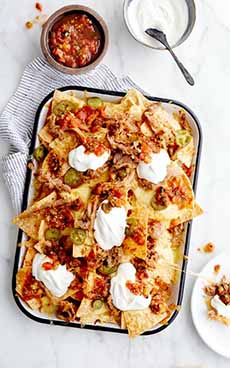
    [1] Carnitas nachos with shredded pork (photos #1 and #3 © Good Eggs).


    [2] Double-sauce nachos, with salsa and crema (photo © Natasha Bhogal | Unsplash).


    [3] Nachos with salsa verde, green salsa made with green chiles, tomatillos, and cilantro. Check out the different types of salsa.

    Nachos With Queso Sauce
    [4] Here’s a nicely loaded plate: nachos with black beans, cilantro, crema, pico de gallo, sliced jalapeno, sliced radish, queso/cheese sauce (photo © Hannah Kaminsky | Bittersweet Blog).


    CHECK OUT WHAT’S HAPPENING ON OUR HOME PAGE, THENIBBLE.COM.


    Comments off

    The World’s Best Cheeses: The Top 10 From The World Cheese Awards


    [12] Olavida, Spanish goat’s milk cheese from a tiny producer took first place out of 4,000+ entries! (photos #1 and #6 © Quesos y Besos).


    [2] This Epoisses produced by Fromagerie Berthaut in the town of Epoisses, France, was a close runner-up (photo © Marky’s).


    [3] Eminence Gris Tomme Chevre, a Dutch goat’s milk cheese, is aged in caves that held ammunition on World War II (photo © Van der Heiden Kaas).


    [4] Baracska, a semi-hard cheese from Hungary, took fourth place (photo © Csíz Sajtműhely).


    [5] Twentse Bunkerkaas Geit is another goat’s milk cheese, and another winner from The Netherlands (photo © Gastropedia).


    [6] Another winner from Quesos y Besos, Camembesos is made in the style of Camembert.


    [7] Caerphilly is a hard, crumbly white cheese that originated in the area around the town of Caerphilly, Wales. The winner is Gorwydd (photo © Vin Sullivan Foods).


    [8] Montano Intenso is an aged Gouda from The Netherlands (photo © Maaz Cheese).


    [9] Gorgonzola Dolce DOP from Caseificio Brusati is so creamy, you can eat it with a spoon (photo © Caseificio Brusati).


    [10] Vorarlberger Bergkäse g.U. is a traditional mountain cheese from Austria (photo © Alma).


    A soft, creamy goat’s milk cheese from Spain was named World Champion Cheese in Oviedo, Spain—where coincidentally this year’s World Cheese Awards was held. On Wednesday, November 3rd, Quesos y Besos’ Olavidia was voted to the top of the shortlist of 20 cheeses. This year, it is the best cheese on the planet.
     
     
    ABOUT OLAVIDIA GOAT CHEESE

    Produced by a husband-and-wife duo who established Quesos y Besos (Cheese and Kisses) in 2017, the cheese is made in the small town of Guarromán in Andalusia, in southern Spain. Head cheesemaker Silvia Peláez and her team of six people make the cheese entirely by hand.

    What makes a cheese #1 of 4,000+ entries? It has “everything” in exceptional amounts: appearance, aroma, texture, flavor, and originality.

    One of the judges in the final judging, Jason Hinds of the famed Neal’s Yard Dairy in the U.K., commented:

    “This cheese charmed me and stole my heart. This is unlike anything I’ve seen before. Its appearance is so original and it didn’t let me down. It’s unctuous, seductive, pillowy, warm and comforting.”

    The Peláezes come from a long line of shepherds, and decided to make a lactic cheese*, which is one of the oldest forms of fermentation. Lactic fermentation gives the cheese a buttery flavor; the the vegetation in the pasture where the goats graze provides and floral notes.

    The goat’s milk cheese is matured with Penicillium Candidum* and has a visually striking layer of olive stone (olive pit) ash running through its middle.

    John Farrand, managing director of the Guild of Fine Food, organizers of the World Cheese Awards, noted: “As the World Cheese Awards was founded over three decades ago to showcase the work of small artisan cheesemakers, it gives me immense pleasure to see a tiny family-run cheesemaking business taking top honours once again.”

    Ms. Peláez noted, “We’ve been making cheese for less than 5 years, so we never imagined we could win the world’s biggest prize in cheese so soon….To have such recognition from the World Cheese Awards judges is an incredible achievement and truly overwhelming.”

    And that’s not all. Her other cheese, Camembeso, took 6th place!
     
     
    A VERY CLOSE FINISHbeautifu

    In a close finale, second place was awarded to Epoisses Berthaut Perrière, made by Fromagerie Berthaut of France.

    All 4,000+ entries were judged in a single day, as 250 experts from 38 different countries. A super jury of 16 judges selected the World Champion Cheese from a 20-cheese shortlist. The Top 10 are below.

    The 4,000+ competing cheeses represented 45 different countries. Recent additions such as Colombia, India, and Japan joined established cheesemaking nations such as France, Italy, Spain, Switzerland, and the U.K.
     
     
    THE TOP 10 CHEESES IN THE WORLD, 2021

    Thanks so much to Love Food of the U.K., whose review of the Top 20 finalists provided the tasting notes on these cheeses. You can review all 20 cheeses here.

    Styles of cheese are made by multiple producers—Caerphilly and Gorgonzola, for example, in these Top 10. The awards go to cheeses made by particular producers. So if you want the best Caerpohilly, for example, look for the one made by Trethowan’s Dairy.

    1st Place: Olavidia, Quesos y Besos, Spain (photo #1)

    2nd Place: Epoisses Berthaut Perrière, France The pungent cheese, with fans around the world, is on the official list of Protected Designation of Origin (PDO) products in Europe. It is only produced in central France. Made since the 16th century, Epoisses is a cow’s milk cheese with a washed rind, soft texture and creamy taste. This winning version, made by Fromagerie Berthaut in Burgundy, is washed with Marc de Bourgogne. (photo #2)

    3rd Place: Eminence Grise, Tomme Chèvre Grise au Bleu, The Netherlands. This Dutch goat’s milk cheese is aged in caves in France. Made by Van der Heiden Kaas, it has delicate blue veins and a natural rind. Tomme Chèvre Grise au Bleu is ripened for at least six months and has a soft, mild taste. (photo #3)

    4th Place: Baracska Semi-Hard Cheese, Hungary. The fatty milk of Hungarian cows grazing in the Váli Valley gives this cheese a particular richness and flavor of the pasture. Produced by Csíz Sajtműhely, it’s a flexible cheese that softly melts in the mouth with a sweet flavor, reminiscent of caramel. (photo #4)

    5th Place: Twentse Bunkerkaas Geit, Netherlands. Another Dutch winner, Twentse Bunkerkaas Geit, is an aged goat’s milk cheese. It’s ripened in former ammunition bunkers for 25 weeks. Creamy and spicy with an intensely pure flavor. The producer is Zijerveld Food. (photo #5)

    6th Place: Camembesos, Quesos y Besos, Spain. Another cheese from the first-place winning cheesemakers, Camembeso, a Camembert-like cheese is made from the milk of Malagueña goats. The cheese is pasteurized and matured for 60 days to ensure it has a wonderful depth of flavor. The flavor is light and buttery with floral and nutty notes. (photo #6)

    7th Place: Gorwydd Caerphilly, Trethowan’s Dairy, United Kingdom. Gorwydd Caerphilly is a semi-soft cheese produced by Trethowan’s Dairy in North Somerset, England. Caerphilly is thought to have been created in Caerphilly, Wales to provide food for the local coal miners.

    Made with unpasteurized cow’s milk, it has a natural rind and a mushroomy cream layer around a springy, citrus core. The same dairy made the 14th-place-winning Pitchfork Vintage Cheddar. (photo #7)

    8th Place: Montana Intenso, The Netherlands. Dutch producer MAAZ Cheese makes Montana Intenso, an extra-aged Gouda with a sweet and extra piquant taste flavor. It’s aged for 40 weeks on wooden shelves. (photo #8)

    There was a tie for 9th Place, meaning that there was no 10th Place winner this year.

    9th Place: Gorgonzola Dolce DOP Caseificio Brusati, Italy. Made by Caseifico Brusati, this is a particularly creamy Gorgonzola Dolce. It can be eaten with a spoon! The aging process helps it develop its signature soft texture and slightly sweet flavor.

    It’s also beautiful to look at, with typical light blue and greenish veins that are irregular, as a result of the handmaking process. (photo #9)

    9th Place: Vorarlberger Bergkäse g.U. – über 10 Monate, Austria. Vorarlberger Bergkäse is a traditionally produced hard cheese made from raw cow’s milk made in Vorarlberg, a mountainous province in westernmost Austria. The cheese is produced exclusively in the Alpine Bregenz Forest.

    Made from fresh hay milk, the cheese is matured for more than 10 months in special air-conditioned rooms, which delivers a unique hearty, spicy flavor. This cheese was also an award winner in 2014. g.U. is an abbreviation for Geschützte Ursprungsbezeichnung, German for Protected Designation of Origin or P.D.O. (photo #10)
     
     
    > THE HISTORY OF CHEESE
     
     
    > THE DIFFERENT TYPES OF CHEESE
     
     
    > HOW TO TASTE CHEESE
     
     
    > CHEESE TASTING TERMINOLOGY
     
     
    > A GUIDE TO CHEESE CONDIMENTS
     
     
    > HAVE A CHEESE TASTING PARTY
     
     
    > PAIRING CHEESE WITH BEER & WINE
     
     
    > PAIRING CHEESE & TEA
     
     
    > A GUIDE TO CHEESEMONGERS


    ________________

    *Lactic cheeses, as opposed to the firmer rennet-set cheeses, are primarily made with little to no rennet and rely primarily on the action of the bacteria converting the milk lactose to lactic acid. When the milk acidity becomes high enough, the milk will coagulate even without the use of rennet. Here’s more about it.


    CHECK OUT WHAT’S HAPPENING ON OUR HOME PAGE, THENIBBLE.COM.


    Comments off

    Runamok Infused Honey & Raw Honey For Your Table Or For Gifts

    What do you do when you’re an acclaimed maker of artisan maple syrup, seeking to add to your wares? Why it’s perfectly logical: You turn to another sweetener and fine food ingredient, honey.

    The artisans at Runamok Maple Syrup, a Nibble Top Pick Of The Week, have created a line of artisan honey: raw varietal honey, hot honey infused with chiles, and other specialty flavors.

    Like maple syrup, honey is of nature’s great natural sweeteners. Like maple syrup, honey lends itself to infused flavors. It elevates everyday food and beverage experiences, as you can see below in “Ways To Use Honey.”

    The raw honey is supplied by Todd Hardie, one of the nation’s most respected beekeepers.

    These jars of honey are wonderful gifts for home cooks and mixologists, in addition to people who love honey and sweet heat.

    We’ve been using the Chile de Arbol- and Chipotle Morita-infused honeys as a condiment on everything from breakfast eggs and toast to grilled, roasted and fried chicken and shrimp.

    The infused flavors are seductive dipping sauces, alone or mixed with mayonnaise and/or plain yogurt.

    The product line is certified kosher by OU (as are the maple syrups).
     
     
    RUNAMOK HONEY

    The new line is exciting, including both raw* honey and infused honey.

    Runamok Raw Honey

  • Beekeepers Cut Honey by Runamok (a wildflower honey of asters, rudbeckia, and goldenrod)
  • Florida Orange Blossom Honey by Runamok
  • High Plains Clover Honey by Runamok
  •  
    Runamok Infused Honey

  • Chile de Arbol Infused Honey by Runamok (a heat level similar to cayenne)
  • Chipotle Morita Infused Honey by Runamok (heat with a hint of smoke)
  • Hibiscus Flower Infused Honey by Runamok (tangy flavors of raspberry and lemon)
  • Lemon Verbena Infused Honey by Runamok (bright and citrusy)
  • Szechuan Peppercorn Infused Honey by Runamok (piney with a tongue-tingling finish)
  •  
     
    WAYS TO USE THE HONEYS

    Your own palate will guide you to which honey to use for what purpose. We don’t like to give restrictive recommendations. But here’s how we use the honeys:

  • As a dessert drizzle (grilled fruit, pound cake, ice cream).
  • As a glaze for pork roast, ribs, grilled chicken, salmon, shrimp…and carrots.
  • As a sandwich condiment, spread on cheese (including grilled), grilled vegetables, ham, turkey.
  • For basting.
  • For dipping—anything from chicken nuggets to pretzels.
  • For drizzling on a pizza (we enjoyed it on a goat cheese pizza as well as pepperoni).
  • In baking, particularly blended with pecans on a pie or tart.
  • In a cocktail, including a hot toddy.
  • In a pan sauce: add a half teaspoon when you deglaze the pan.
  • In marinades and glazes.
  • In salad dressings†.
  • In tea, hot or iced.
  • On cereal, granola and porridge.
  • On corn on the cob.
  • On pancakes, waffles, French toast.
  • On cornbread, English muffins, scones, toast.
  • Stir into mustard for honey mustard, add to softened butter for honey butter.
  • Stir into yogurt, or add to a yogurt parfait.
  • With cheeses: anything from soft goat cheese to blue cheese to aged Parmigiano-Reggiano.
  •  
    If you eat it directly from the jar…join the group.
     
     
    GET YOUR RUNAMOK HONEY

    Head to RunamokMaple.com.

    While you’re there, check out the maple syrups—also wonderful gifts and treats for your home table.
     
     
    > THE HISTORY OF HONEY

    > THE DIFFERENT TYPES OF HONEY

    > HONEY FACTS & TRIVIA

    > HONEY PAIRINGS

    > STORING & USING HONEY


    [1] Eight artisan honeys from Runamok include three raw honey varietals and five infused honeys (all photos © Runamok Maple).


    [2] The infused honeys are delicious on grilled cheese and other sandwiches. Here, grilled cheese with Taleggio; we also loved it with Brie.


    [3] We particularly liked the chile flavors as a condiment with fried and roasted chicken. Any of the honeys can be used for basting or marinating.


    [4] Add a jar of honey and a drizzle stick to a cheese board.


    [5] A drizzle of honey is delicious on sandwiches from PB & B (banana) to ham and cheese.

     
    ________________

    *“Raw honey” comes straight from the hive. It can be filtered or unfiltered. Filtration helps to remove any air bubbles, so that the honey remains a clear liquid for a longer time. “Pure honey” is pasteurized but contains no added ingredients. Pasteurization helps to extend honey’s shelf life and makes it nice and smooth. If not labeled raw or pure, “regular” honey is pasteurized, and may contain added sugars.

    †We loved it with a salad of roasted beets, goat cheese, watercress, and toasted pecans.


    CHECK OUT WHAT’S HAPPENING ON OUR HOME PAGE, THENIBBLE.COM.


    Comments off


    © Copyright 2005-2026 Lifestyle Direct, Inc. All rights reserved. All images are copyrighted to their respective owners.