|
THE NIBBLE’s gluten-free expert, Georgi Page, reports on another excellent product.
Glutino Food Group has been in the gluten-free business for a long, long time, since the days when it wasn’t necessarily a cash-cow, but more of a labor of conviction.
They claim that their strategy is to simply “shut up and listen” and I have tasted enough to honestly believe them: The proof is in the pastries! Their responsiveness to what their market craves, and their brilliance at translating it, shows in the quality of their gluten-free products. And not just the quality, but the satisfaction, which is so far unparalleled for a gluten-free food brand (and I have tasted plenty).
Recently, I had a chance to revel in the latest offerings from Glutin: Toaster Pastry.
|
|

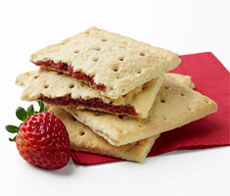
A superior toaster pastry in Apple Cinnamon or Strawberry. Photo courtesy Glutino Food Group. |
A treat along the lines of Pop-Tarts, the Glutino Toaster Pastry is actually more like that snack’s older, more intelligent cousin. It forsakes the cloying frosting and the candied filling with a crisp pastry that enfolds tangy, not-too-sweet apple cinnamon and strawberry fillings. It’s that breakfast-on-the run, or that late-afternoon snack with coffee or tea.
The Apple Cinnamon is my favorite, with a flavor profile that went far beyond my expectations. It actually tastes like apples, and coming from a Minnesotan, there are few higher compliments.
The trick is that it is in fact made with apples, with just the right amount of sweetness and spice. The crust, after toasting, is flakily satisfying without being greasy, yet still manages to have a great mouthfeel. Each pastry is 160 calories, with only 45 from fat; and the sugar content is a completely justifiable 12g. These are comparable to—or even better than—your average healthy granola bar!
|
Mmm, delicious! Photo courtesy Glutino Food
Group |
|
GOOD FOOD
Nothing in the ingredients list is scary. The one ingredient I questioned, inulin, turned out to be a naturally-derived carbohydrate—a soluble fiber that can increase calcium and magnesium absorption as well as promote the growth of beneficial intestinal flora (as long as eaten in moderation)!
The only thing that would make these better as a quick breakfast on-the-go, would be additional nutritional supplementation. But I don’t even ask that much. These pastries have already delivered something above and beyond, as Glutino manages to do every time. The brand is my gold standard.
|
|
AND A COUPON!
But as any manufacturer will tell you, the best ingredients are costly. Some retailers won’t carry these higher price point because of that, making it harder to get your hands on the line.
To make trial a bit more affordable, here’s a link to a coupon for $.55 off of any Glutino product. Some retailers include Fresh Direct and Whole Foods, and you can find the products on Amazon.com.
A box of 5 individually-wrapped pastries is $4.49 (90¢ each) on Amazon; a case of six boxes (30 pastries) saves a few cents.
Here’s a store locator.
MORE GOOD FOOD
I cannot wrap up this review without a rave for a few of Glutino’s other standouts. The company makes a nice range of gluten-free products, from cookies to crackers, breads and pastas. The quality of what I’ve tried is unparalleled, the flavor is flawless.
The gluten-free pretzel chips are a big hit! Glutino’s pretzels, with their delightful crispness and shiny malty flavored coating tapped into the dormant pretzel monster within. I found that they had the perfect balance of toastiness to saltiness.
I also have to give kudos to Glutino’s chocolate vanilla creme cookies—but be careful, you could easily eat the whole package. I found myself putting them out of view and tip-toeing away to avoid the temptation. They are crunchy and luscious-tasting, and the creamy filling melts in your mouth.
I have not tried it, but am eager to sample the gluten-free spaghetti. I have no doubt it will be spectacular.
The line is certified kosher by Scroll K.
—Georgi Page
|
|