THE NIBBLE BLOG: Products, Recipes & Trends In Specialty Foods


Also visit our main website, TheNibble.com.

Potato, Mushroom & Chicken Hot Pot Recipe

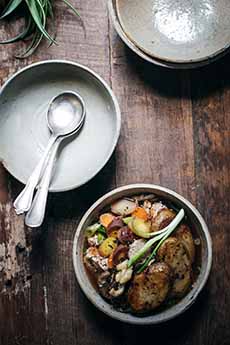
Bowl Of Chicken Hot Pot
[1] This potato and chicken hot pot recipe is below (photo © Little Figgy | Idaho Potato).


[2] Note the divided dish, which holds two different broths (photos #2 and #3 © Little Sheep | Pasadena [alas, permanently closed])


[3] Grasp food with chopsticks, dip it into hot broth, cook, and eat. Repeat.

Strips Of Beef For A Mongolian Hot Pot
[4] Beef from our favorite spot in Flushing, New York (photo © Xiang Hot Pot | Facebook).

Dipping Raw Beef Into A Mongolian Hot Pot
[5] The food item—here beef, but anything from meat and fish to vegetables, dumplings, tofu, and beyond—is dipped into hot broth to cook it (photo © @MichaelOyu | Xiang Hotpot Flushing | Facebook).

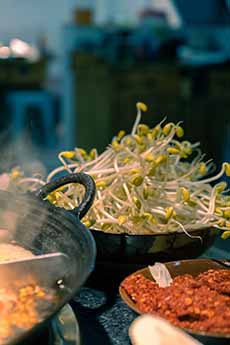
Bean Sprouts For Chinese Hot Pot Recipe
[6] Bean sprouts and other ingredients ready to cook in the hot broth (photo © Peijia Li | Unsplash).

Hot Pot Dipping Sauces
[7] Restaurants offer a variety of sauces to dip the cooked food: chili oil, garlic sauce, ponzu, satay sauce, sesame sauce, soy sauce, etc.

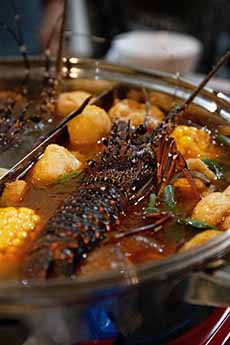
Lobster Hot Pot
[8] Lobster: a luxury hot pot ingredient (photo © Amanda Lim | Unsplash).


May 11th is Eat What You Want Day. While some people use this as an excuse to pile on the sugar or chips, we’re using it to shed light on a dish not enjoyed enough in the U.S.: hot pot. You may have heard of Mongolian hot pot (or hotpot), a dish that is served at restaurants devoted to the dish.

We had hoped to head out to Flushing, Queens, to our favorite hot pot restaurant, Xiang Hotpot. But we couldn’t get away, so we made our own Asian-inspired chicken hot pot recipe, Potato Mushroom Chicken Hot Pot. The recipe is below.

The recipe below lets you enjoy a family dinner in a slightly different way.

It’s an adaptation of comfort food that brings to the table a pot of simmering chicken broth stocked with chicken. Each diner dips vegetables into the broth, to cook them. It’s fun and festive.

In our childhood, perusing the menu at our family’s favorite Chinese restaurant, our eyes always stopped at the fetching-sounding Mongolian Hot Pot.

We wanted one, but Mom didn’t. So it remained a simmering desire in our heart until we were old enough to take ourselves to the restaurant.

It was worth the wait. We were delighted and enamored.
 
 
WHAT’S A HOT POT?

Hot pot or hotpot (the term in China is literally “fire pot”), is a cooking method from Mongolia.

It’s a simmering pot of soup stock brought to the dining table, containing a variety of raw meats, seafood, vegetables, and noodles to be cooked in the hot broth; then dipped into a variety of sauces (momiji-oroshi [chili-radish], ponzu, sesame, soy, etc. (photo #7).

It’s a group meal: the hot broth at the center of the table, surrounded by platters of food to be cooked.

Mongolian Hot Pot is perhaps the best-known dish of Mongolia, an autonomous region of northeast China*.

Like fondue, it’s a group meal; except that the bubbling pot is filled with broth instead of cheese; and there’s no bread or other eady-to-eat foods to dip on skewers, but instead, a large selection of raw foods.

Little Sheep Mongolian Hot Pot, a chain with thousands of locations in Asia and a toehold several locations in North America, has a variety of broths and some 100 dipping items, ranging from shellfish to lamb meatballs to thin-sliced beef and kidney; and almost every vegetable you can name. Check out some examples here.

And dumplings—don’t forget the dumplings. ribeye and pork kidney to winter melon, lotus root, egg dumplings, and oyster mushrooms.

It’s a franchise, so if you have visions of Hot Pot whenever you want it, check it out.
 
 
WHAT’S THE DIFFERENCE BETWEEN MONGOLIAN HOT POT & JAPANESE SHABU SHABU?

Both Mongolian Hot Pot and Japanese Shabu Shabu fall into the category of cooking raw ingredients in a hot broth.

The main difference is that shabu-shabu is milder, served with only kombu dashi (seaweed) broth instead of the variously spiced broths of Mongolian Hot Pot.

Yes, Mongolian Hot Pot’s broths are bold, as well as fragrant. At Little Sheep Mongolian Hot Pot, the principal broth has a blend of 36 aromatic ingredients, including black cardamom pods, whole garlic cloves, goji berries and ginseng [source].

Hot Pot restaurants offer a variety of broths. Some restaurants use a “split pot” divided into two sections (photos #2, #3, and #5). One can hold a spicy broth, and the other a milder broth.

As the concept spread beyond Mongolia, the dish took on flavors and ingredients that vary by region—from curry to tom yum broths. Szechuan Hot Pot, for example, offers a chicken broth highly spiced with chiles and peppercorns.

The recipe that follows is an Americanized hot pot. It’s a simple technique, made for the average home. No special pots or other equipment are required.

 
RECIPE #1: POTATO, MUSHROOM, & CHICKEN HOT POT

This recipe for Potato, Mushroom & Chicken Hot Pot (photo #1) is not Mongolian, but was created “in the spirit” of Asian hot pots by Stacey Doyle of Little Figgy Food, for the Idaho Potato Commission.

The idea is to enjoy a group dinner of simmering the vegetables in the broth, along with the already-cooked chicken.

The cooking process is similar to the fondue style of cooking, both of which enable enjoyable mealtime with each other while each person cooks his/her own food.

The recipe combines fresh and wholesome ingredients like mushrooms, carrots, spring onions, Idaho® potatoes, chicken breasts, and stock—with flavorful mix-ins like soy sauce, poultry herbs, and crushed red pepper flakes.

This slurp-worthy soup is best served the same day and is a filling comfort-food dinner. Customize it as you like. For example:

  • For a vegetarian/vegan version, swap out the chicken broth for vegetable broth and tofu for the chicken.
  • For seafood lovers, use shrimp instead of chicken.
  •  
    Tips from Stacy:

  • Cook the potatoes for ten minutes and flip them over halfway through until they turn golden brown.
  • It’s best to cook this recipe in steps rather than throwing it all in the pot at once.
  • It’s best served the same day.
  •  
    Ingredients For 4 Servings

  • 8 ounces baby Bella or gourmet blend mushrooms, sliced
  • ½ cup white wine, divided
  • 2 tablespoons olive oil
  • 2 large carrots, peeled and sliced
  • 2 large Idaho® potatoes, sliced into ¼-inch thick rounds
  • 1 bunch scallions (spring onions) sliced, additional for garnish, optional
  • 2 pre-cooked large chicken breasts, chopped
  • 1 liter chicken stock
  • 2 tablespoons soy sauce or liquid amino acids
  • 1 tablespoon poultry herb seasoning (recipe below)
  • 2 teaspoons hot sauce or crushed red pepper flakes, optional
  • Optional garnishes: finely chopped scallions, red pepper flakes, hot sauce
  •  
     
    RECIPE #2: POULTRY HERB SEASONING

    If you don’t have a jar of poultry herb seasoning, you can blend your own with these ingredients:

  • 2 teaspoons dried ground sage
  • 1½ teaspoons dried ground thyme
  • 1 teaspoon dried ground marjoram
  • ¾ teaspoon dried ground rosemary
  • ½ teaspoon ground nutmeg (we like to freshly grind it from a nut)
  • ½ teaspoon ground black pepper
  •  
    Preparation
     
    COMBINE well and transfer to an airtight container.

    NOTE: In addition to poultry, you can use poultry seasoning—a blend of popular herbs—on beef, lamb, pork, and vegetables; in soups, and in sauces. It’s most flavorful when added to food during the last few minutes of cooking. You can also season appetizers, breads, and salads.
     
    Preparation

    1. DRY CHAR† the sliced mushrooms in a large nonstick saucepan or casserole pan over medium heat, until they start to turn golden, about 5 minutes. Remove from pan and set aside.

    2. ADD ¼ cup of the white wine to deglaze the pan. Add the olive oil and heat over medium-high heat.

    3. ADD the carrots and potatoes and cook for about 10 minutes. Turn halfway through and cook until the potatoes start to turn golden and the carrots are just starting to soften. Optionally, if you prefer, you can set aside the potatoes to add at the end and enjoy like steak cut fries; or leave them to continue cooking.

    4. ADD the scallions, chopped cooked chicken, broth, soy sauce, the remaining white wine, the poultry herb seasoning, and the cooked mushrooms. Turn the heat to medium-low and continue to cook for 15-20 minutes, stirring occasionally. Taste and adjust flavor if needed.

    5. GARNISH with scallions if desired, and serve with optional hot sauce or crushed red pepper flakes.


    ________________

    *You may have heard of both Inner Mongolia and Outer Mongolia. Since 1912, Mongolia has been an independent country, sometimes referred to as Outer Mongolia. It is sandwiched between China and Russia. Inner Mongolia is an autonomous region of China, equivalent to a province. It is to the east of the sovereign nation of Mongolia. Both countries speak a variety of languages within the Mongolian language family.

    †To dry char, simply place the mushrooms in a pan and cook them on the stovetop, with no butter or oil. By skipping the fat, the pan will get very hot without smoking, so the mushrooms become charred (not steamed or smoked) as they cook.


    CHECK OUT WHAT’S HAPPENING ON OUR HOME PAGE, THENIBBLE.COM.


    Comments off

    Veuve Clicquot & Pommery Champagne & Great Books For Mother’s Day

    Champagne Widows Book Cover
    [1] The Champagne Widows” is the story of Veuve Clicquot, the woman and her eponymous Champagne empire (photo © Lion Heart Publishing).

    Madame Pommery Book Cover
    [2] Among her many contributions, Louise Pommery changes the profile of Champagne from a sweet dessert wine to the brut style we know today. Get the book (photo © Lion Heart Publishing).

    Veuve Cliquot Champagne Orange Label Bottle & Box
    [3] The familiar orange label of Veuve Clicquot. Both houses make different styles of Champagne (photo © Veuve Clicquot Ponsardin).

    Pommery Brut Royal Champagne Bottle & Box
    [4] Pommery and Veuve Cliccquot are both designed with different labels and packaging. Here are the Pommery wines (photo © Champagne Pommery).

    Pouring Veuve Clicquot  Champagne into a glass
    [5] If only every day could end like this (photo © Lauren Bates Photography via Veuve Clicquot).

    Pommery Champagne Bottle & Glass On Tray
    [6] Curl up with a good book and a tulip or flute of Champagne (photo © Vintage Wine Merchants).

    Madame Pommery Portrait
    [7] Madame Louis Pommery, 1875 portrait by Édouard Louis Dubufe.


    Recently we had two reading experiences that we deemed to be perfect as gifts for the Champagne lover. Historical novels written by Rebecca Rosenberg, each book focused on a woman who became a legendary Champagne producer: Barbe-Nicole Ponsardin Clicquot, the eponymous Veuve Clicquot, and Louise Pommery, of Champagne Pommery.

    In the early 19th century, the Napoleonic Code denied women civil and political rights, prohibiting them from working, voting, or earning money. Nor could they attend schools and universities without the consent of their husbands or fathers.

    Widows were the only women in France allowed to run their own businesses.

    Both Madame Clicquot and Madame Pommery became role models for entrepreneurs, showing persistence and courage against the odds, with diligence and vision that engendered positive change in their industry.

    The books weave their efforts with the history of the times, in fascinating, colorful, and lively page-turners.

    Both women were amazing irrespective of their gender. Their achievements included keeping their wineries going while facing wars, ruinous agricultural seasons, lack of funds to pay for staff and operations, and difficult business partners, all while raising children and maintaining a household.

    As women, they withstood the scorn of men and other women who believed a woman’s place was in the home, and that women could not, and should not, be winemakers.

    Was it a benefit to be a woman when invasion by alien armies meant the conscription of their workers and the confiscation of their horses, livestock, food, and the wines themselves?

    At least women couldn’t be conscripted; but by the same token, no winemaker of either gender could ship Champagne through a war zone to the big buyers outside of France. Unless, of course, they could figure out some sort of subterfuge….

    As a gift for any fan of Champagne, we highly recommend gifting one or both books with a corresponding bottle of Champagne.
     
     
    BARBE-NICOLE PONSARDIN CLICQUOT OF VEUVE CLICQUOT

    Barbe-Nicole Ponsardin (1777-1866, photo #8), daughter of the affluent Baron Nicolas Ponsardin, married François Clicquot at the age of 21. Her husband died just six years later leaving her a widow (veuve in French) at 27 with a young daughter.

    The widow began a lifetime of fighting: not only fighting for her assets during six Napoleonic wars, but fighting the French social class system, the “women belong at home” Champagne patriarchs and her own obstinate business partners.

    During a lifetime of striving to ensure her winery’s legacy, she taught herself the complexities of making better-quality Champagne. Her efforts were greatly enhanced by the gift of “Le Nez,” an uncanny sense of smell said to be inherited from her great-grandfather, a renowned producer of Champagne.

    Nose aside, one of Madame Clicquot’s innovations was the technique called riddling. Prior to then (1816), Champagne was cloudy as a result of the sediment in the bottles that remained from the yeast used to ferment the wine and create the bubbles.

    She also created:

  • The first vintage champagne (1810).
  • The first known blended rosé champagne (1818).
  •  
    Get the book “Champagne Widows.”

    Give it with a bottle of Veuve Clicquot. Here are the different wines.
     
     
    LOUISE POMMERY OF CHAMPAGNE POMMERY

    Jeanne Alexandrine Louise Mélin (1819-1890, photo #7), married Alexandre-Louis Pommery, who owned a winery that was making light reds and very sweet sparkling wines.

    She was widowed at thirty-eight with two children to support. Unlike Madame Clicquot, who hailed from a wealthy family, Madame Pommery needed an income.

    Taking the burden of the winery upon her shoulders, Madame Pommery ditched the reds and revolutionized her Champagne by turning it from a sweet dessert wine* to a dry style that evolved into the brut style we enjoy today. (Today, there are seven levels of sweetness in Champagne.)

    Her motivation was the British market, typically the largest customer for French wines. British palates preferred less sweet wines.

    Champagne Pommery was the first house to commercialize a brut Champagne in 1874—to the scorn of other Champagne makers, who said no one would want it. Madame Pommery had the last laugh: Soon enough, her competitors were adapting her brut style.

    In the vineyard, she left the grapes on the vine to ripen for a longer time and made quality improvements in viticulture.

    In addition to style and quality improvements, Madame Pommery was also a pioneer in the treatment of her workers, providing them with a living wage and benefits.

    The drama never ended in Madame’s quest to keep her business going. Her son and all of her workers are conscripted to fight in the Franco-Prussian war (1870-1871—Madame taught their wives the techniques so they could take their husbands’ places).

    After Napoleon and more than 100,000 French troops were captured (including Madame’s son), the Prussians invaded France. Prussian General Frederick Franz II, Grand Duke of Mecklenburg-Schwerin, rode into town and commandeered Madame Pommery’s house as his army headquarters.

    What to do then? Madame then secretly excavated ancient Roman chalk quarries under the Reims city dump (!) and moved her bottles there, innovating again by storing and aging Champagne in cool constant temperatures. The wine caves were also useful for hiding partisans!

    Get the book “Madame Pommery.”

    Give it with a bottle of Champagne Pommery. Here are the different wines.
     
     
    MORE ABOUT CHAMPAGNE

  • Appetizers With Champagne
  • Autographed Champagne Bottles
  • Champagne Cocktails
  • Champagne Is A Sustainable Wine
  • Get A Champagne Recorker
  • The History Of Champagne
  • How To Pour Champagne
  • How To Quickly Chill Champagne
  • Oysters & Champagne
  • Pairing Champagne & Barbecue
  • Rosé Champagne With Turkey
  • The Seven Levels Of Sweetness In Champagne
  • The Six Styles Of Champagne
  • Vintage Vs. Non-Vintage Champagne
  •  
     
    ________________
     
    *Sweet dessert Champagnes are still made, but represent a small portion of the region’s total output. They are labeled demi-sec and sec. Although sec means dry in French, the wines are sweet. The seven levels of sweetness in Champagne.


    Veuve Cliquot Portrait
    [8] Madame Clicquot and her great-granddaughter Anne de Rochechouart de Mortemart (the future Duchesse d’Uzès), by Léon Cogniet in 1862 (via Wikipedia). A pioneer in her own right, Anne (1847-1933) was the first woman in France to receive her driving license and drive racing cars.


    CHECK OUT WHAT’S HAPPENING ON OUR HOME PAGE, THENIBBLE.COM.


    Comments off

    Queso Dip Recipe For Cinco De Mayo & The Other 364 Days

    Queso is the Spanish word for cheese, but in Mexico, it also refers to a warm cheese dip, a truly great comfort food. We’ve got a queso fundido recipe below.

    Queso fundido is a rich Mexican comfort food dish that’s typically served as an appetizer. It consists of pieces of chorizo, tomatoes, onions, poblano peppers, and gooey melted cheese.

    The standard queso dip found in the U.S. is a simpler, Tex-Mex variation of queso fundido (molten cheese), a thick sauce of melted cheese seasoned with chorizo and spices. The goal is a bubbling dish of stringy melted cheese (photo #7).

  • Some recipes fold in chorizo, chopped tomatoes or strips of roasted red peppers and/or green poblano or Hatch chiles, sautéed mushrooms, and/or onions.
  • Some are topped or blended with pico de gallo salsa (photo #1).
  • Some top the queso with dried beef, guacamole, refried beans, or a combination.
  • Some restaurants present the dish as queso flameado (flamed cheese—photo #6), bringing the hot cheese to the table to flambé with brandy, rum, or tequila.
  • Some serve the queso with a side of pickled vegetables—carrots, cauliflower, celery, and cauliflower, plus olives (photo #5).
  •  
    A variation, chile con queso (chile with cheese), sometimes simply called queso, adds chile peppers to the melted cheese.

    If you order simply “queso,” you may get a bowl of queso fresco, just plain melted cheese (photo #2). Not that there’s anything wrong with that!

    > The recipe is below.

    > So is the history of queso dip.

    > The history of cheese.

    > The different types of cheese: a photo glossary.

    > The year’s 30 cheese holidays. (March 23 is National Chip & Dip Day.)

    > There are links to 85 additional Hispanic recipes below, for Cinco de Mayo or any occasion.
     
     
    HOW TO SERVE QUESO DIP

    Whichever version of queso you choose, it’s typically served hot with tortilla chips or warm corn tortillas. You can also:

  • Serve it as part of a “tortilla chip buffet” with different salsas and guacamole (photo #4).
  • Pour it as a sauce—over burritos, on nachos and other Tex-Mex foods as well as on grilled poultry and other foods.
  • Use it as a sandwich dip.
  • Dip crudités, French fries, pretzel bites, etc.
  •  
    > Recipe: Short Rib Chilaquiles With Queso Fundido & Pickled Red Onion

    > Recipe: Green Chile Queso Fundido
     
     
    THE HISTORY OF QUESO DIP

    The dish is said to have originated sometime in the 19th century (if not before), around the borders of northern Mexico and the southwestern U.S., as a campfire dish [source]. The first known recipe dates to 1896 [source].

    The recipe was published in a California-based magazine, The Land of Sunshine. At the time, European-style fondue was rising in popularity in the U.S., which possibly could account for the idea behind the Mexican cheese dip.

    Menus from the decades that followed the publication show that chile con queso was served at restaurants in San Antonio, and then expanded beyond. Recipes for queso dips in cookbooks and community publications became more commonplace.

    Texas had been a part of Mexico from 1821 to 1836, and became America’s 28th state in 1845. Mexican heritage and cuisine were an important part of Texas culture.

    As a result, there is speculation that the queso we know today was developed to make Mexican food more Anglo-American dishes, and thus acceptable to consumers who didn’t want “foreign food” [source].

    In modern times, you can find queso dips ready-made in a jar for heating and dipping (or pouring). Cacique, Old El Paso, Pace, Tostitos, and Whole Foods 365 are some brands to look for (photo #8).
     
     
    WHAT CHEESES TO USE IN A QUESO DIP

    Chef Alberto Gonzalez of Grizzelda’s in Austin, Texas, makes his queso fundido combines stretchy Oaxaca cheese, Manchego and Chihuahua cheeses. Melting the ingredients in a skillet on the stove, he adds grilled poblano and red bell peppers, combined with milk and heavy cream to achieve a melty cheesiness. Here’s his recipe.

    But as with cheese fondue, you can customize your recipe as you wish. Mexican Oaxaca cheese and Chihuahua cheese are popular.

    Check out these Hispanic melting cheeses, but melt your favorites. You can end up with a multinational combination:

  • Cheddar (English), Havarti (Dutch), Monterey Jack, Muenster, or Pepperjack (American).
  • Other good melters: Colby (American), Edam (Dutch), Emmental (Swiss), Monterey Jack Cheese (American), Tilsit (Prussian/Germany), whole milk mozzarella (Italy).
  • As blending cheeses, you can add those that aren’t stringy/melty by nature, but add particular flavors you’d like, such as goat cheese and Parmesan (you can find hard goat cheese to grate, such as Garrotxa and Queso de Murcia al Vino from Spain, and aged goat Gouda from The Netherlands).
  •  
    Many queso recipes in the U.S. use American cheese (the Kraft type), even Velveeta. It’s edible, but not our kind of edible.

    Melt on the stovetop or in the oven. While melting cheese in the microwave may seem to be the easiest option, you won’t be happy with it. The cheese comes out of the microwave hot and melty, but in two minutes the texture becomes rubbery (not enjoyable!).
     
     
    RECIPE: QUESO FUNDIDO

    Prep time is 20 minutes. Thanks to Roth Cheese for the recipe. They used their delicious Roth Original Havarti cheese, but you can use any of the cheeses mentioned above.
     
    Ingredients For 2-1/2 Cups

  • 2 tablespoons butter, cubed
  • 2 tablespoons all-purpose flour
  • 1-1/2 cups milk
  • 1 teaspoon each of garlic powder, onion powder, and ground cumin
  • 10 ounces shredded (2-1/2 cups) cheese of choice
  • 1-1/2 cups pico de gallo, drained
  • Optional mix-ins: 8 ounces crumbled and cooked chorizo, 1 cup corn kernels, 2 scallions thinly-sliced, chopped fresh chiles to taste
  • For serving: tortilla chips, crudités
  •  
    Preparation

    1. MELT the butter in a large saucepan over medium-low heat. Whisk in the flour until light brown. Gradually whisk in the milk, garlic powder, onion powder, and cumin.

    2. BRING to a boil. Cook and whisk for 2 minutes or until thickened. Reduce the heat to low. Gradually whisk in havarti until melted.

    3. REMOVE from the heat. Stir in the pico de gallo. Serve with tortilla chips.
     
     
    85 MORE CINCO DE MAYO RECIPES
     
     
    DRINKS

  • 30+ Margarita Recipes
  • Bandera Tequila Shots
  • Chipotle Beer
  • Cinco Punch
  • Coconut Rum Margarita
  • Cucumber-Apple Agua Fresca
  • Michelada
  • Paloma Cocktail (recipe above)
  • Spicy Lemonade
  • Tequila Cocktail Recipes #1
  • Tequila Cocktail Recipes #2
  • Tropical Agua Fresca
  • Make Your Own Chile-Infused Tequila
  •  
     

  • BREAKFAST
  • Fried Egg Quesadilla
  • Skillet Cornbread
  • Taco Eggs
  • Turkey Chorizo Scrambled Eggs
  •  
     
    LUNCH

  • Deconstructed Enchilada Salad
  • Mexican Pulled Pork Sandwiches
  • Mexican Torta Sandwich
  •  
     
    APPETIZERS – FIRST COURSES

  • Bacon Guacamole
  • Beer & Salsa Bar
  • Ceviche acapulqueño
  • Chili Cornbread Layered Salad
  • Chipotle Meatballs
  • Guacamole Trio
  • Hispanic Cheeses With Hot Pepper Mango Salsa
  • Homemade Salsa
  • Jalapeño Poppers
  • Lobster Guacamole #1
  • Lobster Guacamole #2
  • Mango Guacamole
  • Menudo Soup
  • Mexican Chicken & Rice Soup
  • Mexican Fiesta Won Tons
  • Mexican Haystacks
  • Mexican Hummus
  • Nacho Cheesecake
  • Nachos Fully Loaded
  • Naked Nachos & Skillet Nachos
  • Prickly Pear Salad Dressing
  • Salsa Fresca
  • Savory Chocolate Gazpacho
  • Savory Mexican Parfait
  • Tomatillo Guacamole
  • Tex-Mex Queso Dip
  • Tortilla Chips & Steak Bites
  • Uses For Tortilla Chips At All Meals
  •  
     
    MAINS & SIDES

  • Chicken Enchiladas
  • Chicken Enchiladas Casserole
  • Cinco de Mayo Baked Potatoes
  • Corn & Bean Salsa Baked Potatoes
  • Enchiladas Suizas
  • Fish Veracruz Style
  • Fried Plantains
  • Gourmet Chilaquiles
  • Grilled Chicken Or Fish With Pico De Gallo
  • Homemade Corn Tortillas
  • Homemade Flour Tortillas
  • Homemade Tacos
  • Jalapeño Compound Butter
  • Jalapeño Pasta Bake
  • Jicama Salad
  • Mexican Lasagna
  • Mexican Meatloaf
  • Pork Pozole
  • Potato Wedge Nachos
  • Red Pepper Sour Cream Garnish
  • Tortilla Soup
  •  
     
    DESSERT

  • Baked Churros
  • Biscochitos Cinnamon Bookies
  • Chile & Chocolate Fondue
  • Chocolate Churros
  • Cinco de Mayo Strawberries
  • Churros Recipe Ideas
  • Dessert Nachos
  • Dulce De Leche Cookies
  • Dulce De Leche Rice Pudding
  • Grilled Mango Bowls With Ice Cream
  • Ice Cream Tacos
  • Margarita Chile Cheesecake Bars
  • Mexican Cheese Course
  • Spicy Chocolate Fondue
  • Tres Leches Cake
  •  
     
    ALSO CHECK OUT:

  • Cinco de Mayo Cocktail Party
  • Hispanic Cheeses: How To Use Them
  • Sweet & Heat Pairings
  •  


    [1] Queso dip with salsa (photo © Wisconsin Cheese).

    Queso Dip With Tortilla Chips
    [2] A classic queso dip kept warm with a tea candle (photo © Valeria Boltneva | Pexels).

    Queso Fundido In A Skillet
    [3] Hatch chile queso fundido. Here’s the recipe (photo © Melissa’s Produce).

    Queso Dip, Salsas, and Guacamole With Tortilla Chips
    [4] Queso dip with red and green salsas, guacamole, and refried beans (photo © Frankie Lopez | Unsplash).

    Queso Dip With Salsa
    [5] Queso dip garnished with salsa, served with pickled carrots, cauliflower, and (photo © El Original | New York City [permanently closed]).

    Queso Flameado, flambeed queso dip, in a skillet
    [6] Queso flameado, flaming queso dip (photos #6 and #7 © Grizzelda’s | Austin).

    Queso Dip in a skillet with garnishes of jalapeno and cilantro.
    [7] A simple queso garnished with cilantro and jalapeño.

    Organic Whole Foods Queso Dip In A Jar
    [8] Whole Foods private label queso is organic (photo © Whole Foods Market).


    CHECK OUT WHAT’S HAPPENING ON OUR HOME PAGE, THENIBBLE.COM.


    Comments off


    © Copyright 2005-2026 Lifestyle Direct, Inc. All rights reserved. All images are copyrighted to their respective owners.