THE NIBBLE BLOG: Products, Recipes & Trends In Specialty Foods


Also visit our main website, TheNibble.com.

RESTAURANT: Death Ave

Now that spring is really here, New Yorkers and visitors to the city are heading to the High Line, the elevated train tracks that have been turned into a unique urban park.

Built in 1934 to transport goods through Manhattan, the High Line ran from 34th Street to Spring Street in SoHo. The elevated tracks were built through the center of blocks, rather than over the avenue.

By 1980, interstate trucking was the preferred mode of commercial transportation, and the trains ceased to run. Over time, the tracks covered with wild vegetation. Property owners wanted the tracks torn down.

In 1999, two neighborhood residents began to advocate for the High Line’s preservation and reuse as public open space. The first part of the renovation opened to the public in 2009 and it is now complete—and magnificent.

The High Line is part of the renaissance of the far west side of Chelsea, long a bleak industrial area. A decade ago, art galleries priced out of other neighborhoods led the gentrification, followed by boutique hotels.

   
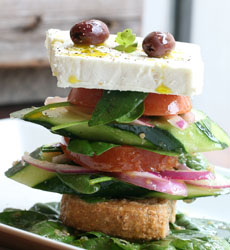
vertical-horiatiki-deathave-230

One of Death Ave’s deconstructed dishes, a stacked Greek salad. Photo courtesy Death Ave | NYC.


Then the high rise residential buildings began to pop up, many along the High Line. If you’re going to live far west in Chelsea, having a neighborhood park—especially such a hip, trendy one—is an amenity unmatched by other ‘hoods.

Along with the burgeoning numbers of visitors and residents came the restaurants. We recently visited a particularly charming one, Death Ave.

A RESTAURANT NAMED “DEATH?”

First, you’ll say: What kind of name is Death Ave for a restaurant, much less a modern Greek one?

Its location, Eleventh Avenue, was nicknamed “Death Avenue” in the late 19th century.

In the mid-1800s, the Hudson River Railroad built freight train tracks, to transport meat and other goods to the city’s bustling Meat Packing District (today, there’s no more meat packing but a loft and condo neighborhood).

Although inconceivable today, the train tracks ran at street level, right through the same avenue that was used by pedestrians and carriage traffic. Inevitably, hundreds of people were hit and killed by the trains. By the 1890s, the street was nicknamed “Death Avenue.”

The stretch of avenue where the restaurant is located is drab, but gentrification will come. And until then, restaurateur Michael Tzezailidis has built a beautiful new restaurant. A 120-year-old tenement building has been transformed into an urban oasis.


death-ave-dining-room-230
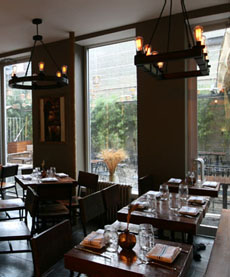
The dining room at Death Ave, looking out onto the patio. Photo courtesy Death Ave | NYC.
  The restaurant has been built with old world craftsmanship. We envied the bronze floor tiles and the handsome stone walls. The room tables are reclaimed wood.

There’s a bar for drinking and nibbling; private, curtain-enclosed booths; a main dining room with and a splendid patio with a retractable roof for rainy days. It has a large bar and lounge area along with table seating.

The menu is a creative modernization of Greek fare: a deconstructed Greek salad and souvlaki “tacos” for dinner and deconstructed ham and eggs for breakfast and brunch.

There is also more conventional fare, from a mezze plate to braised octopus and lamb shank, all stylishly served.

The cocktails are impressive (be sure to have the current specialties); and although we have to return to try the beer, there’s an in-house brewery. Death Ave is an “estiatorio and zythopoiia”; in Greek, estiatorio is a restaurant, zythopoiia is a brewery.

It’s a lovely place to relax after your stroll on the High Line.

 
Death Ave is located at 315 10th Avenue between 28th and 29th Streets (not on 11th Avenue, “Death Avenue”); 212.695.8080. You can also reserve via Open Table on the Death Ave website.


Comments off

TIP OF THE DAY: Raw Milk Cheese

Today is Raw Milk Appreciation Day.

Raw milk, another term for unpasteurized milk, is used for drinking and making cheeses. When milk is pasteurized (heated to more than 100°F/40°C), hundreds of varieties of beneficial bacteria are killed along with the potentially harmful ones.

If left alive, those good bacteria interact with the milk to provide significantly more complexity and depth of flavor to the cheese.

That’s why many connoisseurs prefer raw milk cheeses.

Due to rare but potential illness from unpasteurized milk, the FDA restricts the distribution of raw milk cheeses aged less than 60 days*; although raw milk cheeses are readily available in Europe.

So you can buy raw milk cheese in the U.S., just not fresh ones (for example, no fresh goat cheese or Camembert). The restriction also applies to imported cheeses.

Nor can retailers sell raw milk for drinking; although in its wisdom, the FDA allows consumers who visit farms bring their own containers to buy raw milk.†

THE ISSUE WITH RAW MILK

Despite modern sanitation, there are still some questionable practices in industrialized dairying.

   
ouleout-vultocreameryNYS-230b

This bloomy-rinded cheese from New York State is aged for 60 days, just enough to be legal in the U.S. It’s made by Vulto Creamery in Walton, New york. Photo courtesy Murray’s Cheese.

 
Raw milk may still harbor a host of disease-causing organisms (pathogens), including E. coli, Listeria and Salmonella and Staphylococcus aureus. A small number Americans become ill each year from raw milk-related causes; in the past, there have been periodic related fatalities in Europe.

How did mankind survive thousands of years of eating unaged raw milk cheeses?

They did it before the scourge of food industrialization. With the shift from farm to factory, there was an increase in foodborne pathogens.

In industrialized production, cows are crammed into feedlots (rather than those that graze in meadows) have a greater risk of carrying pathogens. Milk from different farms is delivered to a central processing facility. There is a much greater risk that one or more farms delivers contaminated milk.

The U.S. government instituted policies to ensure that the milk, cheese and other dairy products were not harmful to human health by insisting on pasteurization for drinking milk and young cheeses.

Many of today’s small farmers feel that fresh milk from healthy animals, handled in a responsible manner and used immediately, does not require pasteurization. They drink their own milk raw, because it is far more flavorful.

As with other foods involving potential rare pathogens—Caesar salad, mousse (it’s made with raw eggs and not cooked), steak tartare, sushi and so forth, the decision to drink raw milk or eat raw milk cheese is a personal one. As outbreaks of E.coli from meat and vegetables prove, many “legal” foods are unsafe.


baylen-hazen-whole-sliced-jaspberhill-230r
Raw milk Bayley Hazen, aged three months, is one of America’s favorite connoisseur blue cheeses. It’s made at the Cellar at Jasper Hills in Vermont. Photo courtesy Jasper Hill.
  BUY RAW MILK CHEESE TODAY

Head to a cheese store or a market with a good cheese department, and buy a selection of raw milk cheeses. They’re often not marked, so you may need a cheese specialist to point them out.

Enjoy a cheese plate for lunch—with fruits, nuts, breads or crackers and a salad on the side—or after your main dinner course, instead of dessert.

Have wine or beer with your cheese plate. After all, it’s a celebration!

 
*The 60-days rule was established in 1949, with questionable scientific evidence. It posited that within 60 days, the the acid and salt in cheese would kill the harmful bacteria. But there have been outbreaks of pathogens in both raw and pasteurized cheeses.

†It is illegal to distribute raw milk in the U.S., but the law allows consumers to go to a farm with their own containers and purchase raw milk. This is essentially ludicrous, as many who would buy it cannot get to the farms; and any containers brought from home will not be as clean as new ones used by farmers.


Comments off

12 Cheese Ball Recipes for National Cheese Ball/Cheeseball Day

April 17th is National Cheese Ball Day.

Here are 12+ cheese ball recipes, spelled cheeseball, if you prefer. The recipes are both savory and sweet (dessert cheese balls).

  • Along with a beer or a glass of wine, why not:Whip up a savory cheese ball to serve with beer, wine or cocktails.
  • For dessert or a tea party/coffee klatsch, serve a sweet cheese ball with shortbread or other cookies.
  • Consider a potluck cheese ball party: You supply the drinks, the guests make their favorite cheese ball recipes.
  •  
    The first recipe below is from Taylor Takes a Taste for EatWisconsinCheese.com.

    Also below:

    > Today’s recipe.

    > 11 more delicious cheese ball recipes.

    > Different cheeses you can use.

    > Flavorful mix-ins.

    > Different coatings for cheese balls.

    Elsewhere on The Nibble:

    > Cheese ball history.

    > The history of cheese.

    > The history of Cheddar.

    > The history of cream cheese.

    > The different types of cheese: a photo glossary.

    > The year’s 30 cheese holidays.

    > The year’s 90 snack holidays.

    > The year’s 40+ beer holidays.

    > The year’s 25+ red wine holidays.

    > The year’s 22+ white wine holidays.
     
     
    RECIPE: PIMENTO CHEESE BALL WITH SALTED PECANS

    Ingredients For 5-8 Servings

  • 2 tablespoons unsalted butter
  • 2 cups pecans
  • 1 1/2 teaspoons kosher salt
  • 2 cups (8 ounces) sharp Cheddar cheese, grated
  • 4 ounces pimentos, drained and chopped
  • 3 ounces softened cream cheese
  • 3 tablespoons mayonnaise
  • 1 tablespoon lemon juice
  • 2 teaspoons grated yellow onion
  • 1 1/2 teaspoons Worcestershire sauce
  • 1/4 teaspoon fresh cracked black pepper
  • 1/8 teaspoon hot sauce
  • 1/4 teaspoon dry mustard
  •  
    Preparation

    1. MELT the butter in a non-stick skillet. Add the pecans and toast until fragrant, but not burned. Remove from the heat and toss in the salt. Allow to cool, then chop into medium to small pieces. Set aside.

    2. PLACE the remaining ingredients into a large bowl. With a fork, mix until creamy. Chill for 1 hour.

    3. LAY about 12 inches of plastic wrap on a level surface. Scoop out the chilled pimento cheese and form into a ball on top of plastic wrap. Roll the cheese ball in the chopped pecans, making sure the entire surface of ball is covered.

    4. WRAP the ball tightly in plastic wrap and freeze. Before serving, allow the frozen ball to thaw for half an hour. Serve with your favorite crackers, chips or pretzels.
     
     
    MORE CHEESE BALL RECIPES

  • Bald Eagle Cheese Ball For July 4th
  • Christmas Pomegranate Cheese Ball
  • Cream Cheese Balls For Brunch
  • Dessert Cheese Balls
  • Halloween Nacho Cheese Ball
  • Holiday Pine Cone Cheese Ball
  • Mini Holiday Cheese Balls
  • Mini Cheese Balls For The Cheese Course
  • Pimento Cheese Ball With Pecans
  • Pine Cone Cheese Ball With Pecans
  • Pomegranate Arils Cheese Ball
  •  

    Herb & Nut Coated Cheese Ball
    [1] While many cheese balls are coated in crushed nuts, this one adds fresh herbs for vibrant appearance and taste. Here’s the recipe. You’ll find more delicious coating ideas below (photos #1, #4, #5, #6, #7, and #8 © Taste Of Home).


    [2] How about a cheese ball covered in bacon, jalapeños and pecans? Here’s the recipe (photo © Brown Eyed Baker).

    Mini Cheese Balls
    [3] Mini cheese balls in phyllo cups. Here’s the recipe from A Spicy Perspective (photo © A Spicy Perspective).

    Crab Rangoon Cheese Ball
    [4] Crab Rangoon Cheese Ball. Here’s the recipe.

    Cheese Ball With Crackers
    [5] Serve different crackers, toasts, and breads with the cheese ball.

     
    Pumpkin Cheese Ball
    [6] It’s not hard to make this pumpkin-shaped cheese ball. Here’s the recipe. 
     
     
    DIFFERENT CHEESES TO USE FOR CHEESE BALLS

    While the traditional cheese ball is usually built on a foundation of cream cheese and sharp Cheddar, the possibilities can employ any cheeses with the texture and flavor profile you desire. The most important combination is one with spreadability.
     
     
    Soft Cheese(s) For The Foundation

    To start, you need a “binder” cheese that’s soft enough to mix but firm enough to hold a spherical shape once chilled.

  • Cream Cheese: The most popular base, it provides the necessary structure and a neutral, slightly tangy base.
  • Goat Cheese (Chèvre): For goat cheese lovers, its distinct earthy tang is a delight. It’s often blended with a bit of cream cheese to ensure it doesn’t get too crumbly.
  • >Mascarpone: This richer, silky cheese is popular in dessert cheese balls.
  • Neufchâtel: This slightly lower-fat alternative to cream cheese maintains a similar structural integrity.
  •  
     
    The “Flavor” Cheeses

    These are usually semi-hard cheeses, finely shredded so they incorporate evenly into the soft base.

    For the best results, always grate the cheeses yourself. Pre-shredded bagged cheeses are coated in potato starch or cellulose to prevent clumping, which can give your cheese ball a slightly grainy or waxy mouthfeel.

  • Gouda or Smoked Gouda: Adds a buttery sweetness or a campfire-depth to the mix.
  • Pepper Jack: Perfect for adding a bit of “kick” and moisture.
  • Sharp Cheddar: The most common choice, it delivers a bold color along with its familiar, punchy flavor.
  • Swiss or Gruyère: A popular combination with bacon and almonds, with any mix-ins it provides a nuttier, more sophisticated profile. See the *footnote about Swiss vs. Gruyere below. Here’s the difference between French Gruyère and Swiss Gruyère.
  •  
     
    The “Accent” Cheeses

    These are crumbles typically folded in sparingly to add dimension without overwhelming the “flavor” cheese. However, you’re the chef here: Add as much as you want to, to achieve your desired flavor profile.

  • Blue Cheese or Gorgonzola: For cheese lovers who want a sharp, pungent profile, these deliver. They’re especially great with after-dinner dessert wines, including Port,
  • Feta: Used in Mediterranean-style cheese balls, the natural mix-ins are chopped olives and sun-dried tomatoes with dill or oregano.
  • Parmesan or Pecorino Romano: Often as an outer coating, when finely grated into the mix it adds a salty, umami finish.
  •  
     
    Pioneer Woman Cheese Ball
    [7] This recipe, popularized by the Pioneer Woman, has bacon and scallions into the classic Cheddar-cream cheese base.
     
    FLAVORFUL MIX-INS

    You can build layers of flavor and texture in the interior of the cheese ball. Since the base is dense, chop the mix-ins finely. Be sure to thoroughly pat dry “wet” ingredients.

  • Crunchy mix-ins: nuts, single variety or a mix.
  • Savory Mix-Ins: capers, crispy bacon, olives, pickles, pimentos, sundried tomatoes.
  • Zesty Mix-Ins: horseradish, lemon or lime zest (especially in the cream cheese), pickled jalapeños, scallions, Worcestershire sauce.
  • Sweet Mix-Ins: dried cherries, cranberries, or other dried fruit.
  •  
     
    OUTER COATINGS FOR CHEESE BALLS

    The classic coatings are crushed pecan or walnuts, which are delicious. But there’s so much more to consider.

    The goal of the coating or “crust” is to find something that provides a crunch or a flavor pop to contrast with the cheeses. Consider:

  • Arty: Finely crushed beet, carrot, or kale chips provide intense color and earthy flavor.
  • Crushed & Crispy: Crushed crackers, fried onions, garlic chips, pretzels, tortilla or veggie chips, plus panko breadcrumbs. With this group, roll the coating right before serving to forestall sogginess.
  • Everything Bagel Seasoning: A powerhouse combo of sesame seeds, poppy seeds, dried garlic, and onion.
  • Fresh Herbs: Finely chopped chives, cilantro, dill, or parsley gives the cheese ball a vibrant appearance.
  • Spices & Seeds: toasted black/white sesame mix, caraway, fennel seeds, nigella, or other favorite seeds; or for heat, a heavy dusting of smoked paprika and chili flakes.
  •  
    Garlic Parmesan Cheese Ball
    [8] In addition to crackers or baguette slices, add crudités to the plate. Here’s the recipe for this Garlic Parmesan Cheese Ball
     
    ________________
     
    *The difference between “Swiss” and Gruyere cheeses: There are five different categories of cheese made in Switzerland. However, when Swiss cheese makers immigrated to the U.S. the hard style called Emmental/Emmenthal/Emmentaler, hard with large holes (called eyes), was the style Americans learned to think of as “Swiss cheese.” Not all authentic types of Swiss cheese are hard or have eyes.
     

    CHECK OUT WHAT’S HAPPENING ON OUR HOME PAGE, THENIBBLE.COM.


    Comments off


    © Copyright 2005-2026 Lifestyle Direct, Inc. All rights reserved. All images are copyrighted to their respective owners.