THE NIBBLE BLOG: Products, Recipes & Trends In Specialty Foods
Also visit our main website, TheNibble.com.
|
June 22, 2015 at 8:34 am
· Filed under Cookies-Cake-Pastry, Food Fun
|
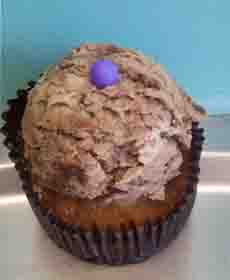
A fresh-baked cupcake topped with cookie dough. Photo courtesy Carolina Cupcakery. |
|
Who needs icing?
Carolina Cupcakery tops this cupcake with a scoop of cookie dough.
Who can top that?
Make your own cookie dough, or top your homemade cupcakes with a slice from a roll of cookie dough.
If you’re concerned with raw eggs, read the label on purchased dough to see if the eggs are pasteurized. If not, make your own cookie dough with Safe Eggs pasteurized eggs.
For more cupcake fun, visit CarolinaCupcakery.com.
THE DIFFERENCE BETWEEN FROSTING & ICING
Although the words are used interchangeably, professional bakers know that there’s a difference:
Frosting is made with table sugar (granulated sugar).
Icing is made with confectioner’s sugar (also called icing sugar).
|
Of course, when you top the cake with cookie dough, there’s no issue!
|
|
|
Permalink
|
|
June 22, 2015 at 8:18 am
· Filed under Fish-Seafood-Caviar, Recipes, Vegetables-Salads-Herbs
|
|
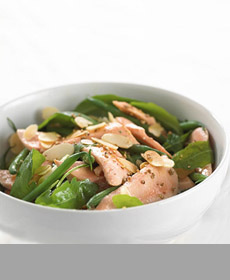
We first made this recipe from Maille with leftover poached salmon from the fridge. Subsequently, we made it as specified, with warm poached salmon. Both are equally delicious.
The recipe serves four as a first course, two as a main course. Prep time is 5 minutes, cooking time is 15 minutes.
RECIPE: SUMMER SALAD WITH POACHED OR GRILLED
SALMON
Ingredients
12 ounces salmon fillets
8 ounces green beans, trimmed (substitute sugar snap peas)
1 heaping teaspoon Dijon mustard
Juice and peel of ½ lemon
¼ cup olive oil
Salt and freshly ground pepper to taste
1 cup arugula
¼ cup slivered almonds, toasted
|
|

Poached salmon salad: a taste of summer. Photo courtesy Maille. |
Preparation
1. POACH salmon in large skillet filled with lightly salted water until salmon turns opaque, about 10 minutes. Remove salmon and keep warm.
2. COOK the green beans in medium saucepan filled with lightly salted water until tender, about 5 minutes; drain and keep warm.
3. WHISK together the mustard, lemon juice, lemon peel, olive oil and salt and pepper; set aside.
4. PEEL the skin from the salmon, then flake the salmon into large pieces. Toss the arugula with the green beans, then add the salmon.
5. ADD the dressing and toss lightly. Plate, garnish with almonds and serve.
|
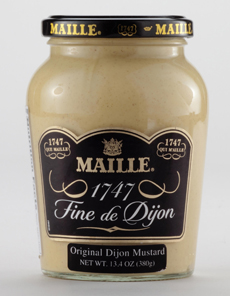
A fine food staple since 1747. Photo courtesy Maille. |
|
MUSTARD TRIVIA
Mustard is a cruciferous vegetable. Mustard greens are the leaves of the mustard plant). It is part of the genus Brassica, which also includes bok choy, broccoli, Brussels sprouts, cabbage, cauliflower, collards, kale, radish, rapeseed, turnips and other vegetables.
Whole mustard seeds have no heat. Mustard seeds, from the flower of the mustard plant, don’t have heat and pungency until they are cracked and mixed with a liquid. This causes a reaction between two components of the seed (the enzyme myrosinase and the mustard oil glycosides), which produces a sugar and several chemical irritants.
MORE MUSTARD
The history of mustard
The different types of mustard
More Mustard Trivia
|
|
|
|
Permalink
|
|
June 22, 2015 at 7:49 am
· Filed under Fruits, Nuts & Seeds, Tip Of The Day, Vegetables-Salads-Herbs
|
|
Following our recent article on spring produce, here’s what’s in season for summer. Not everything may be available in your area, but what is there should be largely American-grown—not imported from another hemisphere.
Some of the items are harvested for only a few weeks; others are around for months. So peruse the list, note what you don’t want to miss, and add it to your shopping list.
The list was created by the Produce For Better Health Foundation. Take a look at their website, FruitsAndVeggiesMoreMatters.org for tips on better meal planning with fresh produce.
SUMMER FRUITS
Acerola/Barbados Cherries
Apricots
Asian Pear
Black Crowberries
Black Currants
Blackberries
Blueberries
Boysenberries
Breadfruit
Cantaloupe
Casaba Melon
|
|
If you’ve never had fresh lychees, this is the season to get your fill! Photo courtesy Baldor Food. |
|
Champagne Grapes/Corinthian Currants/Zante Currants
Crenshaw Melon
Durian
Elderberry
Fig
Galia Melon
Grapefruit
Grape
Honeydew Melon
Jackfruit
Lime/Key Lime
Loganberry
Longan
Loquat
Lychee (photo above)
Mulberry
Nectarine
Olallieberry*
Passion Fruit
Peach
Persian Melon
Plum
Raspberry
Rose Apple†
Sapote/Sapodilla
Strawberry
Sugar Apple
Watermelon
*Olallieberries, developed in 1949 by the U.S. Department of Agriculture at Oregon State University by crossing a loganberry with a youngberry. They are two-thirds blackberry, one-third European red raspberry.
†Rose apples are not related to European apples (family Rosaceae), which originated in Turkey. They are members of the myrtle family, Myrtaceae. Native to the East Indies, they are also known as plum roses and Malabar plums.
|
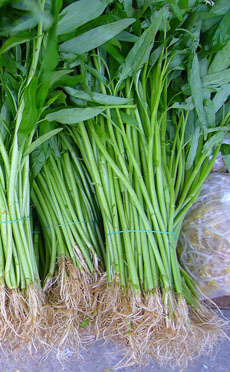
Ong choy, Chinese water spinach. Photo by Eric | Wikimedia. |
|
SUMMER VEGETABLES
Anaheim Chile
Armenian Cucumber‡
Beet
Bell Pepper
Butter Lettuce
Chayote Squash
Chanterelle Mushrooms
Chinese Long Bean
Corn
Crookneck Squash
Cucumber
Eggplant
Endive
French Bean
Garlic
Green Bean
Green Soybean (Edamame)
Heart of Palm
Jalapeño Chile
|
|
Lima Bean
Okra
Ong Choy Water Spinach (photo above)
Pea
Radish
Shallot
Sugar Snap Pea
Summer Squash
Sweet Onions
Tomatillo
Tomato
Winged Bean
Yellow Squash
Yukon Gold Potato
Zucchini
Enjoy the feast!
‡The Armenian cucumber, Cucumis melo var. flexuosus, is a long, slender fruit which tastes like a cucumber and looks somewhat like a cucumber inside. It is actually a variety of muskmelon, a species closely related to the cucumber. However, cucumbers and melons are botanical first cousins. Both are from the binomial order Cucurbitales, family Cucurbitaceae and genus Cucumis, differing only at the species level. Watermelon rind is edible and tastes like cucumber. That’s why it is often turned into pickles, like cucumbers.
|
|
|
Permalink
|
© Copyright 2005-2026 Lifestyle Direct, Inc. All rights reserved. All images are copyrighted to their respective owners.