|
May is National Coffee Cake Month, April 7th is National Coffee Day. Those are two reasons why a coffee cake lover should consider baking a coffee cake.
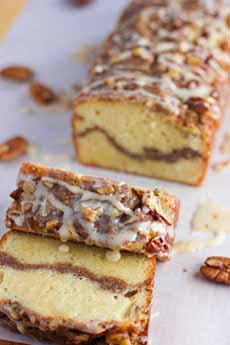
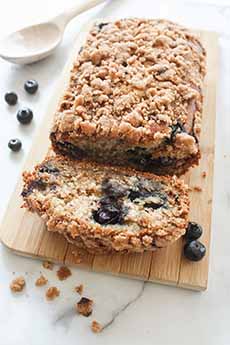
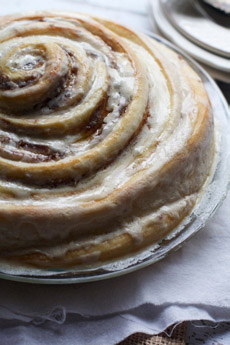
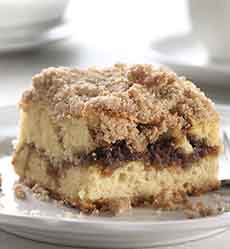
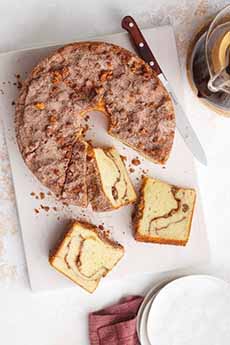
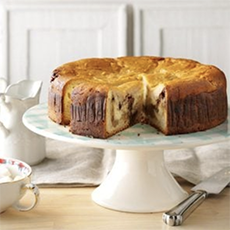
Coffee cake is a yeast-leavened cake that’s typically served at breakfast or as a snack with coffee or tea. It is often glazed with a white confectioner’s sugar icing (photo #1) or topped with streusel (photo #2). The latter is also called crumb cake.
Many of us would love a delicious piece of coffee cake with our morning coffee. But finding a really delicious one is getting harder and harder.
If you can find an artisan-baked coffee cake in your area, great. We live in a big city where the rents are so high that the beloved neighborhood mom-and-pop bakery serving up great coffee cake is largely a thing of the past.
So the only solution: Order by mail (check out this terrific povitica, an Eastern European coffee cake) or bake your own.
You won’t be too surprised to learn the origin of coffee cake.
Below:
> The history of coffee cake.
> Modern coffee cake.
> Seasonal recipes for modern times.
Elsewhere on The Nibble:
> The history of coffee.
> The history of cake.
> The different types of cake: a photo glossary.
> The different types of coffee: a photo glossary.
> The year’s 55 cake holidays.
> The year’s 25 coffee holidays.
THE HISTORY OF COFFEE CAKE
Food historians generally agree that the tradition of eating sweet cakes with coffee originated in northern or central Europe in the 17th century—particularly in Austria, Denmark, and Germany—when coffee was introduced from the Middle East.
Early coffee cakes were typically yeasted sweet breads, rather than the yeast cakes we enjoy today.
The modern coffee cake might not have evolved as it had without the creation of the coffee klatsch (Kaffeeklatsch in German) in the mid-18th century. The term comes from the German words “kaffee” (coffee) and “klatsch” (gossip or chat).
While men were free to go to coffee houses, these were males-only domains where politics, business, and current events were discussed.
The coffee klatsch, an informal social gathering of friends and neighbors, enabled women to create their own version.
They would gather in mid-afternoon to enjoy coffee, cake, and discuss community news and gossip (Klatsch).
It was one of the few acceptable ways for women to gather without male supervision, providing women with opportunities to share information, build community connections, and develop social networks at a time when their public roles were limited.
The coffee klatsch rotated among homes and became formalized with specific customs, including showcasing homemade cakes and pastries and serving Kaffee und Kuchen (coffee and cake) on one’s best china.
Households in went from serving areas already The sweet yeast breads of Northern Europe, evolved into “coffee cake,” yeast cake made with flour, eggs, sugar, yeast, nuts, dried fruit, and spices.
The Klatsch Arrives In America
The custom spread to neighboring countries. When European immigrants came to America in the 1700s and 1800s, they brought their coffee cake-and-klatsch traditions with them.
But England, even though it had coffee houses at the same time as other countries in Europe, did not adapt the coffee klatsch concept for women. Instead, it created its own ritual: afternoon tea.
The practice began in the 1840s when Anna, the Duchess of Bedford, started requesting tea and light refreshments in the late afternoon to bridge the long gap between lunch and dinner. She began inviting friends to join her, and the custom quickly spread throughout aristocratic and upper-class circles. Here’s more about it.
When the crumb topping called Streusel originated in Germany in the early 19th century, that crumbly mixture of flour, butter, sugar, and sometimes nuts was quickly ported to coffee cakes. It became a defining characteristic of American coffee cakes during the 20th century.
By the late 19th century, coffee cake had become firmly established in American culinary culture. The introduction of chemical leavening agents like baking powder and baking soda in the mid-1800s transformed coffee cakes from dense, bread-like creations to the lighter versions we enjoy today.
Inevitably, regional variations of coffee cake emerged. The Midwest liked their coffee cake made with sour cream, and New Englanders went for cinnamon-heavy recipes.
Cream cheese, an American creation of the late 19th century (the history), was incorporated into some recipes.
More elaborate recipes incorporated cream cheese, jam, or fruit curd. The mid-20th century found the newly-popular yogurt used by some in place of sour cream, and others added creamy fillings and ribbons of chocolate.
But the story doesn’t end there…

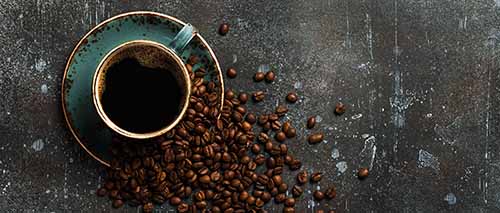
[11] Time to make the coffee (photo © Vadims Puzdrans | Dreamstime).
MODERN COFFEE CAKE
Coffee cake has evolved considerably in recent decades, adapting to changing tastes, dietary preferences, and culinary trends.
These modern adaptations maintain the essence of traditional coffee cake while re-imagining it for contemporary palates and trends.
Flavor Innovations
Global cuisine influence has led to the incorporation of ingredients like matcha, chai spices, cardamom, and tahini. Not to mention miso butterscotch!
Artisanal coffee popularity has led to using specialty coffee in the batter or glaze: cold brew concentrate, espresso, and dual flavors such as caramel macchiato and mocha.
Herbs and spices comfort has led to the incorporation of basil, black sesame, lavender, rosemary, and thyme, have made their appearances, sometimes paired with fresh fruits.
Health-Conscious Adaptations
Whole grain interest has led to using spelt, whole wheat, or ancient grains.
Reduced sugar requests have led to substituting traditional sugar with monk fruit, stevia, or coconut sugar.
Gluten-free diets have switched wheat flour to almond flour, oat flour, or gluten-free flour blends.
Veganism has provided plant-based substitutions like flax eggs, plant milks, and coconut oil.
Structural Innovations
Single-serve formats include individual coffee cake muffins or cups.
Pull-apart versions, along the lines of monkey bread, have created tear-and-eat formats.
Layer cake formats, such as multiple thin layers of cake alternating with filling and streusel.
Bundt pans have engaged the variety of Bundt pan designs for new aesthetics, as well as affording tunnels of filling or glaze.
Serving Innovations
Coffee cake breakfast bowls incorporate crumbled coffee cake as part of açaí or yogurt bowls.
Deconstructed coffee cakes created by fine pastry chefs.
Seasonal special, beginning with pumpkin spice (to serve with pumpkin spice lattes, of course) varieties in fall, berry versions in summer.
WANT TO CREATE YOUR OWN SEASONAL COFFEE CAKE?
Become famous in your crowd for a monthly open house “coffee klatch” with revolving flavors:
Spring Coffee Cakes
Carrot cake-inspired coffee cake with cream cheese swirl.
Lavender honey coffee cake with floral notes.
Lemon poppyseed coffee cake with fresh citrus zest.
Meyer lemon and blueberry coffee cake.
Strawberry rhubarb coffee cake with pink glaze.
Summer Coffee Cakes
Coconut lime coffee cake with tropical flavors.
Fresh peach coffee cake with almond streusel.
Triple berry (raspberry, blackberry, blueberry) coffee cake.
Stone fruit coffee cake featuring nectarines, plums, or cherries.
Sweet corn coffee cake with blackberry jam (using kernels of fresh summer corn).
Early Fall Coffee Cakes
Apple cider coffee cake soaked in reduced cider.
Concord grape coffee cake with seed crunch topping.
Fig and honey coffee cake with rosemary.
Maple walnut coffee cake with foraged nuts.
Poached pear coffee cake with warm spices.
Winter/Holiday Season Coffee Cakes
Cranberry orange coffee cake with sugared cranberries.
Eggnog coffee cake with nutmeg and rum glaze.
Gingerbread coffee cake with molasses and warming spices.
Maple pecan coffee cake with bourbon glaze.
Peppermint chocolate coffee cake with crushed candy canes.
Pumpkin spice
|
|
[1] Classic coffee cake with a cinnamon ribbon, topped with icing and nuts. Here’s the recipe (photo © Laughing Spatula).
[2] Streusel was invented in Germany in the 19th century, and became a popular topping for coffee cake (photo © Izabelle Acheson | Wesual | Unsplash).
[3] The “cinnamon roll” coffee cake was designed to look like a giant cinnamon roll. Here’s the recipe (photo © The Baker Chick).
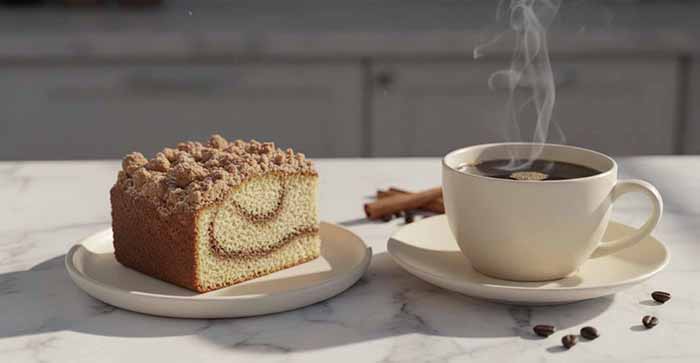
[4] A classic streusel-topped coffee cake with a cinnamon ribbon running through the center. Here’s the recipe (photo © King Arthur Baking).
[5] A coffee cake inspired by the blueberry muffin. It takes just 10 minutes to mix, and 40 minutes in the oven. Here’s the recipe (photo © The Baker Chick).
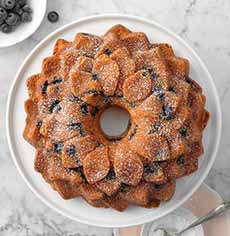
[6] Fancy Bundt pans enabled a new aesthetic. Here’s the recipe for this blueberry and sour cream coffee cake (photos #6, #7, #8, #9, and #10 © Taste Of Home).
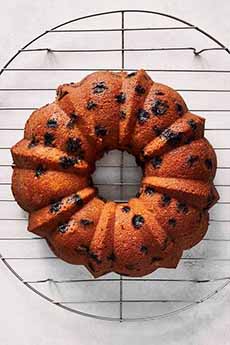
[7] The cake looks good in the traditional Bundt pan, too. Here’s the recipe.
[8] You can also bake a coffee cake in a tube pan. Here’s the recipe.
[9] Coffee cakes with modern touches follow. Here, a cream cheese cinnamon roll coffee cake. Here’s the recipe.
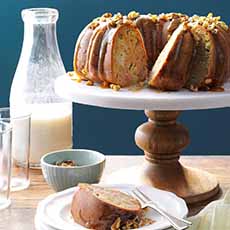
[10] Caramel apple coffee cake with walnuts. Here’s the recipe.
|