THE NIBBLE BLOG: Products, Recipes & Trends In Specialty Foods


Also visit our main website, TheNibble.com.

JULY 4TH RECIPE: Red, White & Blue Potato Salad

Whenever we’re asked to a July 4th party, we always bring our Red, White & Blue Potato Salad. It’s special on Independence Day and potato salad occasion.

While we generally enjoy sharing, we keep our exact recipe a secret. We worked for years to get the dressing right!

But the United States Potato Board sent us a substitute red, white and blue potato salad recipe. It mixes three different potato types with onions, bell peppers, and ham in a balsamic vinaigrette. This fancy potato salad is a world away from a potato-mayonnaise mix, a delight for potato salad fans.

The recipe was created by Jill Melton, MS, RD, former senior food editor of Cooking Light and director of communications for Food Insight. We had bacon on hand and substituted it for the ham: delicious!

And a bonus: Here’s another red, white and blue potato salad recipe, with white stars cut from non-browning Envy apples.

> Fun potato trivia (below).

> The history of potatoes.

> The different types of potatoes.

> 60 more red, white and blue recipes.
 
 
RED, WHITE & BLUE POTATO SALAD RECIPE

Ingredients
 

  • 1 pound small white potatoes (Creamer,* Fingerling or Yukon Gold)
  • 1 pound small red potatoes
  • 12 ounces Purple Peruvian potatoes
  • 3 tablespoons walnut oil or olive oil, divided
  • 2 ounces chopped ham or bacon
  • 1/3 cup chopped walnuts
  • 8 garlic cloves, finely chopped
  • 3 tablespoons sherry or white balsamic vinegar
  • 1 cup finely chopped red or orange bell pepper
  • 4 green onions, chopped
  • 1/2 teaspoon salt
  • 1/4 teaspoon freshly ground pepper
  •  
    Preparation

    1. Cut the potatoes into 1-1/2 inch pieces (do not peel). Steam for 25 minutes or until the potatoes are tender.

    2. Heat 1 tablespoon of oil in a medium skillet. Add ham, walnuts, and garlic. Sauté 10 minutes. Add sherry vinegar, and stir well.

    3. In a large bowl, toss ham mixture with potatoes, additional 2 tablespoons of oil, red pepper, green onions, salt, and pepper. Serve warm or cold with grilled steak, burgers, chicken, or fish.
     
     
    Find more delicious potato recipes from the U.S. Potato Board.

     
    [1] A potato salad for any festive occasion (photo © U.S. Potato Board).
    Red, White & Blue Potatoes For July 4th Potato Salad
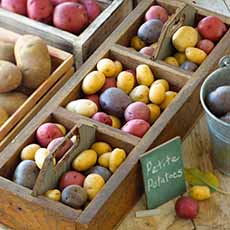
    [2] Petite potatoes in red, white, and blue (photo © Potato Goodness).
    Purple Peruvian Potatoes For July 4th Potato Salad
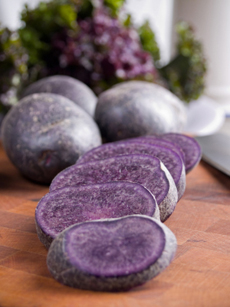
    [3] Some varieties of purple potatoes have a more blue hue, but for July 4th, we’ll pretend these are blue (photo © Mona Makela | iStock Photo).

     
    ________________

    *Creamer potatoes are potatoes that are harvested while young, tender, and small—often as little as one inch in diameter. The flesh contains a lower level of starch, which makes them suitable for boiling. Creamer potatoes are typically Yukon Gold or red potatoes, which are called gold creamers or red creamers, respectively.


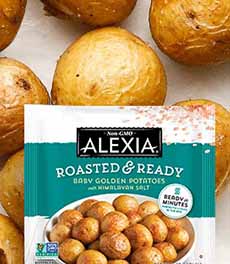
    Alexia Brand Frozen Potatoes
    [4] Most of the potatoes sold in the U.S. are frozen. A large amount is sold to restaurants and other foodservice (photo © King Soopers).

    [5] Fresh potatoes are the second largest category. These Yukon Gold potatoes are a favorite of chefs and foodies (photo © Bonnie Plants).

      POTATO TRIVIA

    According to the USDA Economic Research Service, potatoes are the largest vegetable crop in the U.S., with an annual production of 41.3 billion pounds. More than one million acres of potatoes are planted annually—the equivalent of filling the entire state of Rhode Island with potato plants.

    The U.S. Per Capita Potato Consumption is 117 pounds a year. Here’s the breakdown of what we eat, based on the 2010 forecast:

  • Frozen Potatoes: 50 pounds
  • Fresh Potatoes: 37 pounds
  • Potato Chips: 17 pounds
  • Dehydrated Potatoes: 12 pounds
  • Canned Potatoes: 1 pound
  •  
     
    TOP 10 POTATO PRODUCING STATES
    (in Billion Pounds)†

    Potatoes are grown in all 50 states, but most of those 41.3 billion pounds are grown in:
    1. Idaho 11.5
    2. Washington 9.3
    3. Wisconsin 2.9
    4. Colorado 2.3
    5. North Dakota 2.3
    6. Minnesota 2.0
    7. Oregon 1.9
    8. Michigan 1.5
    9. California 1.5
    10. Maine 1.5

    ________________

    †2008 Figures from USDA/NASS.


    CHECK OUT WHAT’S HAPPENING ON OUR HOME PAGE, THENIBBLE.COM.


    Comments off

    TIP OF THE DAY: How To Stop Grilled Meat Carcinogens

    Grilled food tastes great. But the ugly truth most of us try to forget is that grilling animal proteins—beef, fish, lamb, pork and poultry—as well as pan frying them, produces carcinogens. The more well-done the meat, the more carcinogens. (Here’s the scoop from the National Cancer Institute.)

    Consuming dietary carcinogens has been associated with different cancers in humans; a new study has shown that they can cause prostate cancer in rats.

    Research has shown that grilled beef is a major source of dietary HCAs when cooked at temperatures of 375°F and above.

    Now, ScienceNewsDaily.com, which reports on the latest research, offers a cure…or rather, a marinade. All it takes is marinating the protein with certain antioxidant herbs and spices to prevent HCAs from forming in cooked meats.

    J. Scott Smith, Ph.D, a professor of food chemistry at Kansas State University, conducted research for the Food Safety Consortium to discover what effect marinating steaks could have on reducing carcinogenic compounds (HCAs and PAHs*) produced by grilling.

     
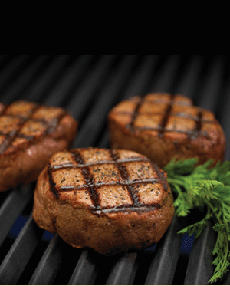
    Filets mignon on the grill. Photo courtesy AllenBrothers.com.
     
    *Heterocyclic amines (HCAs) and polycyclic aromatic hydrocarbons (PAHs) are chemicals that form when muscle meat—including beef, fish, lamb, pork and poultry—is cooked using high-temperature methods, such as pan frying or grilling directly over an open flame. Both have been found to cause cancer in animals, and some tests have correlated with cancer in humans.

    The findings: Cooking meats with specific herbs and spices decreases or eliminates HCAs on meat, up to 87%. Dr. Smith and his team successfully used spices in the mint family: basil, marjoram, mint, oregano, rosemary, sage, savory and thyme. Most of these herbs are rich in three potent antioxidants: carnosic acid, carnosol and rosmarinic acid.

    The herbs and spices were contained in a supermarket brand of powdered marinade containing rosemary and thyme. The cooked meat’s level of reduced HCAs correlated to the amount of antioxidant herbs and spices present in the marinades.

  • The marinade containing rosemary and thyme had the greatest effect on reducing HCAs.
  • The rosemary/thyme marinade that contained pepper, allspice and salt, was found to be almost as effective.
  • Two other effective marinades included oregano, thyme, garlic and onion; and oregano, garlic, basil, onion and parsley, respectively.
  •  
    You can make your own marinades using these herbs. And certainly, add the herbs and spices directly to ground beef. Rosemary and thyme are delicious additions to any protein.
     
    Here’s the original article.
      

    Comments off

    TOP PICK OF THE WEEK: Veggie Patch Meatless Cuisine


    Meatless corn dogs are one of the vegetarian
    treats from Veggie Patch. Photo courtesy
    Veggie Patch.

      Some people choose to go meatless for ethical, health, religious or environmental reasons. While we’re on the sustainable, environmental bandwagon, we buy meatless prepared foods like Veggie Patch because they’re delicious.

    This vegetarian line includes family favorites:

  • Meatless Corn Dogs, Meatless Meatballs, Ultimate Meatless Burgers, Veggie Dogs
  • Chick’n Cutlets, Chick’n Nuggets, Meatless Buffalo Wings
  • Traditional Falafel Chickpea Balls and Mediterranean Chickpea Patties with added spinach and onion
  • Snacks and sides including Broccoli Bites With Cheese, Spinach Bites With Cheese, Potato And Mushroom Puffs, Spinach Nuggets and Zucchini Sticks
  •  
    Chick’n and Veggie Dogs taste like the real, meaty deal; and the Broccoli Bites and Spinach Bites will convince everyone to eat more veggies.

    Try them all!

    See all of the Top Picks Of The Week.


    Comments off

    TIP OF THE DAY: Steak Grilling Tips

    If you’re grilling steaks on July 4th, here’s how to keep the sizzle and avoid the fizzle: grilling tips from Carlos Garcia, Executive Chef at Sullivan’s, Austin’s* premier steakhouse. In the cattle-rich, red-meat-loving state of Texas, you’ve got to get it right!

    *There are 20 Sullivan’s locations across the U.S. See the website for the roster of cities.

    Here are Chef Garcia’s tips to avoid the most common grilling “misteaks”:

    MISTEAK #1: Going Too Lean

    Marbling is what delivers the flavor: It is one of the most important factors in steak selection. When selecting your meat, look for small streaks of fat and you’ll have a more flavorful steak. But, the more marbled the cut, the pricier the meat. The solution (approved by your healthcare provider): Eat smaller amounts of better meat.

    MISTEAK #2: Taking Meat Directly From Fridge To Grill

    Take the steak out of the refrigerator and let it come to room temperature before you start grilling. This engenders more even cooking and more tender meat.

     
    A beautiful rib-eye steak from AllenBrothers.com.
     
    MISTEAK #3: Under- Or Over-Seasoning

    The steak should be the star. Avoid heavy marinades, butter and rubs; let the flavor of the meat shine by simply seasoning with salt and pepper. Chef Garcia recommends larger-grain salt, such as kosher salt or coarse sea salt, and cracked pepper. He advises, “Be generous but not heavy handed.”

    MISTEAK #4: Skipping The Pre-Heat

    For the best prep, the grill should always be preheated before the steak goes on. Gas grills require 5-10 minutes; charcoal grills may take a bit longer. When using a charcoal grill, make sure the coals are white hot: They will produce the most heat. Searing first will help keep the seasonings on the steak through the cooking process.

    MISTEAK #5: Not Letting The Steak Rest

    Pull the steak off the grill and let it rest for 5-10 minutes before serving. While the meat rests, the hot juices are absorbed back into the muscle, making it juicier and more tender.

    DO YOU KNOW YOUR CUTS OF BEEF?

    Check out our beautiful Beef Glossary.


    Comments off

    RECIPE: The Reverse Steak Salad (Or Grilled Chicken Or Fish Salad)


    Add the salad on top of a skirt steak. Photo
    © ChickenFriedGourmet.com.
      We recently discovered Louisiana chef Michael O’Boyle, who writes the blog ChickenFriedGourmet.com. The photo gallery on the site is an inspiration to lovers of nouvelle cuisine, and has inspired us to cook up a storm based simply on his concept.

    Lucky people in the Shreveport area can take part in Chef O’Boyle’a Gulf Pig Underground Dinner Club, with changing locations and menus. (Next up: a dinner in late July/early August and two in September/October.)

    Chef O’Boyle is a consulting chef to the Louisiana Seafood Promotion and Marketing Board, which acquainted us with him by sending one of his recipes.

    While most home cooks may not want to take on his Tomato Gelée, it’s easy to whip up his reversal of the conventional steak salad, greens topped with sliced steak.

    Here, the positions are reversed.

     
    Chef O’Boyle topped a skirt steak with pickled green tomatoes and a baby arugula salad, garnished with Parmesan cheese. Create your own variations with this template:

    Ingredients

  • Protein. Take your pick: beef, lamb, pork, poultry or tofu.
  • Pickled Vegetable. It’s easy to pickle your favorite veggies: asparagus, bell peppers or hot chiles, cabbage, carrots, cucumbers, jicama, mushrooms, onions, summer squash, tomatoes, etc. Here’s a quick and easy recipe; you can pickle in as little as an hour in advance.
  • Salad. Look for “flexible” greens that can be mounded atop the protein, as opposed to stiff lettuces. We like baby arugula and spinach, mâche and mixed baby greens. Toss the salad lightly in vinaigrette right before serving. A good recipe: Whisk together 3 tablespoons olive oil, 2 tablespoons vinegar and 1 teaspoon Dijon or whole grain mustard.
  • Garnish. Choose from croutons, freeze-dried vegetables (see Crunchies), dried berries, cheese (crumbled blue cheese, grated Parmesan), slivered nuts, etc.
  •  
    Preparation

    1. Pickle the vegetables (this can be done up to a week in advance).

    2. Cook and plate the protein.

    3. Top the protein with the dressed salad.

    4. Garnish and serve.


    Comments off

    The Nibble Webzine Of Food Adventures
    RSS
    Follow by Email


    © Copyright 2005-2026 Lifestyle Direct, Inc. All rights reserved. All images are copyrighted to their respective owners.