|
August 23rd is National Sponge Cake Day. It celebrates an airy cake that’s just right for summer, garnished with fresh berries and whipped cream.
Below:
The different types of sponge cakes.
Sponge cake variations.
THE HISTORY OF SPONGE CAKE
The modern sponge cake dates to Europe in the early 19th century. Precursors were cookie-sized treats called biscuit bread and sponge fingers (a.k.a. boudoir biscuits, ladyfingers, Savoy biscuits [English] and savoiardi [Italian]); as well as sweet “slices of bread” from Italy, Portugal, and Spain.
These earlier forms date back to the Renaissance (15th century) and were used in numerous desserts including trifles and fools. Early 17th century English cookbook writers note that recipes for fine bread, bisquite du roy [roi, i.e. king] and common biscuits were similar to sponge cake.
Savoiardi, ladyfingers, originated in the late 15th century at the court of Catherine of Medici, created to mark the occasion of a visit by the King of France to the Duchy of Savoy.
The recipe found its way to England in the early 18th century.
The sponge cake is thought to be one of the first of the non-yeasted cakes; the rise comes from well-beaten eggs.
The earliest recipe in English is found in a 1615 book by Gervase Markham*. The term “sponge cake,” describing the sponge-like openness of the crumb, probably came into use during the 17th century.
The earliest reference cited in the Oxford English Dictionary is in an 1808 letter written by Jane Austen, who apparently was fond of them. [Source: Food Timeline]
THE MODERN SPONGE CAKE
The modern American sponge cake is a light-textured cake made of eggs, sugar, and flour†; there is no fat or leavening. The rise comes from the beaten egg whites. The French sponge, génoise, is used for thinner cake layers, so the egg whites and yolks are beaten together.
Sponges can be baked in cake pans, tube pans, or sheet pans. They can be used to make layer cakes, tube cakes, roulades (rolled cakes), and cupcakes. They can be variously flavored and filled.
The basic sponge cake recipe is also used to make ladyfingers and madeleines; slices can be used instead of biscuits to make a shortcake.
_________________
*“The English Huswife, Containing the Inward and Outward Virtues Which Ought to Be in a Complete Woman.”
†Since sponge cakes are not leavened with yeast, they can be eaten during Passover, made with matzo meal instead of wheat flour.
_________________
|
|
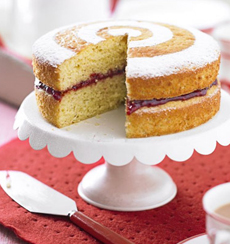
[1] A Victoria Sandwich is a sponge. Queen Victoria’s favorite filling was raspberry jam, but you can use any jam you like (photo © Stylenest; here’s the recipe).

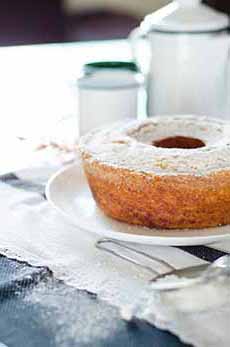
[2] A sponge cake made in a tube pan, garnished with powdered sugar (photo © Isabella Mendes | Pexels).
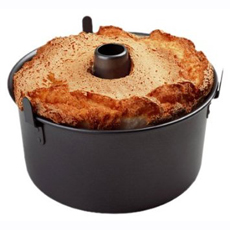
[3] A simple American sponge cake, made in a tube pan (photo © Chicago Metallic Bakeware). Use a tube pan with feet, since sponge cake (as well as angel cake) must be inverted to cool, without touching the counter. |
TYPES OF SPONGE CAKES
American Sponge Cake
The American Sponge is a high-rising cake, gaining volume from the air whipped into the egg whites and yolks. The dry ingredients (flour, baking powder, salt are folded in. Then the egg whites and more sugar are beaten until stiff and folded into the yolk mixture. It is often baked in an ungreased tube pan, which maximizes the volume of the cake, and emerges the springiest and spongiest of the sponge cakes.
British Sponge Cake
The classic British sponge of modern times is the Victoria Sponge Cake (see below).
Génoise Sponge Cakes & Cookies
The French sponge cake, génoise (jen-WOZ), is named for the Italian port city of Genoa, where a precursor of it, Genoa Cake, originated in the early 19th century.
Génoise sponge differs from American sponge cakes in that the eggs are beaten whole, rather than beating the yolks and whites specialty for more rise. In fact, the rise is not the goal; flatter cake layers are sought. Sheets of genoise are used to make Swiss rolls and other roulades, such as Buche de Noel. Genoise is also used to make ladyfingers and madeleines.
Génoise sponge is the basis of many French layer cakes and roulades. Baked in pans or thinner sheets, it can be filled with fruit purée, jam, or whipped cream. It can be iced and decorated simply, elaborately, or not at all.
|
|
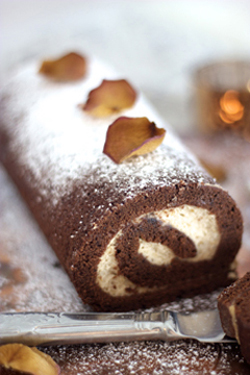
[4] Chocolate génoise roulade (roll) filled with chestnut cream (photo © Dirty Kitchen Secrets).
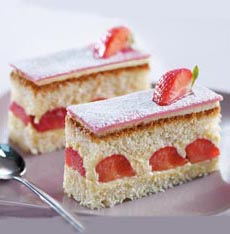
[5] Thin layers of génoise used to assemble cakes (photo © La Cigale Doree).
|
|
Genoa Cake (Not A Génoise Sponge)
By the middle of the 18th century, cake bakers began to use well-beaten eggs instead of yeast as a leavening agent. The cake would be baked in a mold or in layers made by pouring the batter into two hoops, set on parchment paper and a cookie sheet (hoops atop baking sheets were the precursor of the modern cake pan).
Genoa Cake originated in the port city of Genoa, Italy in the early 19th century. Some ingredients that came into the busy port from the East and the Middle East—almonds, candied fruit and peel, citrus zest, currants, raisins, vanilla, cinnamon and other spices—often found their way into Genoa Cake, a light fruitcake that is different from the airier genoise. Liqueur could be incorporated into the batter.
Like the French génoise sponge, it could be served plain, filled with jam and/or cream, iced, or simply dusted with powdered sugar.
There is also Italian génoise, called pan di Spagna (“Spanish bread”) in Italy.
Sponge Roll (Roulade)
A sponge roll is a thin layer of génoise, no more than an inch deep, baked in a sheet pan. It has the flexibility to be filled with jam and/or cream and rolled into a Bûche de Noël (Yule Log), Jelly Roll, Swiss Roll† or another type of roulade.
‡A Swiss roll is also called a cream roll when filled with whipped cream or other cream variation, and is often used as another term for jelly roll.
Victoria Sponge Cake
England’s Queen Victoria enjoyed a slice of sponge cake with her afternoon tea, garnished with raspberry jam and whipped heavy cream (called double cream in the U.K.) or vanilla cream (vanilla-flavored whipped cream, called chantilly in French).
|
Her preferences led to the creation of the Victoria Sponge. Jam and cream are sandwiched between two sponge layers; the top of the cake is served plain or with a dusting of powdered sugar. It also came to be known as the Victoria Sandwich, and sometimes the Victorian Cake. (See the photo at the top of the page.)
SPONGE CAKE VARIATIONS
Angel Cake or Angel Food Cake, a sponge cake that uses only the egg whites. This produces a white cake instead of a conventional sponge colored yellow by the egg yolks.
Castella, a Japanese sponge cake that’s a specialty of Nagasaki. It was introduced there by Portuguese merchants in the 16th century (see Pão de Castela, below), and is typically made in long loaves.
Cantonese Steamed Sponge Cake, steamed in a water bath and called Ma Lai Gao in Cantonese. You may find it in the U.S. at restaurants that serve dim sum
Chiffon Cake, invented in 1927 in Los Angeles. It is based on the sponge cake recipe plus some added fat. Here’s more about Chiffon Cake.
Eve’s Pudding, a Victoria Sponge made with sliced apples that cook at the bottom of the cake pan or baking dish, underneath the cake batter. Think of it as a cousin to Tarte Tatin.
Italian Génoise—see Pan di Spagna, below.
Ma Lai Gao—See Cantonese Steamed Sponge Cake, above.
Malay Steamed Cake, a steamed sponge, based on the Cantonese Steamed Sponge Cake.
Pandan Cake or Pandan Chiffon, a fluffy sponge cake of Indonesian and Malaysian origins, flavored with the light green juice of pandan leaves (which has notes of coconut, citrus and grass). It sometimes made a deeper green with food color.
Pan di Spagna, also called Italian Génoise or Torta Genovese. An Italian recipe that evolved in Sicily during the Spanish rule (1559–1714), it is flavored with vanilla and/or citrus zest. It is the cake base for Sicilian Cassata, Tiramisu, Zuccoto and Zuppa Inglese. [Source]
Pão de Castela, “bread from Castil,” is a Portuguese variation of Pan di Spagna.
Pão de Ló is an unsweetened bread sponge “cake,” created by a Genovese cook, Glovan Battista Cabona, in the mid-1700s‡‡. It was cooked in a water bath, which was more reliable than early ovens.
Passover Sponge Cake or Plava, is made with Kosher for Passover ingredients, with matzo meal, matzo flour, or potato flour, replacing the wheat flour. It is sometimes flavored with almonds or pecans, apples or apple juice, dark chocolate, lemon, orange juice, or poppy seeds.
Tres Leches Cake, a sponge soaked in evaporated milk, sweetened condensed milk, and whole milk. The recipe originated in Latin America.
Twinkies are described by Hostess as “golden sponge cake with a creamy filling.” However, unlike a home- or bakery sponge cake made with 4 ingredients (eggs, sugar, flour, baking powder), Hostess Twinkies are made with 37 ingredients, most of them chemicals.
_________________
‡‡According to About.com, the cook’s name was Giobatta Cabona, and was in the service of Marchese Domenico Pallavicini, Genova’s (Genoa in English) Ambassador to Spain in the mid-1700s. The Marchese asked for a new cake for a banquet, and Cabona created a light and airy confection he called Pâte Génoise, or Pasta Genovese in Italian. A slightly simplified version was called Pan di Spagna, to honor the Spanish Court.
CHECK OUT WHAT’S HAPPENING ON OUR HOME PAGE, THENIBBLE.COM.
|
|